BMW Exhaust Upgrade Guide - Catback, Downpipe & Valved Systems
If you've been driving your BMW with the stock exhaust, you already know the feeling - that muted, almost apologetic burble that tells the world you're running a perfectly engineered German machine while simultaneously hiding every ounce of character the engine actually has. BMW's factory exhaust setups are designed by committee, tuned for noise regulations in seventeen countries, and optimized to pass emissions in California. They're not designed for you, the person who actually cares about what this car sounds and feels like. That's where the aftermarket steps in, and if you're on this page, you're already thinking about it.
Exhaust work on a BMW is one of the most impactful modifications you can make - not just for sound, but for actual performance. A proper exhaust system reduces backpressure, which means your turbo spools faster, your engine breathes better, and you feel the difference in throttle response almost immediately.
20-40 whp
Downpipe Gains
5-10 whp
Catback (turbo)
15-30 whp
Headers (NA)
Best of Both
Valved Systems
But the market is full of options ranging from a forty-dollar eBay muffler delete to a full titanium system that costs more than some used E46s. This guide breaks down every section of the exhaust system, what each upgrade actually does, which platforms benefit most, and how to build a setup that makes sense for how you actually use the car.
The Exhaust Anatomy - What Each Section Does
Before you start throwing parts at the car, you need to understand what you're working with. A BMW exhaust system runs from the exhaust ports on the cylinder head all the way to the tips hanging out the back bumper, and every section has a specific job.
Headers/Exhaust Manifolds - These bolt directly to the cylinder head and collect exhaust gases from each cylinder. The factory units on most BMWs are cast iron or stainless steel and are designed for longevity and heat management, not flow. On naturally aspirated engines, headers are a significant performance upgrade. On turbocharged motors, you're looking at turbo manifolds instead, which direct exhaust flow directly into the turbine housing.
Downpipe - On turbocharged BMWs (which is most of them built after 2006), the downpipe connects the turbocharger outlet to the rest of the exhaust. The factory downpipe has one or two catalytic converters bolted inline, and this is the single most restrictive section of the exhaust. Aftermarket downpipes either eliminate the cats entirely (test pipes) or replace them with high-flow units that flow dramatically better while retaining some emissions compliance.
Midpipe - This section bridges the gap between the downpipe and the catback. On some setups it's a simple connector; on others it includes resonators designed to cancel specific exhaust frequencies. Upgrading the midpipe is often part of a full exhaust build rather than a standalone modification. See our full selection of midpipes for platform-specific options.
Catback System - Everything from the rear catalytic converter back. This includes the mid-section, resonators, muffler, and tips. A catback swap is the most common exhaust mod because it's fully emissions-legal (you're not touching the cats), it's a bolt-on job most experienced DIYers can handle in an afternoon, and the sound difference is immediately noticeable. Browse our complete cat-back exhaust catalog here.
Muffler and Tips - The muffler is the last sound-dampening component before the exhaust exits the car. Tips are purely cosmetic, though they affect the exit diameter and can influence how sound projects. If you want to change the look without touching anything else, our exhaust tips section has direct-fit options for every bumper cutout.
Catback Systems - Sound Without the Headache
For the majority of BMW owners, a catback system is the right move and the right starting point. You're not cutting any cats, you're not triggering check engine lights, and in most states you can pass an inspection without issue. The performance gains on a turbocharged car are modest - you're working in the lower-pressure section of the exhaust - but on naturally aspirated engines like the N52 and S65, a proper catback makes a real difference in top-end breathing.
The bigger story with a catback is sound. This is where you tune the character of the car. A resonated catback will give you a deeper, more aggressive tone compared to stock while still being liveable on a two-hour highway run. A straight-pipe catback removes all the resonators and muffler baffling, and on some platforms - especially the S65 in the E92 M3 - that's exactly what you want because the engine already sounds incredible, you're just removing the filter.

AWE SwitchPath Catback Exhaust — G8X M3/M4 (Diamond Black Tips)
$3,077.86
On the turbocharged six-cylinder cars - N54, N55, B58 - a catback without a downpipe upgrade is the sound modification, not a power modification. You'll hear more exhaust note, you'll get some nice pops on overrun, but don't expect to see big dyno numbers from a catback alone on a boosted engine. If power is the goal, you need to read the downpipe section below, because that's where the restriction actually lives.
Downpipes - Where the Real Power Lives
This is where things get serious. On every turbocharged BMW from the N54 forward, the factory downpipe is the single largest restriction in the entire exhaust system. BMW squeezes two catalytic converters into this section on most applications, and the result is a massive flow bottleneck right after the turbine wheel. When exhaust gas can't exit the turbo quickly enough, turbine wheel speed drops, boost builds slower, and you feel it everywhere in the rev range.
An aftermarket downpipe on an N55 or B58 can free up anywhere from 20 to 40 wheel horsepower depending on the platform, the tune, and what else is done to the car. On the N54 twin-turbo in the F30 predecessors, downpipe gains were even more dramatic because the factory units were particularly restrictive. This is not theoretical - these are real, repeatable, dyno-verified numbers.
| Downpipe Type | Cat Cell Count | Flow Improvement | Street Legal | CEL? |
|---|---|---|---|---|
| Factory | 400-600 cell | Baseline | Yes | No |
| High-Flow Catted | 200-300 cell | 60-70% better | Gray area | Usually no with tune |
| Catless / Test Pipe | 0 (straight) | 100% (max) | No | Yes, needs tune |
High-Flow Catted (200 or 300 cell) - The factory cats run around 400-600 cells per square inch of filter material, which is extremely restrictive. Aftermarket high-flow cats drop to 200 or 300 cell, which flows far better while still technically being a catalytic converter. In many cases these can pass a visual inspection. They won't always pass a tailpipe sniffer test, but they're the street-legal compromise.
Catless / Test Pipe - Straight pipe, no cats, maximum flow. This is the track day setup, and it sounds absolutely savage. On an N55 or B58 with a catless downpipe and a proper tune, you will hear turbo flutter, wastegate chatter, and exhaust note you didn't know existed in this car. But you will also smell like you're running a diesel at every stop light, and you will have a check engine light that never goes away without a tune to suppress the downstream O2 sensor codes.
Catback + Downpipe as a System - The right way to do a full exhaust build. The downpipe does the performance work; the catback handles sound tuning. When you spec these together, you want matching tube diameters and compatible flange specs. Mixing a 3-inch downpipe with a 2.5-inch catback defeats the purpose.
One critical point: after installing an aftermarket downpipe on a turbocharged BMW, you need a tune. Not optional. The ECU needs to see revised fuel maps, revised boost targets, and the downstream O2 sensors need to be recalibrated or the car will run in a degraded state while hunting for the emissions targets it can no longer hit. Check out our ECU tuning guide for what to expect from the software side of this equation.
Browse our complete downpipes catalog, sorted by platform.
BMW F30 335i N55 Exhaust Sound
Axle-Back & Muffler Deletes - Quick and Cheap
Not everyone needs or wants a full catback. An axle-back swap replaces only the rear section - from the rear axle back, muffler and tips included - and it's often the fastest way to change the exhaust note on a budget. On most BMW platforms this is a two-bolt job you can do in a driveway with basic hand tools in under an hour.

Dinan Free Flow Axle-Back Exhaust — F30 328i / F32 428i
$732.50
The limitation of an axle-back is obvious: you're only modifying the tail end of the system, so you're not touching any of the resonators that typically live in the midpipe section. On many BMW models, there are one or two resonators upstream that do a lot of the sound dampening work. An axle-back will make the car louder and change the tone somewhat, but a catback that addresses those mid-resonators will produce a more dramatic change in character.
Muffler deletes are the most extreme version of this approach. You're removing the muffler entirely and replacing it with either a straight section of pipe or a resonated section. The sound result is louder and rawer than any commercial product, and on some platforms - particularly the inline-six cars - it produces incredible top-end exhaust noise. On others, without any muffling at all, the result is a raspy, tinny drone that gets unpleasant fast.

Evil Energy Burnt Tip Stainless Steel Muffler — 3" Inlet 4" Outlet
$56.99
Muffler deletes work best on specific platforms with specific exhaust character. The S54 and S65 naturally aspirated cars respond beautifully to muffler deletes because the engine produces a complex, musical exhaust note. The turbocharged four-cylinders (B46, B48) are another story - removing the muffler just makes the underwhelming louder. Full catback on the four-cylinder cars, no question. See all muffler delete options by fitment.

Jiarear Carbon Fiber Dual Exhaust Tips — F22/F30/F32 2.0T (N20/B48)
$99.99
For those who want that factory-ish look in the back with just a visual upgrade, our axle-back exhaust section has options ranging from subtle to full quad-tip conversions.
Valved Exhaust - The Best of Both Worlds
Valved exhaust systems are, objectively, the smartest exhaust solution BMW owners have come up with. The concept is simple: an electrically operated butterfly valve in the exhaust path changes the routing of exhaust gas depending on a signal from the driver or the ECU. Open the valve, and exhaust bypasses the resonators and muffler baffling for maximum sound. Close the valve, and you're back to a relatively quiet setup for highway cruising, garage parking at 6 AM, or any situation where you don't want the neighbors filing a noise complaint.
BMW itself has used this approach on the M cars - the M Performance exhaust on the G80 M3 and G82 M4 is a factory-valved system, and it's genuinely excellent. But the aftermarket has taken this concept much further, with systems that offer finer control over the valve position, app connectivity, and valve behavior tied to driving mode.
The installation complexity varies significantly by platform. On some cars the valve actuation wiring taps cleanly into existing connectors; on others it requires a standalone controller module. Budget-level valved systems use a manual switch or a key fob remote - functional but inelegant. Premium systems like the AWE Switchpath integrate with the factory drive mode controls so opening to sport mode also opens the exhaust. Browse the full valved exhaust catalog for platform-specific options.
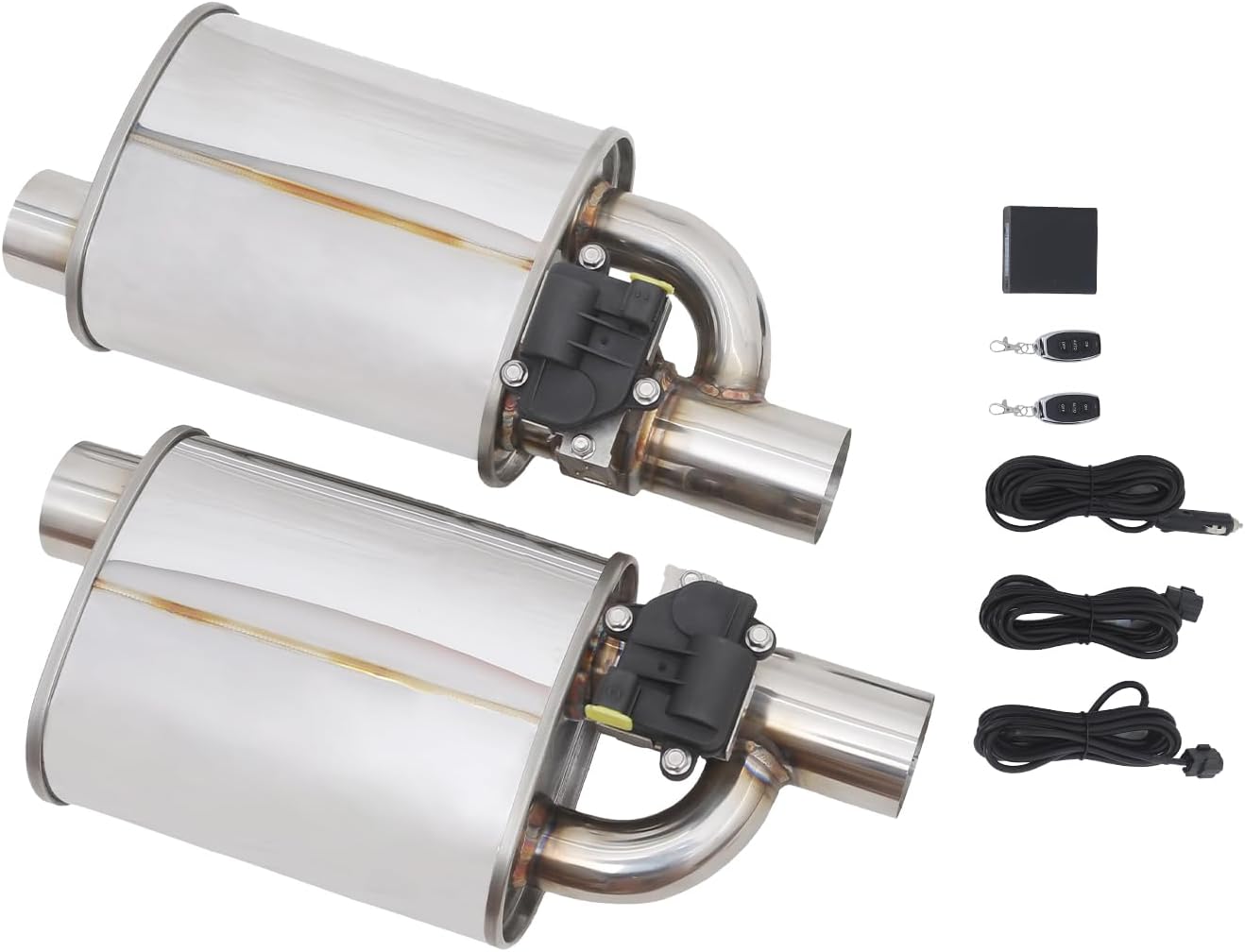
YRAG-PART 3" Universal Valvetronic Muffler Kit — Stainless Steel Pair
$347.99
Headers & Manifolds - The Naturally Aspirated Play
If you're running a naturally aspirated BMW - the N52, S54, S65, or the older M50/S50 series - headers are where you chase power, not downpipes. The factory exhaust manifolds on these engines are not terrible, but they're cast iron log manifolds that prioritize heat containment and emissions compliance over scavenging. Long-tube headers change the geometry to take advantage of exhaust pulse scavenging - the phenomenon where a properly timed negative pressure wave from an exhaust pulse in one cylinder actively pulls exhaust gases from an adjacent cylinder, improving cylinder fill.
On an N52 in the E90 328i, a proper shorty header with a matching catback is worth 15-20 horsepower at the wheels on a stock engine. On an S65 V8 (the E90/E92 M3), long-tube headers paired with a free-flowing catback can produce gains north of 30 horsepower and transform the already spectacular exhaust note into something genuinely otherworldly.
Headers also pair well with other breathing upgrades. If you're building a naturally aspirated BMW to its limits, check out our guides on cold air intakes to complete the intake side of the equation. Browse all headers and manifolds here.
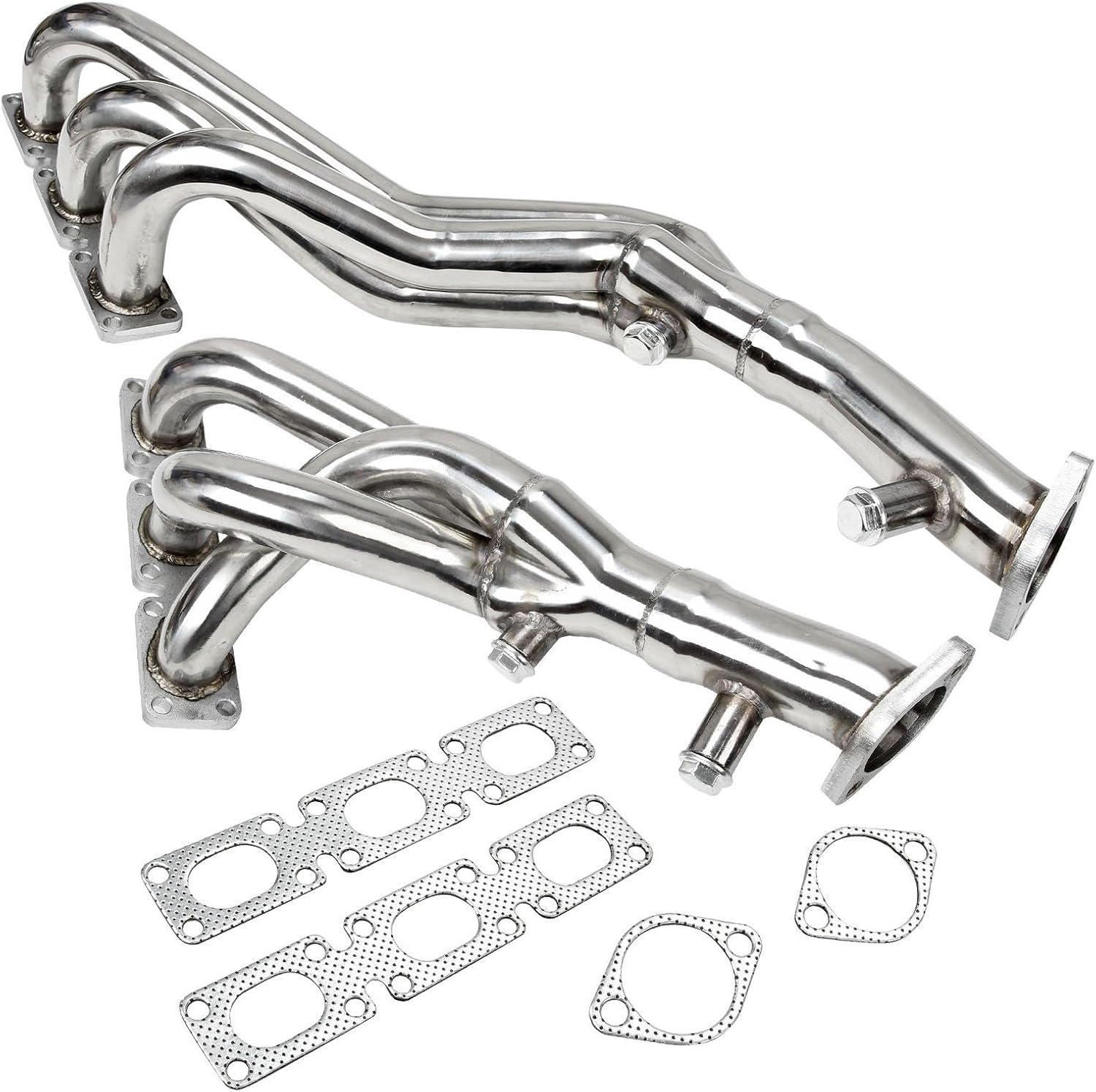
304 Stainless Steel Exhaust Header (6-2-1) — E46 325/330, E39, Z3
$229.99
Matching Your Exhaust to Your Engine
| Engine | Type | Best First Mod | Power Gain (FBO) | Sound Character |
|---|---|---|---|---|
| N52 | NA I6 | Headers + catback | 15-20 whp | Smooth, refined growl |
| N54 | Twin-turbo I6 | Downpipe + tune | 40-50 whp | Aggressive, turbo flutter |
| N55 | Single-turbo I6 | Downpipe + tune | 30-40 whp | Mid-range growl, turbo whistle |
| B58 | Single-turbo I6 | Downpipe + tune | 30-45 whp | Deep burble, overrun pops |
| S55 | Twin-turbo I6 | Catback (start) | 15-25 whp | Raw, high-RPM scream |
| S65 | NA V8 | Headers + catback | 25-35 whp | Exotic, flat-plane wail |
N52 (E90 328i, E60 528i, Z4 3.0) - Naturally aspirated inline-six. No downpipe upgrade applicable. Focus on headers or manifolds plus a catback for the best result. The N52 has a smooth, slightly muted exhaust character stock - a catback with minimal resonators brings out a much better tone.
N54 (E90 335i, E89 Z4 35i, E82 135i) - Twin-turbo inline-six. This engine loves a downpipe upgrade more than almost any other BMW application. The twin-turbo setup compounds the factory downpipe restriction, and an aftermarket high-flow or catless setup paired with a tune produces huge gains. The N54 is the engine that built the BMW tuning scene as we know it.
N55 (F30 335i, F10 535i, E82 1M) - Single-turbo inline-six. Similar story to the N54 but with a single scroll turbo that responds particularly well to reduced backpressure. The N55 exhaust note with a downpipe and catback is one of the better-sounding turbocharged six-cylinders in the game - there's a distinctive mid-range growl that the stock system completely smothers.
B58 (G20 330i/340i, G82 M440i) - The current-generation turbocharged inline-six. BMW did a better job with the factory exhaust on B58 cars than they did with N54/N55, but the downpipe is still the restriction point. The B58 is notably more sensitive to tune quality after exhaust mods - make sure you're using a reputable tune. Pair with an intercooler upgrade for the full FBO setup.
S55 (F80 M3, F82 M4) - The twin-turbo S55 in the M cars is a different animal entirely. Many owners run a catback-only setup because the stock downpipe is less restrictive than on the standard models. For high-power S55 builds heading north of 500 horsepower, a proper downpipe is still part of the recipe.
The Legal Reality - Emissions, Inspections, and Track Days
In CARB states (California, plus the dozen states that follow California Air Resources Board rules), any aftermarket exhaust component that affects the catalytic converter or emissions equipment is presumed illegal for street use unless it carries a CARB EO (Executive Order) number. This means catless downpipes are definitively illegal, high-flow catted downpipes without a CARB EO are illegal, and even some catback systems that don't include resonators may face scrutiny. AWE, Borla, and a few other manufacturers have invested in getting CARB certification for select products - if you're in a CARB state, filter for those specifically.
In OBD-II inspection states (most of the remaining US states with emissions testing), the inspection is a plug-in ECU scan. If your downpipe has eliminated the rear O2 sensor or triggered permanent readiness codes, you will fail. This is solved by a proper tune that addresses O2 sensor calibration.
Track days have their own rules. HPDE events typically don't have specific exhaust noise regulations, but many track days set a noise limit measured in decibels at a specific distance. Catless exhausts with straight-pipe catbacks can absolutely exceed 103 dB limits that some tracks enforce. If you're building a track car, confirm the specific noise limit at your target venues before speccing a full open exhaust. Valved systems are genuinely useful here - drive to the track on a closed valve, open it up for sessions, and you have one car that works for everything.
The bottom line: catback systems are nearly universally street-legal. High-flow catted downpipes occupy a gray area that most owners navigate successfully. Catless downpipes are track-use components. Build your exhaust setup to match how you actually use the vehicle, and you won't have surprises.