
BMW X5 E53 Suspension Upgrades
Affiliate disclosure. BimmerTalk is a proud partner of the Amazon Associates Program and Turner Motorsport. We may earn a small commission on qualifying purchases through our links, at no extra cost to you. Read the full disclosure.
Coilovers
11 part for BMW E53
BrowseSway Bars
11 part for BMW E53
BrowseEnd Links
11 part for BMW E53
BrowsePopular E53 suspension
Hand-picked suspension parts that fit the BMW E53 - mid-tier price band, mixed across subcategories.


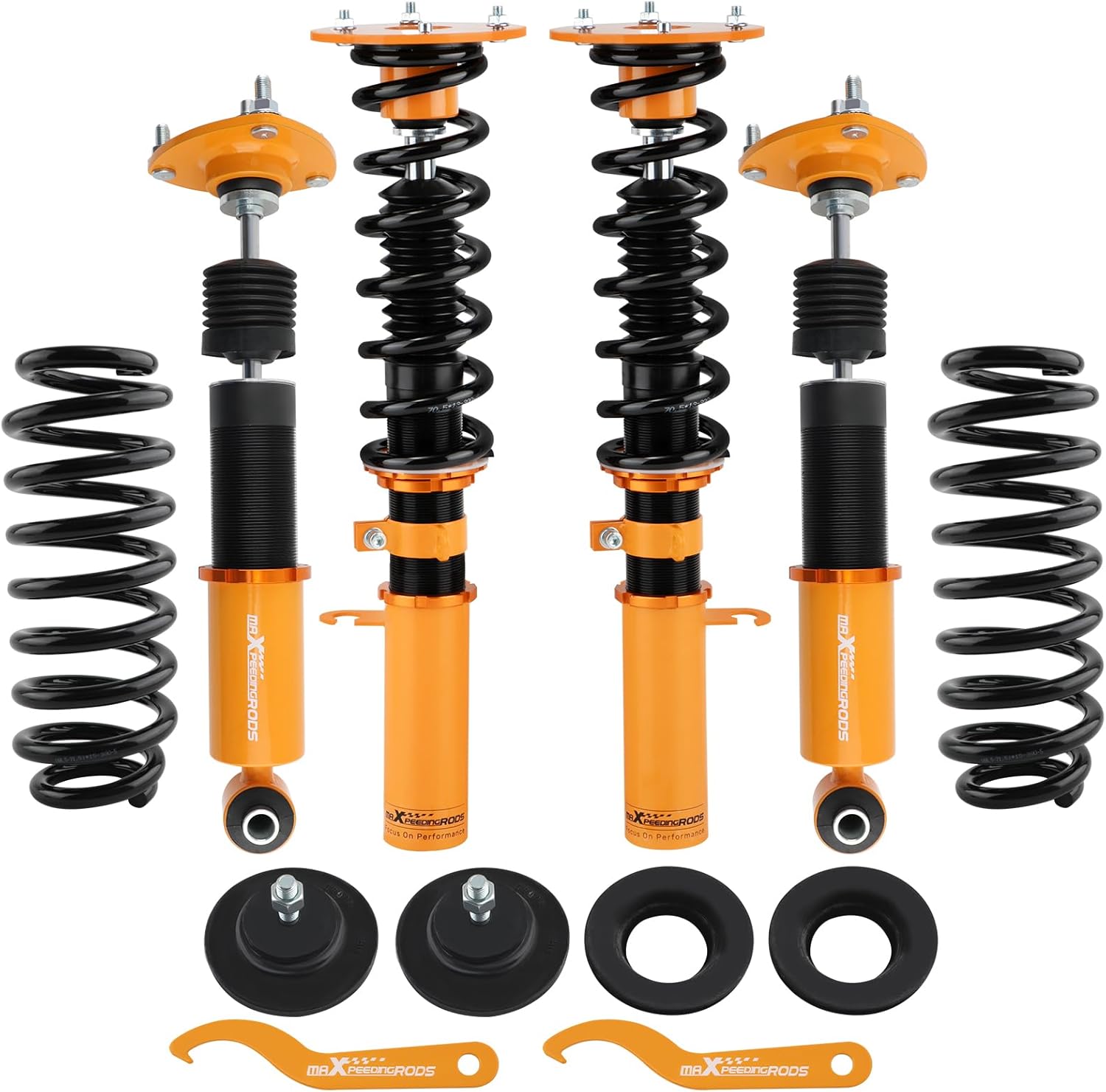
BMW Suspension - What This Category Covers and Why It Matters
If you care about how your BMW actually drives, BMW suspension is the single most impactful category on this site. Not intakes, not exhaust, not a tune - suspension. Everything that determines whether your car feels planted and precise or vague and wallowy runs through the four corners. I've been wrenching on BMWs for five years, I daily a G20 330i with the B48 turbo four, and I spent a year doing marketing inside the BMW and MINI ecosystem. My honest take: the factory engineers do a solid job, and then they sand off every interesting edge to hit a price point and satisfy a customer who's never going to push the car. That leaves a massive gap that the aftermarket fills extremely well - if you buy smart.
This page is the hub for everything suspension on BimmerTalk. Whether you're replacing worn struts on a 200,000-mile E46, trying to find the best BMW suspension setup for a weekend track car, or sorting out an air suspension nightmare on a G12 7 Series, you're in the right place. Below I'll walk through every major subcategory, explain how to think about the market by chassis generation, rank the brands honestly, and give you concrete picks for street, track, show, and daily use. No padding, no hype - just what I'd actually tell a friend in the shop.
Stock BMW Suspension - What You're Starting With
Let's be direct about what BMW ships from the factory. The baseline suspension on most production BMWs is a double-wishbone or multilink front setup paired with a multilink rear - genuinely sophisticated geometry that gives the aftermarket something real to work with. The platform fundamentals are strong. The problem is the calibration and the component quality ceiling that Munich sets based on cost targets and the need to serve the broadest possible customer base.
A standard G20 330i rides on what BMW calls the CLAR platform with a passive damper setup on the base trim. It's comfortable enough, it doesn't embarrass itself in corners, and if you never push it hard you might think it's fine. But add 20mph to your corner entry speed, throw some elevation change into the equation, and the body motion becomes significant. There's roll, there's pitch under braking, and the dampers feel like they're optimized for absorbing expansion joints on the autobahn at 100mph rather than carrying real load through a technical section. That's not a criticism - it's exactly what BMW engineered it to do.
Step up to M Sport suspension on the same car and you get stiffer springs and slightly retuned dampers. It's a meaningful improvement in body control but it's still a compromise - now a little harsh on sharp impacts without being meaningfully better in corners than a properly set up aftermarket spring-and-damper combo. And if you're on a car with adaptive M suspension (standard on M cars, optional on everything from the G22 4 Series up), you have electronically controlled damping that's genuinely useful but also adds complexity and cost to any aftermarket upgrade path.
The other honest thing to say: stock suspension wears. Struts and shocks on E-chassis cars at 80,000-100,000 miles are not performing at the spec they were when new. Control arm bushings on E9x cars are well-documented to go soft by 60,000-70,000 miles. Worn OEM hardware is not a baseline - it's a liability. Sometimes the most important "upgrade" is simply restoring the car to what it was supposed to feel like when it left the factory.
The Subcategory Breakdown - How to Navigate What's Here
Suspension is not one thing. It's a system, and understanding the individual components helps you spend money in the right order. Here's how I break it down, and where each subcategory lives on this site.
Coilovers
The king of the performance suspension world. A coilover is a single unit where the spring wraps around the shock body, and the whole assembly is height-adjustable via a threaded collar. Good coilovers let you set ride height independently of spring preload, which means you can run the car lower without sacrificing suspension travel or jacking up spring rates inappropriately. Premium kits add adjustable damping - either single-way (rebound only), two-way (compression and rebound), or in some cases three-way adjustability for motorsport use.
For deeper reading on which specific kits to buy for your chassis, check the coilovers subcategory page and the best BMW coilovers buyer's guide. I'll give you the overview here and the specific picks later in this page.
Lowering Springs
Springs only - no new dampers. You drop your existing struts and shocks and install shorter, stiffer springs. Cheaper, simpler, and perfectly adequate for a street car where you want stance and slightly tighter handling without coilover complexity. The tradeoff is that your original dampers are now operating outside the range they were tuned for (shorter travel, faster oscillation), so if your OEM shocks are already worn, you'll chew through them faster and the ride will feel jarring. More at the lowering springs subcategory page.
Sway Bars and End Links
Massively underrated category. A stiffer sway bar reduces lateral body roll in corners by better linking the suspension movement side to side. The key insight is that you can reduce roll stiffness without increasing spring rates - meaning you can tighten up cornering feel without beating yourself up on rough roads. End links are the connectors between the sway bar and the suspension; the OEM units on E-chassis and F-chassis cars are known to wear and rattle. Upgraded end links are cheap and worth doing any time you touch the sway bars.
Control Arms, Bushings, and Ball Joints
This category straddles maintenance and performance. Worn control arm bushings on E9x cars are a handling killer, full stop. Before you spend a dollar on coilovers, verify that your control arm bushings, ball joints, and tie rod ends are in good condition. For street use, Meyle HD and Lemforder OEM-spec replacements are the right call - they last, they don't create harsh NVH, and they're reasonably priced. For track cars, polyurethane or spherical bushings give you crisper response at the cost of more noise and vibration into the cabin. Know what you're buying.
Strut Mounts and Top Hats
Often overlooked. The strut mount sits at the top of the strut assembly and allows the strut to rotate as the wheel turns while also absorbing some impact energy. Worn strut mounts on high-mileage cars contribute to clunking, vague steering feel, and inconsistent damper behavior. On lowered cars, camber plates - which replace the OEM strut mounts - give you camber adjustment that the factory design doesn't allow. Essential on any car that's dropped more than 25mm and sees track use.
Strut Tower Braces
A strut tower brace (STB) connects the two front strut towers across the engine bay. On older, less rigid platforms like E36 and some E46 variants, it measurably stiffens the front end and tightens steering response. On newer monocoque platforms like the G20, the body is already stiff enough that the gains are smaller - but on high-power builds or cars with open engine bay exposure to repeated track stress, it's still worth running. For subframe reinforcement, look at E9x M cars specifically - the rear subframe mounting points are a documented failure mode under repeated hard use.
Air Suspension Components and Conversion Kits
BMW's air suspension systems appear on the 7 Series (G11/G12), X5 (G05 with self-leveling), X7, and some X6 configurations. When these systems work, they're genuinely impressive - variable ride height, adaptive comfort across load conditions. When they fail, which they do, repair costs are brutal. An air strut replacement on an F15 X5 can run $800-$1,500 per corner at a dealer. Strutmasters explicitly markets air-to-coil conversion kits as a cost-effective alternative for BMW owners who want out of the air suspension ecosystem entirely. These kits sit at the $300-$1,200 entry tier and are one of the most practical things this category offers for high-mileage luxury BMWs.
The Chassis Generation Map - E, F, and G Explained
The single most important variable in your suspension shopping decision is chassis generation. Not model, not year - generation. Here's the honest picture for each era in 2026.
E-Chassis - The Mature Value Market
E-chassis BMWs - the E36, E46, E9x (E90/E91/E92/E93), E6x (E60/E61), E8x (E82/E87/E88) - are the most affordable and most fully supported platforms in the aftermarket. The suspension hardware on these cars is mechanically simpler than anything coming out of Munich post-2012. No adaptive dampers, no electronically controlled chassis systems to worry about (with a few exceptions like the EDC system on some E9x M cars), and a massive catalog of proven fitments.
The market for E-chassis suspension is mature and broad rather than fast-growing. That's actually great news if you're a buyer - prices are stable, fitment is well-documented, and you can find genuine user reviews with 100,000+ miles of data behind them. An E90 335i with the N54 or N55 engine is still one of the best performance platforms per dollar in BMW history, and the suspension aftermarket treats it accordingly.
For E-chassis builds, the full range is accessible - springs, coilovers, bushings, arms, mounts, track setups. If you're building an E-chassis for track use, you can put together a genuinely serious setup for reasonable money. A set of KW Variant 2 coilovers on an E92 M3 with the S65 V8, proper alignment, and refreshed bushings is a complete package that would embarrass most modern sports cars on a back road.
F-Chassis - The Broadest Performance Market
F-chassis cars - F30/F31/F34 3 Series, F32/F33/F36 4 Series, F80/F82/F83 M3/M4, F10/F11 5 Series, F15/F16 X5/X6, and the rest - represent the widest and most commercially developed segment of the BMW suspension aftermarket right now. These cars are old enough to have proven aftermarket catalogs but modern enough to remain desirable, which is a sweet spot.
The F80 M3 and F82 M4 with the S55 engine are arguably the most suspension-worked BMWs in the aftermarket today. Every major brand has multiple kits, multiple price points, and documented user feedback. The F30 328i/330i/340i is similarly well-served for street-oriented buyers. F-chassis cars with adaptive dampers (the F80 M3 came standard with them, for instance) require more careful fitment selection, but even here the market has caught up - brands like KW and Bilstein offer specific kits that retain or replace the adaptive function depending on what you want.
CarBahn's current F95/F96 X5 M/X6 M coilover kit is a live example of continued investment in this generation family, targeting the high-performance end at the premium $3,000-$7,000+ tier. The F-chassis market isn't slowing down - it's consolidating around proven products with strong user bases.
G-Chassis - The Fast-Moving Electronics Challenge
G-chassis BMWs - G20/G21 3 Series, G22/G23 4 Series, G80/G82 M3/M4, G05 X5, G06 X6, G87 M2, and the rest - are the fastest-moving and most complex part of the aftermarket in 2026. Modern BMWs increasingly rely on electronically controlled adaptive damping as a core part of how the car handles. The G80 M3 with M xDrive uses electronically controlled dampers that communicate with the chassis stabilization systems in real time. You can't just bolt on any coilover and expect it to behave.
The good news is that the premium brands have largely kept pace. KW, Bilstein, Öhlins, and others now offer G-chassis specific kits designed to work with or replace the adaptive damper function. The bad news is that chassis-specific tuning at this level costs money - you're typically looking at $3,000-$7,000+ for a kit that properly addresses a G-chassis M car's suspension needs without creating warning lights or degrading the factory safety systems.
BMW's own M Performance Track Kit for the G87 M2 is a notable development - the factory competing directly with the aftermarket on its own newest chassis. MotorTrend covered this as part of the 2026 M2 story, and it signals that BMW understands the track-day buyer better than it once did. Pricing wasn't confirmed in that report, but it positions BMW M Performance as a legitimate option alongside the traditional aftermarket brands for G-chassis buyers.
If you're on a G-chassis and dealing with adaptive damper questions specifically, this BimmerPost thread on the X3 M Sport adaptive damper situation is worth reading - it shows exactly how real owners are navigating the adaptive vs. passive decision in 2026.
The Brand Landscape - Premium, Mid, and Budget Tiers
The BMW suspension aftermarket has a clear brand hierarchy, and knowing where each brand actually sits helps you avoid wasting money or under-buying for your use case. Here's my honest ranking.
Premium Tier - $3,000 to $7,000+
KW Suspension is the benchmark for performance street and track use. German-made, genuinely well-engineered, with specific kit variants for nearly every BMW chassis going back to the E36. The Variant 1 is fixed damping with height adjustment. The Variant 2 adds rebound adjustment. The Variant 3 gives you independent compression and rebound. For an F80 M3, the Variant 3 is where I'd start any serious build. KW also makes the DDC (Dynamic Damper Control) system that retains electronic damping compatibility on adaptive-equipped cars - that's the product you want on a G-chassis M car if you don't want to delete the adaptive function.
Öhlins is the name in motorsport-derived dampers. Their Road and Track coilovers are fully adjustable and genuinely competitive with anything in the market. Öhlins kits for BMW typically run at the higher end of the premium tier. If you're doing serious track days and want a single kit that can be properly tuned for different circuit conditions, Öhlins is a legitimate choice. The tradeoff is price and the fact that they're not as widely available off-the-shelf - you're often waiting on specific fitments.
CarBahn is a strong name in the high-performance BMW niche, particularly for heavier SUV platforms where corner weights and power levels make generic kits inadequate. Their F95/F96 X5 M/X6 M kit is built specifically for a 5,000-pound-plus vehicle making 600+ horsepower, which is a very different engineering problem than a 3,300-pound M3. If you're building an X5 M for track use, CarBahn is where I'd look first.
Bilstein B16 and B8/B6 occupy an interesting position - they're premium in engineering quality but slightly below KW and Öhlins in outright adjustability. The B16 coilover system offers ride height adjustment and is a well-regarded choice for street-focused buyers who want quality without the complexity of full damping adjustment. The B8 and B6 shock/strut replacements are the gold standard for OEM-plus upgrades - significantly better than worn stock, significantly more affordable than full coilovers.
Mid Tier - $1,200 to $3,000
H&R is the most trusted name in the mid tier for both springs and coilovers. Their spring rates are well-documented, their fitments are extensively tested, and they've been in the BMW market long enough to have established a genuine reputation. H&R Sport Springs on an F30 328i or 330i are a proven combo that drops the car 25-30mm and improves handling without destroying ride quality. I've recommended this exact combination to friends who want a cleaner stance and sharper feel on a daily driver, and I've never had anyone come back unhappy.
BC Racing sits in the mid tier for coilovers and offers solid value, particularly on E-chassis and older F-chassis cars. Build quality is acceptable, the adjustment range is decent, and the price is considerably below KW and Bilstein. On a budget E92 track build, BC Racing makes sense. On a G80 M3 where you're dealing with complex electronics and want the setup to last 50,000 track miles, spend more and buy KW.
Ground Control and Eibach also deserve mention in this tier. Eibach Pro-Kit springs are a popular alternative to H&R for street lowering - similar philosophy, slightly different spring rates and drop measurements depending on the specific fitment.
Entry Tier - $300 to $1,200
The entry tier is dominated by two product types: basic replacement shocks and struts, and specialty solutions like air-to-coil conversion kits. For basic replacements, Bilstein B4 and Monroe OEM-spec replacements are reasonable choices if you just need functional hardware at low cost. For air suspension conversions on F15 X5, G12 7 Series, and similar models, Strutmasters is the most visible brand - their BMW-specific air-to-coil conversion kits offer a way out of expensive air suspension repair without going to a full custom coilover setup.
I want to be honest about what the entry tier is and isn't. These products are not going to transform your car into a track weapon. They're appropriate for high-mileage daily drivers where the goal is functional suspension at reasonable cost, or for air suspension escapes where the alternative is a $3,000 dealer repair bill. Don't buy entry-tier coilovers for a car you're tracking - the damper internals aren't built for that duty cycle and you'll be buying twice.
My Picks by Use Case - Street, Track, Daily, Show
Enough context. Here's what I'd actually buy for each use case, by chassis era.
Street Performance - You Drive It Hard but It's Still a Daily
This is the most common scenario and the one where buying wrong is most costly, because you have to live with the decision every day. The goal is noticeably better handling and a cleaner stance without spine-compressing ride quality on normal roads.
- E9x (E90/E92/E93) - H&R Sport Springs plus Bilstein B8 shocks. Drop is approximately 25-30mm, ride quality stays livable, and you get properly matched spring and damper rates. Total cost in the $800-$1,400 range depending on model. If you want full coilovers on an E9x for street, KW Variant 2 is where I'd stop - the Variant 3's compression adjustment is more useful at the track than on the road.
- F30/F32 (N20/B48/N55/B58) - Same logic applies. H&R Sport Springs on a F30 330i or 340i are proven and well-priced. If you're on the B58-powered 340i and want coilovers, Bilstein B16 is my pick for street use - height adjustable, quality damper, doesn't fight with the M Sport suspension tuning if you have it.
- G20/G22 - I'm running my own G20 with M Sport suspension from the factory and I've been evaluating what makes sense. On the G-chassis, if you don't have adaptive dampers from the factory, H&R coilovers or KW Variant 2/3 are your best street options. If you have adaptive dampers, the KW DDC system is the cleanest solution - it retains the electronic interface and gives you more damping adjustment than the stock setup.
Track Days - You're Actually Going to Drive It on Circuit
Track use changes the equation significantly. You need adjustable damping, the ability to run more negative camber than OEM geometry allows, and damper internals that can handle thermal cycling from repeated hard use. Lowering springs with OEM dampers are not a track setup.
- E9x M3 (S65) - KW Variant 3 is the standard answer and I agree with it. Pair with camber plates up front (more on this below), refresh the rear subframe mounting points if you haven't, and get a proper four-wheel alignment with more negative camber than stock. This is a complete track setup for $2,500-$3,500 in parts.
- F80 M3 / F82 M4 (S55) - KW Variant 3 or Öhlins Road and Track. The F80 came with electronically controlled dampers, so you need a kit that either retains EDC functionality (KW DDC) or deletes it with a bypass harness. Many serious track day drivers delete EDC and run a passive adjustable coilover because electronic damper systems can be conservative in ways that passive adjustment lets you override. Your call based on how much you want to manage.
- G80 M3 / G82 M4 - This is the complex one. The xDrive system on the G80 and the chassis stability controls are deeply integrated with the adaptive dampers. KW DDC or the OEM-backed M Performance options are the safest path if you want to retain full electronics. Full coilover deletes with chassis coding are possible but require proper coding work - more on that in the install section. Check the chassis coding tools section for what's involved on G-chassis cars.
- X5 M (F95) for track - CarBahn's coilover kit is purpose-built for this. A 5,000-pound SUV making 617hp doing track laps needs a fundamentally different damper setup than anything designed for a sedan. This is where you don't try to adapt a generic kit.
Show and Stance - You Want It to Look Right
I'm not here to judge show builds, but I will say this: a car slammed to the bumpstops on stiff springs with no suspension travel is not fun to drive and can cause real damage. Good stance builds use quality coilovers set to a reasonable ride height - low, but not dragging. You want negative camber dialed in properly, not just from bending components.
- For stance-focused builds, BC Racing BR series coilovers offer the most drop range and camber plate options at a price that makes sense for a build where aesthetics are the primary goal. Pair with adjustable control arms at the rear on E-chassis cars for proper camber correction when you're running more than 15mm of drop.
- On F-chassis cars, H&R coilovers have enough range for most stance applications while maintaining decent build quality. Don't try to get aggressive negative camber purely from camber plates on a car you're driving on the street - your tire wear becomes a maintenance problem fast.
Daily Driver Repair - You Just Want It to Drive Right Again
If your car has 80,000+ miles of original suspension, the right answer is often not an upgrade - it's a proper restoration to factory spec with upgraded-quality OEM replacement parts.
- Control arms - Meyle HD or Lemforder for E-chassis and F-chassis. These are OEM-spec parts from OEM suppliers, made to a higher quality standard than cheap aftermarket replacements. Don't buy generic Chinese arms to save $30 on a safety-critical component.
- Shocks and struts - Bilstein B4 (OEM spec) or B6/B8 (slightly upgraded) for daily driver use where you're not lowering the car. The B4 is a like-for-like replacement that will last and won't degrade the ride quality the way cheap replacement shocks will.
- Air suspension problems - If you're on an F15 X5 or a G12 7 Series and an air strut has failed, get repair quotes before you commit. If you're over 100,000 miles, consider the Strutmasters conversion kit seriously - at $400-$900 for the kit versus $800-$1,500 per corner for OEM air strut replacement, the math can be compelling for a car you're keeping another 50,000 miles without caring about the variable ride height feature.
Sway Bars, End Links, and the Underrated Middle Ground
I want to spend more time on this because it's the most overlooked category for people who want real handling improvement without the full coilover investment. If you only do one upgrade on an otherwise stock BMW that's in good mechanical condition, a stiffer rear sway bar and quality end links will give you the clearest improvement in cornering confidence per dollar spent.
Here's why. Stock BMW sway bar tuning is conservative because BMW needs the car to feel stable for a wide range of driver inputs and confidence levels. They undersize the rear sway bar in particular on most non-M cars, which means the rear of the car wants to roll out in corners. Upgrading to a bar that's 2-4mm thicker at the rear dramatically reduces this tendency, tightens up the chassis balance, and makes the car rotate more naturally through corners. The spring rates don't change, the ride quality barely changes, and you haven't touched the struts or shocks.
On an E46 330i, upgrading from the stock 18mm rear sway bar to a 20-22mm adjustable bar is a change you feel immediately. On an F30 320i or 328i with the non-M Sport suspension, the same logic applies - the rear bar is soft because BMW is prioritizing comfort and understeer-biased safety behavior.
End links are worth replacing any time you're touching sway bars, and worth replacing on their own if your end links are past 60,000 miles or showing play. OEM end links on E9x and E8x cars rattle when worn, and that rattle is often mistaken for something more serious. A $30-$60 pair of quality end links (I'd use Meyle HD or OEM BMW) resolves it cleanly.
For track cars specifically, adjustable end links and adjustable front and rear sway bars are part of dialing in handling balance. Running a stiffer front bar and softer rear bar gives you more understeer; softer front and stiffer rear leans toward oversteer. M cars come from the factory with more rear bar stiffness than standard models, which is part of why they rotate so much more willingly.
Control Arms, Bushings, and When Maintenance Is the Upgrade
I said this earlier and I want to say it again more forcefully: if your BMW has worn control arm bushings, you don't have a suspension - you have a system that's actively working against your chassis geometry. On an E92 M3 with 80,000 miles and original front lower control arm bushings, the geometry is shifting dynamically under hard cornering loads in ways that your alignment spec can't account for. You're chasing handling with degraded hardware.
The E9x front lower control arms are particularly notorious. The OEM BMW arms use a large compliance bushing in the front position that allows deliberate flex for ride quality - and that bushing deteriorates. By 60,000-70,000 miles, the flex has increased to the point where you're losing precision. The fix is straightforward and the parts are well-sourced: Meyle HD complete control arms with upgraded bushing durometer or Lemforder arms are the standard recommendation, and they're available for $80-$180 per arm depending on model. Do both sides at once. Get an alignment immediately after.
For performance builds where NVH isn't a concern - think dedicated track car or weekend-only car with a stripped interior - polyurethane bushings from SuperPro or Powerflex offer a meaningful step up in response. They're stiffer, they last longer than rubber, and they give crisper geometry retention under load. The cost is more cabin vibration and drivetrain noise transmitted into the chassis. On a daily driver, this gets old fast. On a car that's going to a circuit monthly, it's worth it.
Spherical bearings - fully metal-to-metal contact with no rubber at all - are the next step up and are appropriate only for dedicated race or track cars. They transmit everything: road texture, drivetrain vibration, suspension impacts. They also give you the most precise, consistent geometry retention possible. For an E9x M3 or E92 M3 that's doing 15+ track days per year, spherical front control arm bearings make sense. For a street car, they're miserable.
Ball joints are separate from bushings and deserve their own attention. A worn ball joint on a front lower control arm is a handling problem and a safety problem. On older E-chassis cars, check ball joint play as part of any suspension service. The test is simple: wheel off the ground, grab the tire at 3 and 9 o'clock and push/pull - any clunking movement indicates a worn ball joint. Meyle HD and OEM BMW supplier parts are my standard recommendation here.
Strut Mounts, Camber Plates, and the Alignment Conversation
Camber plates are the upgrade most commonly skipped by people doing their first coilover install, and then bought six months later when they realize they need them. Here's the situation.
When you lower a BMW on coilovers, you change the suspension geometry. Depending on how much you lower and what the original geometry was, you can end up with insufficient negative camber for the car to handle correctly - or in some cases, too much positive camber if the geometry works against you. The factory suspension mount doesn't allow camber adjustment; it's fixed. A camber plate replaces the top of the strut assembly with an adjustable version that lets you slide the strut position, adding negative camber independently of ride height.
For street use on a car lowered 15-25mm, you may not need camber plates. Your alignment shop can often get acceptable camber within spec using the adjustment range the factory geometry provides. But if you're lowering more than 25mm, running wider tires, tracking the car, or want to run -2.0 degrees or more of front camber, camber plates are essential. Without them, you'll either run insufficient camber (understeery, excessive outer tire wear) or you won't be able to get an alignment at all.
On E9x and F30/F32 platforms, quality camber plates from Ground Control or Turner Motorsport are well-documented and properly engineered. On G-chassis, the product landscape is still developing - verify fitment carefully and favor brand-specific kits over generic solutions.
One more thing on alignment: after any suspension work, get a proper four-wheel alignment from a shop that has experience with BMWs and access to the factory alignment spec. The stock alignment spec is designed for a stock car; if you've lowered or modified geometry, talk to your alignment tech about what you're using the car for and what the optimal targets are. For a street car, I'd typically run -1.5 to -2.0 degrees front camber and minimal toe - neutral handling without aggressive tire wear. For a track car, -2.5 to -3.0 degrees front camber and slightly more aggressive numbers overall, adjusted based on what the tires are telling you.
Air Suspension - When to Fix It and When to Convert
BMW air suspension is a topic that generates strong opinions and for good reason. The systems are sophisticated and work well when they're new. The maintenance picture at high mileage is brutal if you're not prepared for it.
Here's the honest breakdown of what fails and what it costs. Air struts develop leaks - usually at the air bladder or at fittings. On an F15 X5 with the rear self-leveling air suspension, a rear air strut failure costs $800-$1,200 per side from an independent shop, more at a dealer. The compressor that keeps the system pressurized can fail and runs $400-$800 to replace. The height sensors that tell the system where the car is sitting fail and cost $100-$300 each. These failures don't always happen simultaneously, but on a car with 80,000+ miles they can cascade.
The 7 Series situation (both F01/F02 and G11/G12) is similar. Front and rear air suspension on these cars is standard, and when it goes wrong it's expensive enough that some owners walk away from otherwise good cars rather than repair them.
The conversion kit option addresses this directly. Strutmasters' BMW-specific kits replace the air struts with conventional coilover-style spring and damper assemblies. You lose variable ride height and the load-leveling function (relevant for the rear on SUVs that actually carry cargo). You gain a system that doesn't require compressed air, doesn't have bladders that can rupture, and doesn't need a compressor to function. The car sits at a fixed height. Ride quality on a properly designed conversion kit is close to the original firm-comfort spec, not as variable but not harsh.
My take: if the car is a luxury hauler that's going to live its remaining years as a comfortable daily, and the air suspension has already had one repair cycle, the conversion kit is the rational choice. If the car is a relatively low-mileage example that you're planning to sell, maintain the OEM system - the conversion will show up on an inspection and some buyers will want it restored.
Common Owner Mistakes - What I See People Get Wrong
After five years of doing this work and spending a lot of time on forums, I've watched people make the same suspension mistakes repeatedly. Here's what to avoid.
Buying Coilovers Before Checking Bushing Condition
I've said this multiple times and I'll say it again because it's the most expensive mistake people make. A $2,500 coilover kit on a car with shot control arm bushings is a waste. You're feeling the slop in the bushings, not the coilovers. Sort the fundamentals first, then add performance hardware.
Skipping the Alignment
Every single suspension change - even replacing shocks with identical-spec units - requires a four-wheel alignment. The geometry is disturbed any time you remove and reinstall suspension components. "I'll do it later" becomes never, and then you wonder why your tires are wearing on the inside edge. Alignment is not optional. Budget it as part of the job - typically $100-$200 at an independent shop.
Mismatching Springs and Dampers
If you install lowering springs on stock dampers that are already at 80,000 miles, you're putting a stiffer spring on a worn damper. The damper can't properly control the increased spring rate, which results in a bouncy, unsettled ride and accelerated wear on the remaining damper life. Either do a complete spring-plus-damper replacement together, or go straight to coilovers. Partial upgrades on worn hardware don't work.
Ignoring the Rear Subframe on E9x M Cars
The rear subframe mounting point cracking issue on E90/E92 M3 cars is well-documented. Under repeated hard use - especially on track - the mounting points in the body sheet metal can develop cracks. Subframe reinforcement plates address this before it becomes a structural problem. If you're buying a used E9x M3 for track use, inspect these points before you invest in suspension upgrades. Fixing cracked subframe mounts is significantly more expensive than preventative reinforcement.
Over-Lowering for Daily Use
A car slammed 50mm lower on stiff springs with no suspension travel left is not a handling upgrade - it's a car that crashes over every bump, scrapes on every driveway, and eats tires. The sweet spot for street performance is typically 20-30mm of drop with appropriate spring rates for the chassis weight. More than that and you're making compromises that most people underestimate until they live with it.
Ignoring Electronics on G-Chassis Cars
The most expensive modern mistake. Installing an incompatible coilover kit on a G80 M3 or G20 330i with adaptive dampers and not addressing the electronics will generate warning lights, can affect stability control behavior, and may disable features the car relies on for safe operation. Check compatibility before you buy, not after. If you need to code out a warning or adapt the system, use proper tools - the BMW coding and diagnostic tools section covers what's available for G-chassis cars specifically.
Install Considerations - What You Need to Know Before You Wrench
I'm going to be straight about difficulty levels here. Some of this work is genuinely accessible to a home mechanic with basic tools and a lift or jack stands. Some of it requires specialty tools and experience. Knowing the difference saves you a frustrating afternoon and potentially a damaged car.
What a Home Mechanic Can Reasonably Do
- Lowering spring replacement with existing shocks (requires spring compressors - rent or borrow quality ones, do not improvise)
- Full coilover installation on E-chassis cars (straightforward once you understand the front strut assembly)
- Sway bar and end link replacement (usually accessible and simple with basic tools)
- Shock and strut replacement on rear axle (generally more accessible than front)
- Control arm replacement if you're comfortable with torque specs and have the right sockets
What I'd Send to a Shop
- Any front strut assembly work on a car with adaptive dampers that requires electrical reconnection and coding
- Subframe reinforcement on E9x M cars (this involves welding or serious structural work)
- Air suspension component replacement (system needs to be properly depressurized)
- Any alignment work - this is not DIY territory unless you have alignment equipment
- Full rear trailing arm and subframe work on F-chassis cars (more complex than E-chassis)
Tools Worth Owning
If you're going to do BMW suspension work regularly, these are the tools that make a real difference: quality spring compressors (not cheap harbor freight units), a proper torque wrench that goes to at least 150 ft-lb for subframe and control arm hardware, a set of E-Torx sockets (BMW uses these extensively on suspension fasteners), and a decent floor jack with low-profile capability if you're working on a lowered car. For G-chassis electronic work, an ISTA-compatible diagnostic tool or a quality OBD-based solution is useful for clearing adaptation values after damper changes.
One torque spec that causes problems: BMW suspension fasteners are frequently torque-to-yield on the final step, meaning they're tightened to a specific torque and then rotated an additional specified angle. Don't guess on these - look up the exact spec for your chassis and use an angle torque gauge or a quality torque wrench with angle measurement. The wrong torque on a control arm bolt can be a dangerous failure.
When to Leave Stock Suspension Alone
This is the section most upgrade guides skip, and I think it's important. Not every BMW benefits from suspension modification, and not every owner should do it.
If you have a stock G05 X5 with air suspension that's running perfectly, you use the car as a family hauler that occasionally sees snow and you're happy with how it drives, don't touch the suspension. There is no upgrade that will give you more of what you actually want from that use case. The factory system is optimized for exactly what you're asking it to do.
If you have a G80 M3 that you bought as a daily driver and you occasionally take it to a mountain road but you're not tracking it, the factory M suspension with M Mode active is genuinely very good. You might get marginally more from a premium coilover setup, but the difference at street pace on public roads is smaller than you think and the cost is significant.
If your car is under warranty or CPO coverage, check what aftermarket suspension work does to that coverage before you touch anything. BMW warranty coverage and aftermarket suspension modifications have a complicated relationship, particularly on newer G-chassis cars where the systems are more integrated.
If your budget for suspension work is under $500, spend it on replacing worn factory components with quality OEM-spec replacements, not on cheap aftermarket "performance" springs and unknown-brand shocks. A well-maintained stock suspension is always better than a poorly-specified cheap modification.
The X5, X6, and SUV Suspension Situation
BMW's performance SUV lineup - X3 M, X4 M, X5 M, X6 M - has become one of the most active segments in the BMW suspension aftermarket, and it deserves specific discussion because these cars present different engineering challenges than sedans and coupes.
The core problem is weight. An F95 X5 M Competition weighs approximately 5,200 pounds. That's nearly twice the weight of an F80 M3. Damper internals that work beautifully on a 3,400-pound sport sedan will cavitate and overheat under the thermal load of managing that much mass through fast corners. This is why platform-specific kits from brands like CarBahn matter - they're not just resizing springs, they're engineering damper valve stacks and spring rates appropriate for the actual corner weight and dynamic loads of these specific vehicles.
The X3 and X4 M market is also generating significant forum discussion around adaptive damper compatibility, as this BimmerPost thread on the G01 X3 adaptive damper question demonstrates - owners are actively navigating whether to work with or around the factory adaptive system when upgrading.
For X5 and X6 M owners specifically looking at performance suspension, the CarBahn F95/F96 coilover kit is the most purpose-built solution currently available. If budget is the constraint, a quality set of matched Bilstein B8 replacement dampers with H&R springs is a solid mid-tier approach that's well within reach without the premium kit price.
Pairing Suspension With Other Modifications - The System View
Suspension doesn't exist in isolation. Here's how it interacts with the rest of your build and what order to do things in.
Wheels and Tires First - I say this firmly: if your tires are mediocre, fix that before you spend on suspension. A set of Michelin Pilot Sport 4S or Continental ExtremeContact Sport 02 tires on stock suspension will outperform cheap all-seasons on a coilover kit by a meaningful margin at any speed that's legal on public roads. Check the aftermarket wheels section and the associated tires content before you finalize your suspension plan. The interaction between tire sidewall stiffness and damper tuning is real - a very stiff sidewall like a run-flat can actually work against a performance damper's ability to manage small impacts.
Brakes - If you're tracking the car, better brakes matter at least as much as better suspension. You can't use the handling capability of a premium coilover setup if you're braking later and softer because the stock rotors are fading. The brake pads section is worth reading alongside your suspension planning for any track-focused build.
Power - Engine modifications and suspension are related only indirectly, but a tuned B58 or N55 that's making meaningfully more power needs properly functioning suspension even more than stock because you're carrying higher speeds into corners and putting more lateral load through the tires. If you're looking at an ECU tune, make sure your suspension is sorted first - more power on worn suspension is not an improvement.
Aerodynamics - At track speeds, aerodynamic downforce and suspension spring rates interact. This is relevant for M car owners who are adding front splitters and rear diffusers. More downforce means you can run higher spring rates without losing compliance at low speeds. This is more relevant for experienced track builders than street car owners, but it's worth knowing the relationship exists.
Watching a Suspension Install - Resources That Actually Help
Before you do any significant suspension work for the first time, watch it done. I've found video content to be genuinely useful for understanding what you're getting into, particularly for the front strut assembly on BMWs where the spring compressor use and strut disassembly have some non-obvious steps. This BMW suspension walkthrough on YouTube is worth your time before picking up tools, particularly if you're approaching coilover installation for the first time on a BMW platform.
For chassis-specific guidance - torque specs, alignment targets, common problem points - the factory service information (BMW TIS) is the authoritative source. Access to TIS is available through paid subscription services and is worth it if you're doing significant work. The chassis lookup tool on BimmerTalk is useful for confirming what suspension components apply to your specific production date and options coding, since BMW builds cars to order and two 2018 M3s can have meaningfully different suspension specs based on what options were ticked.
Price Reality Check - What to Actually Budget
Let me put real numbers together so you know what you're getting into before you start.
| Upgrade Type | Parts Cost | Typical Install + Alignment | Total Budget |
| Lowering springs only (H&R/Eibach) | $250-$450 | $200-$350 | $450-$800 |
| Springs + Bilstein B8 dampers | $700-$1,200 | $300-$500 | $1,000-$1,700 |
| Entry coilovers (BC Racing) | $900-$1,400 | $300-$500 | $1,200-$1,900 |
| Mid coilovers (KW V2, Bilstein B16) | $1,500-$2,500 | $350-$600 | $1,850-$3,100 |
| Premium coilovers (KW V3, Öhlins R&T) | $2,500-$4,000 | $400-$700 | $2,900-$4,700 |
| Top-tier / platform-specific (CarBahn X5 M, KW DDC G-chassis) | $3,500-$7,000+ | $500-$900 | $4,000-$7,900+ |
| Control arm refresh (E9x, both sides) | $200-$500 | $200-$400 | $400-$900 |
| Sway bars + end links (front + rear) | $200-$600 | $150-$300 | $350-$900 |
| Air-to-coil conversion (Strutmasters) | $400-$900 | $300-$600 | $700-$1,500 |
These are real-world ranges based on parts pricing and independent shop labor rates in 2026. Dealer labor rates will be higher - typically 40-60% more than a quality independent BMW specialist. If you're in a high cost-of-living market like California or the Northeast, add 20-30% to the labor numbers.
FAQ - Questions I Actually Get Asked
Will coilovers void my BMW warranty?
The honest answer is "it depends, and the dealership has discretion." Under the Magnuson-Moss Warranty Act in the US, a manufacturer can't blanket-void your warranty because you added an aftermarket part. They have to show that the aftermarket part caused the specific failure you're claiming under warranty. That said, if you install coilovers and then bring in a car with damaged strut mounts or unusual tire wear, don't expect sympathy. For new cars under warranty, I'd wait until after the warranty period for aggressive suspension modifications, or stick to changes that are clearly reversible and not obviously involved in any warranty concern.
Can I install coilovers myself or do I need a shop?
On E-chassis cars, a competent home mechanic with proper spring compressors, a good jack and stands, and access to torque specs can absolutely do this job. It takes most people 3-5 hours the first time. On F-chassis cars it's similar. On G-chassis cars with adaptive dampers, the mechanical installation is manageable but you may need a coding session afterward to clear adaptation values or configure the car to recognize a passive damper setup. Factor that in. Always get a professional alignment immediately after regardless of who did the install.
How much should I lower my daily driver BMW?
For a street car you drive every day, 20-30mm of drop is the sweet spot that gives you visual improvement and handling benefit without creating ground clearance problems on driveways, speed bumps, and snow. More than 30mm and you start having to think about every parking lot exit. More than 40mm and you're either on a car that was designed to be lowered aggressively or you're making a compromise that affects daily usability.
Are aftermarket sway bars worth it without coilovers?
Yes, absolutely. A stiffer rear sway bar on stock suspension reduces body roll significantly and improves the car's balance without affecting ride quality the way stiffer springs do. It's one of the best value-per-dollar suspension upgrades available. If you're not ready for coilovers yet, upgraded sway bars are the move.
What happens if I run lowering springs on worn OEM shocks?
Short answer: the handling won't be as good as it should be, and your remaining shock life will get shorter. Worn dampers can't properly control spring oscillation, and putting a stiffer spring on a worn damper means the spring is working the damper harder than it was designed to handle at that wear level. You'll feel it as a somewhat bouncy, unsettled ride - not harsh, just vague and imprecise. If your shocks are past 80,000 miles and original, replace them at the same time you do the springs.
Do I need camber plates if I'm only lowering 20mm?
Probably not for street use. At 20mm of drop, most BMW platforms can achieve acceptable alignment within factory geometry range. Beyond 25-30mm of drop, or if you want to run more than -2.0 degrees of front camber for track use, camber plates become useful. Check with your alignment shop after the install before buying camber plates - see what numbers they can achieve with stock geometry and decide based on what they tell you.
Is the BMW M Performance suspension worth buying over aftermarket?
It depends on the car. The M Performance Track Kit for the G87 M2 is a legitimate option that comes with factory engineering support and doesn't require you to navigate electronics compatibility - BMW designed it for the car. For older platforms where the aftermarket has 10+ years of documented fitment and user feedback, brands like KW and Bilstein have proven products that are often better than what BMW's M Performance accessories offered at the time. Evaluate it platform by platform rather than as a blanket preference for either factory or aftermarket.
How do I know if my BMW has adaptive dampers?
Check your options list. In iDrive on most modern BMWs, you can navigate to Settings - Vehicle - Chassis and see what suspension mode options you have. If you have "Comfort," "Sport," and "Sport+" damper modes that adjust independently of engine mapping, you have electronically controlled adaptive dampers. You can also use your VIN to decode options through a BMW options decoder - the chassis tool on BimmerTalk can help confirm your specific build. On E9x M3/M4 cars, the EDC (Electronic Damping Control) option is easy to spot from the factory sticker or Sedan vs. other body coding. If you're unsure, ask before you buy coilovers - compatibility matters.
What's the best suspension setup for an E46 M3 on a budget?
This is a platform with great aftermarket support and a lot of proven budget options. My starting point for an E46 M3 on a budget: refresh all bushings and ball joints with Meyle HD or OEM-spec parts (check everything - this car is old and these parts are almost certainly worn), upgrade to a front strut tower brace if not already fitted, and add stiffer sway bars front and rear. Total cost in the $600-$1,200 range gets you a car that handles dramatically better than a worn stock example. Then if you want to add springs or coilovers after, you're doing it on a properly sorted foundation.
Can I track a BMW on stock suspension?
Yes, with caveats. A stock F80 M3 or G80 M3 with the M suspension tuning can do track days without suspension modification - these cars are genuinely capable from the factory for occasional circuit use. What you'll find is that the stock damper tuning is relatively soft for sustained fast laps, and the stock alignment spec isn't optimal for track use. Upgrading to track alignment settings (more negative camber, more static toe-out at the rear) is the first step, and that doesn't require any hardware change. Once you're doing 8+ track days per year and pushing the car harder, coilovers start to pay off.
What's the right order to do suspension upgrades in?
I'd prioritize like this: First, make sure all worn components are replaced - bushings, ball joints, strut mounts, end links. Second, tires - make sure you have real performance rubber. Third, alignment. Fourth, sway bars if you want handling improvement without coilovers. Fifth, coilovers with a proper alignment after install. Sixth, camber correction if needed for your drop and use case. Everything else - bracing, subframe work, spherical bearings - comes after the fundamentals are sorted.
Are there any BMW suspension upgrades that are actually a waste of money?
Yes. Cheap coilovers from unknown brands with unspecified spring rates and no published damper tuning data - typically the $400-$700 "full coilover" kits that appear on eBay and generic e-commerce sites - are often worse than a properly maintained OEM suspension. The springs are usually too stiff for the dampers, the damper internals wear quickly, and the ride quality is harsh without the handling benefit of a properly engineered kit. If you can't afford a quality kit, buy quality OEM-replacement hardware and upgrade properly later. Also: strut tower braces on already-rigid modern platforms (G20, G80) are largely aesthetic for most street drivers. The platform is stiff enough that the marginal gain is very small.
The Summary - Start Here if You're in a Hurry
The BMW suspension aftermarket in 2026 is mature, well-developed, and offers genuinely excellent options at every price point and use case - as long as you buy smart. Here's the condensed version of everything above.
Start with the fundamentals: worn bushings, ball joints, and end links need to be replaced before anything else. A properly maintained stock suspension is better than a "upgraded" suspension on worn components. Always get an alignment after any suspension work. Tire quality matters more than most suspension modifications at street pace.
Match your upgrade to your actual use case. Street daily driver? H&R springs plus Bilstein B8s or a quality mid-tier coilover like KW Variant 2. Track-focused? KW Variant 3 or Öhlins Road and Track with camber plates and a track alignment. High-mileage luxury car with failed air suspension? Strutmasters conversion kit as a pragmatic fix. X5 M or X6 M track build? CarBahn platform-specific kit, not a generic sedan coilover.
Generation matters more than almost anything else in your shopping decision. E-chassis is simple, broadly supported, and affordable. F-chassis is the deepest catalog with the best value at every tier. G-chassis requires electronics-aware solutions and typically costs more to do right - but the products exist if you buy correctly.
If you're ready to shop, start with the coilovers subcategory or the lowering springs subcategory depending on what fits your use case and budget. The best BMW coilovers buyer's guide goes deeper on specific kit comparisons if you want more detail before making a decision. And if you're building a more comprehensive performance package, look at the models section for chassis-specific build guidance that puts suspension in context alongside everything else.
The platform is good. The aftermarket is deep. Buy right the first time and you'll wonder how you drove the stock setup for as long as you did.

Kamil Siegień
Founder of BimmerTalk. Five years wrenching on BMWs, currently dailying a G20 330i with the B48 turbo four. Spent a year doing marketing for BMW and MINI before going independent. I write everything on this site myself.
More about the site