BMW Tire Fitment Guide - Every Size, Offset & Spec You Need
Getting tire fitment wrong on a BMW isn't like getting it wrong on a Camry. BMW suspension geometry is precise - camber angles, scrub radius, and steering axis inclination are all tuned around specific tire dimensions. Put the wrong size on and you're not just dealing with rubbing fenders. You're changing how the car steers, brakes, and responds at the limit. This guide covers the actual specs you need for every modern BMW chassis, plus the upgrade paths that work without compromising how the car drives.
We're not going to tell you to "consult your owner's manual." You already know the OEM size. What you want to know is: can I go wider, can I go lower profile, what fits without rolling fenders, and what's the real-world difference. That's what this is for.
Understanding BMW Tire Specs - The Numbers That Matter
Before we get into chassis-specific fitments, here's a quick reference on what each number actually controls:
Section width (e.g., 255) - the tire's width in millimeters from sidewall to sidewall when mounted on the recommended wheel width. Going wider increases contact patch and grip, but also increases rolling resistance, weight, and susceptibility to hydroplaning. On a BMW with tight fender clearance, 10mm wider per side is often the practical limit without modification.
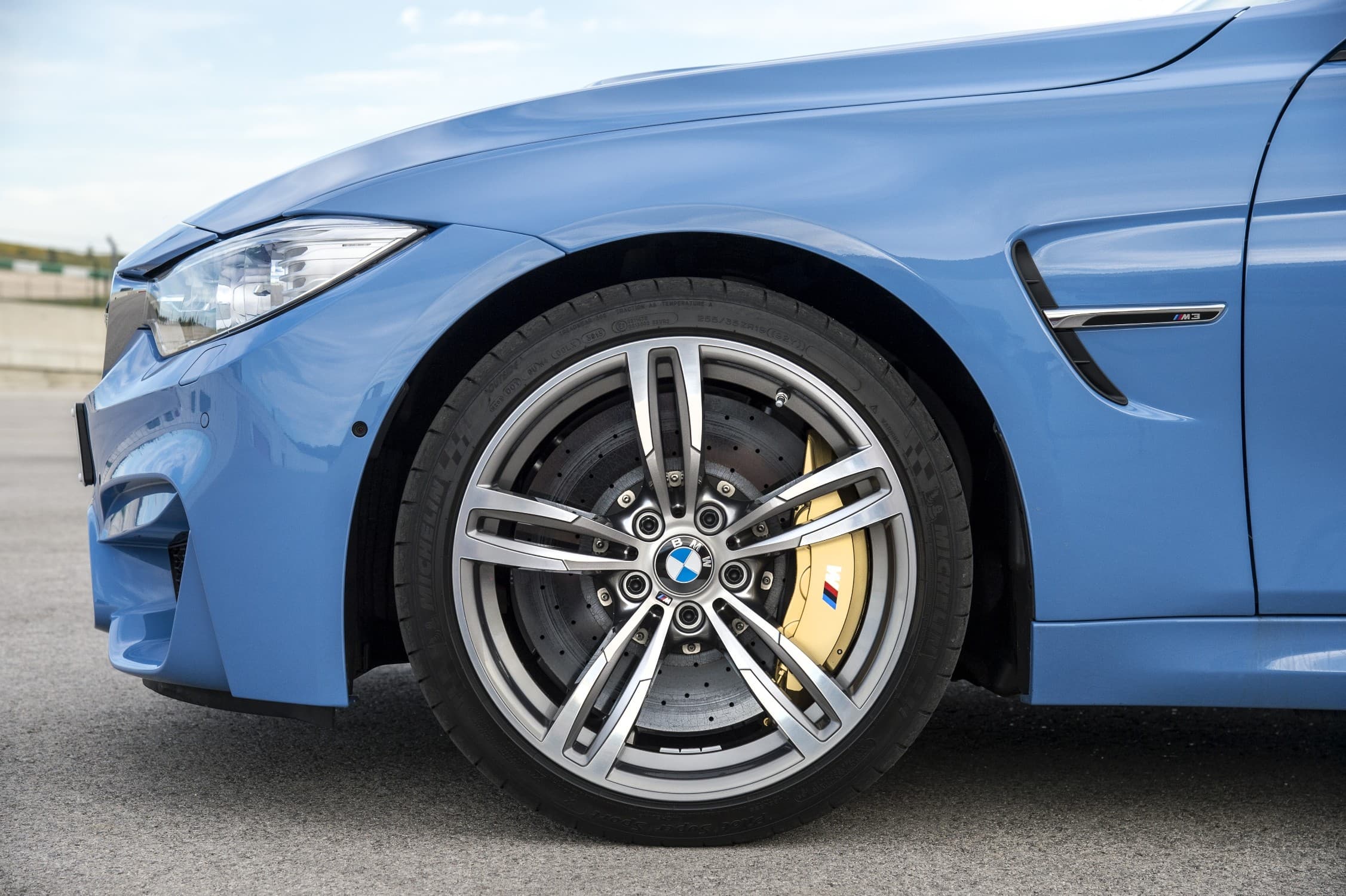
Aspect ratio (e.g., /35) - the sidewall height as a percentage of the section width. A 255/35 tire has a sidewall height of 89mm. Lower aspect ratios give sharper steering response but transmit more road imperfections. They also reduce the tire's ability to absorb curb impacts - watch your lips on those 19" wheels.
Load index - this is the one people ignore and shouldn't. BMW specifies load index requirements based on vehicle weight distribution and speed rating. An F30 335i with a rear-biased weight distribution needs a higher load index on the rear tires than an equivalent FWD car. Running underrated tires can cause sidewall flex under hard cornering, leading to unpredictable breakaway behavior. Always match or exceed the OEM load index.
Speed rating - must match or exceed your vehicle's top speed capability. For most BMW applications: H (130 mph) is the minimum, V (149 mph) is standard on sport packages, W (168 mph) covers M Sport and M Performance models, and Y (186 mph) is required for full M cars. Dropping below the factory speed rating isn't just a bad idea - in some jurisdictions it voids your insurance coverage in an accident.
| Speed Rating | Max Speed | Typical BMW Application |
|---|---|---|
| H | 130 mph (210 km/h) | Base models, winter tires |
| V | 149 mph (240 km/h) | Sport Package sedans |
| W | 168 mph (270 km/h) | M Sport, M Performance |
| Y | 186 mph (300 km/h) | Full M cars (M3, M4, M5) |
E-Series Fitment - E46, E90, E92, E60
The E-chassis BMWs run a 5x120 bolt pattern with a 72.56mm hub bore. These are the most wheel-and-tire-friendly BMWs ever made - the aftermarket has two decades of fitment data, and the fenders are relatively forgiving.
| Chassis | Bolt Pattern | Hub Bore | OEM Front | OEM Rear (M Sport) | Popular Upgrade |
|---|---|---|---|---|---|
| E46 3 Series | 5x120 | 72.56mm | 205/55R16 | 225/40R18 / 255/35R18 | 235/40R18 square on 18x8.5 ET38 |
| E46 M3 | 5x120 | 72.56mm | 225/45ZR18 | 255/40ZR18 | 265/35R18 square on 18x9.5 ET35 |
| E90/E92 | 5x120 | 72.56mm | 205/55R16 | 225/40R18 / 255/35R18 | 235/40R18 square on 18x8.5 |
| E60 5 Series | 5x120 | 72.56mm | 225/55R16 | 245/40R18 / 275/35R18 | 245/40R18 / 275/35R18 on 18x8.5/9.5 |
E46 3 Series (1999-2006): Popular upgrade is square 235/40R18 on 18x8.5 ET38 for all-around use, or staggered 225/40R18 front / 255/35R18 rear on 18x8.5/18x9.5 for a sportier look with more rear grip. Max without modification: 245/35R18 rear on a 9.5" wide wheel. Beyond that, expect rubbing on bumps with stock suspension.
E46 M3 (S54): The E46 M3 is one of the most common track cars in the BMW world. Square 265/35R18 on 18x9.5 ET35 is the proven track formula - maximum contact patch with enough sidewall for curbing. For street, the factory staggered setup is already well-sorted.
E90/E92 3 Series (2006-2013): Popular upgrade is 245/35R18 front / 265/35R18 rear on 18x9 / 18x10 for aggressive street. For daily driving, 235/40R18 square on 18x8.5 is the sweet spot - less tire noise, cheaper to replace. The E92 335i on coilovers with 265/35R18 rear tires is one of the best-handling setups in this price range. Period.
E60 5 Series (2004-2010): The E60 is heavier than the E9x, so load index matters more. Stick with 91+ load index front and 95+ rear. Popular setup: 245/40R18 / 275/35R18 staggered on 18x8.5 / 18x9.5. Don't go below 40-series sidewall on a daily-driven E60.
F-Series Fitment - F30, F32, F80, F10
F-chassis cars transitioned to 5x112 bolt pattern (same as Audi/VW) starting with the F30, which massively expanded wheel options. Hub bore remains 72.56mm. These cars have slightly more aggressive factory alignments and the fenders are tighter, so going wider requires more planning.
| Chassis | Bolt Pattern | OEM Front | OEM Rear (M Sport) | Popular Upgrade | Max Without Mods |
|---|---|---|---|---|---|
| F30/F31 | 5x112 | 225/50R17 | 225/45R18 / 255/40R18 | 235/35R19 / 265/30R19 on 19x8.5/9.5 | 265/30R19 rear |
| F80 M3 | 5x112 | 255/35ZR19 | 275/35ZR19 | 275/35R18 / 285/35R18 on 18x10/11 | 285/30ZR20 |
| F82 M4 | 5x112 | 255/35ZR19 | 285/30ZR20 (Comp) | Cup 2 in 285/30ZR20 | 305/30ZR19 |
| F10 5 Series | 5x112 | 225/55R17 | 245/45R18 / 275/40R18 | 245/40R19 / 275/35R19 | 275/35R19 rear |
F30/F31/F34 3 Series (2012-2019): The classic aggressive-but-functional setup is 235/35R19 front / 265/30R19 rear on 19x8.5 ET35 / 19x9.5 ET38. For daily comfort, 245/40R18 square on 18x8.5 ET35 is excellent. If you're running lowering springs with a 1.2"+ drop, check rear clearance with 265-width tires at full compression. The F30 rear arch is tight.
F80 M3 / F82 M4 (2015-2020): Track upgrade: 275/35R18 front / 285/35R18 rear on 18x10 / 18x11 - going to 18" gives more sidewall for curbing and opens up tire selection for semi-slicks. The F80/F82 can eat rear tires alive with the aggressive rear camber. If you're burning through rears every 12,000 miles, get an alignment with -1.5° rear camber (factory is -1.8° to -2.0°).
F10 5 Series (2011-2017): The F10 is a heavy car (3,800+ lbs). Load index is critical - never go below 97 rear. The 20" OEM option looks great but the 30-series sidewall is punishing on bad roads. 19" is the performance sweet spot.
G-Series Fitment - G20, G22, G80, G05
The latest generation maintains 5x112 with 72.56mm bore. Factory fitments have gotten wider and more aggressive, which means less room for upgrades before you hit fender limits. The G-series also introduced more advanced TPMS that can be finicky with aftermarket sensors.
| Chassis | OEM Front | OEM Rear (M Sport) | Popular Upgrade |
|---|---|---|---|
| G20 3 Series | 225/50R17 | 225/45R18 / 255/40R18 | 245/35R19 / 275/30R19 on 19x8.5/9.5 |
| G80 M3 | 275/35ZR19 | 285/30ZR20 | 285/30R19 / 305/30R19 on 19x10.5/11 |
| G05 X5 | 265/50R19 | 275/45R20 / 305/40R20 | 275/40R21 / 315/35R21 |
G20/G21 3 Series (2019+):
OEM: 225/50R17 (base), 225/45R18 / 255/40R18 (M Sport), 225/40R19 / 255/35R19 (M Sport 19")
The G20 has wider fenders than the F30, which actually helps with wider tire fitments. 245/35R19 / 275/30R19 on 19x8.5 ET30 / 19x9.5 ET35 is aggressive but workable on M Sport suspension. For the M340i, the factory 255/35R19 front is already well-sized - focus upgrades on tire compound rather than going wider.
Michelin Pilot Sport 4S in the OEM sizes transforms the G20's handling. It's the single best tire upgrade for this platform.
G80 M3 / G82 M4 (2021+):
OEM: 275/35ZR19 front / 285/30ZR20 rear (base), 275/35ZR19 / 285/30ZR20 (Competition)
The G80/G82 already run aggressive factory sizes. Track builds typically go wider: 285/30ZR19 front / 305/30ZR19 rear on 19x10.5 / 19x11 squares out the contact patch for balanced grip. Cup 2 R in these sizes is the current track weapon of choice.
Important: the G80's xDrive variants have different optimal tire pressures than the RWD versions. Don't just copy forum setups without matching your drivetrain configuration.
G05 X5 (2019+):
OEM: 265/50R19 (base), 275/45R20 / 305/40R20 (M Sport), 275/40R21 / 315/35R21 (M50i/M60i)
SUV tire fitment is its own world. The G05 is heavy (4,800+ lbs) and tall, so load index and sidewall stiffness matter more than on any sedan. Don't go below 107 load index on any tire. The 20" M Sport setup is the practical sweet spot - 21" looks incredible but the tires cost 40% more and last 30% less.
Staggered vs. Square - Which Setup and Why
| Factor | Staggered (Wider Rear) | Square (Same All Around) |
|---|---|---|
| Rear Grip | More rear traction for RWD | Balanced, neutral handling |
| Tire Rotation | Side-to-side only | Full rotation (30-40% longer life) |
| Tire Cost | Two sizes to stock | One size, simpler purchasing |
| Handling Balance | Factory understeer bias | More neutral at the limit |
| Best For | Street, daily driving | Track, autocross, HPDE |
| Aesthetics | Fills rear fenders better | Even stance front to rear |
Staggered (wider rear) is BMW's factory default on most sport-packaged cars. More rear grip, fills the rear fenders better, allows the rear to put power down more effectively. The trade-off is you can't rotate tires front-to-back, rear tires wear faster, and you're buying two different sizes.
Square (same size all around) is increasingly popular for track use. Full tire rotation extends tire life 30-40%. A square 265/35R18 setup on an F80 M3 with 18x10 wheels all around is a proven track formula that eliminates the factory's built-in understeer bias.
For most daily drivers, the factory staggered setup is fine. If you're tracking the car regularly or burning through tires faster than you'd like, consider going square on your next set.
Tire Pressure - The Free Performance Mod
BMW's TPMS targets are set for comfort and tire longevity, not grip. Factory recommendations typically run 32-36 PSI depending on model and load. For spirited driving, dropping 2-3 PSI from the factory recommendation increases the contact patch and improves mechanical grip. For track use, most performance tires want 30-34 PSI hot (measured after 3-4 hard laps), which usually means starting at 28-30 PSI cold.
If you're seeing uneven tire wear - more wear on the center than the edges - your pressures are too high. More wear on both edges than center means too low. One edge only? That's an alignment issue, not pressure. Get a proper alignment with your new tire setup, especially if you've also changed your suspension.
Pairing Tires with Your Build
Tires don't exist in isolation. If you've added power through ECU tuning, you need tires that can handle the extra torque - especially on RWD BMWs where wheelspin becomes a real issue above 350 whp. Going from an all-season to a proper summer performance tire can be the difference between spinning through second gear and hooking cleanly.
If you've lowered the car on coilovers or springs, recheck your fitment - a 30mm drop can turn a perfect tire setup into a rubbing nightmare on full compression. And if you're running wheel spacers, factor the added track width into your tire width calculations. A 15mm spacer plus a 265 tire that fit separately might not fit together.
Browse our aftermarket wheels collection for BMW-specific fitments, or head to brakes if you need to upgrade stopping power to match your new rubber. The tires are only as good as the system around them.