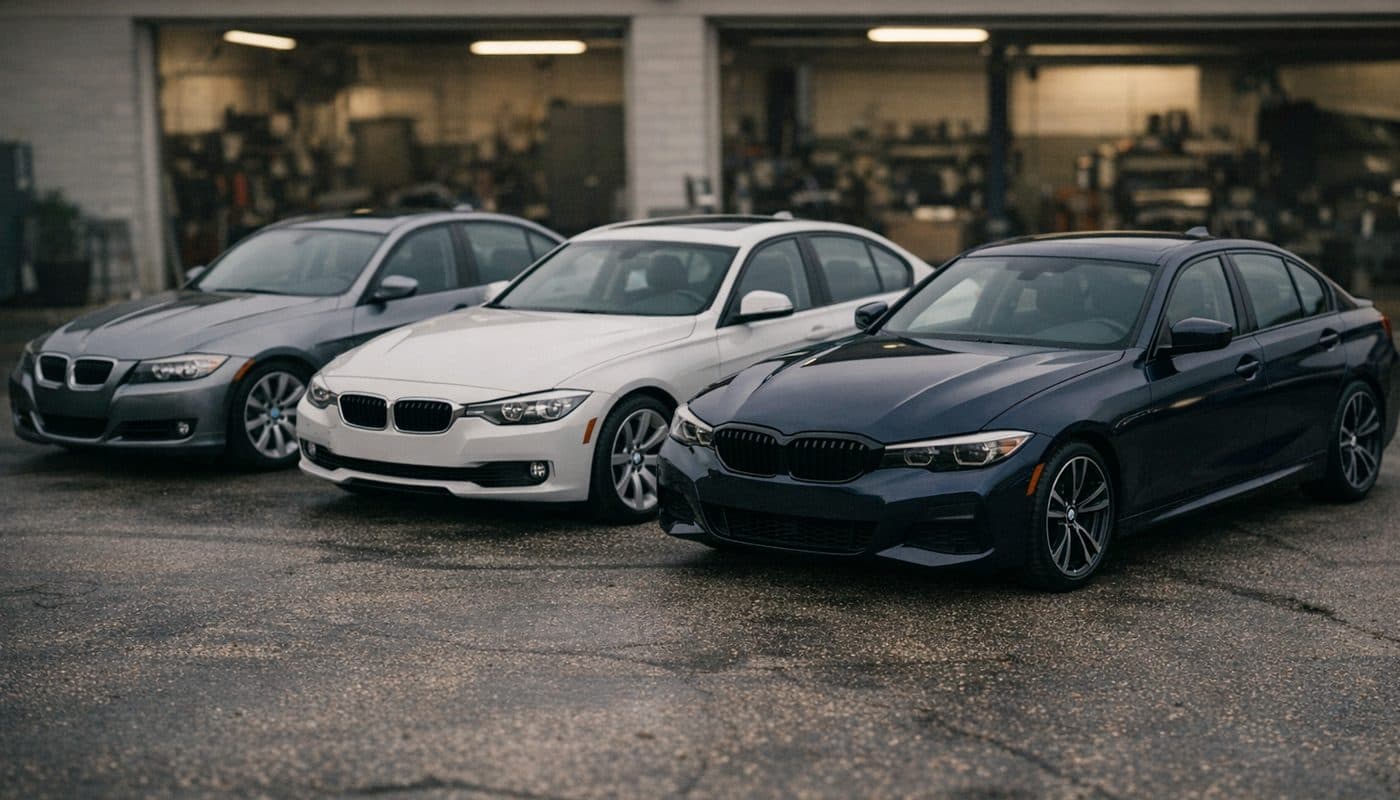
The Cheapest BMWs Worth Buying in 2026
Affiliate disclosure. BimmerTalk is a proud partner of the Amazon Associates Program and Turner Motorsport. We may earn a small commission on qualifying purchases through our links, at no extra cost to you. Read the full disclosure.

Let's get this out of the way immediately: there is no truly cheap BMW. There are BMWs that are cheap to buy. Cheap to own is a different conversation, and confusing the two is how people end up selling their E46 in a parking lot for $800 with a blown head gasket and crying about it.
That said, BMW does offer something most other premium brands don't: a used car market deep enough that you can find genuinely excellent machines at genuinely reasonable prices if you know exactly what you're looking for and what you're getting into. This guide is that map.
We'll cover the cheapest new BMW you can buy, then work through used price tiers - under $5K, $5K-$10K, and $10K-$15K - with specific model recommendations, what to look for, and what to run screaming from.
~$38,000 (230i)
Cheapest new BMW (2026)
~$3,500 (E46 325i)
Cheapest used BMW worth buying
$200-$500/year more than Japanese cars
Average used BMW repair cost
E46 325i (M54 engine)
Most reliable cheap BMW
The Cheapest New BMW You Can Actually Buy
In 2026, if you want to drive something off a dealer lot with a BMW badge, the entry point is the 2 Series Coupe 230i, which starts around $38,000 before dealer markup games. The X1 sDrive28i slots in right around the same territory.
Both are genuinely good cars. The 2 Series especially - it's rear-wheel-drive, it's got a 2.0L turbocharged four-cylinder making around 255 hp, and it's kept a more driver-focused character than almost anything else at its price point. BMW has resisted turning it into a bloated crossover, which is more than you can say for a lot of its lineup.
The X1, meanwhile, is practical, efficient, and has a perfectly usable interior. It's also front-wheel-drive based, which will earn you exactly zero street cred at a car meet but will keep your grocery runs dignified.
Are these $38,000 BMWs "cheap"? No. But they're the cheapest way into new BMW ownership in 2026 without stepping into the used market. And with BMW's current financing offers and the CPO program, some lightly-used examples of these end up in a more interesting price conversation.
For most people reading this, though, the real answer to "what's the cheapest BMW worth buying" is used. So let's go there.
Under $5,000 - Yes, This Is Possible
Five thousand dollars buys you a BMW. Whether it buys you a reliable BMW is entirely a function of which one you choose and how well you inspect it.
The E46 325i or 330i (1999-2005)
The E46 is the obvious call here. These cars are old enough that the depreciation curve has effectively flattened, mechanically sorted examples exist everywhere, and the M54 inline-six engine that powers the 325i and 330i is one of BMW's all-time greats - smooth, relatively simple, and with a documented maintenance history it'll run forever.
At under $5K you're shopping for cars with 130K-180K miles. That's not a dealbreaker for an M54 that's been maintained. The engine itself can go well past 200K with proper oil changes. The issues at this price point are the surrounding systems.
What you will almost certainly need to address on a sub-$5K E46:
- Cooling system - plastic coolant expansion tank, radiator, thermostat, water pump. Budget $400-$700 for parts if you DIY. This is not optional, it's a question of when not if on a 20-year-old car.
- Subframe reinforcement - the notorious E46 rear subframe can crack. Check the rear subframe mounts carefully. A cracked subframe is not the end of the world if it's caught early, but it's a negotiating point and a repair that needs doing.
- Window regulators - every E46 eventually eats window regulators. The clips break. It's cheap to fix but annoying.
- DISA valve - the intake manifold DISA valve on M54s fails eventually. It's a $30-$80 part and an afternoon job.
For the cooling system work, an OEM-spec kit covers the essentials:
- BOXI Coolant Expansion Tank with Thermostat for BMW E46 - covers the tank plus thermostat in one purchase
- Complete Water Pump Kit for BMW E46 - fan blade, fan clutch, pulley, thermostat, tank, and sensor in one kit
- OEM Filters and Spark Plugs Kit for BMW E46 325i/330i - air filter, oil filter, cabin filter, fuel filter, and spark plugs together
If you buy a sub-$5K E46 and immediately spend $600-$900 doing the cooling system and a full service, you have a car that should give you years of reliable driving. Budget-conscious BMW ownership is a DIY sport. Embrace it.
What to Avoid Under $5K
The E46 M3. Yes, you can find them under $5K. No, you should not buy one at that price unless you are a BMW specialist with a fully equipped garage and infinite patience. The S54 engine is spectacular and also expensive to maintain correctly. Vanos rebuild, rod bearing anxiety, throttle body service - the M3 at a bargain price is almost always a bargain for a reason.
Also avoid. E60 5 Series under $5K. The N62 V8 (545i, 550i) is one of the most expensive engines in the BMW catalog to maintain. Valve stem seals, cooling system complexity, and electrical gremlins abound. The six-cylinder E60 525i or 528i is more forgiving but still a complicated car at this price point.
$5,000 to $10,000 - The Sweet Spot
This is where BMW value buying gets genuinely interesting. The price is still accessible, but you're now in range of cars that someone has already sorted and maintained - or at least maintained long enough to sell at a reasonable price rather than a desperate one.
E90 328i or 330i (2006-2011)
The E90 is the successor to the E46 and it's an excellent car that often gets overlooked because everyone's obsessing over the E46. At $5K-$10K you're looking at clean examples with 80K-140K miles. The N52 inline-six in the 328i is almost as good as the M54, with a bit more power and slightly more complexity (electric water pump, VANOS on both ends).
The electric water pump is the E90's version of the E46 cooling system gotcha - it will fail, and when it does it happens fast. Budget for replacement or verify it's been done. On the positive side: the E90's body is tight, the interior quality is excellent for the price, and they have enough room in the back seat to be genuinely usable as a family car.
- MITZONE Engine Coolant Thermostat Assembly for BMW E90 328i - a must-check item on any E90 purchase
- Bapmic Coolant Reservoir Expansion Tank with Sensor for BMW E90 - the plastic tanks crack; replace proactively
E83 X3 (2004-2010)
Unpopular opinion: the E83 X3 is one of the best-value used BMWs in existence and nobody talks about it enough. It's small, it's RWD-based (real AWD, not FWD with torque vectoring trickery), it's got a reasonable maintenance profile, and at $5K-$8K you can find clean examples with full service history.
The 2.5i and 3.0i variants with the M54 give you the same proven engine as the E46 in a more practical package. Quirks: the interior is dated, the power steering pump moans when cold, and finding parts can occasionally require a bit more searching than E46/E90 stuff. But solid car.
F30 320i or 328i (2012-2018)
At the upper end of this bracket - $8K-$10K - you start seeing F30 3 Series examples with reasonable mileage. The F30 is a fundamentally good car with excellent tech, a comfortable but still engaging chassis, and BMW's turbocharged N20 four-cylinder engine.
The N20 caveat: timing chain tensioner. It's the known weak point. Early cars (2012-2015) had the worst of it; later production improved. If you're buying an F30 328i, inspect the timing chain and ask whether the tensioner has been done. It's not catastrophic if caught early, but it can be if ignored.
For oil maintenance on the F30:
- Mann Filter HU 816 z KIT Cartridge Oil Filter for BMW 320i/328i F30 - OEM supplier, correct spec for the N20 engine
$6,500-$9,000
E90 328i avg asking price (2026)
$8,500-$12,000
F30 328i avg asking price (2026)
$5,000-$8,000
E83 X3 3.0i avg asking price (2026)
$3,500-$7,000
E46 325i avg asking price (2026)
$10,000 to $15,000 - Actual Comfort Here
At this tier, BMW used car shopping gets legitimately enjoyable. You're not bracing for impact the moment you buy - you're making choices based on what you actually want to drive.
F30 328i or 335i (2014-2018)
Clean F30s with under 80K miles start appearing here. The 335i with the N55 turbocharged inline-six is a genuinely entertaining car - 300 hp, smooth power delivery, and a soundtrack that rewards enthusiastic driving. The N55 is also considerably more robust than its predecessor, the N54 twin-turbo. If you find a well-maintained 335i at $12K-$14K with documented service, that is a real car for a real price.
F10 528i (2011-2016)
The F10 5 Series is criminally undervalued in 2026. You get a bigger, more luxurious car than the 3 Series, with the same N20 or N52 engines depending on year, at similar price points. If you have kids or just appreciate not having your knees against the dashboard, the F10 528i at $11K-$14K is a tremendous value proposition. Maintenance costs are slightly higher than the 3 Series - more complex air suspension on some cars, bigger brake components - but the driving experience and daily comfort are genuinely premium.
E60 525i or 528i (not the V8)
The generation before the F10 can be had for $6K-$10K now, which puts it within the lower edge of this bracket for clean ones. The six-cylinder E60s (525i, 528i) are solid, if complex. Avoid the 545i and 550i unless you know exactly what you're doing - the N62 V8 will make you question your life choices. The six-cylinder cars are a different story.
The Honest Answer About "Cheap" BMW Ownership
Look, every BMW you buy used will eventually ask you for money. The question is whether it asks politely in small amounts or demands aggressively all at once. The difference between those outcomes is almost entirely about preparation and maintenance.
A $5K E46 that you immediately service properly, with a fresh cooling system and fresh fluids, will cost you far less than a $10K E46 that someone drove into the ground and sold you as "just needs brakes."
The single best investment you can make alongside any cheap used BMW purchase is a proper diagnostic scanner. Not the $15 generic OBD-II dongle - a BMW-specific tool that can read all modules, clear service lights, and register a new battery.
- iCarsoft BMM V3.0 BMW-Specific OBD2 Scanner - reads all systems, handles battery registration, covers BMW/MINI/Rolls-Royce, lifetime updates
Before you buy any used BMW, plug this in and read every module. Faults hiding in ABS, airbag, transmission, or DSC modules that don't trigger the check engine light but will eventually surface. A seller who refuses to let you scan the car is telling you something important.
Quick Reference - Models and What They Really Mean
| Model | Price Range | Engine | Watch Out For |
|---|---|---|---|
| E46 325i/330i | $3,500-$7,000 | M54 I6 | Cooling system, subframe, DISA |
| E90 328i/330i | $6,500-$9,000 | N52 I6 | Electric water pump, control arm bushings |
| E83 X3 3.0i | $5,000-$8,000 | M54 I6 | Power steering pump, driveshaft guibo |
| F30 328i | $8,500-$12,000 | N20 I4 Turbo | Timing chain tensioner, oil leaks |
| F30 335i | $10,000-$15,000 | N55 I6 Turbo | Valve cover gasket, high-pressure fuel pump |
| F10 528i | $10,000-$14,000 | N20/N52 | Similar to F30, plus more complex systems |
| E60 525i/528i | $6,000-$10,000 | N52 I6 | VANOS seals, electronics aging |
E46 325i/330i
- Price Range
- $3,500-$7,000
- Engine
- M54 I6
- Watch Out For
- Cooling system, subframe, DISA
E90 328i/330i
- Price Range
- $6,500-$9,000
- Engine
- N52 I6
- Watch Out For
- Electric water pump, control arm bushings
E83 X3 3.0i
- Price Range
- $5,000-$8,000
- Engine
- M54 I6
- Watch Out For
- Power steering pump, driveshaft guibo
F30 328i
- Price Range
- $8,500-$12,000
- Engine
- N20 I4 Turbo
- Watch Out For
- Timing chain tensioner, oil leaks
F30 335i
- Price Range
- $10,000-$15,000
- Engine
- N55 I6 Turbo
- Watch Out For
- Valve cover gasket, high-pressure fuel pump
F10 528i
- Price Range
- $10,000-$14,000
- Engine
- N20/N52
- Watch Out For
- Similar to F30, plus more complex systems
E60 525i/528i
- Price Range
- $6,000-$10,000
- Engine
- N52 I6
- Watch Out For
- VANOS seals, electronics aging
Final Word
The cheapest BMW worth buying in 2026 is whichever one you buy with your eyes open. A $4,000 E46 with complete service records and a healthy cooling system is worth more than a $9,000 F30 with mystery miles and a check engine light someone cleared before listing it.
Know your price tier. Know the model-specific problems. Bring a scanner. Ask for records. And remember that "cheap to buy" and "cheap to own" are two very different things - but with the right preparation, you can have both.
There's a reason BMW has been making some of the most engaging cars on the planet for 50 years. A well-bought used example from almost any era will remind you of that every single time you get on an on-ramp. That experience doesn't have to cost new-car money. It just costs preparation money. And in the BMW world, that's a trade worth making.
Ready to search available parts for your new-to-you BMW? Start with the maintenance items specific to your model - your future self will thank you.