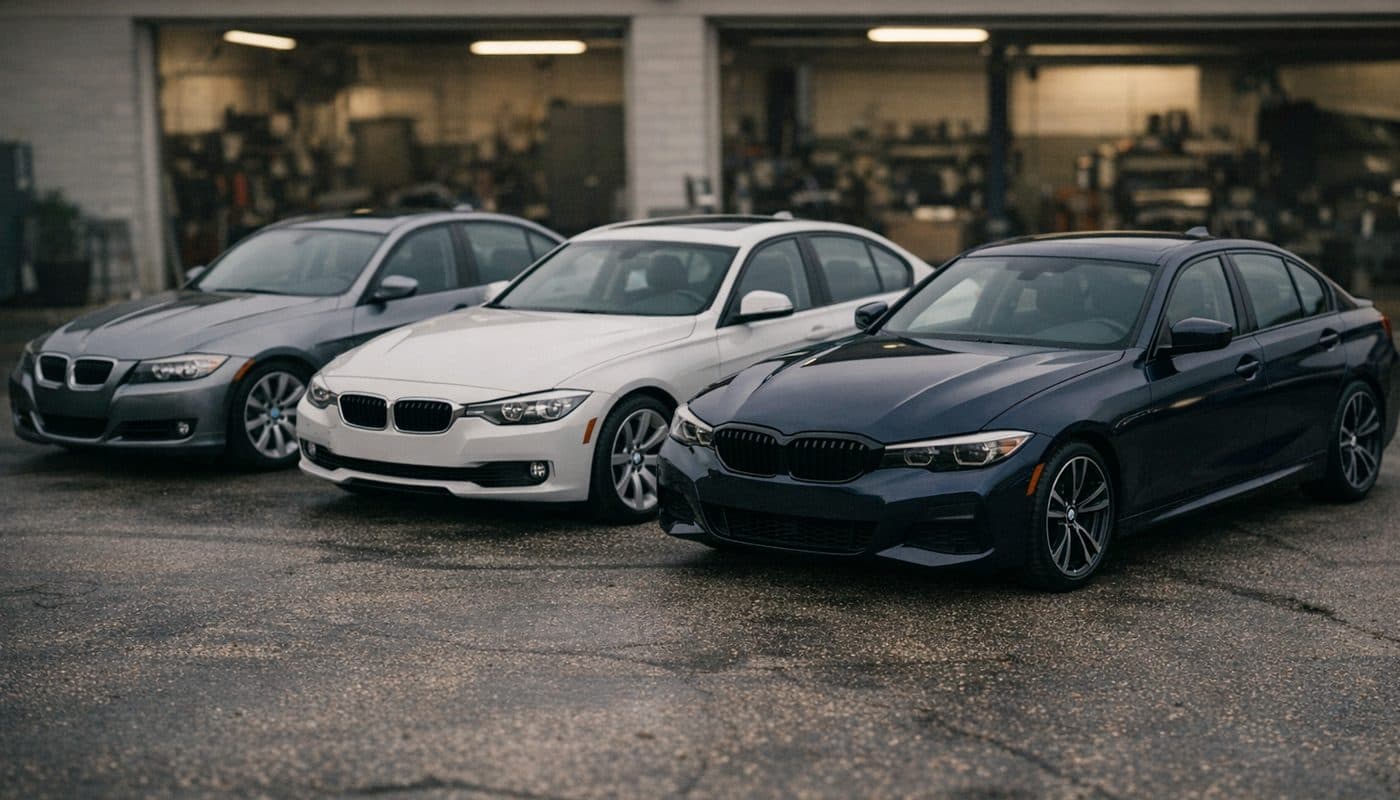
I've been wrenching on BMWs for fifteen years. I've owned seven of them. I currently daily a G20 330i with a Stage 1 BM3 tune and BC Racing coilovers, and yes, I fully understand the irony of writing a "best BMW to buy" guide while making my own car progressively more expensive. But that history is exactly why I'm writing this - because I've bought the wrong BMW more than once, and I've watched friends do the same thing over and over again. The used BMW market punishes ignorance and rewards research. This guide is the research.
I also spent several years inside a BMW dealership, first in service and then on the floor. That time taught me two things. One, BMWs are genuinely remarkable machines at every price point when they're properly maintained. Two, an enormous percentage of the used ones are not properly maintained. Deferred coolant work on E46s. Skipped HPFP replacements on N54 cars. Oil change intervals stretched to BMW's absurd 15,000-mile recommendations on cars that are being driven hard. The difference between a great used BMW purchase and a money pit is knowing what to look for, having a specific chassis in mind before you start shopping, and being willing to walk away when the inspection reveals problems. I'll help you with all three.
This is a 2026 guide, which means the market has shifted meaningfully from even two years ago. E46s have crossed from "cheap transportation" to "enthusiast platform" - prices are up and clean ones are getting harder to find. F30s are right in the depreciation sweet spot, meaning they're attainable but the good ones still have value. The G20 generation is now old enough that the early examples have had one or two owners and are hitting the independent shop market. And the F80/F82 M cars are doing something interesting - they're cheap enough for enthusiasts but the S55 maintenance requirements are weeding out the neglected examples. Lots has changed. Let's go budget by budget.

6
Budget Tiers
E36 to G80
Chassis Covered
$5K-$80K
Price Range
High
Ownership Cost
| Budget | Best Chassis | Engine | Key Issues to Check |
|---|---|---|---|
| Under $10K | E46, E39, E83 | M54, M52TU, N52 | Subframe cracks, cooling |
| $10K-$20K | E90, E92, E60 | N52, N54, N55 | HPFP (N54), oil leaks |
| $20K-$35K | F10, F30, F32 | N55, N20, B58 | Timing chain (N20), charge pipe |
| $35K-$50K | F80 M3, F82 M4, G20 | S55, B58 | Rod bearings (S55), carbon buildup |
| $50K-$80K | G80 M3, G82 M4 | S58 | Fresh warranty-era, DME lock post-2020 |
| Over $80K | M5 G90, CS variants, used M2 G87 | S63, S58 | Premium but collectible |
Budget Under $10K - Entry BMW Ownership
Ten grand or under is where a lot of people fall into one of two traps. The first trap is buying on emotion - you see a clean-looking E46 M3 for $8,500 and figure you're getting a deal. You're not. You're buying someone's rebuild project that ran out of money. The second trap is buying on price alone - the cheapest E90 on Facebook Marketplace, zero service history, "ran when parked." Don't do either. In this bracket, condition beats chassis every time. A slightly boring N52-powered E90 with full service records from an independent BMW shop is worth more than any M3 with question marks in its history. More on that in a moment.
What does the under-$10K BMW market actually look like in 2026? E46 sedans and coupes are genuinely attainable in the $6,000-11,000 range depending on mileage and condition. E39 5 Series have quietly appreciated and good ones are now $8,000-14,000. E83 X3s sit at the bottom of the market, $4,000-8,000, and they're underrated. E90 328i sedans and coupes start around $5,000 for high-mileage examples and top out around $10,000 for clean, low-mileage ones. There's a lot to work with at this price point, as long as you know the traps specific to each chassis.
BMW E46 3 Series (1999-2006) - The One That Started It All
The E46 is the answer to a question that should be obvious: what happens when BMW builds a compact sports sedan at the absolute peak of their analog engineering philosophy? This is what happens. Perfect 50/50 weight distribution from the factory. A naturally aspirated inline-six in 323i (M52TU), 325i (M54B25), or 330i (M54B30) form that loves to rev and makes a sound no turbocharged BMW has ever matched. Hydraulic steering with genuine road feel. A chassis so well-sorted that driving instructors still use E46s to teach oversteer control.
The 330i with the M54B30 is the one to target. Enough torque to be genuinely satisfying in normal traffic, enough headroom for real modifications later, and the engine is fundamentally bulletproof when the cooling system is maintained. A clean 330i with a well-documented history can hit 200,000+ miles without significant drama. I've personally seen E46 330is with 180,000 miles that drove better than neglected examples with 80,000. Miles are not the issue on these. Maintenance history is everything.
In 2026, clean E46 330i sedans are trading around $7,000-12,000. The manual coupe in good condition can push $13,000-15,000 because enthusiasts know what they're worth and there are fewer of them. The E46 is also the best entry-point BMW from a modification standpoint - a complete parts ecosystem, encyclopedic community knowledge, and a platform that rewards investment without punishing small mistakes. A properly sorted E46 with coilovers and a header-back exhaust is one of the most entertaining road cars in existence for under $20,000 all-in.
What to check on pre-purchase inspection:
- Rear subframe - this is the big one. Get under the car and look at the subframe mounting points in the trunk floor. Cracks radiating from the subframe mounting holes are common on hard-driven examples, especially M3s and manual cars. Subframe reinforcement is a $800-1,500 job; subframe replacement is significantly more. Walk away from severe cracks unless you're planning the repair immediately.
- VANOS unit - the variable valve timing solenoids rattle on cold starts when they're worn. A healthy VANOS is quiet. Any cold-start rattle that disappears at operating temperature is a warning sign. VANOS rebuilds are $400-700 from a specialist.
- Cooling system - everything plastic cracks on a 20-year-old BMW. Water pump impeller, expansion tank, thermostat housing, radiator end caps. If none of these have been replaced recently on a high-mileage car, budget $600-900 for a complete cooling system refresh before you have a roadside boil-over.
- Rear subframe bushings - worn subframe bushings cause vague handling and clunking over bumps. Urethane replacements are the correct fix on any car you plan to enjoy driving.
- Oil leaks - valve cover gasket, rear main seal, oil filter housing gasket. All common, all manageable if you know about them going in.
Real ownership costs: Budget $1,500-2,000 for a thorough mechanical refresh on a new-to-you E46. Insurance is cheap - these cars are old enough that full coverage on a $9,000 example runs $80-120/month in most markets. Parts are abundant and reasonably priced. Independents who know E46s charge $80-100/hour versus dealer rates of $180+. The E46 is one of the most affordable BMWs to maintain properly once it's sorted.
BMW E39 5 Series (1997-2003) - The Sophisticated Option
The E39 is what happens when BMW builds a luxury sports sedan that actually handles. The 525i with the M54B25 and the 528i with the M52TU are the sweet spot at this price point - the M54B30-powered 530i is better but harder to find under $10K in good condition. The E39 540i with the M62 V8 is a tempting but expensive proposition - V8 maintenance costs add up quickly.
The E39 feels bigger and more refined than the E46 but still drives like a BMW should - that rear-wheel drive balance, that hydraulic steering weight, that slightly playful character when you push it. The M54 inline-six in the 525i and 530i is one of the most durable engines BMW has ever built. I've personally inspected E39 530is with 200,000 miles that ran perfectly. If it's been maintained, the engine genuinely doesn't care how many miles are on it.
What to check:
- DISA valve - the intake manifold variable geometry unit is plastic and cracks with age. A failed DISA causes rough idle and power loss. $150 in parts, one afternoon of your life.
- Window regulators - E39 window regulators fail constantly. Budget for replacements on all four doors eventually.
- Rear shock towers - inspect the rear shock tower mounting points for cracking on any hard-driven example.
- Cooling system - same story as the E46. Replace everything plastic before it fails, not after.
- Center support bearing on the driveshaft - clunking under acceleration on E39s is often this bearing. $80 in parts.
Real ownership costs: The E39 is slightly pricier to maintain than the E46 because it's a larger car with more complex systems. Budget $2,000-2,500 for a proper refresh on a new purchase. The reward is a genuinely luxurious driving experience that costs less than a new Camry payment per month to insure and operate.
BMW E83 X3 (2003-2010) - The Practical Dark Horse
I know. An X3. Bear with me. The E83 X3 with the M54 2.5 or 3.0 inline-six is genuinely one of the most undervalued used BMWs in 2026. You can buy a clean E83 X3 3.0i for $5,000-8,000 and get a fully capable AWD BMW that handles better than any comparable crossover from the same era, has a bulletproof naturally aspirated inline-six, and shares most of its mechanical components with the E46 3 Series. Parts are cheap. Mechanics know it. It just doesn't have the cachet of the sporting cars.
The E83 is worth considering if you need AWD practicality but still want to drive something with actual character. The transfer case xDrive system in early E83s is a clutch-based unit that engages proactively - it's not a pushover SUV drivetrain. On snow or loose surfaces, an E83 X3 will put a smile on your face that a modern crossover can't manage.
What to check:
- Transfer case and rear differential fluid - often forgotten, always needs changing on a used purchase. Use BMW-spec fluids only.
- Cooling system - same as all M54-powered BMWs.
- Power steering pump and rack - E83 power steering leaks are common at higher mileage.
My Pick at This Budget
An E46 330i sedan, 6-speed manual, documented service history, rear subframe inspected and confirmed clean. Budget $8,000-10,000 for the car and another $1,500 for a proper refresh, and you'll have one of the best-driving cars in any parking lot for under $12,000 total. Nothing at this price point from any manufacturer touches it for driving dynamics. The only caveat is that you need to be comfortable with regular maintenance - this is not a "set and forget" purchase. It's a partnership with a piece of German engineering history.

LSD Limited Slip Differential Compatible With BMW 3 Series E46 E90 E91 E92 E93
$671.42
Budget $10K-$20K - The Sweet Spot
This is my favorite bracket to shop in, and I say that as someone who's spent years watching this market evolve. Ten to twenty thousand dollars in 2026 buys you either a genuinely excellent late-model E-chassis BMW or an early F-chassis example, and at the top of this range, you're looking at cars that are genuinely modern in their feature set - iDrive, LED lighting, turbo power - while still being far enough from new to have real depreciation behind them.
What the market looks like right now: E90 325i/328i sedans start around $5,500 and clean examples top out around $11,000. E90/E92 335i cars - the turbocharged ones - run $7,000-14,000 depending on condition and mileage. E60 528i/535i 5 Series are $8,000-16,000, with the N54-powered 535i at the high end. Early F30 328i models are entering this bracket at the lower end. And at the very top, you occasionally see early E46 M3s in the $17,000-22,000 range - a significant appreciation from three years ago.
BMW E90/E92 3 Series (2005-2013) - The Most Versatile Used BMW
The E90 is the chassis I recommend most often when someone asks me "what BMW should I buy?" It covers more use cases than any other BMW of the era. Daily driver? E90 328i. Weekend car? E92 335i coupe. Track build? E90 M3. Winter beater with style? E90 328xi. The platform is that flexible.
The N52-powered 328i is the most reliable turbocharged - wait, it's actually naturally aspirated. That's the point. The N52 doesn't have a turbo, and that's why it's so dependable. BMW's 3.0L inline-six in naturally aspirated form, mated to a ZF 6-speed automatic or a proper 6-speed manual. It's not the most exciting engine on paper - 230 HP from a 3.0L is conservative by any standard - but the delivery is smooth, linear, and completely stress-free to own. I've seen N52 engines go 250,000 miles with only routine maintenance. Find a clean E90 328i with records and you're buying reliability.
The N54-powered 335i is a completely different conversation. The twin-turbo 3.0L makes 300 HP stock and will do 450+ WHP on the factory turbo with supporting modifications. It's one of the great tuner engines of the modern era. But - and I'll say this plainly because I've owned N54 cars and worked on them professionally - a neglected N54 is a money sink. The high-pressure fuel pump issue was real and was revised multiple times. The injectors foul. The charge pipe cracks. The wastegate rattle that develops on high-mileage cars is the engine telling you it needs attention. None of this makes the N54 a bad engine. It makes it an engine for attentive owners.
What to check on pre-purchase inspection:
- N54 HPFP part number - check that the high-pressure fuel pump has been updated to the revised spec (13517616170 or later). Old-spec pumps fail under load and leave you stranded. This is a known issue with a known fix.
- Charge pipe condition - on any N54 car, the stock plastic charge pipe is a liability. If it hasn't been replaced with an aluminum unit, that's a condition of sale or a price reduction item. Plan for $200-250 for the part.
- Wastegate rattle - cold start the N54 and listen carefully. A rattling sound on cold start that goes away as the car warms up is normal N54 behavior. A rattle that persists at operating temperature means the wastegate actuator is worn. Not a deal-breaker but it needs addressing.
- Oil leaks - valve cover gasket and oil pan gasket are common on higher-mileage N54 cars. Look under the car and check the engine bay for oil residue.
- Cooling system on N52 - same drill as E46. Water pump, thermostat, expansion tank.
BMW E60 528i and 535i (2004-2010) - The Driver's 5 Series
The E60 is the most divisive BMW of the 2000s because of the styling - Chris Bangle's controversial flame-surfacing design split the community straight down the middle. But here's the thing: it doesn't matter what the car looks like from the outside when you're the one driving it. And from the driver's seat, the E60 is one of the better large BMW sedans of the decade. The chassis dynamics, especially on the 535i, are properly engaging for a car this size.
The N52-powered 528i is the safe bet - same reasoning as the E90 328i, same engine, same reliability story. The N54-powered 535i is genuinely quick and the same modification potential applies, but a high-mileage neglected E60 535i can be an expensive proposition because the 5 Series chassis adds complexity and cost to everything. Higher-end suspension components, more complex electronics, more things to go wrong.
What to check:
- SMG transmission on M5 versions - if you're looking at an E60 M5 in this price range, the SMG transmission is the primary concern. These gearboxes require regular fluid changes and clutch pack inspections. A neglected SMG is a $3,000-8,000 rebuild. The V10 S85 engine is similarly high-maintenance. A sub-$15,000 E60 M5 is almost always someone else's problem - proceed only with a specialist inspection.
- Sunroof drain tubes - E60 sunroof drains clog with debris and flood the cabin. Check for water stains in the front footwells and the trunk.
- iDrive system - early E60 iDrive systems can be glitchy. The controller and screen can fail. An aftermarket head unit replacement exists but it's a project.
E46 M3 - Entry Point Is Here (Barely)
The E46 M3 deserves its own mention because prices have moved significantly. In 2022, a decent E46 M3 was $18,000-25,000. In 2026, the market has pushed clean examples to $22,000-35,000, with ultra-low-mileage cars touching $40,000+. At the very bottom of this bracket - $16,000-18,000 - you'll find high-mileage examples or cars that need work. These are not the deals they appear to be.
The S54 inline-six in the E46 M3 is one of the great naturally aspirated engines. 333 HP from 3.2 liters without forced induction, an engine that loves to be revved to its 8,000 RPM redline, and a sound that no turbocharged BMW can replicate. But the S54 is also a high-maintenance engine - rod bearings need inspection at 80,000+ miles, the VANOS system requires attention, and oil changes every 5,000 miles are mandatory, not optional. An E46 M3 that has been maintained properly is spectacular. One that hasn't is terrifying from an ownership cost perspective.
Real ownership costs: Budget $15,000-18,000 to buy, $2,000-3,000 per year in maintenance on an E46 M3 assuming you're doing oil changes and addressing things as they come up. More if you track it. The E90/E92 is $800-1,200 per year for routine work. The E60 528i is the cheapest of the lot - $600-900 per year if you stay on top of it.
My Pick at This Budget
Between $10,000-15,000, I'm buying a clean E92 335i coupe with the N54 in verified good health, aluminum charge pipe already fitted, HPFP updated. Between $15,000-20,000, I'm looking hard at a clean E90 M3 - which just barely touches this bracket - or a mid-mileage F30 335i. The E92 coupe body is one of the best-looking BMWs of the decade and the N54's modification potential means you can build something genuinely fast while the car still looks stock from the outside.

Vgate vLinker BM+ Bluetooth OBD2 Scanner — BMW & Mini
$46.99

Borla Cat-Back Exhaust System — F30 335i / F32 435i
$1,668.99
Budget $20K-$35K - Modern BMW Enters the Picture
At $20,000-35,000, you're entering genuinely modern BMW territory. F10 5 Series, F30 3 Series, F32 4 Series - cars with real iDrive infotainment, LED lighting, advanced driver assistance systems, and BMW's turbocharged B-series engines. And at the very top of this range, early G20s with the magnificent B58. This bracket has the widest variety of any tier in this guide.
Market reality in 2026: Clean F30 335i/340i sedans are $18,000-26,000 depending on mileage and spec. The B58-powered 340i is particularly sought after and commands a premium. F32/F36 4 Series cars run similarly. F10 528i/535i 5 Series are $16,000-28,000, with clean low-mileage examples well into the upper end. Early G20 330i cars from 2019-2020 are now hitting $22,000-28,000, and G20 M340i examples from 2020-2021 are $28,000-36,000 - technically straddling this and the next bracket.
BMW F30 328i and 335i/340i (2012-2018) - The Definitive Daily Driver
The F30 is one of the best used car purchases you can make in 2026, full stop. I'm not being hyperbolic. The chassis dynamics are proper BMW - sharper than the E90, better-weighted steering, more planted at the limit. The interiors aged remarkably well. iDrive 6 is actually usable without wanting to throw your phone through the screen. And the range of engines gives you a genuine choice about what kind of driver you want to be.
The N20-powered 328i was historically controversial because of timing chain issues on pre-2015 build-date cars. Here's the situation in 2026: if you're buying a 2016 or later F30 328i, BMW had revised the timing chain tensioner by then and the issue is largely behind you. If you're buying a pre-2016 car, you need to verify the timing chain service history. It's not a reason to avoid the platform - it's a reason to verify before you buy. The N20 with healthy chain and good service history is a genuinely good engine.
The N55 335i is the sweet spot for drivers. Same basic formula as the E90 335i - single twin-scroll turbo, 300 HP stock, huge modification headroom - but in a more refined package. The F30 N55 is easier to live with than the E90 N54 because the single turbo is simpler and the charge pipe situation, while still needing an aluminum replacement, is better engineered than the E90's setup. A Stage 1 flash tune on an F30 335i is $350 and adds 35-40 wheel horsepower. Full bolt-ons push past 380 WHP. The car still looks like a sensible sedan.
And then there's the B58-powered 340i. This is the one I'd buy at the top of this bracket without hesitation. The B58 is a closed-deck block turbocharged 3.0 inline-six that makes 320 HP stock and responds to tuning better than almost any street engine I'm aware of. Stage 1 on the B58 340i takes you to 380-400 WHP. Stage 2 with a downpipe and upgraded charge pipe pushes 420-440 WHP. The engine is more reliable than the N55 under modification because the closed-deck block handles boost pressure better structurally. If you can find a 2016-2019 F30 340i in good condition for $24,000-28,000, buy it immediately.
What to check on pre-purchase inspection:
- N20 build date and timing chain history - for pre-2016 328i cars, verify the timing chain service has been performed or budget $1,200-1,800 for the repair.
- Charge pipe condition on N55 and B58 - aluminum replacements should already be fitted on a performance-oriented car. If not, it's an immediate purchase.
- Carbon buildup on direct injection engines - all N20, N55, and early B58 engines are direct injection, which means intake valves never get a fuel wash. At 60,000-80,000 miles, walnut blasting the intake valves is recommended. Budget $400-600 for this service if it hasn't been done.
- Fuel injectors on N20 - the N20 can develop injector issues at higher mileage. Check for rough idle and misfires.
- Suspension bushings - F30 suspension bushings wear out by 80,000 miles on cars driven normally, sooner if driven enthusiastically. Front control arm bushings are the first to go. Budget $800-1,200 for a full front suspension bushing refresh on a high-mileage car.
BMW F10 528i and 535i (2011-2016) - The Underrated Executive Sedan
The F10 5 Series is having a quietly interesting moment in 2026. These cars are old enough to have depreciated significantly but new enough to have genuinely modern features - large touchscreen iDrive, sophisticated suspension, real luxury. A clean F10 528i with the N20 engine and moderate mileage is $18,000-24,000, and it delivers a level of interior refinement that makes the F30 feel compact by comparison.
The N55-powered F10 535i is the performance choice. Same engine as the F30 335i, more car around it - longer wheelbase, softer suspension tune stock, more isolation from road noise. It's not a driver's car the way the F30 is, but it's a genuinely fast luxury machine that can be tuned to real performance levels without sacrificing the refinement that makes it special as a daily driver.
What to check:
- N20 timing chain on 528i - same story as F30. Pre-2015 cars need verification.
- Air suspension on xDrive and higher-spec models - F10 with adaptive air suspension can develop compressor and air bag failures at higher mileage. The system warns you with a ride height issue. Budget $800-1,500 for air suspension component replacement if the car has it.
- Valve stem seals on N55 - higher-mileage N55 cars burn oil through worn valve stem seals. Check for blue smoke on cold start and check the oil level after the test drive.
BMW F32 428i and 435i (2013-2020) - The Stylish Alternative
The F32 4 Series coupe is mechanically a twin of the F30 3 Series - same chassis, same engines, same platform - but the two-door coupe body completely changes the character of the car. It's longer, lower, wider in visual proportions, and the interior feels more intimate. The 428i with N20 and 435i with N55 deliver the same ownership considerations as their F30 counterparts. At this price point, F32 435i coupes are genuinely compelling - the styling has aged exceptionally well and the N55 mod platform is mature.
My Pick at This Budget
A 2017-2019 F30 340i or F32 440i with the B58, 50,000-70,000 miles, and an independent BMW shop service history. I'd pay $25,000-30,000 for the right example without hesitation. The B58 at Stage 1 turns this car into something that genuinely challenges cars costing twice as much, and the F30/F32 platform is mature enough that everything you'd want to do to it is well-documented and affordable.

BC Racing BR Series Coilovers — F30 3 Series AWD (5-Bolt)
$1,195.00
Budget $35K-$50K - M Performance Territory
Thirty-five to fifty thousand dollars in 2026 means you're in M car territory. Real M cars. Not M Sport packages, not M Performance accessories - actual M Division products with dedicated engines, unique chassis tuning, and the storied M badge earned the correct way. This bracket is where the BMW purchase decision gets genuinely exciting and genuinely consequential. The cars are spectacular. The maintenance expectations are real.
What's in this market right now: F80 M3 sedans are $35,000-48,000 depending on condition and service history. F82 M4 coupes run $40,000-52,000 for clean examples. The F10 M5 with the S63 twin-turbo V8 is $30,000-45,000 - an extraordinary amount of car for the money if you understand what you're getting into. G20 M340i at the top of this bracket overlaps with the previous section. And at the very high end, a particularly clean E92 M3 with documented history is now touching $42,000-50,000 because the enthusiast market has recognized what these cars are.
BMW F80 M3 (2015-2018) - The Last Analog M3 With Real Power
The F80 M3 is one of those cars that the BMW community is going to appreciate more and more as time goes on. 425 HP from the S55 twin-turbo inline-six, a DCT transmission that's faster than any human reflexes, M compound brakes standard, electronically controlled M rear differential, and a chassis that was tuned at the Nurburgring specifically for driver engagement. This is a proper M car built in the tradition of M cars.
The S55 has a well-documented rod bearing issue that develops on cars with high miles and irregular oil changes. This is not a death sentence for the platform - it's a known maintenance item. At 60,000-80,000 miles, rod bearing inspection is recommended. If the bearings show wear, replacement is $800-1,200 in parts and $400-600 in labor at a good independent. A healthy F80 M3 with documented rod bearing work is an excellent buy. An F80 M3 with no record of the inspection and 90,000 miles is a risk.
What to check on pre-purchase inspection:
- Rod bearing condition - an oil sample analysis can detect bearing material in the oil. Request this or do it yourself before buying any high-mileage S55 car.
- DCT fluid service - the Getrag DCT requires fluid changes every 30,000-40,000 miles under hard use. Ask for service records specifically mentioning this.
- Carbon buildup on S55 - same as all direct injection engines. Walnut blasting at 60,000+ miles.
- M differential fluid - often overlooked. Should be changed every 50,000 miles.
- Throttle body carbon on S55 - the S55 throttle bodies carbon up and cause rough cold idle. A clean on used cars is recommended.
- Abuse history - pull the car fax, check for track day documentation, look for modifications that suggest hard driving without corresponding maintenance records.
BMW F82 M4 (2015-2018) - The Two-Door Version of the Argument
The F82 M4 and F80 M3 share the same S55 engine, same mechanical platform, and same ownership considerations. The difference is the body - the M4 is the two-door coupe, the M3 is the four-door sedan. Which you choose is entirely personal preference. The M4 looks more aggressive from the outside and has a slightly more driver-focused feel due to the shorter wheelbase. The M3 is more practical and slightly more livable as a daily driver. I'd buy whichever one presents the cleaner history at the right price.
BMW E92 M3 - The Analog Alternative at a Premium
The E92 M3 with the naturally aspirated S65 V8 is now genuinely collectible, and prices reflect it. A clean, documented E92 M3 with the 6-speed manual is touching $42,000-50,000 in 2026, which puts it at the very top of this bracket. Is it worth it compared to a similarly priced F80 M3? That depends entirely on what you value.
The S65 8,400 RPM V8 in the E92 M3 is one of the finest naturally aspirated engines ever put in a production car. It makes 414 HP from 4.0 liters without a turbo, and the delivery - particularly in the upper rev range from 6,000-8,400 RPM - is unlike anything a turbocharged car can replicate. If you're buying for driving sensation, the E92 M3 wins every time. If you're buying for outright performance and trackday results, the turbocharged F80 wins. Both are extraordinary machines.
BMW G20 M340i and M440i - Modern Performance Without M Prices
The G20 M340i sits at the very bottom of this bracket - 2020-2021 examples are $32,000-40,000 in good condition - and it's worth serious consideration as an alternative to a used M car. The B58 in M340i tune makes 382 HP stock, which is more than the old F80 M3's output of 425 HP... wait, no. But the 382 HP B58 with a Stage 1 tune from Bootmod3 or MHD hits 450+ WHP, which is F80 M3 territory. And the B58 reliability story is considerably better than the S55.
The trade-off is character. An M340i is a fast, competent, refined sports sedan. An F80 M3 is a focused driving machine with genuine motorsport DNA. They're different animals for different purposes. If you're primarily a daily driver who occasionally does spirited canyon runs, the M340i may actually be the better purchase at this price point. If you track your cars or care deeply about the M Division pedigree, the F80 is the answer.
Depreciation curves in this bracket: The F80 M3 has already taken its major depreciation hit - from $65,000 new to $38,000-45,000 now. It will continue to depreciate slowly, and may reverse into appreciation territory within five to eight years as the enthusiast market recognizes it as a future classic. The G20 M340i is earlier in its depreciation curve and will continue to lose value for the next three to four years. From a pure financial perspective, the F80 M3 is the safer choice at this price point.
My Pick at This Budget
A well-maintained F80 M3 Competition with documented rod bearing inspection, DCT service history, and somewhere around 50,000-65,000 miles. I'd budget $42,000-46,000 for a genuinely clean example and consider it money well spent. The F80 M3 Competition is one of the great performance cars of its era and prices are not going to get meaningfully cheaper at this point. If the S55 scares you, a clean F30 340i with a Stage 2 tune and good coilovers accomplishes 70% of the performance for considerably less money.


ANCEL BM500 OBD2 Full-System Diagnostic Scanner — BMW & MINI
$94.99
Budget $50K-$80K - Current M Cars
Fifty to eighty thousand dollars is where you cross into cars that are either nearly new or freshly out of their factory warranty window. The purchase decision changes character at this price point - you're not just buying driving quality, you're buying confidence in the car's mechanical state and, ideally, some remaining warranty coverage. The math works differently here, and so does the risk profile.
What's on the market: G80 M3 Competition models from 2021-2023 are $55,000-72,000 for well-maintained examples with 15,000-35,000 miles. G82 M4 Competition coupes run similarly - $58,000-75,000. The G87 M2 launched at $62,900 new in 2023 and used examples are starting to hit the $52,000-58,000 range. F90 M5 Competition from 2018-2020 with reasonable miles is $55,000-70,000 - an extraordinary deal for what it is. And occasionally you'll see F90 M5 CS models in the $95,000+ range - beyond this bracket but worth mentioning as a benchmark.
BMW G80 M3 Competition (2021-2024) - The Current King
The G80 M3 Competition is the best production M3 BMW has ever built. I know that's a statement that invites argument from E46 M3 and E92 M3 devotees, and I understand the emotional attachment to those cars. But on objective performance metrics - power, lap times, driver engagement that can be tuned from comfortable touring to full track mode - the G80 simply does more, does it better, and does it more reliably than any M3 before it.
The S58 engine is the headline. 503 HP in Competition form from the same 3.0L inline-six architecture that underpins the whole BMW M lineup, but with a closed-deck block, revised cooling, and a twin-scroll turbo setup that generates boost earlier and more consistently than the S55. The S58 has proven dramatically more reliable than the S55 - rod bearing issues that plagued the S55 are not a concern at normal mileage on the S58, BMW addressed the fundamental engineering that caused the problem. A G80 M3 with 30,000 miles and a clean service history is about as confidence-inspiring as a used high-performance car can be.
The DME lock situation post-July 2020: BMW began implementing a DME lock on M cars from July 2020 production onwards, making Stage 1 ECU flashing via OBD port significantly more complicated. The lock specifically prevents third-party tunes from being flashed without dealer-level hardware. This matters because one of the great pleasures of owning an M car is the tuning potential. A pre-lock G80 (build date before July 2020, which means very early production examples) can be flashed relatively easily. A locked car requires either a hardware solution (bootmod3 has workarounds) or you accept the car at stock power levels. This is not a reason to avoid the G80, but it's information you need before buying a used example in this price range.
What to check on pre-purchase inspection:
- Build date and DME lock status - check the door jamb for production date and verify with the seller whether ECU flashing has been done or whether the car is locked.
- S58 carbon buildup - the S58TU uses port injection in addition to direct injection (TGDI - twin injection), which significantly reduces intake valve carbon buildup. Earlier S58 cars without TGDI should still be checked at 50,000+ miles, but it's less urgent than on previous generations.
- xDrive front differential on xDrive models - verify differential fluid has been serviced.
- Warranty status - BMW's factory warranty is 4 years/50,000 miles. Many 2021 G80s are right at this boundary. A CPO extension is worth paying for if available.
BMW G87 M2 (2023+) - The Driver's Car of Its Generation
The G87 M2 is what happens when BMW M listens to the complaints about the F87's successor and does penance. The original G87 rumors were concerning - too big, too heavy, wrong engine. The reality is far better than the rumors. The S58 engine in 453 HP M2 tune, a proper 6-speed manual available as no-cost option, a chassis tuned specifically for driver engagement, and a size that sits right between the old M2 and M3 rather than bloating into M3 territory.
Used G87 M2s from 2023 are hitting the market in the $52,000-58,000 range, which is genuinely compelling when you consider what you're getting. The 6-speed manual G87 M2 in particular is a special car - BMW has made it increasingly difficult to get a manual M car, and the G87 with the stick shift is the one you'll regret not buying when they stop making it. The S58 reliability story applies here as to the G80.
BMW F90 M5 Competition (2018-2021) - The Bargain of the Tier
The F90 M5 Competition may be the best value in the entire used high-performance car market in 2026. Think about what this car is: 617 HP from the S63 twin-turbo V8, an M xDrive system that can be switched to pure rear-wheel drive mode for track work, an active M rear differential, and M compound brakes. 0-60 in 3.1 seconds from a full-size luxury sedan. New it was $120,000+. A 2019-2020 example with 30,000-40,000 miles is now $55,000-68,000.
The S63 is a complex engine - twin turbos, high pressure, sophisticated oil management. But on well-maintained examples it's proven remarkably robust. The key ownership requirement is strict oil change intervals (7,500 miles maximum on a performance-driven car, not BMW's recommended interval), and attention to the turbo inlet and outlet components. A neglected S63 is expensive. A well-maintained S63 is one of the great engines.
Real ownership costs at this tier: This is where ownership costs meaningfully increase. Tires on a G80 M3 - Michelin Pilot Sport 4S or equivalent rear-biased setup - run $400-600 per rear tire, and you'll go through rears in 15,000-20,000 miles if you drive the car as it's meant to be driven. Brake pads for a car with M compound brakes are $200-400 per axle for quality performance pads. Annual maintenance at a BMW independent runs $1,500-2,500 per year. Budget accordingly.
My Pick at This Budget
A 2022-2023 G80 M3 Competition with xDrive, 15,000-25,000 miles, clean service history, and CPO warranty if available. I'd spend $65,000-72,000 for the right example. The S58 is the best BMW M engine of the modern era and the G80 chassis is a proper M car from concept to execution. If budget is tighter, a 2019-2020 F90 M5 Competition at $58,000-65,000 offers more car for less money - it just costs more to run.
Over $80K - Serious Collector BMW
Over eighty thousand dollars in 2026, you're buying either new M cars at list price, limited-production M models, or you're treating your BMW purchase as part financial investment. The cars in this bracket are not just transportation - they're statements, and in some cases they're already appreciating assets. Let's talk about each one clearly.
BMW G90 M5 (2024+) - The All-New M5
The G90 M5 is BMW's first M5 with a hybrid drivetrain. The S68 twin-turbo V8 partners with an electric motor to produce a combined 717 HP - a number that would have seemed absurd on a family sedan fifteen years ago. The new M5 is genuinely extraordinary as a performance machine: 0-60 in under 3 seconds, an AWD system that can be configured for track use, and a level of engineering sophistication that makes the F90 look like a stepping stone.
New G90 M5 pricing starts around $115,000-120,000, which puts it well beyond this bracket. But CPO and early-depreciation used examples of the 2024 G90 are starting to appear in the $85,000-95,000 range. Is the hybrid M5 a philosophical compromise? Some purists think so. But from behind the wheel, the power delivery is immediate, the handling is properly M Division, and the addition of 190 horsepower from the electric motor between 1,000 and 3,000 RPM fills in the very bottom of the power band where even the S63 had a small dip.
BMW M3 CS and M4 CSL - Proper Homologation Specials
The G80 M3 CS (Competition Sport) is a 543 HP limited-production version of the M3 Competition with extensive weight reduction - carbon fiber hood, trunk lid, front splitter, and roof - plus an upgraded suspension and stickier Michelin Pilot Sport Cup 2 tires as standard fitment. New examples sold for $115,000-125,000 and are already selling used in the $95,000-110,000 range. These are future collectibles - the M3 CS will be remembered the way the E92 M3 GTS is remembered now.
The G82 M4 CSL (Competition Sport Lightweight) is even more extreme - 543 HP, rear-wheel drive only, no back seats, 240 pounds lighter than the standard M4. BMW made 1,000 globally. It is already a collector's car while still being current production. New examples traded well above list ($150,000+), and used examples that do appear are not getting cheaper. If you can find a CSL at a reasonable price and you have the budget, it's a buy without hesitation.
BMW M2 CS and G87 M2 New - The Enthusiast's Choice
The F87 M2 CS (2020) used the S58 engine before the G80 got it - 444 HP, extensive carbon fiber, limited to 2,700 units globally. These are appreciating. A clean F87 M2 CS in 2026 is $80,000-95,000 and the number is not going down. If you bought one at launch at $75,000, congratulations, you have an asset. If you're buying now, you're paying collector pricing for a relatively recent car - that's the nature of limited production M cars.
A new G87 M2 at full list price ($65,000-68,000) is technically below this bracket, but dealer markups and limited availability have pushed real transaction prices to $70,000-85,000 in many markets. The G87 with the manual gearbox is the car enthusiasts will look back on as the last pure M2, regardless of whether that's literally true. If you have the budget and you want a no-compromise driver's car that will only appreciate, the G87 M2 in manual is the answer.
Collector considerations: At this price point, service history matters even more than it does in cheaper brackets. A G80 M3 CS or F87 M2 CS with perfect single-owner history and original paint is worth a premium over examples that have been modified, repainted, or track-abused without documentation. These cars are beginning their journey into collector status. Buy clean, keep clean, document everything.
What to Check on Any Used BMW - PPI Guide
I've mentioned the pre-purchase inspection throughout this guide because it's the single most important step in any used BMW purchase. Here's what to specifically look for on every inspection, regardless of budget.
Cooling System Condition
BMW's use of plastic coolant components is a known maintenance issue across every generation. Expansion tanks crack. Thermostat housings warp. Water pump impellers delaminate. On any used BMW with over 80,000 miles, ask specifically when the cooling system was last serviced. If the answer is "I don't know" or "never," budget $600-1,200 for a proactive refresh before you have a roadside failure. Overheating a BMW engine - particularly the inline-sixes - can warp the head at significant cost.
Rear Subframe on E46
Already covered this, but it bears repeating because I've seen buyers miss it and regret it. Get the car on a lift. Look at the trunk floor from underneath. Look at the subframe mounting points. Any cracking radiating outward from the mounting bolts is a structural issue that needs addressing. This is not optional on any E46 you're considering buying for actual use.
VANOS System Health
The variable valve timing systems on E46, E90, and E60 M54 and S54 engines wear with mileage. Cold start behavior is the best diagnostic - start the car from cold and listen for anything rattling or clattering in the first 30 seconds. A healthy VANOS warms up and goes quiet immediately. A worn one makes itself known. VANOS rebuilds are $400-700 at a specialist and completely worth it on a car you're buying to keep.
Suspension and Bushing Condition
BMW's rubber bushings wear with use. On E-chassis cars over 100,000 miles, assume the front control arm bushings, rear trailing arm bushings, and subframe bushings need attention. On F-chassis cars over 80,000 miles, front control arm bushings and front thrust arm bushings are the first to go. Check the suspension upgrade guide for specific replacement recommendations. The symptom is vague, wandering steering and clunking over bumps. If the test drive car exhibits these, either negotiate the repair cost into the price or get them replaced before you sign anything.
Oil Leaks and Consumption
Every BMW leaks a little oil. That's not a statement of defeat - it's just the reality of German engineering with metal-to-metal interfaces designed for performance rather than set-and-forget longevity. The relevant question is where the oil is leaking and how much. Valve cover gaskets (minor, manageable, $100-300 in parts), oil filter housing gaskets (E90 N52 specific, $200-400), and rear main seals (more significant, $400-800 in labor) are the three most common sources. Check the engine bay for residue. Check the oil level dipstick on a warmed-up engine before and after a 20-minute drive. More than a quart of consumption per 1,000 miles on a street car is a concern.
Turbo Boost and Charge Pressure
On any turbocharged BMW - N54, N55, B58, S55, S58 - connect an OBD scanner that can read boost pressure during the test drive and verify the car is building appropriate boost. Stage 1 cars should boost to their mapped target and hold it cleanly through the rev range. Any boost that cuts abruptly or doesn't reach target suggests an issue with the charge pipe, turbo inlet, or boost solenoid. The diagnostic tools section covers what scanner to bring.
Transmission Condition
Manual gearboxes: shift through all gears, including reverse, during the test drive. Any crunch going into second (classic E46 symptom), any grinding, any reluctance to engage should be noted. ZF automatics (6HP and 8HP): listen for flares between shifts on light acceleration. DCTs: check for any hesitation or jerking at low speeds. All of these transmissions are robust when serviced but can be expensive when neglected.
Electronics and iDrive Health
BMW electronics are sophisticated and can be expensive to repair when they fail. During any test drive, test every button and screen function. Check that the climate control works on all settings. Check that the windows operate correctly. Check the iDrive for any error messages or warning lights. On E-chassis cars, CCC (iDrive controller) failures are common - the screen goes blank or displays garbage. On F-chassis, the NBT system is generally more reliable but iDrive software can need updates. On G-chassis, the newer MGU system is very reliable but expensive to replace if the main screen fails.
Brake System
Check pad thickness visually through the wheel spokes - you can usually see the front pads. On M cars with M compound brakes, listen for any squealing or vibration during hard braking. Ask about the last pad and rotor replacement. On high-mileage M cars, budget $800-1,500 for a complete brake refresh if it hasn't been done recently. Visit the brakes section for specific recommendations by model.
Differential Fluid
The most-overlooked fluid service on used BMWs. The rear differential and, on xDrive cars, the transfer case and front differential need fluid changes every 50,000 miles. On a used purchase with no documentation of this service, assume it needs doing immediately. BMW-spec Pentosin differential fluid and a fresh filter will run $150-200 per axle. Not doing it risks differential bearing wear and eventual failure - a much more expensive conversation.
Sunroof and Drain Tubes
Every BMW with a panoramic or standard sunroof has drain tubes at the corners that route water to the bottom of the car. These tubes get clogged with debris and when they overflow, water enters the cabin. Check the front footwell carpets and the trunk floor for moisture or staining. If either is damp, the sunroof drains need cleaning - a $100-200 service - and the cause of any carpet saturation needs investigation.
Service History Completeness
This is the meta-check that encompasses everything else. A BMW with complete, documented service history at appropriate intervals is worth paying a premium for. Period. A BMW with gaps - missing oil change records, skipped inspection services - is a car where you're playing diagnostic archaeology on someone else's decisions. The premium for a documented car versus an undocumented one is almost always worth it because what you discover in the undocumented car's history is rarely good news.
Running Costs - The Real Math
Nobody who's thinking about buying a BMW wants to hear about running costs. I know. I have the same psychological blind spot. But I'm going to be straight with you because I've watched people get into BMWs without understanding the maintenance reality and then resent their cars for being expensive. The E46 that your neighbor has been slowly selling parts off because he "just can't keep up with it anymore" - that's a person who didn't run the numbers before he bought it.
E-Chassis Running Costs (E46, E90, E60, E39)
A properly maintained E-chassis BMW with 80,000-150,000 miles should cost approximately $800-1,500 per year in routine maintenance - oil changes, brake fluid flushes, spark plugs, filters. Add $500-1,000 every other year for wear items - control arm bushings, brake pads and rotors, cooling system components. Insurance on an E46 or E90 runs $70-120 per month for full coverage in most markets depending on your driving record and location. Parts are abundant - the entire E-chassis ecosystem is mature, meaning OEM-equivalent parts are available from Pelican Parts, FCP Euro, and similar suppliers at fair prices.
The one wildcard is electrical. An E46 or E60 with a gremlin in the electrical system can spend weeks at a shop chasing fault codes. This isn't universal, but it's common enough to mention. If you're not handy with a wiring diagram and a multimeter, budget $300-500 annually for electrical oddities on any E-chassis car with over 150,000 miles.
F-Chassis Running Costs (F30, F10, F80, F82)
F-chassis BMWs are more expensive to maintain than E-chassis because the parts are newer, more complex, and the labor rates are higher. A healthy F30 335i should cost $1,200-2,000 per year in routine maintenance. An F80 M3 with an S55 engine that requires 5,000-mile oil changes and rod bearing inspections is $2,000-3,500 per year to maintain properly. Tires on any F-chassis M car are $1,200-2,000 per set due to staggered sizing and performance tire requirements.
The advantage of the F-chassis is parts availability is now very good - the platform is old enough that aftermarket suppliers have caught up, but new enough that BMW dealer parts supply is still robust. Labor rates at independents run $90-130/hour for F-chassis work versus $150-200+ at a BMW dealer.
G-Chassis Running Costs (G20, G80, G82, G87)
G-chassis cars are expensive to maintain because they're newer and more complex. A G20 330i should cost $1,500-2,500 per year in routine maintenance - these cars have very long recommended service intervals from BMW (15,000 miles for oil on some models), but if you care about your engine, you're doing it every 7,500 miles on a performance-driven car. A G80 M3 or G82 M4 with a properly maintained S58 is $3,000-5,000 per year to maintain as a driven car, including tires, brakes, and oil services.
The G-chassis advantage is reliability - the B58 and S58 engines are more fundamentally robust than their predecessors. The disadvantage is that electronics repairs on G-chassis cars are increasingly dealer-required due to coding and adaptation requirements. An independent BMW shop with ISTA+ capability can handle most of it, but some G-chassis electronic work will end up at a dealer. Budget accordingly.
BMWs to AVOID
This section exists because the guide wouldn't be honest without it. Not every BMW is a good BMW, and some specific combinations of chassis, engine, and production era should be avoided by anyone who wants to actually drive their car rather than fix it.
N20 Engine - Pre-2015 Build Date
I've said this multiple times and I'll say it once more directly: the N20 four-cylinder turbocharged engine in BMW F30 328i, F10 528i, and X1 xDrive28i cars with build dates before approximately March 2015 has a documented timing chain tensioner issue that can lead to catastrophic timing chain failure. The chain jumps, the engine bends valves, and the car is done unless you're prepared for a very expensive engine rebuild. BMW knew about this, revised the part, and fixed it - but on pre-fix cars, if the tensioner hasn't been replaced, you're driving with a known fault. Avoid early N20 cars unless you can verify the fix has been done. This is not forum hysteria. This is fact.
Early N63 V8 Engine (Pre-2012 Repair Program)
The N63 twin-turbo V8 used in the F01 750i, F10 550i, and F90 generation cars had severe reliability issues in early form. The turbos ran hot due to their position inside the V of the engine (a "hot-V" layout before BMW perfected the cooling), leading to accelerated wear, coil failures, and in severe cases, oil consumption that destroyed the engine. BMW ran an official Customer Care Package for affected cars, but not all eligible cars received the service. If you're buying any car with an early N63 (pre-2012 production), verify the Customer Care Package was performed. This is available in BMW's service records. Avoid any early N63 car without documented service records.
E90 328xi with ZF Automatic and Early HPFP on N54
The E90 328xi - the xDrive version of the E90 - with the ZF 6-speed automatic transmission had documented transmission control module issues that caused harsh shifting and in some cases transmission failure. The manual E90 328xi is fine. The automatic 328xi specifically from early production years had this problem. Check for transmission service history and test the gearbox thoroughly during any test drive on these specific cars.
Any High-Mileage M Car Without Documentation
This isn't a specific model warning, it's a category warning. A high-mileage M car - over 80,000 miles on an S55, over 100,000 on an S65, over 70,000 on a stock B58 that's been hammered - without complete documentation of its maintenance history is a financial risk. The cars in BMW's M Division lineup are designed to be driven hard, but they require correspondingly attentive maintenance when they are. A neglected M car at any mileage is worse than a well-maintained M car with twice the miles. Documentation is not optional in this segment.
E60 M5 Without Specialist Pre-Purchase Inspection
The E60 M5 with the S85 V10 naturally aspirated engine and the SMG gearbox is one of the most spectacular BMWs ever built and simultaneously one of the most expensive to own without proper diligence. The rod bearings, throttle actuators (ten individual units - one per cylinder), SMG pump, and the sheer complexity of the drivetrain mean that an undocumented E60 M5 is a genuinely high-risk purchase. They exist in this price guide's lower brackets. They should be treated with extreme caution. Only buy one with full, documented maintenance history and a specialist inspection from someone who specifically knows the S85/SMG combination.
FAQ
Is an E46 still worth buying in 2026?
Absolutely, but with calibrated expectations. An E46 in 2026 is a 20-25 year old car and it should be treated as one - meaning proactive maintenance, preventive replacement of worn components, and a realistic budget for the ownership costs. If you buy a properly refreshed E46 330i from a documented history seller for $9,000-11,000 and spend another $1,500 bringing it fully up to date, you'll have one of the most rewarding driver's cars available at any price point. If you buy the cheapest E46 you can find and expect it to be reliable on deferred maintenance, you're in for a rough time. The platform is brilliant. The specific car is what matters.
Is the N54 reliable enough for a daily driver?
Yes - on a well-maintained example with updated components. The HPFP needs to be the revised spec. The charge pipe needs to be aluminum. The wastegate rattle needs to be addressed if present. The oil changes need to happen every 5,000-7,000 miles, not BMW's recommended interval. And you should use a quality full-synthetic oil. An N54 car maintained this way is a genuinely reliable daily driver with extraordinary performance potential. An N54 car that's been serviced at BMW-recommended intervals and had none of the known issues proactively addressed is a maintenance backlog waiting to become your problem.
B58 vs N55 - which should I buy?
The B58 is the better engine in almost every dimension. More power, more reliable under modification stress (closed-deck block), better emissions performance, and a higher ceiling for tuning without major supporting modifications. The N55 is cheaper to buy into right now because it's in older cars, and the modification ecosystem is slightly more mature and cost-effective at entry levels. If budget allows, buy the B58. If you're working with tighter finances, the N55 is not a compromise - it's a proven, capable engine with an enormous community behind it. Read the full comparison in the B58 guide.
Should I buy a BMW with over 100,000 miles?
Yes, if the service history is there and the specific engine and chassis have been properly maintained. The M54 inline-six regularly sees 200,000 miles with proper care. The N52 is similarly durable. The B58 is proving to be in the same class. The engines I'd be more cautious with at high mileage are the N54 (complex turbo system), S55 (rod bearings), and S85 (all of it). Mileage is a data point, not the whole picture. Always prioritize maintenance history over odometer reading.
What's the cheapest way to get into an M car?
In 2026, the answer is an F80 M3 or F82 M4 with 70,000-90,000 miles and documented rod bearing inspection, in the $36,000-40,000 range. That puts you in a 425 HP M Division car with proper motorsport pedigree for the cost of a new mid-range sedan. The catch - and there's always a catch - is that maintenance costs are real. Annual operating costs on a properly maintained F80 M3 are $2,500-4,000. Make sure that's in your budget before you commit to the purchase price.
Are BMW independent shops really better than dealers?
For used BMWs, absolutely yes on cost. A good independent BMW shop with an experienced technician who specializes in the brand charges $85-120/hour versus dealer rates of $180-220/hour. They use the same parts (or OEM-equivalent parts that are often better than BMW dealer-branded products), they have access to the same diagnostic software (ISTA+, INPA, etc.), and the specialists at a good Bimmer-focused independent often have more hands-on experience with specific platforms than dealer technicians who rotate through multiple marques. Ask around in your local BMW club or forums for recommendations before dropping off your car at a random shop.
What's the best BMW for a first-time BMW owner?
A naturally aspirated E90 328i or a slightly newer F30 328i with the post-2015 N20. Both give you the BMW driving experience without the additional variables of turbocharged engine maintenance. The N52 in the E90 particularly is the "can't break it if you try" engine - run regular oil changes and maintain the cooling system and it will outlast the rest of the car. First-time BMW owners sometimes underestimate what it means to maintain a German car properly, and starting on a platform that's forgiving of learning that lesson is smart.
Is the G20 3 Series worth buying over an F30?
If budget allows, yes. The G20 is better than the F30 in nearly every measurable dimension - sharper handling, better steering, more powerful engines, superior infotainment, improved passive safety. The B48 in the 330i and B58 in the M340i are more refined than their F30 counterparts. The trade-off is cost - a G20 330i costs $6,000-10,000 more than a comparable F30 335i for a similar ownership experience. If you're on a tight budget, the F30 is an excellent car. If you can stretch, the G20 is meaningfully better.
How much should I budget for a first-year of BMW ownership?
Budget the purchase price plus 15-20% for initial maintenance, pre-purchase inspection, and addressing any known issues upfront. On an $8,000 E46, that's $1,200-1,600 in additional budget. On a $40,000 F80 M3, that's $6,000-8,000 in reserve for the first year of bringing the car fully up to date. Then budget annually for ongoing maintenance - roughly 8-12% of purchase price per year on older cars, 4-6% on newer ones with remaining warranty. These numbers feel sobering but they're the honest math. A BMW maintained properly is worth every dollar. A BMW maintained inadequately is the source of every horror story you've read on forums.
What should I look for when checking a BMW's service history?
Consistent intervals between services, work done at a BMW dealer or a known BMW-specialist independent, original receipts or a digital service record rather than an owner-handwritten log, and specific mention of the known maintenance items for your specific chassis. An E90 335i with documented HPFP replacement, charge pipe replacement, and rod bearing inspection on an S55-adjacent platform - that's a seller who knows what their car needs and has taken care of it. Generic "oil changes done" without specifics is not the same thing. Ask pointed questions. A seller with nothing to hide will answer them.
Final Verdict - My Personal Budget Picks
After fifteen years of buying, selling, wrenching, and daily driving BMWs across six generations, here's where I land on each bracket. These aren't diplomatic "it depends" answers. These are the specific cars I would buy with my own money at each price point in 2026.
Under $10K - 2003-2005 E46 330i, 6-speed manual, sedan or coupe. Documented subframe inspection, VANOS rebuilt, cooling system refreshed. This is the most driving enjoyment per dollar available in the entire automotive market. Not the BMW market - the entire market. The E46 330i at $9,000-11,000 all-in competes with cars costing five times as much for sheer driving satisfaction. Buy it, refresh it, and stop apologizing for enjoying a car that isn't Instagram-new.
$10K-$20K - 2013-2015 E92 335i coupe, N54, 6-speed manual if possible. Verified HPFP, aluminum charge pipe, full service history. The E92 body is timeless, the N54 in good health is a tuner's dream, and the manual 335i coupe is one of the best driver's packages BMW has ever assembled at any price point. A clean one at $14,000-18,000 is still a legitimate bargain for what you're getting.
$20K-$35K - 2017-2019 F30 340i, B58, sedan. The B58 is the engine I'd want in any car I'm using regularly. In a clean F30 340i at $24,000-28,000, it's a weapon that looks like a daily driver. Stage 1 tune, aluminum charge pipe, BC Racing coilovers, and you've built one of the most enjoyable road cars in existence for under $32,000 total.
$35K-$50K - 2017-2018 F80 M3 Competition, DCT, documented rod bearing inspection. Not the base M3 - the Competition. The upgraded suspension, the Sport exhaust, the added power. A clean Competition with 55,000-65,000 miles and documented S55 maintenance at $42,000-46,000 is still one of the great performance car purchases available. The F80 M3 will be worth more in ten years than it is now. That's not true of most used cars.
$50K-$80K - 2022-2023 G80 M3 Competition xDrive, S58, CPO if possible. The S58 is BMW M's best engine and the G80 is the best M3 they've ever built. At $65,000-72,000 for a low-mileage CPO example, you're buying a car that is both a spectacular daily driver and a machine capable of genuine track performance without modification. Pay the premium for the CPO warranty on a car in this price range - it's proper peace of mind on a significant investment.
Over $80K - G87 M2 in 6-speed manual, new or near-new. At this budget, I'm not buying a collector's car I can't drive. I'm buying the last properly driver-focused M car that BMW is making. The G87 M2 with the manual gearbox is the car that you'll be grateful you bought in five years. The S58 will be reliable. The manual will be appreciated. And the day will come when BMW no longer offers a manual M car, and this one will be what everyone wishes they'd bought. I own a G20 330i and I think about the G87 M2 constantly. Don't be like me.
One final thought, from someone who has been through this process more times than most people: buy with your head, drive with your heart, and maintain with discipline. And once you've bought the right BMW, don't stop there - small interior upgrades like a proper Alcantara steering wheel from our BMW steering wheel buyers guide transform how the car feels every single day. The BMW community is one of the most knowledgeable and supportive enthusiast communities on earth. Forums, local clubs, online resources like our buyer's guides, specialist independents who genuinely care about the cars they work on - all of these exist to help you get the most out of whatever BMW you choose. Use them. The car you drive home is the beginning of the story, not the end of it. Now go find something good to buy.