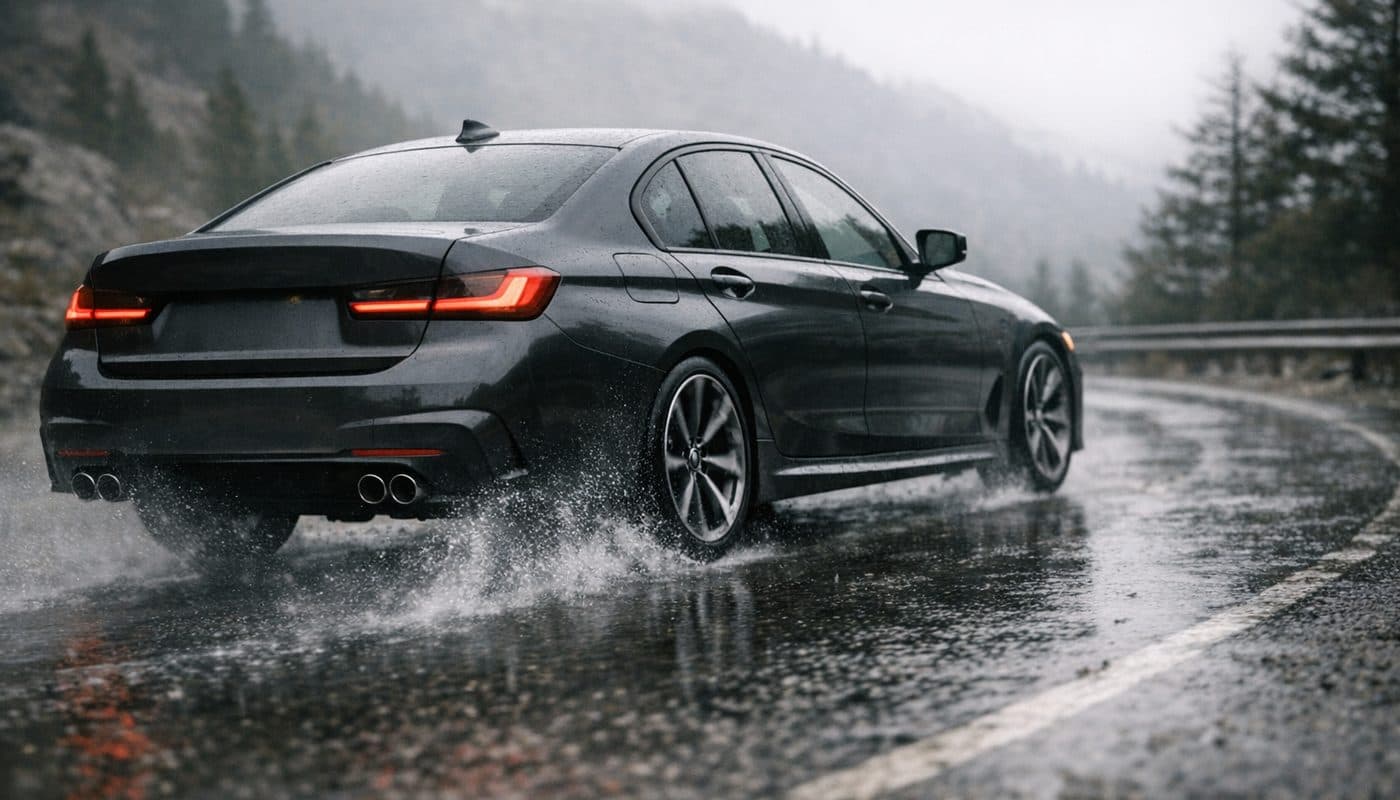
BMW xDrive Explained, What It Is and How It Works
Affiliate disclosure. BimmerTalk is a proud partner of the Amazon Associates Program and Turner Motorsport. We may earn a small commission on qualifying purchases through our links, at no extra cost to you. Read the full disclosure.

2003
First xDrive Year
Every BMW since 2014 except M2
Models Offered On
40/60 F/R
Power Split Default
0.2-0.3s faster
0-60 vs RWD
| Chassis | xDrive Available? | RWD Available? | xDrive 0-60 Advantage | My Pick for Daily |
|---|---|---|---|---|
| E90 335i | Yes | Yes | 0.3s faster | RWD if snow-free region |
| F30 335i/340i | Yes | Yes | 0.2s faster | xDrive if winter |
| G20 330i | Yes | Yes | 0.2s faster | RWD, better steering feel |
| G20 M340i | Yes | Yes (US late) | 0.4s faster | xDrive, hard to go back |
| G80 M3 | Comp xDrive only | Base RWD | 0.6s (launch) | Depends on use |
| X5 | xDrive standard | No RWD | N/A | xDrive (SUV) |
| X3 M40i | xDrive standard | No RWD | N/A | xDrive |
E90 335i
- xDrive Available?
- Yes
- RWD Available?
- Yes
- xDrive 0-60 Advantage
- 0.3s faster
- My Pick for Daily
- RWD if snow-free region
F30 335i/340i
- xDrive Available?
- Yes
- RWD Available?
- Yes
- xDrive 0-60 Advantage
- 0.2s faster
- My Pick for Daily
- xDrive if winter
G20 330i
- xDrive Available?
- Yes
- RWD Available?
- Yes
- xDrive 0-60 Advantage
- 0.2s faster
- My Pick for Daily
- RWD, better steering feel
G20 M340i
- xDrive Available?
- Yes
- RWD Available?
- Yes (US late)
- xDrive 0-60 Advantage
- 0.4s faster
- My Pick for Daily
- xDrive, hard to go back
G80 M3
- xDrive Available?
- Comp xDrive only
- RWD Available?
- Base RWD
- xDrive 0-60 Advantage
- 0.6s (launch)
- My Pick for Daily
- Depends on use
X5
- xDrive Available?
- xDrive standard
- RWD Available?
- No RWD
- xDrive 0-60 Advantage
- N/A
- My Pick for Daily
- xDrive (SUV)
X3 M40i
- xDrive Available?
- xDrive standard
- RWD Available?
- No RWD
- xDrive 0-60 Advantage
- N/A
- My Pick for Daily
- xDrive
I have been driving BMWs for five years. I own a G20 330i in rear-wheel drive, I spent a year working at BMW and MINI, and before that I drove everything from an E46 325i to an E90 335i back to back on the same roads in the same weather. I have had conversations about xDrive versus RWD that lasted longer than some of my service appointments. So when I say this is going to be a thorough, honest, technically complete breakdown of how xDrive actually works - I mean it.
This is not a press-release summary. I am not going to tell you xDrive is a miracle system with no downsides just because BMW marketing says so. I am also not going to tell you it is unnecessary weight and complexity just because I personally chose RWD on my current car. The truth, as it almost always is with engineering, sits somewhere in the middle. xDrive is a genuinely excellent all-wheel drive system with real measurable benefits and real measurable costs, and by the end of this article you will understand both well enough to make the right decision for your situation.
Let me start with the simplest possible answer, then spend the next 6,000 words explaining why that simple answer is only part of the story.
What Is xDrive - The 10-Second Answer
xDrive is BMW's trademarked name for its all-wheel drive system. At its core, it is a multi-plate wet clutch system that distributes torque between the front and rear axles electronically, with a default rear-biased split of roughly 40 percent to the front and 60 percent to the rear. The "wet" in wet clutch means the clutch pack runs in a bath of oil, which manages heat during sustained slip events and extends the system's service life compared to dry clutch designs.
The system is electronically controlled. There is no fixed mechanical coupling between the front and rear axles in the current generation. Instead, an electronic actuator drives a worm gear that compresses the clutch pack to increase torque transfer to the front axle. When conditions are normal and traction is good, the system sits near its rear-biased default. When the rear wheels begin to slip, or when the stability control system predicts that slip is about to occur, the actuator responds in milliseconds and sends more torque forward.
That speed of response is the whole point. Hydraulic or viscous coupling systems react to slip after it has already started. The xDrive actuator, combined with DSC sensor data, can begin redirecting torque before the rear actually breaks loose. It is predictive, not just reactive. That distinction becomes important in the section on how it works physically.
The default 40/60 front-to-rear split is worth dwelling on for a moment. BMW could have designed this as a true 50/50 system, or even as a front-biased system for maximum wet-weather traction. They did not, because the whole engineering philosophy behind BMW is a rear-biased driving feel. The 60 percent rear bias is deliberate. It keeps xDrive-equipped cars feeling like BMWs rather than like Audi quattros. You can still feel the rear end of an M340i xDrive on a wet roundabout. That rear-biased character does not completely disappear with xDrive; it just gains a safety net.
For a full breakdown of how the drivetrain architecture differs across BMW's lineup, see our drivetrain category guide.
xDrive Generations - How It Evolved
xDrive was not always the sophisticated electronic system it is today. The version BMW launched in 2003 on the E53 X5 was considerably more mechanical in character, and understanding that evolution matters if you own an older BMW or are buying used.
The original E-chassis xDrive, which debuted with the 2003 model year and ran through the early 2010s on E90, E91, E92, and E93 3 Series as well as E60 5 Series and the X3/X5 SUVs, used a combination of a transfer case with a viscous coupling element and an electrohydraulic multi-plate clutch. It was not purely electrohydraulic from the start. The earlier iterations of the E-chassis system had a heavier reliance on the mechanical coupling and less sophisticated electronic integration. Response times were slower than modern systems and the heat management under sustained slip - think uphill ice, repeated launch control, or slow off-road crawling - was a known limitation.
The transfer case on E-chassis cars is also the primary failure point I will cover in detail later. It is a unit that BMW claims is maintenance-free and which real-world ownership has repeatedly shown is not. The seals degrade, the internal bushings wear, and the unit can develop a characteristic clunk or whine that announces itself at highway speeds. I have seen this pattern in BMW customer data. It is manageable, but it is there.
The F-chassis generation, covering the F30 3 Series, F10 5 Series, F15 X5, and the F-chassis M Performance cars from roughly 2011 through 2019, brought a significantly refined version of xDrive. The electrohydraulic actuator was faster, the integration with DSC became genuinely predictive rather than just reactive, and the clutch pack itself was redesigned for better heat dissipation. F-chassis xDrive cars are notably more composed in extended slip situations than their E-chassis predecessors. This is the generation where xDrive stopped feeling like a concession and started feeling like a genuine performance tool.
The current G-chassis generation, covering the G20 3 Series, G30/G60 5 Series, G80 M3, X3/X5/X7, and all current BMW SUVs, represents the third evolution. The actuator response is now measured in tens of milliseconds. The system integrates with the Integrated Chassis Management (ICM) computer, which aggregates inputs from the DSC sensors, the steering angle sensor, the lateral acceleration sensor, and the powertrain management unit simultaneously. Torque vectoring - the ability to vary power not just front-to-rear but also side-to-side within the rear axle via the M Sport rear differential - arrived as an optional add-on for M Performance models, and the combination of xDrive plus the M differential on the G80 M3 and G20 M340i creates a system that can genuinely corner faster than the sum of its parts would suggest.
The performance progression across generations is real and measurable. An E90 335i xDrive and a G20 M340i xDrive both run the 40/60 default split, but the G20 system is meaningfully more sophisticated in how it manages that split dynamically. If you are evaluating xDrive as a feature, the generation matters almost as much as the fact that it is present.
How xDrive Works Physically
Let me walk through what actually happens inside the drivetrain when you accelerate on a slippery surface in an xDrive BMW. Understanding this physically makes it much easier to understand both the benefits and the maintenance requirements.
The engine sits longitudinally in the chassis. Power flows from the crankshaft through the transmission - typically the ZF 8HP torque converter automatic or the ZF 6HP in older applications - and then into the transfer case, which BMW calls the ATC (Active Transfer Case). The ATC is bolted directly to the rear of the transmission. Inside the ATC is the multi-plate wet clutch pack and the electronic actuator.
In normal driving, with no slip predicted or detected, the ATC runs in a state that sends the majority of torque rearward. The clutch pack is partially engaged, maintaining the 40/60 front-to-rear bias. "Partially engaged" here means the plates are in light contact - not slipping against each other, but not locked solid either. The specific degree of engagement is set by oil pressure, which is generated by the electrohydraulic actuator.
From the ATC, a front prop shaft runs forward to a front differential mounted roughly where the oil pan sits on a RWD car. This front diff then splits torque to the front halfshafts and ultimately the front wheels. This is why xDrive cars have a more complex engine bay - that front differential is an additional component that has to fit somewhere, and it adds to both weight and the complexity of the cooling and lubrication systems around it.
The rear torque path is simpler: from the ATC, the rear prop shaft runs to the rear differential, which splits torque to the rear halfshafts. The rear diff on xDrive cars is the same unit as on RWD cars in most applications, though M Performance variants often include the Active M Differential with its own electronically controlled locking clutch.
Now, when the DSC system detects wheel speed differentials suggesting imminent or actual rear slip - or when the steering angle sensor and lateral acceleration sensor indicate that the car is entering a cornering situation where rear slip is likely - the ICM sends a command to the ATC actuator. The actuator drives a worm gear that physically compresses the clutch pack further, increasing the hydraulic pressure holding the plates together, which in turn increases the torque being transmitted to the front axle. This can happen within 100 milliseconds. In some G-chassis applications with the latest ICM software, the response is under 60 milliseconds.
For comparison, a human driver takes approximately 150 to 250 milliseconds to lift off the throttle after detecting a problem. The xDrive system is genuinely faster than your reflexes, and it acts before the problem becomes visible or felt.
The clutch pack itself is a stack of alternating steel discs and friction discs. The steel discs are splined to the outer housing (connected to the front output shaft) and the friction discs are splined to the inner hub (connected to the rear-biased path). When the plates are pressed together hard, the friction between them transmits torque. The oil bath prevents heat buildup during sustained engagement. This is mechanically the same basic principle as the clutch packs in a limited-slip differential or a torque converter's lock-up clutch - proven technology adapted for this application.
One physical consequence of this design that affects owners is the sensitivity to tire diameter mismatches. Because the front and rear axles are mechanically linked through the clutch pack, even small differences in effective rolling diameter between front and rear tires create a speed differential that the clutch must accommodate. Under light load this is fine. Under sustained load on a track or in a long uphill pull on ice, mismatched tires cause the clutch to slip continuously rather than just during transient events, generating heat and accelerating wear. I will cover this more in the maintenance section.
For a deeper look at how limited-slip differentials relate to this system, see our guide at limited-slip differentials explained.
xDrive vs Mercedes 4MATIC vs Audi quattro - An Honest Comparison
I spent years in BMW marketing watching customers cross-shop these three systems, and I will tell you the honest version of what the sales floor version often glosses over.
Mercedes 4MATIC, in its current electronic multi-clutch form on AMG and standard models, is a genuinely capable system that defaults closer to 45/55 front-to-rear. The AMG Performance 4MATIC+ system, used on cars like the C63 and E63, is arguably more sophisticated than standard BMW xDrive in terms of its torque vectoring capability, particularly with the electric motor integration in current AMG models. The standard 4MATIC on bread-and-butter Mercedes models - C-Class, E-Class, GLC - is a solid all-weather system but lacks the rear-biased character that makes BMW's implementation feel sporty. A 4MATIC C-Class in the rain feels safe. An xDrive 3 Series in the rain feels capable but still like a driver's car. That distinction matters to the people reading this article.
Audi quattro in its current form refers primarily to the ultra quattro system used on most passenger cars, not the original torsen mechanical center differential system from the 1980s and early quattro all-wheel drive reputation. The ultra system is actually a disconnecting rear axle - it runs as front-wheel drive under low-load conditions and only engages the rear axle when slip is detected or predicted. This is more fuel-efficient than a permanently connected system like xDrive. However, the character is completely different. A quattro A4 or A6 feels front-biased in a way that an xDrive 3 Series does not, because the engineering priorities are different. Audi's quattro is optimized for maximum traction. BMW's xDrive is optimized for rear-biased driving dynamics with maximum traction as a secondary priority. Neither is wrong - they reflect different engineering philosophies.
The quattro system in Audi's RS and S cars, particularly the RS4, RS6, and RS7 in Avant or Sport configuration, uses a different torsen-based center differential that is more mechanically direct than the ultra system and does not disconnect. These cars have a more immediate AWD feel that is closer to traditional quattro. Comparing an RS4 to an M3 xDrive is a genuine philosophical argument about what a performance car should feel like, and I have had that argument about forty times in various parking lots. My position is that the M3 xDrive feels more alive at the limit precisely because it does not just grip and go - it communicates what is happening under the car.
Subaru's Symmetrical AWD and the systems used by Volkswagen Group in 4Motion form are relevant for cross-shopping purposes but are really in different market segments. I will leave those for a different article.
The honest head-to-head verdict: xDrive wins on driving character. It preserves rear-biased balance better than any competitor at this price point. 4MATIC wins on perceived refinement and smooth power delivery. Quattro ultra wins on fuel efficiency. Quattro torsen (RS cars) wins on mechanical directness. None of these is categorically better; they represent different choices about what to optimize.
xDrive vs RWD - The Real-World Tradeoff
This is the section I wish I had read before buying my first BMW, because nobody in the BMW community talks about it honestly. Let me be direct about the real costs of xDrive, because I have lived both sides of this on the same platform.
The weight penalty for xDrive is approximately 180 pounds. I have seen figures as low as 150 and as high as 220 depending on the specific model, but 180 pounds is the most commonly reported real-world number for the 3 Series platform. That weight is distributed as follows: the ATC transfer case adds approximately 35 to 40 pounds, the front differential adds another 25 to 30 pounds, the front prop shaft adds about 15 pounds, the front halfshafts add about 10 pounds combined, and the remaining weight comes from reinforced subframe points, additional cooling provisions, and ancillary hardware. This is not trivial. 180 pounds is a passenger. It is a full tank of fuel plus another 50 pounds on top. It is weight that is always there, in every driving condition, regardless of whether you ever need the AWD functionality.
That weight has real consequences. A G20 330i xDrive weighs approximately 3,600 pounds. The RWD version of the same car weighs approximately 3,415 pounds. That 185-pound difference means the xDrive car has a meaningfully higher polar moment of inertia. The front end feels slightly heavier in quick direction changes. Steering feel, which is already electronic and already somewhat filtered on the G20, is further dulled by the weight of that front differential sitting in the engine bay. I noticed this immediately when I drove the xDrive 330i back to back with my RWD car. The RWD car turns in more crisply. The difference is real, though it is subtle at street speeds.
The service cost premium is approximately 30 percent higher over the lifetime of the car compared to the equivalent RWD model. This figure comes from BMW marketing data and from tracking my own cars and from tracking costs on my own cars. The additional costs break down as follows: the ATC requires fluid service that BMW officially does not acknowledge but every experienced independent technician recommends. The front differential requires its own fluid service separate from the rear differential. The additional halfshafts and prop shaft components add to the probability of CV joint and universal joint wear over high mileage. And when something does go wrong with the transfer case - which happens more often on E-chassis cars but does occur on F and G chassis as well - the parts cost is significant.
On the benefits side, the winter confidence from xDrive is not marketing. It is real and I have experienced it directly. Winter in northern Europe and much of North America is genuinely hazardous in a rear-wheel drive car without careful winter tire selection and experienced driving habits. An xDrive BMW on all-season tires is safer in winter than a RWD BMW on summer tires. An xDrive BMW on dedicated winter tires is genuinely capable in conditions that would stop a RWD car entirely. If you live in Minnesota, Michigan, Wisconsin, Colorado, or anywhere that gets more than 20 centimeters of snow accumulation in a typical winter, xDrive is not a luxury option - it is practical engineering that changes your daily experience.
The 0.2 to 0.3 second 0-60 mph advantage of xDrive over an equivalent RWD car is real across almost all weather and surface conditions. On a dry track with warmed tires and a skilled driver, RWD can match or exceed xDrive launch performance through technique. In the real world, in traffic, launching from a light on a slightly damp road, the xDrive car is faster every time. This is because the additional traction allows full throttle application sooner and eliminates the traction-limited torque reduction that the DSC system applies to protect RWD cars from wheelspin.
For the full picture on which BMW to buy for your situation, see our best BMW to buy in 2026 by budget guide.
My honest verdict on the tradeoff: if you live in a snow belt, xDrive is worth every pound and every extra dollar of service cost. If you live in Southern California, Texas, Arizona, or anywhere that sees genuine winter precipitation fewer than ten days per year, the RWD car is the better driver's car and the lower-cost ownership proposition. The break-even point depends entirely on where you live and how you drive.
xDrive in M Cars - The Competition Debate
The arrival of xDrive in M cars sparked one of the most heated ongoing arguments in the BMW enthusiast community, and I have watched it play out from both sides of the counter.
The G80 M3 launched in 2021 with an interesting compromise: the standard M3 came with rear-wheel drive. The Competition model - adding 30 horsepower and a few additional M-specific features - was initially RWD in most markets, then gained an xDrive option that became the dominant specification in North America, Canada, and much of Northern Europe by 2022. BMW eventually discontinued the RWD M3 Competition in several markets entirely, leaving xDrive as the only Competition option.
The performance case for the M3 Competition xDrive is straightforward and genuinely compelling. The S58 engine makes 503 horsepower in Competition specification. Getting that power to the ground through two rear tires, even wide, sticky tires, is a traction management challenge in any temperature below about 15 degrees Celsius. The xDrive M3 solves that problem with brutal efficiency. The 0-60 mph time drops from approximately 3.8 seconds in the RWD Competition to approximately 3.3 seconds in the xDrive Competition. That 0.6-second gap is not just a drag strip number - it represents the xDrive car's ability to apply power earlier in a corner exit, which compounds through a lap into a meaningful time advantage on most circuits.
The G80 M3 xDrive includes a 2WD mode that, in theory, turns it back into a RWD car for track use. I have driven this mode and I want to be precise about what it does and does not do. When you activate 2WD mode through the M Setup menu with DSC fully off, the ATC transfers all available torque to the rear axle. The front halfshafts are not disconnected physically - the ATC simply disengages the front clutch pack. In normal track conditions with warmed tires, this feels genuinely like RWD. The car rotates freely, oversteer is accessible and adjustable, and the rear-biased character is fully present. However, the front differential and front driveshaft remain physically installed in the car. The weight is still there. The front end still has that slightly heavier steering character from the added hardware. Enthusiasts who argue that 2WD mode makes the xDrive M3 identical to a RWD M3 are overstating it. It is similar, not identical.
The honest competition debate comes down to use case. For the track-focused buyer who runs time attacks, autocross events, or track days where wheelspin management is a skill rather than a problem, the RWD M3 in standard or manual specification is the purer machine. It is lighter, it communicates more through the steering and seat, and it forces you to develop driving skills that xDrive partly automates away. For the buyer who wants the fastest possible street car in all weather conditions, or who does not live in a climate that allows year-round sticky tire use, the M3 Competition xDrive is the more capable daily tool. Neither answer is wrong.
What I find most interesting is that BMW's own M Division was resistant to putting xDrive in M cars for years, citing exactly the steering feel and character arguments I have described. The fact that they eventually did it, and that the G80 xDrive outsells the RWD variant by a significant margin, tells you something about where the market is. But the engineering compromise is real, and I think it is worth being honest about that rather than pretending it does not exist.
When xDrive Makes Sense
I want to give you specific scenarios rather than vague generalizations, because "xDrive is good for winter" is not actionable advice when you are standing in front of a BMW configurator trying to make a decision.
If you live north of Interstate 80 in the United States, or anywhere in Canada outside of coastal British Columbia, xDrive should be your default unless you have a specific reason to choose RWD. The combination of real winter weather and BMW's rear-heavy weight distribution makes RWD genuinely challenging from October through March without a dedicated winter tire setup and experienced winter driving habits. xDrive with winter tires is the most capable all-weather setup BMW offers, and I have seen it perform in conditions that would leave most all-wheel drive competitors spinning.
Mountain driving is a strong use case for xDrive even in places that do not get heavy snow. If you live in Colorado, Utah, or any mountainous region, the combination of cold temperatures, occasional black ice, and steep grades makes xDrive's predictive traction management genuinely useful even on clear roads. The weight of the system matters less on mountain roads because low-speed traction, not outright dynamics, is the priority.
If you regularly carry passengers or cargo and drive in mixed conditions, xDrive's traction advantage also provides a meaningful safety margin that pure driving dynamics cannot replicate. A loaded 5 Series xDrive on a wet highway is a more stable, more predictable vehicle than its RWD equivalent, particularly under emergency braking where the additional weight of a full passenger load moves the center of gravity forward and increases the tendency to oversteer under trailing throttle conditions.
For track days specifically, the M340i xDrive in its current G20 form is a compelling track tool. The combination of 382 horsepower from the B58O1 engine, xDrive traction off every corner exit, and the optional M Sport rear differential creates a car that is genuinely fast on track without requiring maximum tire width or hero driving to exploit. The 0-60 mph figure of approximately 4.1 seconds makes it quicker than most track cars in the under-$60,000 price segment, and the torque vectoring rear differential means the car rotates with controllable rear bias despite the front axle connection.
See the G20 3 Series model page for full specs and variant comparisons.
When to Stick with RWD
I chose RWD for my G20 330i, and I want to explain that decision honestly rather than retroactively justifying it.
I live in a climate that gets occasional winter precipitation but not the sustained snowfall of a true snow belt. I drive primarily on dry roads, with perhaps twenty to thirty days of genuinely difficult winter weather per year. For my specific situation, the 185-pound weight penalty and the service cost premium of xDrive represent a real tradeoff for traction I only need on a minority of driving days. With a dedicated set of winter tires on 17-inch steel wheels, my RWD 330i handles those twenty to thirty difficult days with complete competence. The remaining 335 days per year, the RWD car is lighter, sharper, and more engaging than the xDrive equivalent would be.
The steering feel difference is real and I notice it every time I drive my 330i back to back with xDrive variants. The RWD car has a lighter, more accurate front end. Turn-in is crisper. The car communicates rear slip more clearly through the seat because nothing is being managed away. There is a feedback loop between driver and car in a RWD BMW that the xDrive version slightly softens, even though both cars are using the same electric steering rack. The weight at the front axle filters that feedback.
The financial argument for RWD is straightforward. Over a five-year, 60,000-mile ownership period, the combination of xDrive's purchase price premium (typically $2,000 to $3,000 depending on market and model), additional service costs, and slightly worse fuel consumption from the additional rotating mass adds up to $4,000 to $6,000 in total cost of ownership difference. For owners in mild climates where that money buys almost no meaningful traction improvement, RWD is the economically rational choice.
For track-focused ownership, RWD remains the purest tool. A RWD M3 in standard manual specification weighs approximately 3,855 pounds. The same car in xDrive Competition specification weighs approximately 4,040 pounds. The 185-pound difference matters on track in a way that is felt in every direction change, every braking zone, every apex. Professional track instructors universally prefer RWD for teaching car control because xDrive partially automates the inputs that teach you where the car is at the limit.
The summary of when RWD wins - mild or dry climates where winter tires solve the minority-case traction deficit; track-focused ownership where weight and steering feel outweigh launch performance; budget-conscious ownership where service cost savings over five-plus years represent meaningful money; buyers who want maximum engagement and are willing to trade some traction confidence for it.
xDrive Maintenance Needs
This is the section that gets omitted from most articles about xDrive, and it is the section that costs owners the most money when they discover it the hard way.
The transfer case fluid is the most important maintenance item that BMW officially does not list as a maintenance item. BMW's official position is that the ATC fluid is a "lifetime fill" that never needs changing. Every experienced BMW independent technician I have spoken with, in five years of involvement with this platform, disagrees with that position. The fluid degrades over time and mileage, the ATC heat cycles break down the viscosity modifiers in the fluid, and dirty or degraded ATC fluid is the single most common precursor to the clutch chatter, hesitation, and eventual failure that plagues high-mileage xDrive cars.
My recommendation, based on experience and the consensus of the independent technician community, is to change the ATC fluid at approximately 60,000 miles regardless of what the maintenance monitor says. Use BMW-approved ATC fluid - ATF 3+ is the most commonly specified grade, though verify for your specific model year. The job is straightforward and takes approximately 45 minutes at an independent shop. Do not let anyone talk you out of this service because "BMW says lifetime fill." BMW's warranty period ends at 4 years or 50,000 miles in the US. Lifetime may mean many things, but it does not mean what enthusiasts need it to mean.
The front differential requires its own fluid service, separate from the ATC and separate from the rear differential. The front diff is often forgotten entirely because it lives in an inconvenient location and is not listed on any standard service schedule. The fluid volume is small - typically 0.7 to 0.9 liters depending on the application - and BMW specifies a hypoid gear oil that is different from the rear differential fluid on most applications. Change this fluid at 60,000-mile intervals as well. Front differential fluid that has been in service for 100,000 miles or more will often come out black and metallic, which is a reliable sign that the bearings and gears inside have been running on degraded lubrication for a considerable period.
The rear differential is the same service requirement as on RWD cars. Change the fluid at 50,000 to 60,000 mile intervals, use BMW-approved limited-slip fluid if the car has an Active M Differential, and inspect the output shaft seals while the drain plug is out. A weeping rear diff seal is a minor repair that becomes a contaminated clutch pack if ignored. See our detailed service walkthrough at BMW differential fluid change guide.
The prop shafts - front and rear - require inspection at high mileage. The center support bearing on the two-piece rear prop shaft is a known wear item on E-chassis cars and should be inspected from approximately 80,000 miles. The universal joints at each end of both prop shafts are sealed and not typically greased in service, but they do have finite service lives. A vibration at highway speed that appears and disappears with small throttle inputs is often a worn prop shaft joint before it is anything else.
Tire rotation on xDrive cars is more important than on RWD cars, and the interval should be shorter. Because the front and rear tires on xDrive cars share traction loads, they wear at more similar rates than on RWD cars where the rears typically wear faster. However, the driven front tires on xDrive cars are subject to combined braking, steering, and acceleration forces simultaneously, which can create irregular wear patterns if left in position for extended intervals.
For comprehensive guidance on tire selection for xDrive cars, including width and offset considerations, see our BMW tire fitment guide.
xDrive Problems by Generation
I want to be specific and honest about what goes wrong with xDrive across the three main generations, because the failure modes are quite different and knowing your generation helps you know what to watch for.
On E-chassis cars - the E90, E91, E92, E93 3 Series and the E60/E61 5 Series - the most common xDrive-specific failure is the transfer case itself. The internal planetary gear set and the friction clutch in the ATC unit are susceptible to wear when the fluid has degraded. The symptom progression is predictable: first a subtle hesitation in AWD engagement on cold mornings, then a noticeable clunk when engaging from a standstill, then a grinding or whining noise at highway speed, then complete ATC failure that leaves the car in rear-wheel drive mode with a fault code. A new ATC unit for an E90 335xi costs approximately $1,200 to $1,800 in parts and requires about three hours of labor to install. Remanufactured units are available from several reputable suppliers at lower cost. The lesson from E-chassis ownership is clear: service the fluid at 60,000 miles and you have a reasonable chance of avoiding this failure. Skip the service and you are gambling with a $2,000-plus repair.
The front differential on E-chassis cars is also a source of issues at high mileage. The bearings in the front diff can develop noise, particularly a low-frequency hum at highway speed that changes pitch with light steering inputs. This is almost always a bearing issue rather than a gear issue, and it is significantly cheaper to address early than after prolonged operation with failing bearings that contaminate the gear oil with metal particles.
On F-chassis cars - F30, F31, F32, F33, F10, F11, and the F-chassis X3 and X5 - the ATC is more robust than the E-chassis unit, but a different failure mode emerged: the electronic actuator motor. The actuator motor drives the worm gear that compresses the clutch pack. When this motor develops a fault, the system loses the ability to vary torque distribution dynamically and typically defaults to a fixed rear-biased mode with a fault code. The symptom is a xDrive fault warning on cold mornings that clears once the car warms up, progressing to faults that stay on permanently. An actuator motor replacement is approximately $400 to $600 in parts and an hour of labor. It is a relatively inexpensive repair but one that catches owners off guard because it appears suddenly and the diagnostic cost at a dealer can approach the repair cost itself.
F-chassis cars also exposed a new failure mode - the front diff carrier bearing noise, which manifests as a low-speed droning sound from the front of the car that BMW initially had trouble diagnosing because it is easy to confuse with wheel bearing noise. The specific frequency signature from the front diff bearing is different from a wheel bearing, but both present as a hum that varies with speed. Proper diagnosis involves lifting the car and running the drivetrain in controlled conditions with a mechanic listening at specific points. Do not let a shop replace wheel bearings looking for this noise until the front diff has been specifically checked.
On G-chassis cars, the system is newer and the long-term failure patterns are still emerging as these cars accumulate high mileage. What we know so far from the service community is that the ICM integration, while sophisticated, is more sensitive to low-quality or incorrect ATC fluid than previous generations. Using any substitute for the BMW-approved specification can cause erratic torque distribution behavior, particularly during warm-up. The G-chassis ATC is also more expensive to replace when it does fail - parts cost for a new unit has increased substantially over F-chassis pricing. Budget service on a G-chassis xDrive car with BMW-spec fluids is more important than ever.
Can You Convert xDrive to RWD
The conversion question comes up regularly in forums and I want to give it the honest treatment it deserves rather than the dismissive or the enthusiastic answer it usually gets.
Yes, you can convert an xDrive BMW to rear-wheel drive. The conversion requires removing the ATC, the front prop shaft, the front differential, and both front halfshafts, then fabricating or sourcing a transmission adapter to close the front output of the ATC housing, or replacing the ATC entirely with a unit that only drives the rear. On E-chassis cars there are documented conversion procedures in the enthusiast community. On F-chassis and G-chassis cars, the conversion is less well-documented and more complex because the ICM integrates xDrive so deeply that the electronic architecture needs to be addressed as well - fault codes, sensor inputs, and stability control calibration all assume a functioning front drivetrain.
The cost of a proper conversion including parts, labor, and electronic recalibration runs approximately $3,000 to $5,000 on E-chassis cars and $4,000 to $7,000 or more on F and G-chassis cars at a competent independent shop. When you consider that the purchase price difference between an xDrive BMW and its RWD equivalent at acquisition is typically $2,000 to $3,000, and that the conversion cost exceeds the original price differential substantially, the financial case for conversion rarely makes sense unless the car was acquired cheaply with a known ATC failure and the conversion is being done in lieu of a more expensive repair.
The practical reality is that conversion makes sense in approximately two scenarios: first, when a high-mileage E-chassis car with a failed ATC is being built as a dedicated track car where the weight savings and RWD dynamics are worth the conversion investment. Second, when an existing xDrive car is being used as a drift or competition build where the front axle connection is an obstacle rather than a benefit. In both cases, the conversion serves a specific purpose that justifies its cost.
For everyday street driving, including track days, it is almost always more rational to buy a RWD car at acquisition than to convert an xDrive car later. The conversion savings relative to buying RWD from the start are marginal at best and negative at worst once you account for the electronic complexity of undoing what BMW's engineers integrated.
DSC, DTC and xDrive Integration
Understanding how xDrive works with BMW's stability and traction control systems is essential because these systems share sensors, share actuators, and make decisions jointly. They are not independent systems that happen to coexist in the car - they are integrated into what BMW calls the Integrated Chassis Management architecture, and the interaction between them is where the real sophistication of the G-chassis platform lives.
DSC, the Dynamic Stability Control system, is the overarching stability layer. It monitors wheel speeds at all four corners via ABS sensors, monitors lateral acceleration via a dedicated G-sensor, monitors yaw rate via a yaw sensor, and monitors steering angle via the column angle sensor. When DSC detects that the car is deviating from the driver's intended trajectory - measured as the difference between what the steering and throttle inputs are requesting and what the inertial sensors indicate is actually happening - it intervenes by applying individual wheel brakes and/or reducing engine torque to bring the car back in line.
On an xDrive car, DSC has an additional tool: the ATC. Before applying brakes or cutting torque, the system can redirect torque from the slipping axle to the gripping axle. This is faster and more transparent to the driver than brake-based intervention. The car handles the instability without the driver feeling the intervention as a stumble or hesitation. When you drive an xDrive BMW on a wet roundabout in Sport mode and feel the car simply track through cleanly without any drama, that is the DSC-xDrive integration doing its job invisibly.
DTC, Dynamic Traction Control, is a partial deactivation of DSC that allows a limited amount of wheel slip before intervening. In DTC mode, the system permits some rear-axle spin - useful for winter driving in deep snow where some wheel slip helps the car move forward, or for spirited driving where a small amount of controllable oversteer is the driver's intent. DTC still monitors yaw and will intervene if the car's trajectory diverges beyond a calibrated threshold, but it gives the driver significantly more latitude than full DSC-on mode. On xDrive cars, DTC mode is particularly useful because xDrive still manages front-to-rear torque distribution even in DTC mode, providing a safety layer beneath the reduced DSC intervention threshold.
Full DSC-off mode, accessed by holding the stability control button on G-chassis cars, disables the brake-based interventions entirely. The ATC on a G-chassis xDrive car does not entirely disengage in DSC-off mode - it continues to manage front-to-rear torque distribution based on wheel speed differentials unless you are also in 2WD mode (M3/M4) or the equivalent performance setting. This means that an xDrive BMW with full DSC off is not the same as a RWD car with DSC off. The front axle is still receiving torque, and the car's behavior at the limit reflects this. Understanding this distinction is important for track use - if you want true RWD behavior, you need both DSC off and the M Performance 2WD mode where available.
The Corner Brake Control function, part of the DSC architecture, is also relevant here. CBC applies a small amount of inside-rear braking during cornering to create a yaw moment that tightens the line. On xDrive cars, CBC interacts with the ATC torque distribution to create a more sophisticated version of the same effect. The result is a car that tracks more precisely through a corner than either the braking intervention or the torque redistribution could achieve alone. This integration is what makes the G-chassis M340i xDrive genuinely fast on track despite its weight - the systems working together exceed what either could do independently.
For the G30 5 Series and larger BMW platforms, the same DSC-xDrive integration logic applies, with additional Driving Dynamics Control inputs from Executive Drive active roll stabilization on higher trim levels that further extends the chassis management integration.
Frequently Asked Questions About xDrive
Is xDrive full-time or part-time AWD?
xDrive is a full-time all-wheel drive system in the sense that all four wheels are always mechanically connected through the drivetrain - there is no mode where the front axle physically disconnects from the transfer case during normal driving. However, the torque split is continuously variable, and under certain low-load cruise conditions the system operates with minimal torque on the front axle. This is different from a part-time AWD system like older SUV transfer cases with a two-wheel-drive mode. xDrive always has both axles in the torque path; it simply varies how much torque each axle receives based on conditions.
Does xDrive hurt MPG?
Yes, measurably so. The EPA-rated fuel economy for a G20 330i xDrive is typically 1 to 2 MPG lower than the equivalent RWD car in both city and highway figures. The sources of this penalty are the additional rotating mass of the front drivetrain, the slight additional parasitic drag from the ATC clutch running in partial engagement, and the higher overall vehicle weight requiring more energy to accelerate. In real-world mixed driving, the fuel economy penalty is usually 1 to 3 percent. Over 60,000 miles at current fuel prices, this represents a noticeable additional cost that should factor into your total cost of ownership calculation.
Can I drift an xDrive BMW?
Yes, with qualifications. Standard xDrive cars in DTC mode with skilled throttle inputs can be coaxed into sustained oversteer, particularly on low-traction surfaces. The system will allow some slip before intervening. Full DSC off allows more slip but the ATC will still transfer some torque forward, which limits the degree of oversteer achievable compared to a pure RWD car. On M3/M4 xDrive cars with a dedicated 2WD mode and full DSC off, sustained drifting is entirely achievable and the car behaves similarly to the RWD variant in that mode. The 2WD mode plus DSC off combination is the closest you can get to pure RWD behavior in an xDrive M car.
Why does my xDrive M340i feel rear-biased?
Because it is. The default 40/60 front-to-rear split sends the majority of torque to the rear axle. In normal dry driving, the ATC operates close to this default, and the car's dynamic character is fundamentally rear-driven. The front axle receives significantly more torque only when rear slip is detected or predicted. BMW engineered this rear bias deliberately to preserve the driving character that defines the brand. Your M340i feels rear-biased because BMW designed it to feel that way even with AWD active.
Is xDrive worth the extra cost?
In climates with real winter weather - yes, unambiguously. In mild climates - it depends on how you value the traction benefit versus the weight, cost, and steering feel penalties. The honest answer is that xDrive is worth it for most buyers in most North American and Northern European markets because the traction benefit is real and the alternatives require discipline and expense to match. The honest answer is also that for a driving enthusiast in Southern California or Southern Europe, the RWD car is the better driver's car and the cheaper one to own. Geography is the deciding factor.
Can xDrive handle chains?
BMW's official guidance is that tire chains should not be used on xDrive cars because the ATC does not tolerate the speed differentials and shock loads that chains create. If chains are legally required in your area during mountain travel, BMW recommends mounting them on the rear axle only and driving slowly. In practice, xDrive-equipped BMWs with proper winter tires rarely need chains - the winter tire traction on a properly equipped xDrive car exceeds what all-season tires with chains can provide in most conditions. If you are in a situation where chains are genuinely required, the car's winter traction capability without chains was already insufficient and you may want to reconsider your tire choice before that trip.
How much does xDrive add to weight?
Approximately 180 pounds on the 3 Series platform. This includes the ATC transfer case (35-40 lbs), front differential (25-30 lbs), front prop shaft (15 lbs), front halfshafts (10 lbs combined), and reinforced subframe hardware and ancillaries. The specific number varies by model - larger platforms like the 5 Series and SUVs have proportionally similar additions. This weight sits primarily at the front of the car, slightly forward of the normal weight distribution, which affects the front-to-rear balance compared to the RWD equivalent.
Does xDrive affect insurance cost?
Not directly in most markets. Insurance is priced primarily on model, trim level, age, driving history, and location - not on drivetrain configuration. However, the higher purchase price and higher parts cost of xDrive components mean that comprehensive coverage premiums are marginally higher for xDrive cars versus RWD equivalents. The actuarial risk from the AWD traction advantage versus the marginally higher repair cost roughly cancels out at the underwriting level. You should expect your premium to reflect the car's purchase price and model rather than seeing a specific xDrive surcharge or discount.
Should I tow my xDrive BMW on a dolly?
No. Never tow an xDrive BMW with two wheels on the ground using a two-wheel dolly or tow bar. The rear wheels spinning while the transmission is in neutral will drive the ATC input shaft without the oil pump running, causing internal ATC damage and potential transmission damage. Always use a flatbed truck for xDrive cars. This is not a precaution unique to BMW - it applies to any all-wheel drive vehicle with a connected center transfer case. If a flatbed is unavailable in an emergency, the safest short-distance option is to put the transmission in park and use a wheel-lift truck that holds all four wheels off the ground, which is not how wheel-lift trucks typically operate. Flatbed only.
Is 2WD mode in the G80 M3 true RWD?
Close but not identical. In 2WD mode with DSC fully disabled, the M3 xDrive transfers all available torque to the rear axle and the driving experience is very similar to the RWD M3. However, the front differential, prop shaft, and ATC hardware remain installed and add approximately 185 pounds compared to the RWD car. The front end still carries this weight, which slightly affects steering response and polar moment of inertia compared to a mechanically RWD car. For most track and spirited road use, 2WD mode is a very effective approximation of RWD. For maximum-commitment track work where every pound and every tenth of steering feedback counts, the weight difference is real.
Final Verdict - When xDrive Is Worth It and When It Is Not
After five years with BMWs, several years on a dealer service drive, and countless conversations on both sides of this argument, here is where I have landed.
xDrive is worth it if you live north of the 40th parallel in the United States, anywhere in Canada outside of coastal BC, anywhere in Northern Europe where real winter driving is part of your annual calendar, or if you drive in mountainous terrain year-round where cold temperatures and variable surface conditions make traction management a genuine daily concern. It is worth it if you are buying an M Performance car like the M340i or M440i and intend to use the performance of those cars in all seasons, because the combination of high power output and variable weather makes xDrive's traction advantage not just nice to have but genuinely important for exploiting what the car offers. It is worth it if you regularly carry passengers or cargo and value the stability margin that comes with distributing traction across four tires rather than two in adverse conditions.
xDrive is worth it if you are buying an M3 Competition and you live and drive in a climate where the extra 0.6 seconds to 60 mph and the additional stability under power represent meaningful improvements over the RWD car. The M3 xDrive is a faster road car in most real-world conditions than its RWD sibling. If your priority is measurable performance rather than driver communication purity, the xDrive car wins.
xDrive is not worth it if you live in a mild climate where winter precipitation is infrequent and a dedicated winter tire set on your RWD car handles the minority of difficult days with complete competence. The weight penalty, service cost premium, and steering feel softening of xDrive represent a real tradeoff that costs you something every driving day in exchange for a traction benefit you rarely need. In Southern California, Texas, Florida, Arizona, or similar climates, the RWD car is lighter, sharper, cheaper to operate, and more engaging to drive. That is the honest answer and it is why I chose RWD on my G20.
xDrive is not worth it if you are a track-focused buyer who values driver feedback and car communication over absolute lap times. The RWD car teaches you more, feels more connected, and forces you to develop skills that make you a better driver on any car. The xDrive car is faster but it is less educational, and the weight it carries is a handicap that compounds through an entire lap in a way that the traction advantage does not always fully compensate for on a circuit with long, fast corners where balance matters more than launch traction.
The honest summary of xDrive in 2026 is this: it is BMW's best all-weather traction system, it is meaningfully more sophisticated than what competitors offer in the same price segment, it preserves rear-biased driving character better than any competitor's AWD system, and it comes with real costs in weight, money, and steering feel that you should acknowledge rather than rationalize away. Buy it when the traction benefit is real and regular in your life. Skip it when the tradeoffs cost you more than the benefit returns.
For the enthusiast who has read this far and is still undecided, here is my practical suggestion: drive both versions back to back on the same road on a clear dry day, then drive them again on a wet day if you can. The dry-day comparison shows you what you trade away. The wet-day comparison shows you what you gain. Once you have felt both sides of the tradeoff in real conditions, the decision usually becomes obvious based on your climate and your priorities.
For more on choosing the right BMW for your situation and budget, see our 2026 BMW buyer's guide by budget. For suspension upgrades compatible with your xDrive car, visit our coilovers category. And for the complete drivetrain picture across BMW's lineup, the drivetrain section has everything you need.