BMW Oil Change Interval - How Often You Should Really Do It
Affiliate disclosure. BimmerTalk is a proud partner of the Amazon Associates Program and Turner Motorsport. We may earn a small commission on qualifying purchases through our links, at no extra cost to you. Read the full disclosure.

I've had this argument in my driveway more times than I can count. Neighbor with a G05 X5 pulls up, iDrive says 9,200 miles left on the oil service, and he asks why I'm changing mine at half that. Short answer - the little wrench icon on your cluster is guessing. It's a smart guess, built from a lot of BMW engineering data, but it's still a guess, and it's not guessing in your engine's favor the way you think it is.
I've been wrenching on these things for 15 years, spent a year on the other side of the counter at a BMW and MINI dealer, and I currently daily a 2022 G20 330i with a B48 under the hood. I've watched Condition Based Service tell owners they had 6,000 miles left when the oil in the pan looked like it came out of a lawnmower. So let's actually talk about what CBS is measuring, why the interval got stretched out in the first place, and what I run on my own cars instead of just trusting the dash.
This isn't an anti-BMW rant. The CBS system does exactly what it was designed to do. It just wasn't designed to protect your engine for 200,000 miles - it was designed to hit a maintenance-cost number for a lease term.

15,000 mi
BMW CBS displayed max
5,000-7,500 mi
Independent shop recommendation
7,500-15,000 mi
Typical CBS oil life shown
5,000 mi
Recommended interval, short-trip/city
What the CBS Light Actually Measures
Here's the thing nobody tells you at the dealer - there is no oil condition sensor in your BMW. No sensor measuring viscosity breakdown, no sensor checking for fuel dilution, no sensor sniffing for soot load. The Condition Based Service module in the DME/DSC network is running an algorithm off inputs it already has for other reasons.
How the Algorithm Guesses
CBS pulls from things like fuel consumed, engine RPM and load over time, coolant temperature swings, number of cold starts, and general driving profile. It's a formula, not a lab test. Drive mostly highway miles at steady temperature and the algorithm assumes gentle, low-wear use, so it stretches the number out toward that 15,000-mile ceiling. Do a lot of short trips, cold starts in winter, or stop-and-go city driving and the same car might show a service due at 7,500 miles for the exact same amount of driving time.
Why It Can Say 15,000 Miles and Still Be Wrong
The problem is the algorithm has zero idea what's actually happening inside the oil. It doesn't know your B58 has been building up fuel dilution from short trips that never get the oil hot enough to boil that fuel back out. It doesn't know your N55 turbo has been coking up because you shut it down hot after a hard highway pull. It's extrapolating engine wear from driving style, and driving style is a rough proxy at best for oil chemistry.
This is also why two identical 330i's, same mileage, same age, can show wildly different remaining service numbers. One's a weekend car that only sees 20-minute errands, the other is a 45-minute-each-way highway commuter. CBS thinks the second one is easier on the oil. In reality, both are borderline, just for different reasons.
BMW Oil Change Interval by the Numbers
Before I get into the why, here's the quick version for people who just want the numbers side by side.
| Source | Typical Interval Shown | What It's Actually Optimized For |
|---|---|---|
| BMW CBS (highway-heavy use) | 10,000-15,000 miles | Warranty-period maintenance cost |
| BMW CBS (short-trip/city use) | 7,500-10,000 miles | Same algorithm, harsher inputs |
| Independent BMW specialists | 5,000-7,500 miles | Long-term engine and timing-chain health |
| BimmerTalk recommendation | 5,000-7,500 miles or 1 year | Fuel dilution and chain wear margin |
BMW CBS (highway-heavy use)
- Typical Interval Shown
- 10,000-15,000 miles
- What It's Actually Optimized For
- Warranty-period maintenance cost
BMW CBS (short-trip/city use)
- Typical Interval Shown
- 7,500-10,000 miles
- What It's Actually Optimized For
- Same algorithm, harsher inputs
Independent BMW specialists
- Typical Interval Shown
- 5,000-7,500 miles
- What It's Actually Optimized For
- Long-term engine and timing-chain health
BimmerTalk recommendation
- Typical Interval Shown
- 5,000-7,500 miles or 1 year
- What It's Actually Optimized For
- Fuel dilution and chain wear margin
If you want the shop math on what a change actually costs at each interval, I broke that down separately in BMW oil change cost, and if you're not sure which oil spec your engine actually wants, that's covered in the BMW oil type guide.
Why I Don't Trust the 15,000 Mile Number
This is where it gets specific to your engine, because "BMW" isn't one engine, it's a family of very different designs with very different tolerances for stretched oil.
Fuel Dilution on Direct Injection Turbos
Every modern BMW turbo - N20, N26, N55, B46, B48, B58 - injects fuel straight into the cylinder instead of the intake port. Great for power and efficiency, but some raw fuel inevitably washes down the cylinder walls and ends up in the oil pan. Short trips and cold starts make this worse because the oil never gets hot enough for long enough to cook that fuel back out through the PCV/crankcase ventilation system.
Diluted oil doesn't just get thinner and lose lubrication properties - it also loses viscosity margin right when your turbo bearings and rod bearings need it most. I've pulled dipsticks on N55s at 8,000 miles that smelled like a gas station and read half a quart over full because of fuel content. That's not a car that should wait until 12,000 or 15,000 for the CBS light.

Timing Chain Wear on N20 and B-Series Engines
N20 and N26 fours have a well-documented history of timing chain guide and tensioner failures, and a lot of that traces back to oil that was allowed to degrade too far before being changed. Chain guides are plastic, oil pressure and cleanliness matter a lot to the tensioner doing its job, and dirty or thin oil accelerates stretch. The newer B-series engines improved some of this, but they didn't eliminate the sensitivity to oil condition, they just moved the failure point further out.
If you're daily-driving one of these and you're curious how the N54, N55, and B58 actually compare on reliability trends and known weak points, I go deep on that in the N54 vs N55 vs B58 engine comparison.
Short Trips and Cold Starts Are the Real Killer
If your BMW's daily routine is a 10-minute school run or a 15-minute commute, you are in the worst-case scenario for oil life regardless of what CBS tells you. Cold start wear is the highest-wear moment in any engine's life, and if the oil never gets fully up to operating temperature, moisture and fuel just keep accumulating in the sump instead of evaporating off. This is the exact profile where I tell people to ignore the CBS number entirely and just go by time and trip type.
The Interval I Actually Run
On my own G20 330i, I don't wait for CBS. I'm changing oil every 6,000 to 7,000 miles or once a year, whichever comes first, and that's with a mix of daily commuting and some spirited driving on weekends. If a car is doing mostly short trips, I'll pull that down to 5,000. If it's a highway-mile-heavy car with a warm climate and no short-trip abuse, I'll let it stretch to 7,500 but I won't go further than that on a turbo direct-injection engine, full stop.
This isn't me being paranoid for no reason - it's cheap insurance. A full synthetic oil change on most of these engines runs somewhere in the roughly 100-180 dollar range depending on whether you DIY or pay a shop, and whether you're running BMW-spec 5W-30 LL-01/LL-04 or an equivalent approved oil. Compare that to a timing chain job or a turbo replacement and the math isn't close.
How to Reset the Oil Service from iDrive
If you are changing your own oil, or you had a shop do it and the CBS light didn't clear itself, here's the process on most iDrive-equipped BMWs.
Step by Step Through the Menu
Go into Car or My Vehicle, then Vehicle status, then look for Service required or Service requirements. Find Engine oil (sometimes labeled Oil service), select it, and you should see a Reset option. Confirm it, and the system recalculates the interval from zero using the same algorithm described above. On most F- and G-chassis cars this takes under a minute and doesn't need the engine running, just ignition on.
Why the Exact Menu Path Varies by Chassis
The precise wording and depth of the menu shifts a bit between iDrive generations - an E90 with iDrive 1 or 2 looks nothing like a G20 with iDrive 7, and MINI's menu structure under the same corporate ownership is laid out slightly differently again. If you can't find it on the first try, look for anything labeled Service or Maintenance under the main vehicle settings and work from there.
Resetting from the Steering Stalk on Older Cars
Before iDrive got this deep, and even on some current cars as a shortcut, BMW built in a hardware method through the cluster.
The Button and Stalk Method
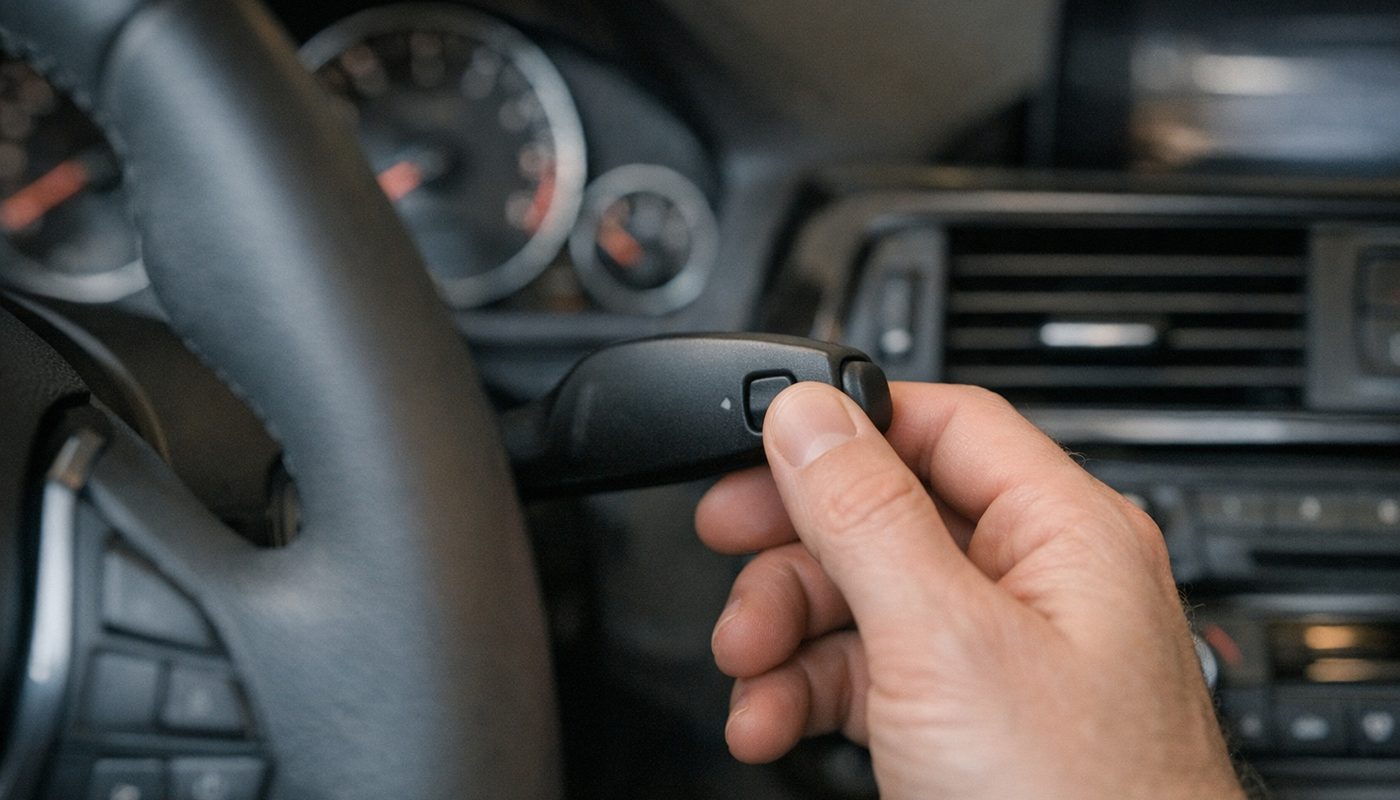
On a lot of E-chassis and early F-chassis cars, you hold the trip/reset button on the instrument cluster (or the BC stalk stem, depending on model) while turning the ignition to position 2 without starting the engine. That drops you into the service menu on the cluster itself, and you scroll using the same stalk to find Engine oil, then hold to confirm the reset. The exact button-hold timing and sequence varies by chassis, so if your first attempt doesn't work, don't assume it's broken - try again and watch the cluster display carefully for the menu prompt.
Confirm It Actually Cleared
After either method, cycle the ignition off and back on and check the service menu again to make sure the oil item shows a fresh interval rather than the old countdown. I've seen resets look successful but not actually save because the ignition got cycled too fast right after confirming.
When You Need a Scan Tool
Sometimes the menu reset just won't take, and that's when you need something with real bidirectional access to the DME and CBS module rather than just the driver-facing menu.
Signs the Manual Reset Isn't Going to Work
If the Engine oil item is missing from the service menu entirely, if you get a fault or timeout message when you try to confirm the reset, or if the car recently had a battery replacement, DME swap, or instrument cluster work done, the CBS module can lose sync with the rest of the car and refuse a plain menu reset. This shows up more often than people expect on older E90/E60-era cars with tired batteries, but it happens on newer G-chassis cars too after certain module updates.
What to Actually Buy
For this you want a proper OBD2 adapter with real manufacturer-specific coding capability, not a generic code reader. I run the


OBDLink CX Bluetooth 5.1 OBD2 Adapter for BimmerCode
$79.95

Veepeak OBDCheck BLE+ Bluetooth OBD2 Scanner - iOS & Android
$41.99
If you'd rather diagnose what's actually going on before throwing money at a reset, our fault code tool is a good first stop to see if there's a real CBS communication fault logged versus just a menu quirk.
What This Costs You Either Way
Let's be honest about the trade-off here. Changing oil every 5,000-7,500 miles instead of waiting for a 12,000-15,000 mile CBS light roughly doubles how often you're paying for an oil change over the life of the car. On a B58 or N55 that's maybe an extra 150-250 dollars a year depending on whether you DIY it or pay a shop, and whether you're buying BMW-approved LL-01/LL-04 oil in bulk or by the case.
Compare that against what you're protecting - a turbo that isn't running on fuel-diluted oil, rod bearings that aren't wearing on thinned lubricant, and on N20/B-series engines specifically, a timing chain system that's a lot more forgiving of clean oil than dirty oil. If you're not sure how much oil your specific engine and sump actually take before you go buy a case, our oil capacity tool will get you the right number by chassis and engine code so you're not guessing at the parts counter either.
FAQ
What car has a 20,000 dollar oil change?
That's usually referencing exotic or ultra-luxury cars with dry-sump systems, specialized oils, and labor-intensive access - think certain Bugatti or Rolls-Royce service packages where the "oil change" bundles in a full inspection and specialty fluids. Nothing in the BMW lineup gets anywhere near that number; even a properly done service on an M-car with dry sump and extra filters is still in the low hundreds, not five figures.
Is it really safe to go 10,000 miles between oil changes?
On a naturally aspirated engine with mostly highway miles and no cold-start-heavy driving, 10,000 miles isn't catastrophic, and that's genuinely what CBS is calibrated around. On a turbo direct-injection BMW with any meaningful amount of short-trip or city driving, I don't consider it safe long term because of fuel dilution and the wear margin it eats into. It won't kill the engine at mile 10,001, but it's stacking risk over years of ownership.
How long should a BMW oil change take?
At a competent shop or doing it yourself with the right tools, expect 30 to 60 minutes for the actual oil and filter swap, plus whatever time it takes to reset the CBS counter and do a quick fluid top-off check. If a shop is quoting multiple hours for a basic oil service with no other work involved, something's off.
Will my BMW tell me when it needs an oil change?
Yes, through the Condition Based Service system on the iDrive cluster, but as covered above, that's an estimate based on driving behavior, not an actual measurement of oil condition. It will tell you something, just not necessarily the right something for your specific driving pattern.
Is 10,000 miles too long for BMW oil?
For a modern turbo BMW with normal mixed driving, I'd say yes, it's pushing past where I'm comfortable, mainly because of fuel dilution risk on direct injection engines. If your car is almost entirely highway miles in a warm climate, it's less of a concern, but I still wouldn't make a habit of it year after year.
Does BMW's CBS system actually check the oil itself?
No, and this is the single biggest misconception people have. There's no sensor measuring oil viscosity, contamination, or fuel content. It's entirely a calculation based on how the car has been driven - cold starts, load, RPM, fuel burned, temperature swings.
Do I need a scan tool for every oil change reset?
No, most oil service resets on modern BMWs go through fine using the iDrive menu or the steering-stalk method on older cars. A scan tool becomes necessary when the menu reset fails, times out, or the service item isn't showing up at all, which happens more after battery or module work.
Bottom Line
CBS isn't lying to you, it's just answering a different question than the one you're actually asking. It's telling you when BMW's cost model says service is due for warranty and maintenance-plan purposes. It's not telling you when your oil has actually broken down enough to stop protecting a turbo, a set of rod bearings, or a timing chain tensioner. On my own 330i and on every BMW I still wrench on for friends, I'm running 5,000 to 7,500 miles or once a year, and I reset the counter myself so I know exactly what the car's actually seeing. Trust the light for what it is, don't trust it for what it isn't, and your engine will thank you at 150,000 miles when everyone else's CBS-only car is dealing with a stretched chain or a tired turbo. Drive it, don't baby it, just don't starve it either.