
Wheel Locks for BMW 3 F30
Affiliate disclosure. BimmerTalk is a proud partner of the Amazon Associates Program and Turner Motorsport. We may earn a small commission on qualifying purchases through our links, at no extra cost to you. Read the full disclosure.


More wheel and tire options for the BMW F30
If you own a BMW F30 and you're thinking about wheels and tires, you're already thinking about the right upgrade first. The F30 3 Series - produced from 2012 through 2019 across the 320i, 328i, 330i, 335i, and 340i variants - is a chassis that responds to wheel and tire changes more noticeably than almost any other mod you can throw at it. The suspension geometry is sharp, the steering feedback is real, and the car is light enough that unsprung mass actually matters. Getting your BMW F30 wheels and tires right transforms the car. Getting them wrong turns a great chassis into something that trams every highway groove and destroys rubber in a season. This guide covers everything from the OEM baseline to what I'd actually bolt on if I were building an F30 today.
Why Wheels and Tires Matter More on the F30 Than You Might Think
A lot of people treat wheels as a cosmetic upgrade and tires as a consumable. On the F30, both assumptions will cost you money and driving pleasure. Here's the real picture.
The F30 platform uses a double-joint spring strut front axle and a five-link rear axle - the same basic architecture that made the E46 legendary. BMW dialed in the front-to-rear weight distribution at close to 50/50, which means the tires on all four corners are doing real work at all times. When you swap to a heavier wheel or a tire with the wrong profile, you're not just changing the look of the car; you're changing how every input feels at the wheel, how quickly the suspension reacts, and how much the car pushes under hard cornering loads.
Unsprung mass is the key concept here. Unsprung mass is everything that moves with the wheel - the wheel itself, the tire, the brake rotor, the hub, the knuckle. The lighter that assembly is, the faster the suspension can react to road imperfections, and the more grip you maintain mid-corner. This is why motorsport engineers obsess over wheel weight in a way they don't obsess over, say, a heavier dashboard. A 2-pound reduction per corner in wheel weight is genuinely measurable in lap times and in how the car feels in fast transitions. On the F30, which has an already-communicative chassis, going from a heavy factory wheel to a proper lightweight aftermarket option is one of the highest-feedback upgrades you can make.
Tires compound this effect. The tire is the only thing connecting the F30 to the road. Everything BMW's engineers did with that five-link rear suspension, all the suspension tuning, all the xDrive or RWD calibration - it all gets filtered through the contact patch between your tire and the asphalt. A bad tire on a well-tuned chassis is like a bad speaker on a great amp. You lose the signal.
The other thing specific to the F30 is that the factory setup is already pretty good. Unlike some platforms where the stock wheels are comically heavy or the factory tires are pure noise generators chosen to reduce warranty claims, BMW actually fitted decent rubber on most F30 variants from the factory. The M Sport packages especially got tires with real performance credentials. So the upgrade path isn't about fixing a terrible baseline - it's about building on a solid one, and that requires more precision, not less.
The F30 OEM Baseline - What You're Starting With
Before you buy anything, you need to understand exactly what's on the car from the factory. The F30 launched in North America with several different wheel-and-tire combinations depending on trim level and model year.
Base and Luxury trim 320i and 328i cars typically came with 17-inch wheels in the style 398 or similar five-spoke designs, running 225/55R17 tires. These are tall, comfortable, and genuinely boring from a performance standpoint. They're not bad tires - BMW typically ran Bridgestone or Continental OEM fitment - but they leave a lot of performance on the table.
Sport Line and M Sport F30s moved to 18-inch wheels, most commonly in the style 397 or style 400 designs, with fitments ranging from 225/45R18 on the front to 255/40R18 on the rear in the staggered M Sport configuration. If you have one of these cars, the factory setup is actually quite good as a starting point. The staggered sizing (wider rear than front) mirrors the rear-biased weight distribution and is designed to prevent understeer and promote balanced handling.
The 335i and 340i M Sport cars pushed to 19-inch wheels in certain configurations, running 225/40R19 front and 255/35R19 rear. These are genuinely performance-oriented fitments, but the low-profile tires that come with them are a mixed blessing on North American roads. The sidewall is thin enough that potholes become real enemies.
The factory wheel weights are worth noting. Most OEM F30 cast aluminum wheels run in the 22-26 pound range depending on size. A quality aftermarket 18-inch wheel can come in at 18-20 pounds or less. That's 2-6 pounds per corner, times four corners - meaningful mass reduction that costs nothing in ride quality if you pick the right tire profile.
Factory offset across F30 variants typically falls in the ET34 to ET45 range. This is important because it defines the pocket you're working in when you choose aftermarket wheels. Go too far outside this window without proper spacers or offset compensation, and you'll either rub on the inner fender or end up with a stance that stresses wheel bearings prematurely.
Fitment Rules for the F30 - Offsets, Widths, and What Actually Fits
Fitment is where a lot of people make expensive mistakes on the F30. I've seen guys buy beautiful wheels that didn't clear the front strut, or run offsets so aggressive the tires ate the rear arch liner. Here's the practical framework.
Wheel diameter
18-inch wheels are the sweet spot for street use on the F30. You get enough diameter to look proportional, you keep enough sidewall height to absorb real-world road imperfections, and you have a massive selection of tires in performance fitments at reasonable prices. 19-inch wheels look more aggressive and are the right call if you want maximum grip and a sharper visual statement, but you're committing to lower-profile tires that demand better roads. I'd go 19s on a track-focused or show build; I'd go 18s on anything that doubles as a daily driver.
You can technically run 17-inch wheels on an F30, and for a dedicated winter/snow setup this actually makes a lot of sense. A 17-inch winter wheel and tire package is cheaper than 18-inch and gives you even more sidewall cushion against winter road damage.
Wheel width
The practical range for the F30 is 8 to 9.5 inches wide on most builds. An 8-inch wide 18-inch wheel with a tire in the 225/40R18 range is a conservative, safe choice that will fit without modification on virtually any F30. Moving to 8.5 inches wide lets you run 245/40R18 rubber, which puts a meaningfully larger contact patch on the road. Going to 9 or 9.5 inches wide requires more attention to offset selection and may require minor arch liner trimming in aggressive configurations, particularly on the rear. Kipar do Racing's F30 fitment guide lays this out clearly with real-world size charts if you want to cross-reference specific combinations.
Offset (ET value)
Offset is probably the single most misunderstood spec in wheel shopping. A higher ET number means the mounting face is further toward the outside of the wheel, pushing the wheel inward (tucked). A lower ET number pushes the wheel outward (flusher with the fender).
For the F30, the safe street zone is roughly ET30 to ET45. The factory typically ran ET34 or ET40 depending on the specific wheel and model. Going below ET30 on a non-modified F30 starts to stress the wheel bearings and can cause fender rubbing under compression. Going above ET45 pushes the wheel too far inward and you lose the visual proportion plus risk inner clearance issues with the strut or brake components.
If you want a flush, aggressive look without modifying the car, targeting ET35 to ET40 with an 8 to 8.5 inch wide wheel on the front and ET30 to ET38 on a 9 to 9.5 inch wide rear is a well-documented formula that works on the F30. This produces a look that's visibly improved over stock without causing rubbing on a car with factory or mildly lowered suspension. If you've dropped the car on lowering springs or coilovers, account for the fact that the tire traces a smaller arc under compression and you'll need a little more inner clearance.
Bolt pattern and hub bore
The F30 uses a 5x120mm bolt pattern and a 72.6mm hub bore. These are consistent across all F30 variants. The 5x120 pattern is somewhat BMW-specific, which narrows your wheel choices compared to the more common 5x114.3 used by most Japanese cars, but essentially all reputable aftermarket wheel brands make F30 fitments. The 72.6mm hub bore is important - always use hub-centric rings when running a wheel with a larger center bore, or you'll feel vibration at highway speeds that no amount of balancing will fix.
The Top Priority Upgrade on the F30
If I had one upgrade budget to spend on an F30, wheels and tires would be it - and specifically, I'd start with the tires before the wheels. Here's why.
The factory wheels on an M Sport F30 are heavy but functional. The factory tires, particularly on cars that have been sitting on a lot or are a few years old, are often the real performance bottleneck. OEM run-flat tires - which BMW fitted on a significant portion of F30 production - are notably worse for grip, ride quality, and handling feel than a quality non-run-flat summer tire. The run-flat construction requires stiffer sidewalls to support the car without air pressure, and those stiffer sidewalls mean less sidewall flex during cornering, which means less predictable limit behavior and a harsher ride over rough surfaces.
Swapping from OEM run-flats to a quality non-run-flat summer tire on stock wheels is a real, immediate improvement in how the F30 drives. You'll notice it in the first 10 minutes. If you want to add a wheel change at the same time and pick something lighter, you compound the benefit. If budget forces a choice, tires first.
The one thing to know about dropping run-flats: if your F30 didn't come with a spare tire (many run-flat-equipped cars don't), you'll want to either buy a space-saver spare for the trunk or carry a quality tire inflation kit. I keep a portable compressor and plug kit in my G20 for exactly this reason - run-flats are gone on that car and I don't miss them for a second.
Best Wheel Picks for the BMW F30
The aftermarket wheel market for the F30 is enormous. Here's where I'd put money at different budget levels, based on what I've seen work and what the BMW community has validated over years of use.
Best Overall Value - Apex ARC-8
The Apex ARC-8 is about as close to a consensus pick as the BMW aftermarket gets. Apex makes wheels specifically for BMW and makes fitment straightforward - they list exact F30 specifications and the wheels are manufactured to hub-centric spec from the start. The ARC-8's flow-formed construction puts weight in the 19-21 pound range for an 18-inch wheel, which is meaningfully lighter than most factory cast wheels. Price runs roughly $300 to $450 per wheel, making a set of four doable in the $1,200 to $1,800 range - not cheap, but not exotic either.
What the Apex gives you is a wheel that's built for the street-to-track pipeline. The spoke design handles brake heat well, the finish options are reasonable, and the warranty is legit. BMW forum consensus is strong on this one - it comes up constantly on threads where people ask "what wheel should I get" and it comes up for good reason. It's not the most glamorous choice but it is the right choice for most F30 owners who want performance with reliable fitment and a wheel they can run to a track day without worrying about it. You can see how the ARC-8 and other aftermarket wheels look on F30 builds before committing.
Best Premium Performance - Advan Racing TC-4
The Advan Racing TC-4 from Yokohama's Rays-engineered wheel division is a genuinely special piece. It's flow-formed with motorsport-derived geometry and comes in at weights that make the Apex look heavy. For an 18x8.5 in the right spec, you're looking at well under 20 pounds. Price is higher at roughly $500 to $700+ per wheel, but you're getting a wheel that was designed with lap times in mind, not just road use.
The TC-4 has a strong reputation specifically within the BMW enthusiast community. Wheelfront's F30 gallery highlights the TC-4 as a meaningful unsprung-mass reduction upgrade for the F30 specifically. The multi-spoke design looks correct on the F30 body - not overdone, not understated. If I were building an F30 for track days with street use in between, this is what I'd run in 18x9.5 with appropriate offset.
Best OEM-Plus Look - BBS CH-R II
The BBS CH-R II is for the person who wants the car to look like it rolled off the M Division floor - premium, refined, correct. BBS has made wheels for BMW motorsport programs going back decades and the CH-R II carries that lineage into a street wheel that fits the F30's design language better than most. Price runs $550 to $800 per wheel, which puts a set at $2,200 to $3,200 for four. That's premium territory.
What you're getting is exceptional finish quality, a multi-spoke design that mirrors BMW's factory M wheel aesthetic without copying it, and a brand name that means something to people who know BMW. The CH-R II is also a properly engineered wheel - not just a pretty face. Weight is competitive for a cast/flow-formed wheel in this price range. If the goal is a show-quality build that still drives perfectly, BBS is hard to argue with. Element Wheels' BMW 3 Series catalog is a good starting point for comparing BBS options and current pricing.
Best Forged Premium - HRE FF10
The HRE FF10 is at the top end of what most F30 owners will spend on wheels. Flow-formed in HRE's California facility, the FF10 offers the closest thing to a full forged wheel at a somewhat accessible price point - roughly $700 to $1,000+ per wheel. The fitment flexibility is outstanding: HRE can make the FF10 in widths and offsets that most catalog wheels can't match, which matters if you have a non-standard suspension setup or want a very specific stance.
The honest reality is that for pure street use, the HRE FF10 is more wheel than most people need. The weight savings over an Apex ARC-8 are real but incremental. Where the HRE earns its price is on track days and for builds where you're also running upgraded suspension and tires and you want the wheels to not be the limiting factor. For a show build or a dedicated track-and-street build where cost is secondary to quality, it's the right call.
Best Budget Option - Konig Hypergram
The Konig Hypergram is what I'd recommend to someone who wants real weight savings without spending Apex money. At roughly $250 to $350 per wheel, a set of four comes in under $1,400, which is accessible. The Hypergram uses a flow-formed construction process that keeps weight down - for an 18-inch wheel you're typically looking at 20-22 pounds depending on size and fitment.
The honest tradeoff with Konig versus Apex or BBS is finish quality and brand prestige. The Hypergram doesn't look as premium up close as a BBS, and the finish options are more limited. But for a daily driver where you want the performance benefit of reduced unsprung mass without a four-figure wheel budget, it's a legitimate choice. The BMW forum community views it as a value play rather than a flagship option, which is exactly the right expectation to bring to it.
Best for Aggressive Fitment - Forgestar F14
The Forgestar F14 occupies a specific niche that other wheels don't fill as well: custom-width and custom-offset flow-formed wheels at prices that don't require a second mortgage. At $350 to $550 per wheel, the F14 can be spec'd in widths and offsets that are dialed to your exact F30 build - whether that's a car on coilovers with stretch fitment or a staggered aggressive street setup. The five-spoke design is clean and works well with the F30 body.
The Forgestar is popular in F30 fitment threads precisely because it bridges the gap between catalog fitment and fully custom wheels. If your planned setup is non-standard - say, a heavily lowered car on adjustable coilovers with aggressive fender work - the ability to order the exact width and offset you need, rather than adapting a catalog wheel with spacers, is genuinely valuable. Check out community builds on the F30 Bimmerpost forums for real-world examples of what different Forgestar fitments look like on the chassis.
Best Tire Picks for the BMW F30
Tires are where I'll spend more time, because this is where the driving experience is actually determined. A mediocre wheel on a great tire beats a great wheel on a mediocre tire every single time.
Best Max Performance Summer Tire - Michelin Pilot Sport 4S
The Michelin Pilot Sport 4S is the default answer to "what tire should I run on my F30" for a reason. It's not the default because of marketing - it's the default because it's genuinely the most balanced high-performance summer tire available at street prices. Grip in the dry is excellent. Wet grip is exceptional for a tire in this category. Tread life is better than competitors at similar grip levels. Ride quality in the right sizing is comfortable enough for daily driving.
For the F30, the typical fitments are 225/40R18 front and 255/35R18 rear in a staggered setup, or 235/40R18 front and rear in a square setup. The PS4S is available in all of these. Price runs roughly $220 to $380 per tire depending on size, which puts a staggered set of four in the $900 to $1,500 range. That's real money for tires, but these tires will last longer than most competitors and perform better for their entire life span. Lionhart's BMW 3 Series tire guide covers sizing compatibility if you want to cross-check fitment against your specific wheel choice.
BMW forum reception for the PS4S is essentially universal praise. I've run these on multiple BMW platforms and they consistently outperform expectations. If you only buy one set of premium tires in your F30's life, make it the PS4S.
Best Budget Summer Tire - Continental ExtremeContact Sport 02
The Continental ExtremeContact Sport 02 is the tire I recommend when people want PS4S-level performance without PS4S prices. Continental's sport compound does an excellent job in wet conditions - genuinely impressive wet grip for a summer performance tire - and the dry performance is very strong. Price comes in at roughly $180 to $320 per tire, saving you a meaningful amount over Michelin on a full set.
The honest difference between the ECS02 and the PS4S is in the fine details. The Michelin has a slight edge in ultimate dry-weather limit grip and a more communicative steering feel as you approach the limit. The Continental is slightly more comfortable on rough road surfaces and has stronger wet-weather performance. For most daily drivers who occasionally push the car, the Continental is the better value. For track day use or true high-performance driving, I'd still pay the Michelin premium.
Best Dry Grip Summer Tire - Bridgestone Potenza Sport
If you live somewhere with reliably good weather and you push the car hard in the dry, the Bridgestone Potenza Sport is worth serious consideration. The steering response is sharper than the PS4S - more immediate turn-in feel and a more communicative limit - and the dry-weather grip is genuinely competitive with Michelin. Price runs about $200 to $340 per tire.
The tradeoff with the Potenza Sport is wet-weather performance, which is good but not as strong as the Continental or Michelin, and tread life, which is somewhat lower than the PS4S. For a track-focused build or a car that rarely sees rain, these are the right call. For a year-round performance daily driver, I'd go PS4S.
Best All-Season Performance Tire - Michelin Pilot Sport All Season 4
The Michelin Pilot Sport All Season 4 is the answer for F30 owners in the northeast, midwest, or Pacific Northwest who want a single tire that handles winter driving without switching to dedicated winter rubber. Price is roughly $180 to $320 per tire.
Let me be direct about what all-season means in this context: the PSAS4 is not a winter tire and it is not a summer tire. What it is, is the best compromise between those two extremes in its category. In temperatures above 40°F, it's remarkably capable - not far behind the ECS02 in dry grip and very competent in the wet. In light snow and cold temperatures down to about 20°F, it manages adequately. In serious winter conditions - ice, deep snow, sustained sub-20°F temperatures - you should be on proper winter tires regardless of what all-season is on the car.
For F30 owners who accept that compromise, the PSAS4 is the right daily driver tire. I have to be honest: if you live somewhere with real winters, I'd rather you run dedicated summer tires and swap to dedicated winter tires than run any all-season. Two sets of purpose-built tires will outperform one set of compromises. But if that's not practical for your situation, this is the best all-season available for the F30.
Best Budget All-Season - General G-MAX AS-07
The General G-MAX AS-07 is a legitimate all-season option for F30 owners who need to keep costs down. At roughly $130 to $200 per tire, it's substantially cheaper than the Michelin all-season. General Tire is a Continental subsidiary, so the underlying tire engineering is serious. Performance is good rather than exceptional - adequate daily driver capability in both summer and light winter conditions without the grip ceiling of the premium options.
Forum reception is mixed-to-positive: people who buy it understand they're getting a value tire, and within that expectation it delivers. If budget is the primary constraint and you need an all-season, the G-MAX AS-07 is a reasonable choice. If you can stretch to the Michelin or Continental all-season options, do it.
Square vs. Staggered Fitment - What to Choose for Your F30
This comes up constantly in F30 wheel threads and there's no universal right answer - only a right answer for your specific use case.
Staggered fitment
Staggered means running wider tires on the rear than the front. The factory M Sport setup of 225/40R18 front and 255/35R18 rear is a staggered configuration. BMW designed the F30 around this setup for rear-wheel-drive variants because the car pushes more load through the rear axle under acceleration and the extra rear grip prevents both understeer and unwanted oversteer at the limit.
Staggered setups feel more natural in spirited driving on the F30. The car rotates correctly, the rear end has the grip to handle the torque without drama, and high-speed stability improves. The downside: you cannot rotate tires front to rear, which means the rear tires wear faster and need replacing more frequently. On a high-performance summer tire running staggered, budget for rear tires about twice as often as fronts.
Square fitment
Square means the same width tire front and rear. A common square F30 setup is 235/40R18 all around. This is the better choice for track use because it lets you rotate tires between sessions, equalizing wear and maximizing the life of the expensive rubber. It also gives you more flexibility in wheel selection since you're buying four identical pieces.
The handling character of a square setup is slightly different from staggered. You'll get a marginally more neutral handling balance - the front and rear have equal grip potential, so the balance shifts based on suspension tuning rather than tire width. For a track-day car, square is usually better because it makes setup adjustments more predictable.
For a street car that occasionally sees spirited driving, I'd keep staggered and accept the uneven tire wear. For a track-focused build or a dedicated autocross car, go square.
Installation Considerations Specific to the F30
There are a few F30-specific things to know before you start swapping wheels and tires.
TPMS compatibility
The F30 uses BMW's direct TPMS system, which means there are physical sensors in the wheels that communicate tire pressure to the car's computer. When you change wheels, you need either to transfer the factory sensors to the new wheels (if they're compatible) or buy new sensors and have them coded to the car. A shop that does a lot of BMW work can code new sensors quickly, but it's a step that gets overlooked. Running without functional TPMS won't hurt the car but you'll have a warning light and, more importantly, you lose the actual tire pressure monitoring function.
Aftermarket TPMS sensors for the F30 are widely available and not expensive - typically $30-$60 per sensor. Factor this into your budget when pricing out a wheel swap.
Hub-centric vs. lug-centric mounting
I mentioned this earlier but it's worth emphasizing. The F30 hub bore is 72.6mm. Many aftermarket wheels have a 74.1mm or larger center bore to fit multiple applications. Always use hub-centric rings to fill the gap between the wheel bore and the hub. The rings are cheap (a few dollars each), and they're the difference between a smooth-running wheel and a vibration that no balancer can fix. Reputable aftermarket brands like Apex spec their F30 wheels at exactly 72.6mm hub bore so rings aren't needed, but verify this with any wheel you're considering.
Torque specs and lug bolts
The F30 uses lug bolts, not lug nuts like most cars. Aftermarket wheels need to be compatible with BMW's lug bolt spec. Most quality BMW-specific wheels are designed for this. Torque spec for the F30 is 88-103 ft-lbs (120-140 Nm). Use a calibrated torque wrench - don't guess, don't use an impact gun without a torque stick. Over-torquing lug bolts is a common and damaging mistake that can warp brake rotors or damage the wheel's bolt holes.
Brake clearance
If you're upgrading brakes - particularly if you've moved to larger rotors or a big brake kit - verify wheel clearance before buying. Some wheel spokes, particularly on deep-dish designs, can conflict with larger caliper bodies or rotor hat heights. This is especially relevant if you've upgraded to a performance brake pad and caliper combination. When in doubt, a test fit before the tires are mounted saves a lot of hassle.
Suspension interaction
If your F30 is lowered on H&R or Eibach lowering springs, or on coilovers, the reduced ride height changes the tire's travel arc during suspension compression. This means a wheel-and-tire combination that clears the fender at stock height may rub on a lowered car. Typically this affects the rear arch under full compression more than the front. The safe approach is to test-fit before finalizing and check clearance at both full lock (front) and full compression.
Spacers are sometimes used to push wheels outward for better fitment or fender clearance, but be conservative. Spacers change the effective wheel offset and add load to the wheel bearing. 5mm hub-centric spacers are generally considered safe. Going beyond 15mm with bolt-on spacers rather than slip-on ones is the threshold where you should really evaluate whether it's worth it versus choosing a wheel with the correct offset from the start.
Common Mistakes F30 Owners Make With Wheels and Tires
I've seen all of these. Some of them I've done myself on other platforms before I knew better.
Buying the wrong offset and assuming spacers will fix it
Spacers are a tool, not a correction for a fundamental fitment mistake. If you buy a wheel with an ET50 offset because it was on sale and then stack 20mm spacers to get it flush, you've created a configuration that stresses the wheel bearing and hub in ways neither component was designed for. Buy the right offset from the start. If you need help calculating, the fitment rules and size charts at Kipar do Racing are a useful reference.
Running run-flat replacements without checking for a spare
If you're switching from OEM run-flats to conventional tires, confirm your car has a spare or carry an inflation kit. I mentioned this earlier but it's the most common overlooked step in a run-flat delete.
Going too wide and too low-profile on a street car
A 275/30R19 on a street F30 looks aggressive in photos and is a disaster in real life. The sidewall is basically nonexistent. Every pothole, every expansion joint, every piece of road debris becomes a threat to the tire and wheel. On a track where the surface is controlled, ultra-low-profile tires make sense. On public roads? You're paying more, risking damage more, and getting a worse ride. The factory's reluctance to go below 35-series profile on 19-inch wheels wasn't timidity - it was engineering good judgment.
Balancing tires without road-force balancing
Standard spin balancing is adequate for most situations but road-force balancing is better, especially for high-performance tires. Road-force balancing simulates the load on the tire as it contacts the road and can detect runout and imbalances that spin balancing misses. If you're spending $250+ per tire, spend the extra $20-$30 per corner for road-force balancing. Highway speed vibration that won't go away is almost always a balancing or mounting issue that road-force balancing would have caught.
Forgetting about TPMS
Already covered this above but worth repeating here. TPMS sensors are a real system that requires real attention during a wheel swap. Don't forget them.
Mixing tire brands or models
Mixing a Michelin front with a Continental rear sounds like it might be fine. It's not ideal. Different tires have different grip characteristics, different response profiles at the limit, and different wet-weather behavior. The F30's suspension calibration assumes consistent behavior across all four corners. Run matching tires front and rear, or at minimum, match left-right on each axle.
Overlooking alignment after a wheel and tire change
A new wheel and tire combination changes the dynamic loads on the suspension. Get a four-wheel alignment after any significant wheel or tire change. If you've also changed ride height (lowering springs, coilovers), an alignment is not optional - it's mandatory. Misaligned F30s eat front tires on the inner edge at a startling rate. An alignment costs $100-$150 and saves you $400 in tires.
Budget Tiers - What You Get at Each Level
Let's be concrete about what different budgets actually buy on the F30 wheel and tire front.
Under $1,500 for wheels plus tires
This is a real constraint but you can work with it. At this budget, I'd focus entirely on tires before touching wheels. A set of four Michelin Pilot Sport 4S in 225/45R17 on your factory wheels comes to roughly $800-$1,000 and transforms the car. Alternatively, four Continental ECS02 in a slightly wider size with the $500-$700 you have left for wheels might get you into used Apex or OEM BMW wheels in good condition if you shop carefully. Used OEM F30 M Sport wheels in the right fitment go for $300-$500 for a set of four on the secondary market and aren't a bad starting point - they're heavy but they fit perfectly and look fine.
$1,500 to $3,000 for wheels plus tires
This is the sweet spot for a genuine performance upgrade. At $1,500-$2,000 you can get a set of four Konig Hypergram or budget-end Apex wheels plus a set of Continental ECS02. At $2,000-$3,000 you can get into proper Apex ARC-8 wheels with a full set of Michelin PS4S. This combination gives you meaningful weight reduction, the best-in-class street tire, and a setup that will genuinely improve every aspect of driving feel. If I had to pick one budget tier to recommend, this is it.
$3,000 to $5,000 for wheels plus tires
At this level you're into BBS CH-R II or Advan TC-4 territory with PS4S rubber. This is a serious performance build for a street car. The wheels are beautiful, the tires are the benchmark, and the combined weight savings over stock will be noticeable in every corner. If you're also planning to do coilovers and potentially an ECU tune, this wheel and tire spend makes sense because the rest of the car will be at a level where the wheels aren't holding anything back.
Over $5,000 for wheels plus tires
HRE territory. Custom widths, custom offsets, forged or flow-formed construction at the highest level. At this spend you're building a show car or a very serious track-day machine. The returns are real but increasingly incremental. Make sure the rest of the car justifies this investment before you sign off on a set of HREs - there's not much point in $5,000 wheels on a car with stock suspension and a cracked windshield.
My Specific Picks for Daily, Track, and Show
My daily driver pick
If I were building an F30 daily driver from scratch today, I'd run 18x8.5 Apex ARC-8 in ET38 with a 225/40R18 front and 255/35R18 rear on Michelin Pilot Sport 4S. This setup fits without modification on a stock or mildly lowered F30, the wheels are light enough to feel significantly better than stock, and the PS4S will handle everything from daily commuting to weekend canyon runs. Total cost for wheels and tires is around $2,800-$3,200 for a full set. That's the benchmark build I'd use as a reference point for everything else.
If budget is a real constraint, I'd downgrade to Konig Hypergrams and Continental ECS02 and come in around $1,800-$2,200. Still a massive improvement over the stock heavy cast wheels and OEM run-flats.
My track-day pick
For a car that regularly sees track days, I'd go 18x9 Advan TC-4 in a square setup with 255/40R18 Michelin PS4S all around. The square setup means I can rotate tires between sessions, which is critical when you're doing multiple track days per season and grinding through rubber quickly. The Advan TC-4 is light enough to genuinely help the chassis respond faster to inputs, and it's a robust wheel that handles the thermal cycling of track use. Total cost is higher - probably $3,500-$4,500 for wheels and tires - but for a track car this is appropriate spending.
I'd also run this setup with dedicated track-day brake pads rather than the street pads. Check the brake pad guide if you're setting up an F30 for regular track use. Tires and brake pads are the two consumables where track use changes the calculus completely.
My show build pick
For maximum visual impact without track use in mind, I'd go 19x9 BBS CH-R II staggered with 255/35R19 rear on Michelin Pilot Sport 4S. The BBS makes the car look like a factory M Performance Edition at a car show. The PS4S keeps it driveable and respectable on the road. I'd probably pair this with a mild suspension drop - 25-30mm on H&R springs - to get the wheel-to-fender gap right. Total cost at this spec is $3,500-$4,500 for wheels and tires, plus $800-$1,000 for quality lowering springs if you're not already on coilovers.
Tire Sizing and Speedometer Calibration
This is a practical detail that gets overlooked. When you change from the factory tire size to a different overall diameter - even slightly - your speedometer and odometer readings change. The F30's speedometer is calibrated for the factory tire's rolling circumference. A tire with a different overall diameter rolls a different distance per revolution.
For most common F30 fitment changes, the difference is small enough that it doesn't matter in practice. Going from 225/45R17 to 225/40R18 results in a diameter change of less than 1%, which is effectively invisible. But if you're making a significant change - say, going to a much wider tire or a very different aspect ratio - it's worth checking the rolling diameter difference with an online tire size calculator.
If the discrepancy is more than 2-3%, you can correct the speedometer calibration with BMW coding tools. This is a straightforward task if you have access to BMW diagnostic software - see the coding and diagnostic tools guide for what tools are capable of this. Most BMW-specific shops can do it in 20 minutes.
Winter Wheel and Tire Strategy for the F30
If you're in a climate that gets real winter weather, the wheel and tire decision has an additional layer: what to do about snow and ice. Running a performance summer tire below about 45°F is genuinely dangerous - the rubber compound stiffens and grip drops off significantly. It's not a theoretical concern; it's measurable in braking distance and cornering grip.
The right approach for F30 owners in winter climates is a dedicated winter wheel and tire package that you swap on before the first frost and swap off in spring. Here's the practical setup:
For the winter package, go with 17-inch steel or cast wheels in a basic style - something you don't mind having road salt and slush flung at. Narrower is actually better in snow: a 205/50R17 winter tire has a smaller contact patch width that cuts through surface snow better than a wide summer tire. The taller sidewall also helps absorb road shock from frozen surfaces.
Winter tire brands that work well on the F30 include the Michelin X-ICE Snow, the Continental WinterContact TS 870 P, and the Bridgestone Blizzak WS90. Budget approximately $150-$220 per winter tire and $100-$200 per winter wheel depending on whether you go steel or cast and whether you buy new or used. A used set of OEM 17-inch BMW wheels in good condition makes a perfect winter setup - they're plentiful on the secondary market and you know they'll fit correctly.
The swap itself is straightforward if you have the tools. If you're doing suspension work or other maintenance, a maintenance schedule check at the same time as your seasonal wheel swap is good practice - it's already on the lift.
Frequently Asked Questions About BMW F30 Wheels and Tires
What is the correct offset for F30 aftermarket wheels?
The safe range is ET30 to ET45 for most F30 builds. The factory typically ran ET34 to ET40 depending on the specific wheel model. For a flush street look, target ET35-ET38 on an 8 to 8.5 inch wide wheel. Going below ET30 without suspension modifications and fender work risks rubbing and adds stress to the wheel bearings. Going above ET45 pushes the wheel too far inward and hurts both aesthetics and inner clearance.
Will 19-inch wheels hurt the ride quality on my F30?
Possibly, depending on what tires you run. The wheel diameter itself isn't the issue - the reduced sidewall height of the tire that comes with 19-inch fitment is. A 255/35R19 has significantly less cushioning than a 255/40R18. If you live somewhere with rough roads, I'd be honest: 18s will ride better and your tires will last longer. 19s look better but come with real-world costs. It's your call, but go in with open eyes.
Can I run a square setup on my staggered F30?
Yes, with some caveats. The front and rear of a staggered F30 may have different wheel arch sizes, and going to a square (same-width) setup might result in a front tire that looks a little narrow or a rear tire that's too wide for the arch. Most commonly, F30 owners running a square setup go with a width that fits the front without modification, which means accepting a slightly narrower rear than the factory staggered spec. This works fine and is the preferred setup for track use where tire rotation matters.
Do I need to code new TPMS sensors after a wheel swap?
Yes. The F30's direct TPMS system needs to know the sensor IDs in the new wheels. This can be done with BMW-compatible diagnostic software (NCS Expert, E-SYS, or an ISTA-based tool) or by any shop that does BMW work regularly. Budget 30-60 minutes of shop time if you're having a shop do it. The cost is usually $50-$100 for the sensor programming.
Is it worth buying used OEM BMW wheels for a winter setup?
Absolutely. Used OEM F30 wheels are plentiful, fitment is guaranteed, and the price is right. Check that the wheels are structurally sound (no cracks, no severe corrosion) and have them inspected and refinished if needed before mounting winter tires. A set of used 17-inch OEM wheels for $200-$400 is one of the best values in BMW ownership for winter-climate owners.
How often should I rotate tires on my F30?
On a square setup, every 5,000-7,500 miles. On a staggered setup, you cannot rotate front to rear without flipping the tire on the wheel (changing rotation direction), which is not recommended with directional tires. If you're running staggered, inspect rear tires at every oil change and be prepared to replace the rears more frequently than the fronts. Rear tires on a hard-driven F30 in a staggered setup might need replacement at 20,000-25,000 miles while fronts could last 35,000-40,000 miles.
What tire pressure should I run on my F30?
The factory door placard spec for most F30 variants is 32 psi front and 36 psi rear for the staggered M Sport setup, or 35 psi all around for a square setup. These are cold inflation pressures. For track use, many drivers start at 32-34 psi cold and let the tire pressure build to 36-38 psi at operating temperature, adjusting based on tire temperature readings if you have a pyrometer. Never adjust tire pressure when the tires are hot - hot pressure readings are higher than cold and you'll end up underinflated once the tires cool down.
Do lightweight wheels actually make a difference you can feel on the street?
Yes, if you're going from heavy OEM cast wheels to a genuine lightweight aftermarket option. The difference isn't dramatic in a straight line - it's not like adding horsepower. Where you feel it is in transitions: turn-in response, direction changes, and the way the car responds to small steering inputs. A 4-pound per corner reduction in unsprung mass is genuinely noticeable if you drive the car with some intent. On a smooth road at steady speed, you probably won't feel anything. In a fast sweeper where you're making mid-corner corrections, the lighter wheel means the car responds faster. That difference is real and meaningful on a chassis as good as the F30.
Can I run wider tires than the factory spec without modifying the car?
Up to a point. Most F30 builds can run up to 255mm wide on the rear without modification on a proper offset wheel. Going to 265mm or wider in the rear usually requires at minimum some fender liner trimming, and potentially arch rolling at the aggressive end. On the front, 235mm is typically the practical limit for a stock-height car before fitment becomes complicated. Lowering the car tightens these limits because the tire traces a smaller arc through the wheel arch under suspension compression.
Putting It All Together - The F30 Wheel and Tire Build Approach
The F30 3 Series is a genuinely great driver's car that rewards thoughtful upgrades. The stock bones - the five-link rear suspension, the near-50/50 weight distribution, the well-tuned electric steering - all respond positively to wheels and tires that let the chassis communicate more clearly.
The approach I'd take on any F30 is: fix the tires first, then fix the wheels. The fastest, cheapest, most impactful upgrade is replacing run-flat OEM tires with quality non-run-flat summer tires on whatever wheels you currently have. Do that, get an alignment, and drive the car for a few months. You'll have a much better sense of what you actually want to change next - whether that's more grip, better aesthetics, a specific stance, or preparation for track days.
When you do buy wheels, don't obsess over weight numbers in isolation. A 20-pound Apex ARC-8 that fits correctly and is properly balanced will outperform an 18-pound exotic wheel that's poorly fitted or hub-centric-ring-less. Fitment first, weight second, aesthetics third - in that priority order.
For tires, match the tire to how you actually drive. Honest assessment: most people don't need a PS4S. They'd be perfectly served by the Continental ECS02 or even a Bridgestone Potenza Sport at lower cost. But if you push the car to its limits regularly, the PS4S justifies every dollar. And if you commute in all weather and can't be bothered with seasonal swaps, the Michelin Pilot Sport All Season 4 is the best single compromise available.
The F30 has been in production long enough that the aftermarket knows it extremely well. Fitment data is well-documented, community knowledge is deep on forums like F30 Bimmerpost, and there's no shortage of people who've done exactly what you're planning and can tell you what worked and what didn't. Use those resources. Cross-reference your wheel choice against real F30 builds before buying.
And once you've sorted the wheels and tires, if the F30 itch is still there, the natural next steps are a coilover upgrade and potentially an ECU tune if you have the N55 or B58. But start here. Wheels and tires on a BMW F30 are the foundation of everything else the car can be, and getting this right makes every subsequent mod more effective and more satisfying to drive.

Kamil Siegień
Founder of BimmerTalk. Five years wrenching on BMWs, currently dailying a G20 330i with the B48 turbo four. Spent a year doing marketing for BMW and MINI before going independent. I write everything on this site myself.
More about the site
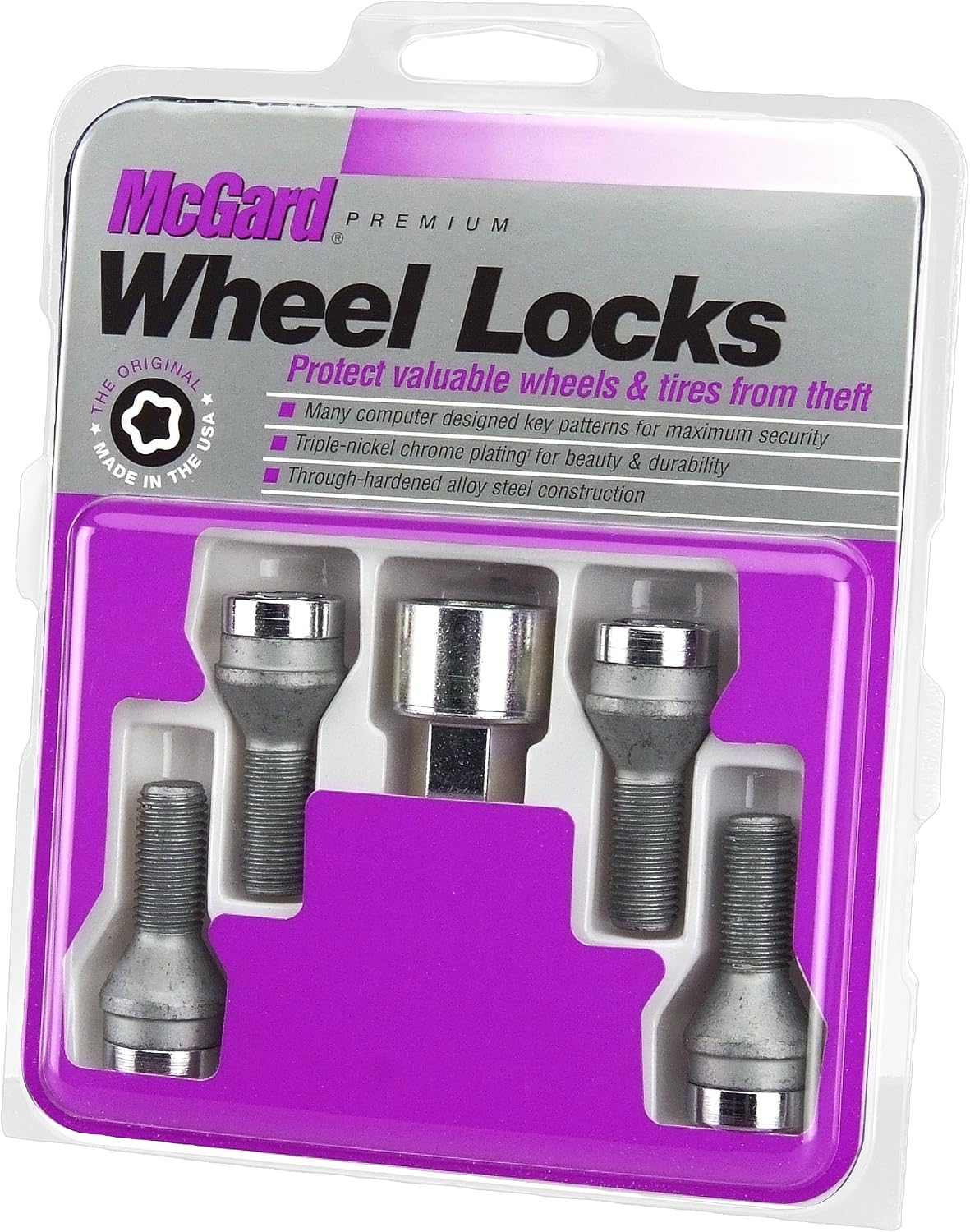
BMW Wheel Locks - Protect Your Investment Without Compromising Style
If you're running aftermarket wheels on your F30, G20, E90, or any other BMW chassis, wheel locks aren't optional - they're essential. A set of quality locking lug nuts is the cheapest insurance you can buy against wheel theft, which disproportionately targets BMWs running popular fitments like 19" or 20" staggered setups on M Sport and M Performance models. Don't wait until you walk out to a car sitting on rotors.
BMW uses a standard 12x1.5mm thread pitch across most modern models including the 3 Series (F30/G20), 5 Series (F10/G30), X3 (F25/G01), X5 (E70/F15/G05), and the M2/M3/M4 lineup. Earlier E-chassis cars like the E46, E60, and E90 share the same spec, so finding a compatible set is straightforward. The 1 Series (F20/F40) and 2 Series (F22/G42) also use 12x1.5, but always double-check your existing lug nut seat type - BMW OEM hardware uses a spherical (ball) seat, not a conical (tapered) seat like most aftermarket wheels require. Using the wrong seat angle is the number one installation mistake and can crack wheel hubs or cause dangerous wheel movement.
What to Look For - and What to Avoid
McGard is the gold standard for BMW wheel locks and the brand you'll find referenced repeatedly in BMW forums. Their Ultra High Security Wheel Locks (part series 24157, 25157) are precision-machined to OEM tolerances, available in both ball and conical seat, and use a patented key design that resists impact wrench attacks and code duplication. For a cleaner OEM-plus look, Gorilla Automotive offers a solid mid-range option, though their key patterns are slightly less unique than McGard's. If you're running a luxury or M-specific build, BMW's own M Performance wheel locks are worth considering - they're McGard-manufactured anyway, just with the BMW roundel and proper OEM fitment guaranteed out of the box.
What to avoid: any budget set under $20 from an unknown brand. These typically use soft steel that shears under moderate torque, and their key sockets wear out fast - often after just one or two removal cycles. You also want to avoid mismatched seat kits bundled with universal hardware. If the listing doesn't specify ball seat vs. conical seat, pass on it.
Install difficulty: Easy. Swap one lug nut per wheel for a locking nut, torque to BMW's spec of 120 Nm (89 ft-lbs), and store your key socket somewhere secure and accessible - glove box or with your spare tire kit. Keep a second key in your home toolkit. Most shops can look up or decode standard McGard keys if you lose yours, but it's a hassle you don't need before a tire rotation.
A few practical notes: if you're running aftermarket wheels with a chamfered seat, confirm the lock's seat spec matches your wheel's lug hole - not your factory hub. Extended-shank locks are available if your aftermarket wheels have thick faces or require a longer thread engagement. And if you've already upgraded your lug nuts for aesthetics, look for locking sets that match your existing hardware finish - McGard offers chrome, black, and brushed options to keep things consistent.
While you're securing your setup, it's also worth reviewing your valve stems and TPMS sensors - aftermarket wheels often require updated stems, and a missing or damaged TPMS sensor will trigger a fault on any BMW built after 2008.
Bottom line: spend $40–$80 on a reputable McGard or M Performance set, match your seat type, torque correctly, and don't lose the key. It's a five-minute job that protects a $2,000–$5,000 wheel investment. No excuse not to.