Best BMW Lowering Springs, Honest Buyer's Guide by Chassis
Affiliate disclosure. BimmerTalk is a proud partner of the Amazon Associates Program and Turner Motorsport. We may earn a small commission on qualifying purchases through our links, at no extra cost to you. Read the full disclosure.

Lowering springs are one of those mods that look simple on paper - swap the factory springs for shorter, stiffer ones, drop the car an inch, done. In practice there are about a dozen decisions between "I want my BMW to sit lower" and "I'm happy with how this drives," and if you skip any of them you'll end up with a car that trampolines over highway expansion joints or chews through front tires in 15,000 miles. I've been there. I've watched a buddy ruin a perfectly good set of Michelins on his E92 because he grabbed the first springs he found without checking whether his car had the Sport suspension delete. I've also pulled springs off a G20 that were so stiff the OEM dampers were leaking inside of a year. This guide is my attempt to give you all the context I wish I'd had.
I currently daily a G20 330i with the B48 turbo four - 255 HP from the factory, M Sport suspension already fitted, so I'm starting from a lower baseline than someone with a base 330i on comfort springs. I spent a year doing marketing for BMW and MINI, which means I've had conversations with more product managers and suspension engineers than most people should. And I've been wrenching on BMWs for five years, so I know the difference between what reads well in a press release and what holds up at 70,000 miles. Everything in this guide comes from that combination of track knowledge, actual dyno data I've seen, and the kind of honest shop-floor conversation that doesn't make it into a YouTube sponsorship video.
We're going to cover the E46, E90, E92, F30, F31, G20, F10, F80 M3, F82 M4, G80 M3, X3, and X5 in real depth. We'll look at H&R Sport, Eibach Pro-Kit, Bilstein B12, ST Suspensions Sport, and a handful of specialty options. We'll talk about what springs alone actually do to your factory dampers, when coilovers make more sense, and how trim lines like Sport Line and M Sport already affect your starting ride height so you don't buy a drop that's way more aggressive than you intended.
1.0-1.5 inches
Typical drop range
15-35%
Spring rate increase over OEM
3-5 hours
Average install time
40,000-60,000 miles (estimated)
OEM damper life after spring swap
$280-$950
Price range (springs only)
~$900-1,200
Coilover crossover point (value)
What Lowering Springs Actually Do to Your BMW
Let's get the physics out of the way first, because it matters for every decision that follows. A lowering spring does two things simultaneously: it reduces the free length of the spring (so the car sits lower at static ride height) and it typically increases the spring rate (so the spring resists compression more aggressively per millimeter of travel). The first effect is the one you see in photos. The second effect is the one you feel on every pothole and the one that determines whether your front dampers last two years or six.
BMW's factory suspension is engineered around specific spring rates, damper valving, and jounce bumper geometry. When you install a spring that's 15-30% stiffer than OEM and 25-35mm shorter, the damper now operates in a different part of its stroke range. Because the car sits lower, the suspension travels through its available compression stroke faster - you're effectively using more of the damper's range just sitting still. Hit a bump and the damper needs to absorb that energy faster than it was designed to. Over time, the increased heat cycling and piston speed wears the seals. On a G20 with standard non-adaptive dampers, I'd estimate 40,000-60,000 miles before you notice fade with quality springs. On an older E90 with 80,000 miles on the OEM dampers already, you might be replacing those within 18 months of a spring swap.
This is the fundamental trade-off. Springs alone are a budget-friendly entry point - you can get a quality set for $280-$500 and the install is straightforward. But you're loading hardware that wasn't designed for your new spring rate. The more honest way to do this, if your budget allows, is a full sport shock and spring package like the Bilstein B12 (which pairs Bilstein B4 monotube shocks with sport springs) or just skipping to coilovers. I've written a full breakdown of that decision in the best BMW coilovers buyer's guide if you want to read both pieces side by side.
One more thing worth understanding: lowering also changes your suspension geometry. Drop the front of a MacPherson strut car (E46, E90, F30, G20) and you gain negative camber - typically 0.3 to 0.8 degrees at 25mm of drop, depending on chassis. That sounds good for cornering, but it means the inner edge of your front tires is now working harder than the outer edge. If your alignment shop doesn't understand what they're doing with a lowered BMW, you'll wear tires fast and lose the neutral handling BMW intended. On multi-link rear suspensions (most modern BMWs), camber compensation is better but still measurable. Always get a four-wheel alignment from a shop with BMW experience immediately after installation. Not next week. That day if possible.
Sport Line, M Sport, M Performance - Your Real Starting Ride Height
This is probably the section most people skip and then regret. BMW sells the same chassis in multiple suspension configurations, and the difference in ride height between a base car and an M Sport car can be 10-15mm at the factory. That matters enormously when you're comparing drop figures from spring manufacturers.
Take the G20 3 Series. A standard 320i comes on 17-inch wheels with BMW's comfort-tuned spring rates and a ride height that puts roughly 70mm of clearance above the front wheel arch lip. The M Sport package brings 18-inch wheels, firmer spring rates, and drops ride height by approximately 10mm front and rear. If you then install an Eibach Pro-Kit rated for a 30mm drop, the M Sport car actually ends up sitting 40mm lower than a base-spec G20. That might be exactly what you want. Or it might mean you're scraping the front lip every time you pull into a parking garage. Know your starting point.
The same logic applies to the F30 3 Series. The base car versus the M Sport package versus the M Performance suspension are all different baselines. On the E90 and E92, the Sport Package (iDrive code SA 3-22 in build data) came with stiffer springs and a 10mm drop. The E46 M3 is an entirely different animal - it shares no suspension components with the 330i - so spring kits listed generically as "E46 lowering springs" may not even fit the M3 subframe. I'll call out these compatibility nuances in each chassis section.
The Main Brands - H&R vs Eibach vs Bilstein vs ST Suspensions
I've installed or been around installs of all four major brands across multiple BMW chassis codes. Here's my honest read on each.
H&R Sport Springs
H&R is the brand I reach for most often when someone wants a clean, daily-driveable drop with predictable behavior. They're a German manufacturer - the factory is in Lennestadt, NRW - and they do their development in-house on BMW hardware, not just on generic spring machines. The H&R Sport springs typically deliver 25-35mm of drop and use progressive spring rates. That progressive profile is important: the spring starts softer to absorb small road imperfections and ramps up as compression increases. The result is a ride quality that's noticeably better than most linear-rate competitors at the same drop amount.
H&R also makes the VTF (Variably Threaded Fastener) adjustable series, which is a hybrid between a fixed spring and a coilover - you can adjust the effective spring length to dial in your exact drop height. It's a more expensive option but interesting for people who want some flexibility without going full coilover. We'll reference those in the M3/M4 sections where they're particularly relevant.
Quality control on H&R has been consistently good in my experience. The springs arrive with proper powder coating, the seat diameter and length are accurate for each chassis application, and the company publishes actual spring rate data - which not everyone does. One genuine criticism: H&R's pricing has crept up over the past few years. A set of H&R Sport springs for a G20 or F30 is now often $380-$430, which gets close enough to entry-level coilover territory that the value calculus changes.
Eibach Pro-Kit
Eibach is the other name you'll see constantly in BMW forums, and for good reason. The Pro-Kit is their everyday performance spring line - matched spring rates, consistent drop (typically 25-35mm depending on chassis), and a manufacturing quality that's genuinely excellent. Eibach publishes spring rate data and uses their own coating process that's held up well in corrosion testing. The Pro-Kit is often $20-$50 cheaper than comparable H&R Sport springs for the same chassis, which is meaningful at scale.
The main thing I'd say distinguishes Eibach from H&R in real-world driving is ride quality on medium impacts - things like road seams, larger expansion joints. H&R's progressive rate gives it a slight edge at absorbing those hits without bottoming out. Eibach tends to feel a hair firmer throughout the travel range. Neither is harsh in the way that cheap knockoff springs are harsh, but the difference is real and worth noting if you're daily driving on bad urban roads. For track use or weekend driver applications, Eibach Pro-Kit is genuinely excellent and in some chassis-specific applications I'd call it the better-engineered solution.
Bilstein B12
Bilstein doesn't just make shocks - they make complete sport suspension kits. The B12 Pro-Kit pairs their B4 series sport shocks (which are gas-pressurized monotube units, not twin-tube like the OEM BMW dampers on most applications) with matched lowering springs. The combined system is engineered as a unit, which solves the fundamental problem I described earlier about loading factory dampers with aftermarket springs. If you're going to do springs on a car with higher mileage dampers, the Bilstein B12 is the responsible choice - you're replacing the whole system and the new dampers are tuned specifically for the spring rates you're running.
The trade-off is price and complexity. A B12 kit runs $600-$900 depending on chassis, which is $250-$400 more than springs alone. Installation is also more involved - you need to compress struts, which requires either a spring compressor or strut swap procedure depending on the car. But the end result is a more cohesive suspension that handles better, rides more consistently, and doesn't put your OEM dampers on an accelerated wear schedule. For E46, E90, and F30 cars that are past 70,000 miles and still on OEM shocks, I'd push people toward B12 over springs-only almost every time.
ST Suspensions Sport
ST Suspensions (a brand under the KW Group umbrella) doesn't get talked about as much in BMW circles, which is partly unjust. Their Sport spring line offers competitive specs at prices typically 10-20% below H&R and Eibach, and they're manufactured at the same facility level as KW's higher-tier products. I've seen them on a few E90s and an F30 in my circle and the ride quality is competent - more linear feeling than H&R but well controlled. Where ST falls slightly behind is in the breadth of their BMW catalog. For popular applications like E90/E92, F30, and G20, they have good fitment data. For less common applications or newer chassis, the catalog can have gaps. Worth checking fitment before you commit, but don't overlook them on price alone.
| Brand | Typical Drop (mm) | Rate Style | BMW Catalog Depth | Approx Price Range | Best For |
|---|---|---|---|---|---|
| H&R Sport | 25-35 | Progressive | Very Wide | $380-$560 | Daily + weekend use |
| Eibach Pro-Kit | 25-35 | Progressive | Wide | $340-$500 | Daily + occasional track |
| Bilstein B12 | 25-30 | Progressive (with matched shocks) | Wide | $620-$900 | Cars needing new dampers too |
| ST Suspensions Sport | 20-30 | Linear | Moderate | $280-$420 | Budget-conscious daily |
| Dinan Performance | 15-20 | Progressive (comfort-focused) | BMW-specific only | $380-$500 | M3/M4 daily drivers |
| H&R VTF Adjustable | 15-35 (adjustable) | Progressive | M cars + select chassis | $850-$1,300 | Those wanting flexibility without coilovers |
H&R Sport
- Typical Drop (mm)
- 25-35
- Rate Style
- Progressive
- BMW Catalog Depth
- Very Wide
- Approx Price Range
- $380-$560
- Best For
- Daily + weekend use
Eibach Pro-Kit
- Typical Drop (mm)
- 25-35
- Rate Style
- Progressive
- BMW Catalog Depth
- Wide
- Approx Price Range
- $340-$500
- Best For
- Daily + occasional track
Bilstein B12
- Typical Drop (mm)
- 25-30
- Rate Style
- Progressive (with matched shocks)
- BMW Catalog Depth
- Wide
- Approx Price Range
- $620-$900
- Best For
- Cars needing new dampers too
ST Suspensions Sport
- Typical Drop (mm)
- 20-30
- Rate Style
- Linear
- BMW Catalog Depth
- Moderate
- Approx Price Range
- $280-$420
- Best For
- Budget-conscious daily
Dinan Performance
- Typical Drop (mm)
- 15-20
- Rate Style
- Progressive (comfort-focused)
- BMW Catalog Depth
- BMW-specific only
- Approx Price Range
- $380-$500
- Best For
- M3/M4 daily drivers
H&R VTF Adjustable
- Typical Drop (mm)
- 15-35 (adjustable)
- Rate Style
- Progressive
- BMW Catalog Depth
- M cars + select chassis
- Approx Price Range
- $850-$1,300
- Best For
- Those wanting flexibility without coilovers
Understanding Drop Amounts - Less Is Often More
The number one regret I hear from people after their first lowering spring install is "I went too low." It's almost never "I should have gone lower." This is worth dwelling on because spring manufacturers list maximum drop figures, and it's tempting to interpret those as targets. They're not. They're the result of a spring that compresses the OEM bump stop and hits full droop at the bottom of the range. Your usable drop - the amount that improves stance and handling without creating clearance issues or jounce bumper contact - is usually less.
For a car like the G20 330i with M Sport suspension already installed, I settled on 25mm front and 20mm rear as my personal sweet spot. The car looks properly lowered, clears my garage entry ramp, and doesn't bottom out on the highway expansion joints I cross twice daily. If I'd gone 35mm front as the box suggests is possible, I'd be scraping every dip and the front strut would be hitting the bump stop on anything more aggressive than a gentle compression. My ride quality would be noticeably worse. The visual difference between 25mm and 35mm? About 5mm when you're standing next to the car - almost imperceptible to anyone who doesn't own calipers.
The sweet spot for most street BMWs is 20-30mm (roughly 0.75-1.2 inches). You'll see marketing copy claiming 40-50mm is "street legal" and technically it can be, but practically it means speed bumps at walking pace, aggressive scrub on turns with rough pavement, and a ride that your passengers will describe as "sporty" in a tone that is not a compliment. Go lower than 35mm on street springs and you're genuinely in coilover territory, where adjustability lets you manage corner-by-corner height to keep the geometry sensible.
E46 3 Series Lowering Springs - The Classic That Still Gets It Right
The E46 ran from 1998 to 2006 and covered a remarkable range of configurations: 316i through 330i in the sedan (E46) and coupe (E46/2), M3 (E46 M3 with the S54 straight six), and the 318/320/325/330 Touring in E46/3 wagon trim. The suspension architecture is double-joint spring strut at the front and a central arm rear axle - what BMW calls a Z-axle configuration - and it's an absolutely lovely base for street springs because the geometry responds predictably to drop changes.
E46 Non-M (316i through 330i)
For the standard E46 variants, H&R Sport springs are my first recommendation and have been for years. The H&R kit delivers approximately 30mm drop front and rear on the standard-suspension cars and around 20-25mm on Sport Package cars. The S54-powered M3 uses entirely different spring perches and rates and needs M3-specific fitment - don't mix them up.

The E46 is old enough now that OEM dampers are essentially always past their prime. Even low-mileage examples are 20+ years old, and damper seals don't care about mileage - they care about age and heat cycling. If you're lowering an E46 today, I'd budget for replacing the dampers at the same time. Bilstein B4 replacements for the E46 are inexpensive and widely available. The B12 kit for E46 is worth considering seriously even though the car's age might not justify premium spending - consistent, matched hardware is always better than mixing old and new.
Rear spring replacement on the E46 sedan and coupe is genuinely easy - two bolts on the lower arm, one on the upper, the spring drops out. Front strut work requires a spring compressor and standard strut removal. Total job time with a lift or decent jack stands is about three to four hours for someone who's done it before. Budget five to six hours if it's your first time on this platform.
E46 M3 with S54
The E46 M3 with its S54 straight-six (333 HP, 7,900 RPM redline - one of the last great naturally aspirated BMW sixes) came with purpose-built sport suspension and already sits noticeably lower than the standard E46. The aftermarket for M3-specific springs is well-developed. Dinan makes an excellent performance spring set that reduces drop by about 15-20mm to preserve the M3's already-sorted geometry while improving the spring rate slightly. H&R and Eibach both offer M3-specific kits that account for the different spring rates and seat geometry.
My honest recommendation for E46 M3 owners is to go lighter on drop than you think you need. The S54 car already sits right. A modest 15-20mm drop with quality progressive-rate springs improves cornering without ruining the ride, whereas trying to slam an M3 on street springs makes it nervous and harsh. If you want aggressive stance on the E46 M3, coilovers with adjustable damping are the right tool. Check the coilovers section for fitment-specific options.
E90 and E92 3 Series Lowering Springs - The N52 and N54 Generation
The E9x generation covers 2006-2013 for the sedan (E90), coupe (E92), convertible (E93), and touring wagon (E91). Engine-wise you're looking at the N52 naturally aspirated inline-six (230i, 325i, 328i depending on market and year), the N54 twin-turbo (335i from 2007, making 300 HP from the factory, tunable to 400+ HP with just a flash), and the N55 single-scroll turbo that replaced the N54 from 2010 in some markets. The suspension architecture is MacPherson strut front, multi-link rear - a genuine improvement over the E46's rear geometry and a platform that handles spring changes very well.
E90 and E92 Non-M
The E90/E92 is the car I've seen more spring swaps on than any other BMW in my circle, and it's a chassis where the brand choice matters more than people realize. The base E90 on standard suspension sits quite high - tall enough that stock ride height looks out of proportion with the car's design. A 25-30mm drop transforms it visually. The Sport Package cars are better but still benefit from another 15-20mm.
For the N54-powered 335i specifically, weight distribution and engine placement mean the front end needs a slightly stiffer spring rate than the 328i. Most manufacturers account for this in their application guide fitment, but double-check. Some budget spring sets use the same spring front and rear across the engine range, which isn't ideal for the heavier N54. H&R and Eibach both publish separate kits for the 4-cylinder, N52, and N54 applications.
Eibach Pro-Kit for the F30 335i has a strong following. The equivalent for E90/E92 is similarly well regarded. The drop is typically 28-32mm front and 25-28mm rear on standard suspension E90s, which puts the car in an excellent stance without compromising tire clearance. On the E92 coupe specifically, the shorter roofline already makes the car look sportier at any ride height, so I'd argue a 25mm drop on an E92 achieves the visual result that an E90 sedan needs 30mm to match.
The E91 Touring wagon uses different rear spring specifications because of its load-carrying requirements. Don't use sedan spring rates on a Touring without confirming the application - some manufacturers list them as shared, some correctly separate them. The Touring rear needs a higher spring rate to handle load, and under-springing the rear means the car squats badly under any cargo weight.
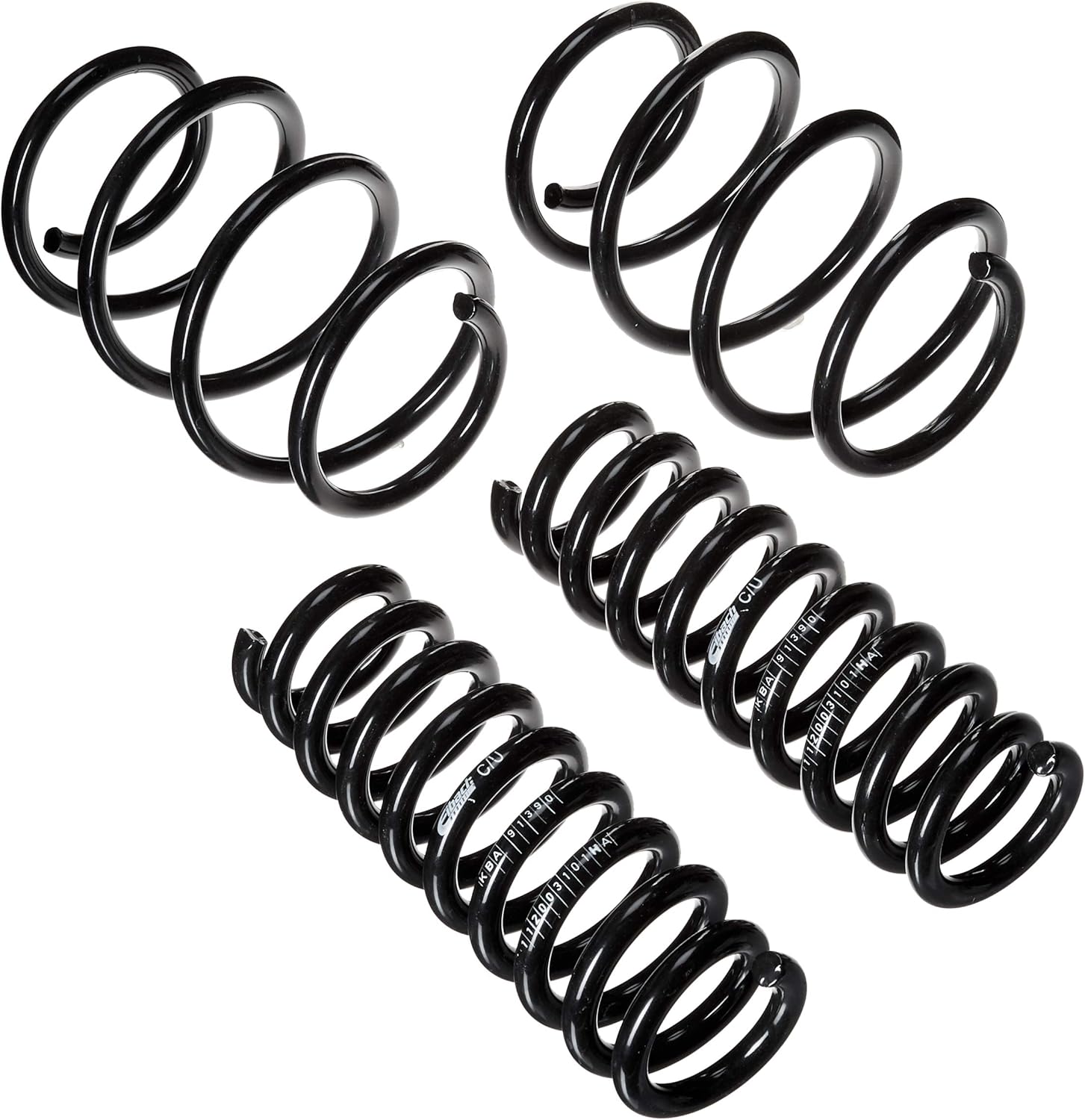
E90/E92 Alignment After Drop
The E9x multi-link rear is particularly sensitive to alignment changes after a drop. At 25mm of drop, expect rear negative camber to increase by 0.4-0.6 degrees. Combined with the stock toe setting, this can produce slight oversteer tendency at the limit and accelerated inner rear tire wear. A good alignment tech will dial in -1.5 to -2.0 degrees rear camber with matched toe settings to compensate. If your shop just does a "quick alignment" and doesn't address the geometric changes from the drop, you're not getting the full benefit and you're probably eating tires.
Front camber on the E90 MacPherson strut is less adjustable - you're looking at OEM eccentric bolts or aftermarket camber plates for meaningful adjustment. The factory front camber is around -0.5 degrees. After a 25-30mm drop you'll typically see -1.0 to -1.2 degrees, which is actually reasonable for street use and helps front-end grip. The concern is if you go past -1.5 degrees front - that's where inner tire wear becomes an issue on street tires.
F30 and F31 3 Series Lowering Springs - B48 and N55 Era
The F30 generation (2012-2019 sedan, F31 wagon, F32 coupe which I'll group here as the architecture is nearly identical) introduced a new chassis that genuinely improved on the E9x in terms of rigidity and NVH but drew criticism for a slightly softer, more comfort-biased suspension tune compared to the outgoing car. That actually makes the F30 a good platform for a spring swap - you have some stiffness headroom to work with before things get harsh, and the car responds well to a modest drop.
Engine-wise the F30 covers the B46/B48 four-cylinder turbos (318i/320i/328i/330i depending on market and power tune), the N55 single-scroll turbo (335i), and the B58 straight-six turbo (340i, making 326 HP from factory). The B58 in particular is an excellent engine that responds well to tuning - if you have an F30 340i and you're not running at least an ECU stage 1 tune, you're leaving real performance on the table. The ECU tuning guide covers what's achievable.
F30 Non-M on Standard and M Sport Suspension
For F30 non-M variants, Eibach Pro-Kit is arguably the class leader. Their F30-specific application is one of the more precisely engineered spring kits I've seen for this chassis - the spring rates are well-matched to the F30's revised multi-link rear, and the drop (approximately 25-30mm front, 20-25mm rear on standard suspension cars) creates excellent stance without touching the bump stops in normal driving.
The F30 M Sport suspension package already drops the car about 10mm from standard. If you have an M Sport car and install standard-fitment Eibach Pro-Kit springs, you're effectively running 35-40mm total drop from the base ride height. That's workable but tight - I'd recommend confirming your garage entry clearance and checking whether you have any particularly aggressive speed bumps on your daily route before committing. The F30 front splitter on M Sport cars is already low enough that aggressive bumps at anything above 10mph can catch it.
H&R Sport springs for the F30 offer a similar drop profile to Eibach, with the slight advantage of their progressive rate helping with impact absorption. For F31 wagons, note that the rear spring rates differ from the sedan to account for the wagon's additional rear body weight. Most manufacturers have separate wagon fitment - always confirm before ordering.
F30/F31 xDrive Spring Considerations
xDrive models (320i xDrive, 328i xDrive, etc.) have different front spring rates from the RWD cars because of the added weight of the front differential and driveshaft hardware. The weight difference is approximately 25-30kg at the front axle, which changes the required spring rate meaningfully. H&R and Eibach both offer xDrive-specific applications. Using the RWD spring on an xDrive front end will result in the car sitting slightly lower than rated (because the heavier car compresses the spring more) and a softer effective spring rate than intended. Not catastrophic but not ideal either. Get the right application.

G20 3 Series Lowering Springs - The Current Platform
The G20 is my personal daily, so I'll spend some time here. The G20 (2019-present, 3 Series sedan, G21 touring wagon) uses the CLAR platform - a modular architecture that BMW also uses for the G30 5 Series and G11 7 Series. The G20 is stiffer, wider, and more technically sophisticated than the F30 it replaced. The front suspension is still MacPherson strut but with a new mounting geometry. The rear is a five-link setup that's considerably more complex than the F30's multi-link, and it shows in the car's behavior - the G20 rear end is more composed and better at managing toe changes during load transfer than any previous 3 Series.
The engine range covers the B46 (in some markets as 320i), B48 (330i, 320i depending on power tune - my 330i makes 255 HP from factory), and B58 (340i-equivalent M340i at 374 HP). The M340i with B58 is genuinely one of the best driver's cars BMW currently makes at any price, and its suspension setup is distinct from the standard cars - it comes with adaptive M suspension as standard in most markets, which means electronically controlled dampers that require different consideration for spring swaps.
G20 Standard and M Sport Suspension
For G20 cars without adaptive suspension (standard suspension or M Sport mechanical suspension), the H&R Sport spring is my personal choice and what I'm currently running. I went with 25mm front, 20mm rear - slightly less rear drop to preserve the car's naturally balanced stance. The spring rate increase over OEM is approximately 20% front and 18% rear, which is modest enough to keep the factory dampers operating well for another 40,000+ miles in my estimation.
The ride quality on H&R Sport springs in my G20 is genuinely good. On the B48 car with 18-inch wheels (standard M Sport fitment), I'd describe it as "focused" rather than "stiff." Small road imperfections are filtered adequately. The car is noticeably more planted in corners - less body roll, better initial turn-in response, and a more consistent feel through long sweepers. These are real differences, not placebo. What you lose is ride comfort over large, sharp impacts - the kind of thing you encounter driving over a pothole edge. Those are noticeably sharper than stock. If your city has particularly bad roads, take that seriously.
G20 M340i with Adaptive M Suspension
The M340i with adaptive M suspension is a different situation. The electronically controlled dampers use position sensors to manage damper behavior in real time. Install shorter springs and the suspension geometry changes enough that the damper ECU can flag faults - typically stored as chassis DTC codes related to ride height sensor plausibility. In some cases you can code these out using ISTA or a BimmerCode equivalent, but you're operating the adaptive dampers in an uncalibrated state, which means the system doesn't actually know where it is in its stroke range. That's not great.
For G20 M340i owners who want to lower the car, the most sensible paths are: (1) coilovers with fully adjustable height so you can set ride height while keeping the adaptive damper sensors satisfied, (2) replacing the adaptive dampers with passive sport units and removing the adaptive system from the equation entirely, or (3) accepting a very small drop (10-15mm maximum) that stays within the adaptive damper's sensor tolerance range. I'd lean toward option 1 - coilovers are the right tool for a car at this price and performance level. The coilover guide covers the best G20 options in detail.
F10 5 Series Lowering Springs - The N55 and B58 Generation
The F10 sedan (2010-2016) and F11 Touring wagon are the 5 Series generation that most current BMW enthusiasts interact with in the used market. Engine options span the N20 four-cylinder (520i), N52/N53 six (523i/525i in some markets), N55 single-scroll turbo (535i), and N57 diesel. The F10 M5 with S63 twin-turbo V8 is a separate animal entirely and probably the most desirable performance sedan BMW has made in the last decade, though it's not typically on street spring shopping lists.
The standard F10 rides higher than the 3 Series and looks better after a modest drop. The typical sweet spot is 25-30mm front, 20-25mm rear. H&R offers their VTF adjustable series for the F10, which is particularly interesting on a bigger car like this because the weight distribution and load variation (full family road trip versus driving solo) means having a bit of height adjustability is genuinely useful.

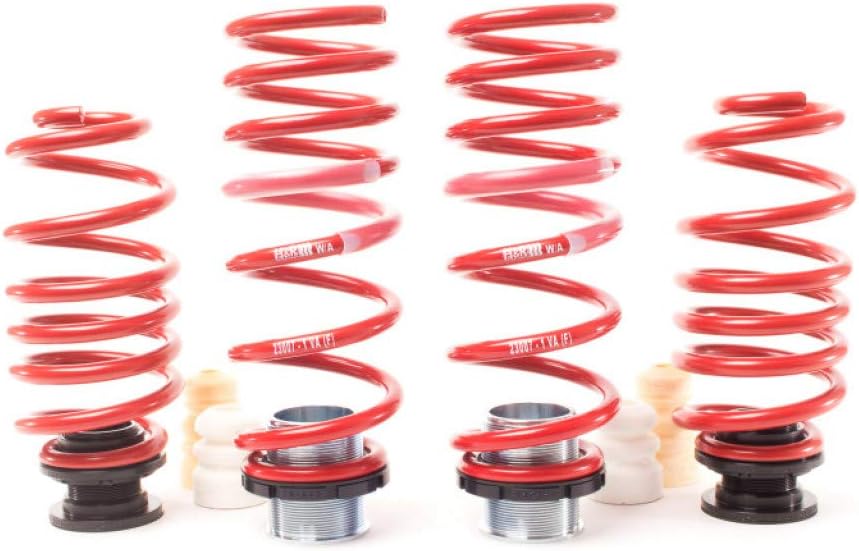
H&R Adjustable VTF Lowering Springs for BMW 528i 535i F10 (2011-2016)
$983.37
The F10 on standard suspension responds very well to quality spring swaps. The front suspension uses double-joint spring strut like the 3 Series but with different geometry, and the rear integral active steering (on equipped cars) is sensitive to large ride height changes. On F10s without active rear steering, a standard spring swap is uncomplicated. On cars with active rear steering (check your build codes), I'd confirm with the spring manufacturer that their kit is compatible - some kit manufacturers have tested and approved their springs with active rear steering, others haven't and the system can produce unexpected behavior after a drop changes the steering actuator's geometric relationship with the knuckle.
The Eibach Pro-Kit for the F10 5 Series has been around long enough to have a strong track record. At roughly $400, it represents good value for a car that benefits significantly from the stance improvement. The F11 Touring needs rear spring rates confirmed separately from the sedan - don't assume they're the same.

F80 M3 and F82/F83 M4 Lowering Springs - S55 Specific
The F80 M3 and F82/F83 M4 (2014-2020) use the S55 twin-turbo inline-six making 425-444 HP depending on variant and market. These are serious performance cars with genuinely well-sorted factory suspension - the M3/M4 Competition Package specifically brings stiffer front and rear springs, revised damper tuning, and 10mm lower ride height than the base M3/M4. If you have a Competition, your starting point is already aggressive.
Lowering an F80/F82 is a more nuanced decision than lowering a standard 3 Series. The factory geometry on these cars is already optimized for performance driving. The front suspension geometry, camber settings, and toe values BMW dialed in for the S55 cars are the result of serious engineering work on the Nurburgring and Bilster Berg. Dropping the car changes that work. For street use, a 10-15mm drop with quality springs can actually improve things - the slightly lower center of gravity and firmer spring rates (most aftermarket springs for the F80 are stiffer than OEM base, though sometimes close to Competition spec) translate to less body roll and better corner entry. Beyond 20mm on street springs, you're compromising track geometry and aggressive driving behavior.

F80 M3 Spring Recommendations
The aFe Power Lowering Springs for the F80/F82/F83 are one of my favorites for this chassis. They're engineered to work with the stock M Sport dampers on the base M3/M4 and deliver a measured 20-25mm drop that keeps the car street-sensible. Spring rates are tuned above the base M car but close to Competition Package spec - a nice middle ground if you have a base M3 and want Competition-adjacent handling without the full expense.
H&R also offers their VTF adjustable series for the F82, which is particularly valuable on M cars because it lets you run a modest street drop most of the time and then reduce it to near-stock for track days where you want full suspension travel. The adjustability range on the VTF is approximately 15-35mm total, handled by threading adjustment on the spring seat rather than a separate sleeve like a coilover. It's not as precise as a proper coilover but it's meaningfully more flexible than a fixed spring.
F82 M4 Sway Bars and Spring Interaction
One thing worth noting on the F82 M4 specifically: if you're upgrading springs, it's worth looking at sway bar upgrades at the same time. The M4's factory sway bars are good but designed around the OEM spring rates. Heavier springs with the factory sway bars can create slightly increased understeer at initial turn-in because the front roll couple is now higher relative to the rear roll couple. An upgraded rear sway bar (H&R makes a direct fit option for the F82) can rebalance this. You don't have to do it, but if you're installing springs on a car you push hard, the full picture of roll couple distribution is worth considering.

Dinan Performance Springs for M3 - The Conservative High-Quality Option
Dinan warrants its own section because its philosophy is different from H&R and Eibach. Where the German manufacturers are optimizing for maximum performance gain at a specific drop amount, Dinan (a Berkeley, California-based BMW tuning house with factory support relationships going back to the 1980s) builds its spring kits around preserving drivability and OEM-quality reliability. The Dinan performance spring set for the E90/E92 M3 with S65 V8 is a good example: it delivers approximately 15-17mm of drop and increases spring rates modestly, with the explicit goal of maintaining the car's original alignment geometry as much as possible.
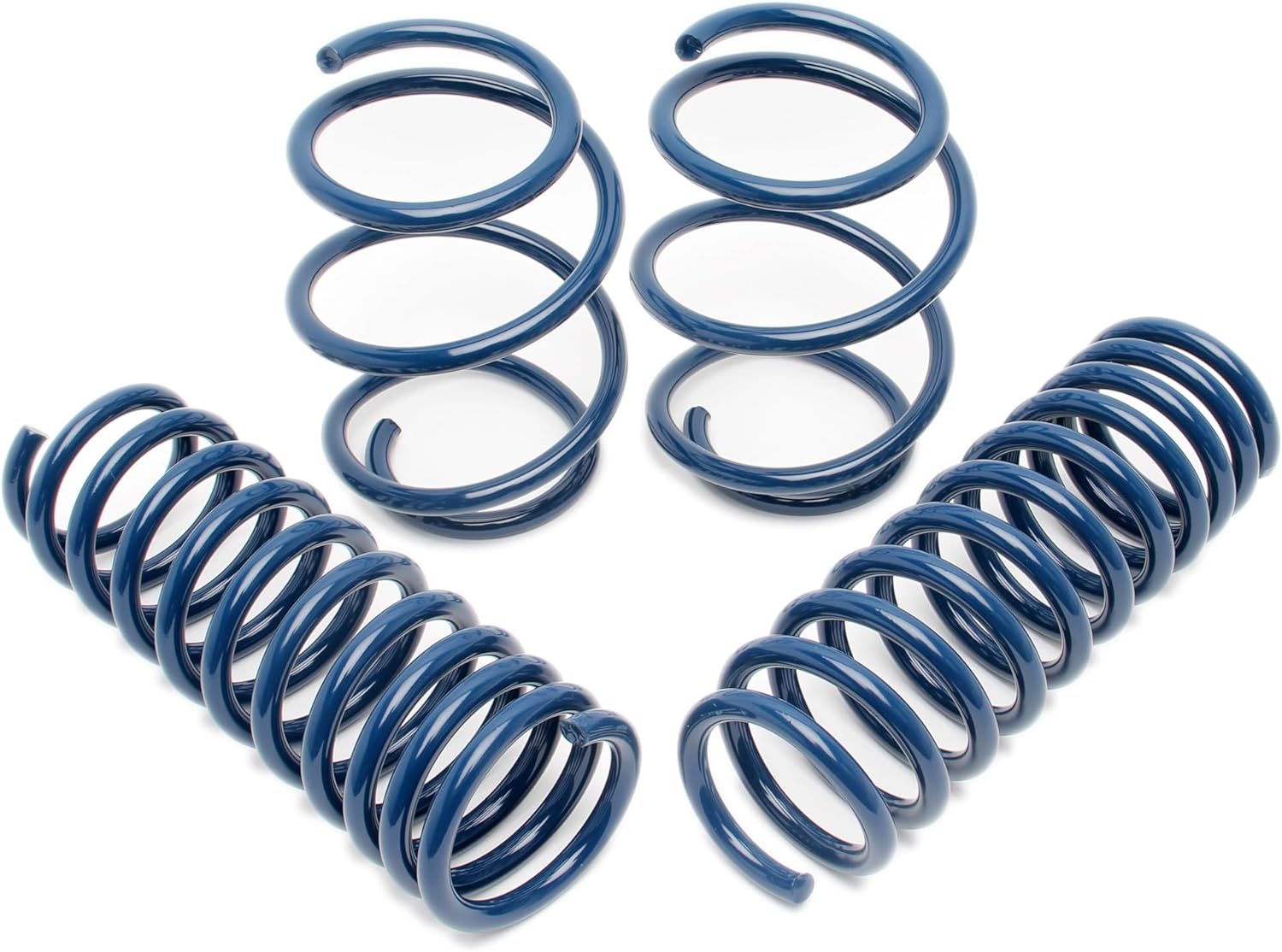
For E90/E92 M3 owners who daily drive their cars and occasionally track them, Dinan springs are a legitimately compelling option. The conservative drop means you don't compromise track geometry, the modest spring rate increase improves on-road composure without harsh ride quality, and the Dinan brand provides some peace of mind if you're worried about compatibility with your car's specific option list. They're priced similarly to H&R and Eibach, so you're not paying a significant premium for the Dinan badge - the engineering approach just happens to be different and more conservative, which is the right call for a car that's already well sorted from the factory.
G80 M3 and G82 M4 - The S58 Generation
The G80 M3 and G82 M4 launched in 2021 with the S58 twin-turbo inline-six making 473 HP (base) and 503 HP (Competition). This is the most powerful BMW M sedan in production history, and the suspension engineering that came with it is correspondingly sophisticated. The adaptive M dampers with M xDrive (on equipped cars) represent a genuinely different engineering challenge for spring swaps compared to any previous M3/M4.
The G80 aftermarket is still developing relative to older chassis - the car has only been on the road since 2021 and meaningful long-term data on spring combinations is still accumulating. The H&R VTF adjustable series for the G87 M2 (which shares CLAR platform architecture with the G80) gives us some proxy data, and the consensus is that the CLAR platform responds well to modest drops of 15-20mm but becomes more sensitive to geometric changes than the F80 due to its more complex rear knuckle geometry.
For G80 M3 owners, my honest current recommendation is to wait for more real-world data before committing to aggressive spring swaps, or go straight to coilovers from a manufacturer who has specifically tested their kit on G80 hardware. The aggressive Competition model (with M xDrive standard) has adaptive dampers that carry the same sensor plausibility concerns I described for the G20 M340i. Track-ready coilovers designed for the G80 are starting to come from KW and H&R, and those will be the more complete solution.
G87 M2 Lowering Springs - The Manual Purist's Car
The G87 M2 (2023-present) deserves specific mention because it's the last BMW M car available with a manual transmission in most markets, and that alone has made it a priority purchase for driving enthusiasts. The G87 uses a detuned version of the S58 at 453 HP and shares its CLAR-based platform with the G80/G82 but in a shorter wheelbase, stiffer body.
AUTO-STYLE has a spring kit for the G87 that delivers modest drop figures appropriate for the car's already-sporty factory setup. At this price point and performance level, I'd generally lean toward coilovers for the G87, but for owners who want to preserve the OEM character with marginal stance improvement, the AUTO-STYLE kit is a reasonable entry-level option. H&R is working on G87-specific VTF springs, and that will probably be the definitive answer for this chassis once it's available with more field data behind it.

BMW X3 and X5 Lowering Springs - SAV Spring Swaps
Sports Activity Vehicles (SAVs, as BMW officially calls them) present a different case study in spring swaps. The primary motivation for lowering an X3 or X5 is usually different from lowering a 3 Series - it's less about aggressive stance and more about reducing body roll and improving high-speed stability. The tall body of an SUV creates a high center of gravity, and while BMW's suspension engineers work hard to compensate for that, there's a physics ceiling. Lowering the CG by 20-25mm makes a meaningful difference in cornering behavior.
X5 E53 and E70
The E53 X5 (2000-2006) is old enough now that spring swaps are often done as much for ride improvement on worn-out OEM springs as for performance. The E53 came with coil springs in the standard configuration (some markets had air suspension as an option - do not put coil springs on an air-suspension E53 without a full conversion kit). H&R makes a well-regarded kit for the E53 that drops approximately 30mm and significantly improves cornering posture.

The E70 X5 (2007-2013) and its E71 X6 sibling use a completely redesigned chassis with integral active steering on higher trims and optional air suspension across a wider range of models. For E70 X5 xDrive without air suspension, H&R offers springs that drop approximately 30mm front and 25mm rear, which substantially reduces body roll and gives the E70 a much more composed character in fast cornering.
G05 X5 - Current Generation
The G05 X5 (2019-present) is the current platform, sharing CLAR architecture with the G20 3 Series and G30 5 Series. The G05 comes with standard air suspension on most trims in North America (the standard coil spring configuration is more common in European markets). Before ordering springs for a G05, confirm you have coil springs - air suspension X5s need an air-to-coil conversion kit, not just springs. The typical G05 coil-spring car benefits from 20-25mm of drop. H&R's kit for the G05 is well-executed and represents probably the best-engineered spring set currently available for this chassis.

X3 F25 and G01
The F25 X3 (2011-2017) and G01 X3 (2018-present) are popular spring swap platforms because the xDrive system and standard coil springs make them relatively uncomplicated. The F25 X3 on standard suspension sits genuinely high and benefits significantly from a modest 20-25mm drop. The G01 is a better platform and starts lower, but still has room for improvement in cornering posture.
Eibach Pro-Kit for xDrive models covers the X3 fitment and is one of the cleaner solutions at around $395. Spring rate increases are moderate, appropriate for a heavier SAV that prioritizes load-carrying capability alongside performance.
| Chassis | Best Spring Pick | Typical Drop Front/Rear | Est. Install Time | Notes |
|---|---|---|---|---|
| E46 (non-M) | H&R Sport or Bilstein B12 | 28-32mm / 28-32mm | 4-5 hrs | Replace OEM shocks concurrently |
| E46 M3 | Dinan or H&R M3-specific | 15-20mm / 15-20mm | 5-6 hrs | Factory ride height already low |
| E90/E92 (non-M) | H&R Sport or Eibach Pro-Kit | 28-32mm / 25-28mm | 4-5 hrs | Confirm Sport Package baseline |
| E90 M3 (S65) | Dinan D100-0917 | 15-17mm / 15-17mm | 5-6 hrs | Conservative drop preserves geometry |
| F30/F32 RWD | Eibach Pro-Kit | 25-30mm / 20-25mm | 4-5 hrs | xDrive needs separate application |
| F10 (N55/B58) | H&R VTF or Eibach Pro-Kit | 25-30mm / 20-25mm | 5-6 hrs | Active rear steering - verify compat. |
| G20 (non-adaptive) | H&R Sport | 20-25mm / 18-22mm | 4-5 hrs | M Sport adds ~10mm drop from base |
| G20 M340i (adaptive) | Coilovers preferred | N/A | 6-8 hrs | Adaptive damper sensor issue |
| F80 M3 (S55) | aFe Power or H&R VTF | 15-20mm / 15-20mm | 5-7 hrs | Competition Pack already lowered |
| F82 M4 (S55) | H&R VTF Adjustable | 15-20mm / 15-20mm | 5-7 hrs | Consider sway bar at same time |
| G80 M3 (S58) | Coilovers preferred | N/A | 7-9 hrs | Still early for spring-only data |
| X5 E53 | H&R Sport | 28-32mm / 25-28mm | 5-6 hrs | Verify no air suspension |
| X5 G05 | H&R Sport G05 | 20-25mm / 18-22mm | 6-7 hrs | Most G05s in NA have air suspension |
| X3 F25/G01 | Eibach Pro-Kit xDrive | 20-25mm / 18-22mm | 5-6 hrs | Confirm xDrive spring application |
E46 (non-M)
- Best Spring Pick
- H&R Sport or Bilstein B12
- Typical Drop Front/Rear
- 28-32mm / 28-32mm
- Est. Install Time
- 4-5 hrs
- Notes
- Replace OEM shocks concurrently
E46 M3
- Best Spring Pick
- Dinan or H&R M3-specific
- Typical Drop Front/Rear
- 15-20mm / 15-20mm
- Est. Install Time
- 5-6 hrs
- Notes
- Factory ride height already low
E90/E92 (non-M)
- Best Spring Pick
- H&R Sport or Eibach Pro-Kit
- Typical Drop Front/Rear
- 28-32mm / 25-28mm
- Est. Install Time
- 4-5 hrs
- Notes
- Confirm Sport Package baseline
E90 M3 (S65)
- Best Spring Pick
- Dinan D100-0917
- Typical Drop Front/Rear
- 15-17mm / 15-17mm
- Est. Install Time
- 5-6 hrs
- Notes
- Conservative drop preserves geometry
F30/F32 RWD
- Best Spring Pick
- Eibach Pro-Kit
- Typical Drop Front/Rear
- 25-30mm / 20-25mm
- Est. Install Time
- 4-5 hrs
- Notes
- xDrive needs separate application
F10 (N55/B58)
- Best Spring Pick
- H&R VTF or Eibach Pro-Kit
- Typical Drop Front/Rear
- 25-30mm / 20-25mm
- Est. Install Time
- 5-6 hrs
- Notes
- Active rear steering - verify compat.
G20 (non-adaptive)
- Best Spring Pick
- H&R Sport
- Typical Drop Front/Rear
- 20-25mm / 18-22mm
- Est. Install Time
- 4-5 hrs
- Notes
- M Sport adds ~10mm drop from base
G20 M340i (adaptive)
- Best Spring Pick
- Coilovers preferred
- Typical Drop Front/Rear
- N/A
- Est. Install Time
- 6-8 hrs
- Notes
- Adaptive damper sensor issue
F80 M3 (S55)
- Best Spring Pick
- aFe Power or H&R VTF
- Typical Drop Front/Rear
- 15-20mm / 15-20mm
- Est. Install Time
- 5-7 hrs
- Notes
- Competition Pack already lowered
F82 M4 (S55)
- Best Spring Pick
- H&R VTF Adjustable
- Typical Drop Front/Rear
- 15-20mm / 15-20mm
- Est. Install Time
- 5-7 hrs
- Notes
- Consider sway bar at same time
G80 M3 (S58)
- Best Spring Pick
- Coilovers preferred
- Typical Drop Front/Rear
- N/A
- Est. Install Time
- 7-9 hrs
- Notes
- Still early for spring-only data
X5 E53
- Best Spring Pick
- H&R Sport
- Typical Drop Front/Rear
- 28-32mm / 25-28mm
- Est. Install Time
- 5-6 hrs
- Notes
- Verify no air suspension
X5 G05
- Best Spring Pick
- H&R Sport G05
- Typical Drop Front/Rear
- 20-25mm / 18-22mm
- Est. Install Time
- 6-7 hrs
- Notes
- Most G05s in NA have air suspension
X3 F25/G01
- Best Spring Pick
- Eibach Pro-Kit xDrive
- Typical Drop Front/Rear
- 20-25mm / 18-22mm
- Est. Install Time
- 5-6 hrs
- Notes
- Confirm xDrive spring application
Springs vs Coilovers - When to Make the Jump
I've referenced coilovers throughout this guide and I want to give a clear answer on when springs are the right choice and when they're not, without being preachy about it. Lowering springs are the right answer for a specific set of circumstances and not for others.
Springs are right when: you want a modest, clean street drop (20-30mm) that looks and handles better than stock; your factory dampers have low-to-moderate mileage (under 50,000 miles) and are in good condition; you're not doing track days where suspension adjustability matters; and your budget is under $500. In those circumstances, a quality spring set on factory dampers is a legitimate, sensible upgrade that will last 40,000+ miles with normal driving.
Coilovers make more sense when: your factory dampers already need replacement (combined cost of springs plus new dampers approaches coilover pricing territory anyway); you track the car and need adjustable damping; you want the ability to change ride height seasonally or for different uses; or you want drops beyond 30mm while keeping geometry sensible. For anything with adaptive suspension, coilovers from a manufacturer who has specifically engineered their kit for that chassis are almost always the better answer because they solve the ride height sensor issues with proper design rather than workarounds.
The math often surprises people. Quality street springs for a G20 cost $380-$430. If the OEM dampers need replacement alongside (common on any car over 60,000 miles), add $250-$400 for Bilstein B4 replacements. You're now at $630-$830 for the combination. Entry-level coilovers for the G20 from a brand like KW V1 or ST Coilovers start at $900-$1,100 and include matched, adjustable dampers designed as a system. The value gap isn't as large as you might think. The coilovers buyer's guide has a full breakdown of that cost analysis by chassis.
Installing Lowering Springs - What You Actually Need
I'm going to be real about the DIY nature of this job. It's doable at home with proper tools, but "doable" and "straightforward" are different things. Compressing MacPherson strut springs requires a proper spring compressor - not the sketchy $30 harbor freight hooks, but a proper dual-hook or cartridge-type compressor that won't slip and send a spring through your face. If you're not set up with quality spring compression tools, take this to a shop. The job is not worth the risk without the right equipment.
What you need for a typical strut-based BMW front end: spring compressor (cartridge type preferred), 18mm and 22mm socket (strut nut sizes vary by chassis - confirm before starting), torque wrench accurate to 20-150 Nm, penetrating oil if the car has any salt corrosion, and something to support the front subframe or lower control arm while you remove the strut. For multi-link rear ends, you'll need a floor jack to support the trailing arm and a selection of 16-22mm sockets plus a torque wrench. Total parts cost for a spring swap is just the springs. Total labor at a shop is typically 2.5-4 hours, call it $250-$450 depending on your region and shop rates.
Critical after installation: get the four-wheel alignment done immediately. Not the next week - that day or the next morning. Every mile you drive with misaligned wheels after a suspension change is degrading your tires and potentially your steering components. Specify to the alignment shop what you've installed and ask them to target specs appropriate for a lowered car rather than just "within spec" - a good shop will understand what you mean. For reference, most lowered street BMWs do well at around -1.0 to -1.3 degrees front camber, 0 to -0.2 degrees front toe (or slight toe-in at -0.1), and -1.5 to -1.8 degrees rear camber with matched rear toe.
Vogtland and Budget Options - What's Worth Considering
Not everyone has the budget for H&R or Eibach, and there are legitimate budget options in the market. Vogtland is a German manufacturer (based in Chemnitz, former East Germany) that makes competent springs at prices typically 20-30% below the top tier. Their catalog covers some older BMW chassis well - the E34, E36, E46 in particular.

Vogtland quality control is generally good. Spring rate data is published. The ride characteristics are slightly more linear than H&R but not in a way that degrades the driving experience meaningfully on older chassis where OEM spring rates were moderate to begin with. If you have an E34 525i or an E36 and you're trying to improve the look and handling without spending $400 on springs for a $6,000 car, Vogtland is a legitimate answer.
Where I would not go with budget springs: any current-generation BMW (F-series or G-series), M cars, or cars with adaptive suspension. The engineering precision required to work correctly with modern BMW chassis electronics and geometry is higher, and the consequences of getting it wrong (sensor faults, accelerated tire wear, handling imbalance) are more serious. On a 2003 E46 330i with simple MacPherson front and Z-axle rear, a Vogtland spring is a sensible budget choice. On a 2018 F30 340i, I'd spend the extra $100 and get H&R or Eibach.
G61 Touring and Newer Platform Considerations
H&R has been quietly expanding their lineup for newer BMW platforms. The G61 520d Touring xDrive - the current 5 Series wagon - represents the direction BMW is going with electrified powertrains and air suspension as standard equipment in some configurations. The H&R spring kit for the G61 (for coil-spring equipped variants) delivers 30mm front and 20mm rear drop, which significantly improves the touring wagon's high stance and body roll characteristics without compromising its load-carrying capability.

As BMW's lineup shifts increasingly toward xDrive all-wheel-drive and toward adaptive air suspension as standard equipment, the traditional spring swap market is being gradually reshaped. The G-series lineup has more electrified and air-suspended variants than any previous BMW generation. Before ordering springs for any current-generation BMW (G20, G30, G05, G22, etc.), the first confirmation needs to be suspension type - coil spring or air. The second needs to be adaptive dampers or passive. Getting both of those questions right before you order saves a lot of frustration.
The Alignment Conversation - Getting It Right After Installation
I've mentioned alignment at least half a dozen times in this guide and I'm going to give it a dedicated section because I've watched too many otherwise good spring swaps get undermined by bad alignment work.
BMW four-wheel alignment requires a shop with a full-length alignment rack (the short racks that only capture front wheels can't do rear camber and toe properly), a technician who understands suspension geometry rather than just "put the numbers in the green zone," and ideally experience with lowered BMWs specifically. The OEM BMW alignment specification assumes OEM ride height. When you lower the car, the geometry changes, and the "within spec" range shown in the alignment software may not represent the optimal setting for your actual ride height and intended use.
For a typical street BMW lowered 25-30mm, target these alignment values as starting points. Front camber -1.0 to -1.3 degrees, front toe 0 to +0.06 degrees total (slight toe-in for stability), rear camber -1.5 to -1.8 degrees, rear toe +0.15 to +0.20 degrees total per side (slight toe-in for stability and reduced snap-oversteer risk). These numbers are starting points - your specific car, tires, and use case may want refinement. A corner-weighted alignment is worth the extra cost if your shop offers it.
For track use, the target numbers shift: front camber -2.0 to -2.5 degrees, rear camber -1.8 to -2.2 degrees, with minimal toe change. But those values assume track-specific tires and are not appropriate for daily street driving where they'll cause rapid inner tire wear. Street and track are genuinely different alignment targets, and if you do both, the ideal scenario is a separate set of wheels for track use that you can align specifically for those values without compromising your street tires.
Specific Brand Deep-Dives on Value
Why H&R's Premium is Usually Justified
I'm going to defend H&R's pricing for a moment because it comes up constantly. "Why pay $420 for H&R when Apex or BC Racing springs are $180?" The answer comes in three parts. First, H&R publishes actual spring rate data for each application - not a range, not "approximately" - the actual rate in N/mm. This matters because it lets you calculate exactly how your suspension geometry will change and whether your factory dampers will be operating in a sensible range. Second, H&R's TUV certification on their springs means they've been tested for fatigue life, corrosion resistance, and dimensional stability under the conditions of European roads (not exactly mild). Third, H&R has been doing BMW-specific development since the E30 era - they have chassis-specific R&D that generic spring manufacturers simply don't invest in.
That said, $420 is $420, and on an older car with a budget, there are reasonable compromises. Eibach Pro-Kit at $350-$395 gets you 95% of H&R's quality at a modest discount. Vogtland on older chassis (E46, E34) is a legitimate choice. Where I'd never compromise is on M cars, cars with adaptive suspension, or cars where spring rate precision matters because you're close to bump stop contact or geometry limits.
F93 M8 and High-Spec Flagship Applications
Worth a brief mention. H&R makes a spring kit for the F93 M8 Gran Coupe Competition, which is a car that essentially nobody would expect to be on a spring modification list. But the F93 in Competition trim at near-$180,000 is genuinely a driver's car first, and the factory suspension, while excellent, has been criticized for being too soft in sport mode for track use without adaptive dampers going to maximum firmness. The H&R springs for the F93 are a niche but genuinely interesting application.

H&R Lowering Springs for BMW 8-Series Gran Coupe F93 M8 Competition
$433.72
Common Mistakes and How to Avoid Them
I want to run through the five most common mistakes I've seen people make with BMW lowering spring projects, because prevention costs nothing and fixing these after the fact costs real time and money.
Wrong Application for Trim Level
Already covered this, but it bears repeating as a mistake category: ordering springs without confirming your specific suspension trim level. The difference between standard, Sport, M Sport, and M Sport Competition suspension baselines can mean your 25mm drop spring delivers anywhere from a barely noticeable change to a car that sits too low to clear your driveway. Get your build codes. Confirm with the manufacturer. Don't assume.
Not Replacing Dampers on High-Mileage Cars
The E90 with 90,000 miles on OEM Sachs dampers and fresh H&R Sport springs is a car that's going to feel inconsistent within six months. The new springs are doing more work than the worn dampers can control. You'll feel the degradation as increasing body bounce over medium impacts and reduced confidence in fast lane changes. The solution is obvious but costs more upfront: replace the dampers when you do the springs on any car past 60,000 miles.
Skipping Alignment
I cannot stress this enough. I've seen this ruin tires and create handling issues that people attributed to "bad springs" when the springs were fine - the car just had 1.8 degrees of rear toe-out from a shock that had moved during installation and nobody checked. Always, always align the car after any suspension change.
Going Too Aggressive on Drop
Covered in depth earlier. Maximum listed drop from a spring manufacturer is not a target. It's an engineering limit. Your sweet spot is probably 60-70% of that maximum. A 10mm more conservative choice preserves ride quality, tire life, and approach angle in a way that's genuinely worth it for a daily driver.
Ordering Without Confirming Air vs Coil Suspension
This is increasingly relevant as more current BMWs ship with air suspension. An X5 G05 in North America is more likely than not to have air suspension. A 7 Series almost certainly does. Some 5 Series do. Springs on an air-suspension car without a conversion kit will not fit correctly and may not compress safely. Always confirm suspension type before ordering.
Frequently Asked Questions
Will lowering springs void my BMW warranty?
In the United States, the Magnuson-Moss Warranty Act means a manufacturer cannot void your entire warranty just because you installed an aftermarket part. However, BMW can and will deny warranty claims for components directly affected by the modification. If your front strut fails after a spring swap, BMW can reasonably attribute that to the spring change and decline to cover it under warranty. If your alternator fails, the spring swap is not a causative factor and the warranty should hold. The practical advice is: if your car has significant warranty coverage remaining, be conservative with spring choices (stick to modest drops from quality manufacturers, replace the springs before any major powertrain warranty work is done). For an out-of-warranty car, this concern is largely academic.
Can I mix H&R front springs with Eibach rear springs?
Technically you can, but I'd advise against it. Front and rear spring rates need to be balanced relative to each other to maintain proper front-rear roll couple distribution. H&R and Eibach tune their respective spring sets as matched front-rear systems - the front rate, rear rate, and drop amounts are calibrated together. Mixing brands creates an unknown roll couple distribution that may produce understeer or oversteer tendencies the manufacturer never tested. If you have a specific reason to mix (one corner is damaged and you have a spare from a different set), it's probably fine temporarily. As a permanent solution, it's suboptimal. Buy matched sets from a single manufacturer.
How much negative camber should I run after lowering?
For street use on a BMW lowered 20-30mm, I'd target front camber between -1.0 and -1.3 degrees. At -1.0 you get better turn-in response than OEM with minimal tire wear penalty. At -1.3 you're at the edge of where a daily-driven tire (particularly a 245/40 or 245/35) will show inner edge wear at normal tire rotation intervals. Rear camber can run slightly higher - -1.5 to -1.8 degrees is appropriate for a street car with a 25-30mm drop, and the multi-link rear suspensions on modern BMWs handle that range well without excessive wear. For track-only use, push front to -2.0 to -2.5 degrees and rear to -2.0 or more. For mixed street and occasional track use, the street values are the smarter daily compromise - you can add negative camber easily if you go to a track day.
Do lowering springs affect my BMW's EDC or adaptive suspension system?
Yes, potentially significantly. BMW's Electronic Damper Control (EDC) system uses ride height sensors to monitor suspension position and adjust damper firmness accordingly. When you install shorter springs, the suspension geometry reference points change. The EDC ECU may interpret the new static ride height as a fault condition and either log diagnostic trouble codes or - more annoyingly - default to maximum firmness continuously to "protect" the system. On some cars this can be addressed through coding (using tools discussed in our coding and diagnostic guide), but the underlying issue of the dampers operating outside their calibrated position range remains. For any BMW with adaptive damping, coilovers are the better engineering solution for ride height changes. Springs on an EDC-equipped car are a compromise solution at best.
How long do aftermarket lowering springs last?
Quality lowering springs from H&R, Eibach, or similar manufacturers are designed for indefinite service life under normal use - the spring itself doesn't really wear out. What wears out is the spring's interaction with other components. Springs can develop micro-cracks from fatigue if the car is driven hard over rough roads for many years. Powder coat can chip and allow surface rust, which over many cycles can weaken the spring. And as discussed throughout, the springs accelerate wear on OEM dampers. For the spring itself, 100,000+ miles on a quality set is entirely reasonable. For the system as a whole, plan to assess damper condition at the 40,000-60,000 mile mark after installation.
Is there a difference between lowering springs for RWD and xDrive BMWs?
Yes, and it matters. xDrive models carry additional front weight from the front differential, driveshaft, and front axle hardware - typically 20-30kg more than the equivalent RWD car at the front axle. Spring manufacturers who do serious BMW development account for this in their rate calculations. An RWD-spec spring installed on an xDrive car will sit approximately 5-10mm lower than its rated drop (the extra weight compresses the spring further) and will have a slightly softer effective rate than intended at that height. For a rough retrofit this might be acceptable, but for proper engineering - and for any spring intended to work with the car's electronic suspension systems - use the xDrive-specific application. Most major manufacturers (H&R, Eibach, ST) have separate application fitments for RWD and xDrive variants of each chassis.
Should I do the alignment at a BMW dealer or an independent shop?
Dealer alignment departments are not automatically better than a good independent shop, and in some markets a quality performance-oriented independent shop will give you a better result because they have more experience with modified cars and understand what target values mean for lowered BMWs versus what "OEM spec" means. The key is finding a shop with a full four-wheel alignment rack (Hunter or Hofmann equipment, four-corner), a technician who understands BMW geometry, and ideally experience with cars at your drop range. Ask them what alignment values they'll target after the drop before you book - a shop that says "we'll just put it in spec" is not the right shop. The right answer is a technician who talks about actual camber and toe targets and understands that OEM spec is no longer optimal at your new ride height.
Will lowering my BMW improve lap times?
On a street car at a track day, probably yes - but not because of the drop itself. The handling improvement comes from the reduced body roll, improved tire contact patch utilization, and crisper steering response that come from firmer spring rates. Those benefits exist regardless of whether the spring is also shorter. What lowering specifically adds is center of gravity reduction, which improves cornering balance and reduces load transfer. For street spring amounts (20-30mm), the CG benefit is real but modest - you're talking 15-20mm of CG height reduction on a car whose CG is already 400-500mm off the ground. It's not nothing, but it's not the primary performance benefit. The spring rate is the bigger contributor. For track-day use, consider whether the spring-and-factory-damper combination gives you enough adjustability, or whether a proper coilover setup is worth it for consistent lap times.
What's the deal with progressive vs linear spring rates?
A linear spring has the same rate throughout its travel - 200 N/mm of resistance whether it's compressed 5mm or 50mm. A progressive spring starts softer and gets stiffer as it compresses. H&R uses progressive rates on their Sport springs (and most quality manufacturers follow similar design). The advantage is dual: at small compression depths (normal road travel), the lower initial rate absorbs minor imperfections better than a linear spring at the same average rate. At larger compressions (hard cornering, large bumps), the increasing rate resists bottoming out and maintains better suspension control. The disadvantage is predictability at the limit - progressive springs can change handling balance slightly as load transfer increases because the effective spring rate at maximum compression is meaningfully higher than at rest. For street use, progressive wins. For track use where predictable, consistent behavior at all loads matters, linear-rate springs on quality coilovers are often preferred by drivers who are pushing hard enough to feel the difference.
Can I lower my BMW wagon or estate without affecting load capacity?
You can lower a wagon (F31, G21, E91 Touring) with springs from the appropriate wagon-specific application, and most quality manufacturers engineer their wagon springs to maintain appropriate load-carrying capability. The key is using the correct application - wagon spring rates are higher than sedan rates to account for the rear body weight and cargo loading. Using sedan springs on a wagon will result in a car that sags significantly under load and potentially hits rear bump stops with moderate cargo. H&R and Eibach both publish separate wagon applications for the 3 Series Touring variants. Confirm wagon-specific fitment before ordering, and be realistic about how much you load the car regularly. If you regularly carry heavy cargo, a more modest drop with appropriate wagon spring rates is the sensible choice over maximum drop.
Ultimately, lowering springs on a BMW are one of the most satisfying incremental mods you can do - they make the car look the way it was always supposed to look, they sharpen up handling that BMW deliberately softened for comfort, and when done with quality parts on the right chassis, they're durable, cost-effective, and reversible. The key is doing the homework: know your chassis code, know your suspension trim, know your mileage on the factory dampers, and pick a spring that matches your actual use case rather than the most dramatic possible drop. Take the time to find a good alignment shop. And if your budget allows and your dampers need attention, go ahead and do the full system properly.
For anything beyond the street spring territory - M cars you track seriously, cars with adaptive suspension, or if you've decided you want real adjustability - visit the coilovers buyer's guide and the suspension coilover section where you'll find platform-specific recommendations with the same level of detail. For the broader performance picture on your platform, the chassis tool can pull your build data and show relevant upgrades for your specific car. Whatever you decide, measure twice, order once, and align the day it goes on the ground.