BMW Thermostat Replacement - Symptoms, Cost, DIY
Affiliate disclosure. BimmerTalk is a proud partner of the Amazon Associates Program and Turner Motorsport. We may earn a small commission on qualifying purchases through our links, at no extra cost to you. Read the full disclosure.

Had a customer roll into the shop a few winters back convinced his 330i's heater core was dead. Cold air blowing at idle, temp needle sitting way under the middle mark, and he'd already ordered a heater core off some parts site. Turned out to be a forty dollar thermostat. I see this exact scenario probably eight or ten times a year on BMWs, and it's almost always the same story - a stuck-open, map-controlled thermostat that the DME can't get to close properly anymore.
This isn't your dad's Chevy with a simple wax pellet that either opens or it doesn't. BMW's been running electrically heated, DME-controlled thermostats since the early 2000s, and when they fail they don't always throw an obvious "check engine" light right away. Sometimes it's just a needle that won't climb, a heater that never quite gets hot, and fuel economy that's crept down half a mile per gallon without you noticing.
I've replaced these on everything from E90s to my own G20, and I've seen the housings crack, the heating elements fail electrically, and the whole unit just give up and stick open. Let's go through what actually happens, how to confirm it before you spend a dime, and what it costs to fix depending on whether you're paying an indy shop or doing it in your own driveway.
$350-550
Indy shop repair
$60-150
DIY part cost
P0128 / 2E7C
Common code
Low or wandering temp gauge
Typical symptom
What a stuck BMW thermostat actually looks like
Before you start throwing parts at this, here's the quick version. If you want the long version with the "why," keep scrolling, but this table is basically what I tell people over the phone.
| Symptom | What's Happening | How Urgent |
|---|
| Symptom | What's Happening | How Urgent |
|---|---|---|
| Low or wandering coolant temp needle | Thermostat stuck open, coolant not staying in the block long enough | Moderate, fix soon |
| Weak cabin heat, especially at idle | Not enough hot coolant circulating through heater core | Moderate |
| P0128 or BMW 2E7C/2E7D code | DME sees coolant temp not reaching target within expected time | Moderate, drive it a bit longer |
| Rich fuel trims, worse MPG | ECU stays in a cold-running fuel map longer than it should | Low urgency, costs you money over time |
| Sudden overheating, needle pegged high | Thermostat stuck closed instead of open, rare but serious | High, stop driving |
Low or wandering coolant temp needle
- What's Happening
- Thermostat stuck open, coolant not staying in the block long enough
- How Urgent
- Moderate, fix soon
Weak cabin heat, especially at idle
- What's Happening
- Not enough hot coolant circulating through heater core
- How Urgent
- Moderate
P0128 or BMW 2E7C/2E7D code
- What's Happening
- DME sees coolant temp not reaching target within expected time
- How Urgent
- Moderate, drive it a bit longer
Rich fuel trims, worse MPG
- What's Happening
- ECU stays in a cold-running fuel map longer than it should
- How Urgent
- Low urgency, costs you money over time
Sudden overheating, needle pegged high
- What's Happening
- Thermostat stuck closed instead of open, rare but serious
- How Urgent
- High, stop driving
Notice that last row is the opposite failure mode. Most of what I see is stuck-open, which is annoying and costs you gas mileage, but a thermostat stuck closed is a different animal entirely and can cook a head gasket in one drive. Know which one you've got before you decide how much you can put off the repair.
How BMW's map-controlled thermostat actually works
Why it's not a simple wax pellet anymore
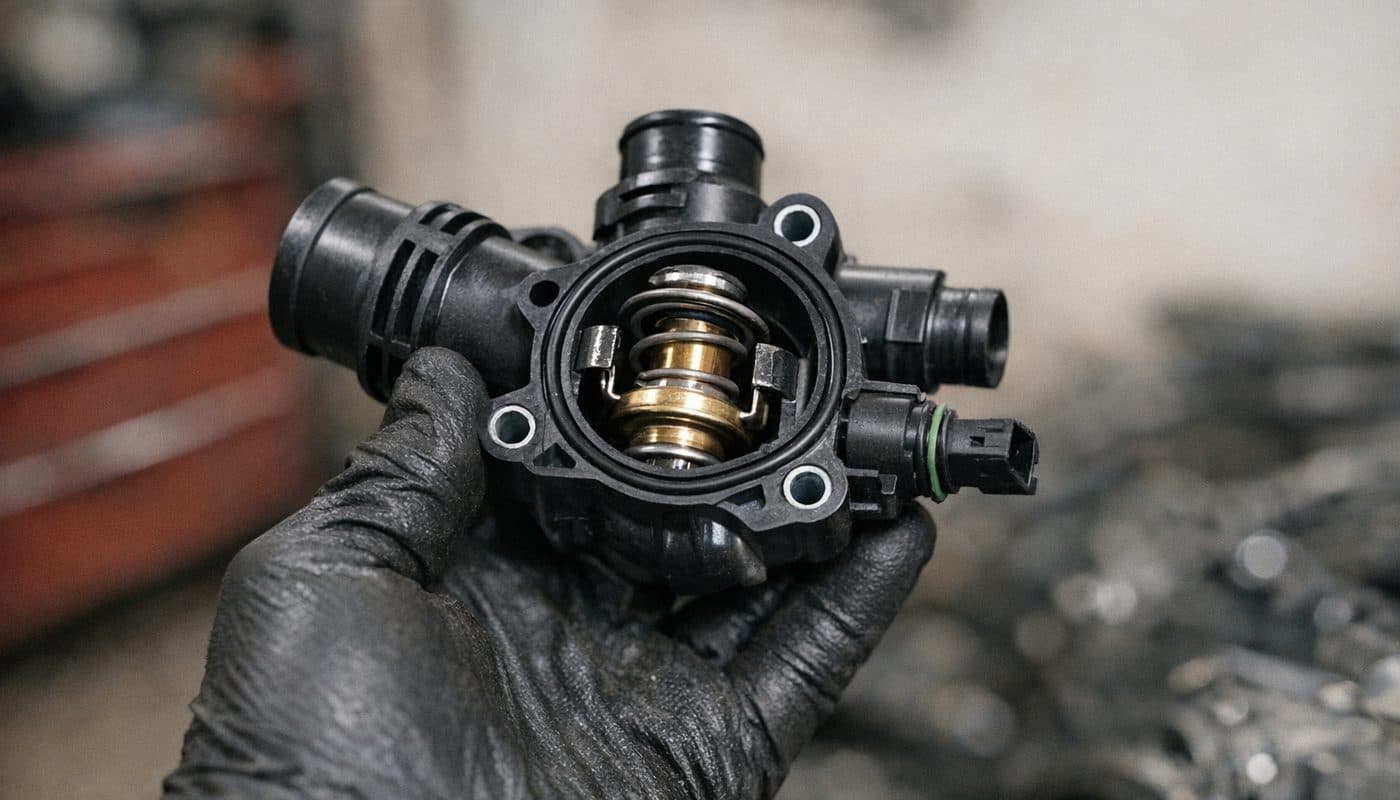
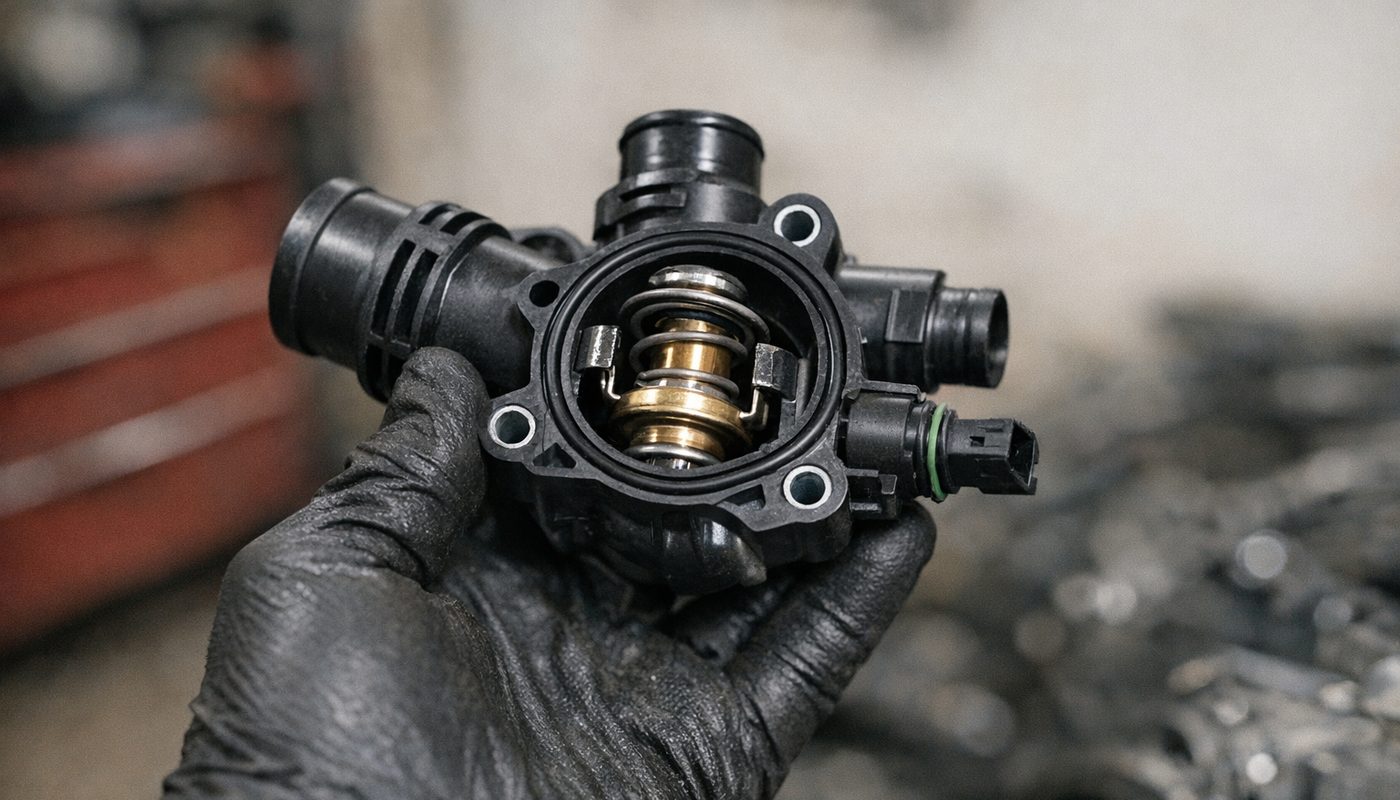
Old-school thermostats are just a wax pellet that expands with heat and opens a valve at a fixed temperature, every time, no matter what. BMW moved to an electrically heated, DME-controlled thermostat starting with a lot of the N52/N54/N55 generation and it carried forward into the N20, N26, and B58 engines too. The idea is smart - under light load and steady cruising, the DME can command the heating element to open the thermostat earlier than the wax alone would, dropping coolant temp slightly to reduce knock tendency and let the engine run a bit more efficiently. Under hard load, it lets temps climb higher for better fuel atomization and less friction.
It's a genuinely good idea on paper. The problem is you've now added an electrical heating element and a connector into a part that lives in 200+ degree coolant for 150,000 miles, and that's exactly the kind of thing that eventually gives up.
What actually fails inside it
Three failure modes I see over and over. First, the heating element itself dies electrically, so the DME loses its ability to control the thing and it just defaults to acting like a dumb wax thermostat, sometimes opening earlier than it should. Second, the wax element itself weakens with age and starts opening at a lower temp than spec, or won't fully close at all. Third, and this is common on N52 and N54 housings especially, the plastic housing itself cracks or the O-ring seats degrade, and now you've got a slow coolant leak on top of the thermostat problem. If you're chasing a mystery coolant loss issue alongside a low-running temp, check out our water pump failure guide too, because the water pump and thermostat share real estate on a lot of these engines and it's common for both to be marginal at the same mileage.
BMW thermostat symptoms - what you'll actually notice
The gauge tells on itself first
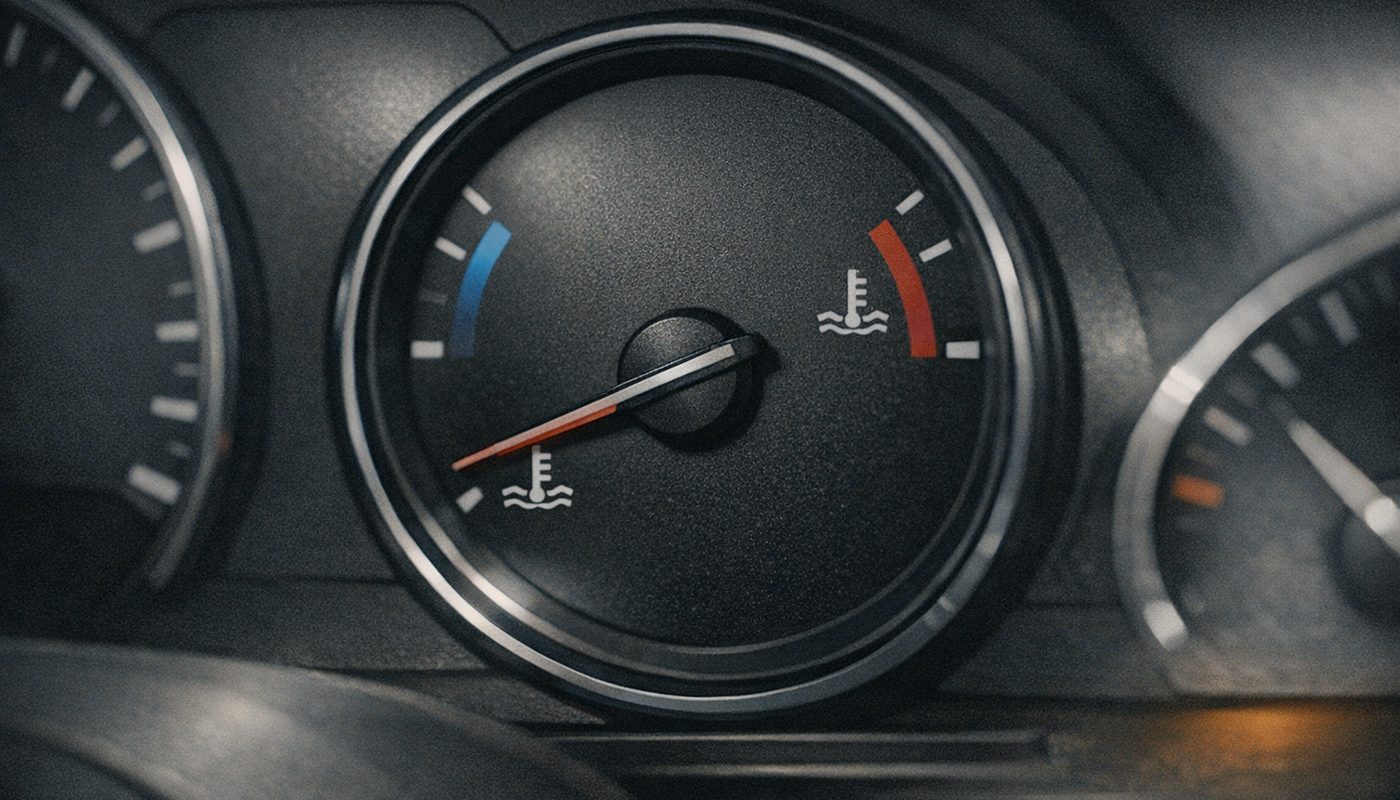
This is usually the first thing an owner notices, even before any warning light. Normal operating temp on most BMWs sits right around the middle of the gauge and stays rock steady there once warmed up. A stuck-open thermostat lets too much coolant flow through the radiator constantly, so the engine can't hold temp. You'll see the needle sitting noticeably below center, or worse, wandering up and down as the DME fights to manage what little control it has left.
Weak heat, especially at idle or in traffic
If your heater blows lukewarm air when you're sitting at a light in January, and it only gets warm once you're cruising at highway speed, that's a coolant temperature problem, not a heater core problem nine times out of ten. The heater core needs hot coolant flowing through it to make heat, and if the thermostat won't let the engine hold temperature, you're never feeding it hot enough coolant to begin with. I'd bet good money that customer with the "dead heater core" I mentioned up top would've saved himself a couple hundred bucks if he'd checked this first.
P0128 and BMW-specific 2E7C / 2E7D codes
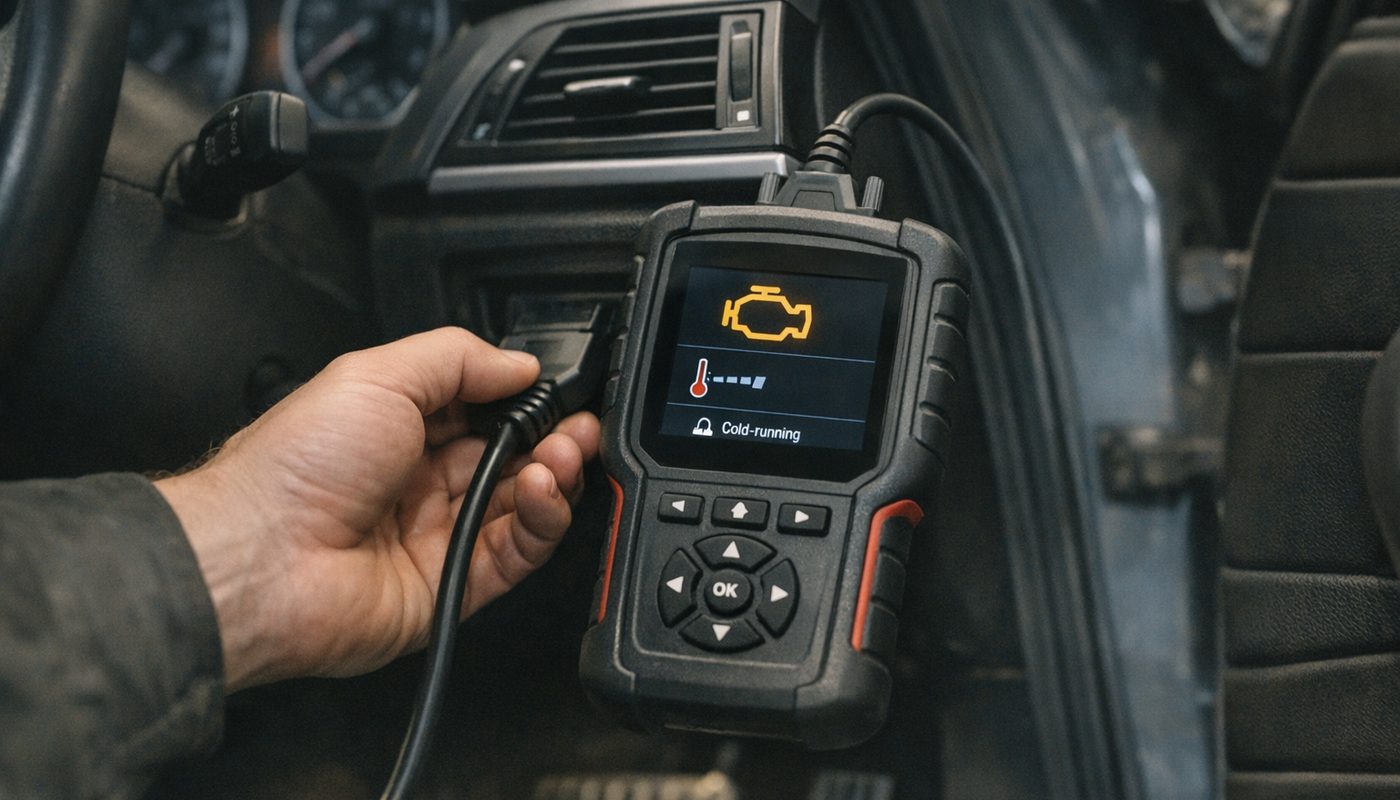
This is where it gets official. P0128 is the generic OBD2 code for "coolant thermostat below thermostat regulating temperature," meaning the DME expected coolant to reach a certain temp within a certain time after startup and it didn't. BMW also throws its own manufacturer-specific codes, commonly showing up as 2E7C or 2E7D, which point more specifically at the thermostat control circuit or the coolant temp not reaching target. If you've got a code reader, pull the actual code rather than guessing. Our fault code lookup tool is a fast way to decode exactly what BMW's telling you before you go buy parts, and if you want the bigger picture on what any check engine light means on these cars, our check engine light guide covers the process end to end.
Worse fuel economy than you'd expect
This one sneaks past people because it's gradual. When the DME thinks the engine is still cold, or can't confirm it's warmed up properly, it runs a richer fuel map to protect against cold-start wear and emissions issues. Richer mixture, longer than it should be, means more fuel burned for the same driving. It's not a dramatic MPG cliff, more like losing 1-2 mpg that you'd only notice if you actually track your fill-ups. Combine that with weak heat and a wandering gauge and the picture gets pretty obvious pretty fast.
Can you still drive it, and will you lose coolant
Driving on a stuck-open thermostat
Short answer, yes, you can drive it, and it won't strand you. A thermostat stuck open just means the engine runs cooler than it should, which is inefficient and not great for long-term wear from incomplete combustion byproducts diluting your oil, but it's not an emergency. I've had customers put a few thousand miles on a car with this exact symptom while waiting on parts or scheduling the repair. I wouldn't make it a permanent plan, but it's not a tow-truck situation.
When it's actually urgent
Flip side, if your thermostat fails stuck closed, that's a completely different situation and you should not keep driving. Coolant can't circulate to the radiator at all, temps spike fast, and you're looking at potential head gasket damage or worse within minutes, not weeks. If your gauge is pegged high and climbing, pull over and shut it down.
Does a bad thermostat cause coolant loss
Not directly, no. The thermostat itself failing open or closed doesn't leak coolant, it just controls flow. Where people get confused is that the housing the thermostat sits in, especially on N52 and N54 engines, is plastic and prone to cracking with age and heat cycling, and that housing absolutely can leak. So if you're seeing low coolant on the dash alongside the low-temp symptoms, it's worth checking the housing itself for weeping or cracks, not assuming the thermostat valve is the source. Our coolant guide walks through how to spot a real leak versus normal top-off levels.
Diagnosing it properly before you buy anything
Pull the actual fault code first
Don't skip this step. A cheap Bluetooth OBD2 reader will tell you within two minutes whether you're actually dealing with a thermostat fault or something else entirely, like a coolant temp sensor that's failing and reporting bad data to the DME, which mimics a lot of the same symptoms but costs about fifteen bucks to fix instead of a hundred fifty.

Veepeak OBDCheck BLE+ Bluetooth OBD2 Scanner - iOS & Android
$41.99
If you want something with a bit more depth, live data logging, and better BMW-specific PID support so you can actually watch coolant temp climb in real time rather than just reading a stored code, I'd step up to something with more capability.

Watch the actual coolant temp PID, not just the gauge
The dash gauge on modern BMWs is intentionally dampened and doesn't always reflect real coolant temp precisely, it's designed to look stable to the driver. Pulling the live coolant temperature PID off the DME gives you the real number. Cold start, you want to see it climb steadily and settle in that 90-105C range within a reasonable warmup period, not stall out at 70-80C and wander.
Rule out the coolant temp sensor
Quick gut check - if your gauge behavior and codes point at cold running but the car otherwise drives fine with no rough idle or misfire, it's most likely the thermostat. If you've also got rough idle, hesitation, or the temp reading looks erratic rather than just low, get the actual coolant temp sensor tested, since a failing sensor reports bad data that fools the DME the same way a bad thermostat does.
BMW thermostat replacement cost
What an independent shop will charge
Figure roughly $350-550 at a solid independent BMW shop for a straightforward thermostat swap, parts and labor included. That range moves around based on how buried the housing is on your particular engine and whether it's a standalone thermostat or a combined unit with the water pump. Dealer pricing runs noticeably higher, often adding another $150-250 on top for the same job, mostly labor rate difference.
What the part actually costs
This is the part that makes DIY tempting. The thermostat housing itself typically runs $60-150 depending on brand and whether it's OEM, Wahler, or Mahle. Wahler units tend to land on the lower end of that range and have a solid reputation in the BMW community, Mahle's a bit pricier but also well regarded. Stay away from the unbranded stuff on marketplace listings for fifteen bucks, I've seen those crack within a year.
| Engine Family | Typical Housing Cost | Shared With Water Pump? |
|---|
| Engine Family | Typical Housing Cost | Shared With Water Pump? |
|---|---|---|
| N52/N54 | $80-140 | Often yes, same service |
| N55 | $70-130 | Sometimes |
| N20/N26 | $60-110 | Yes on many |
| B58 (G20/G05) | $90-150 | No, separate housing |
N52/N54
- Typical Housing Cost
- $80-140
- Shared With Water Pump?
- Often yes, same service
N55
- Typical Housing Cost
- $70-130
- Shared With Water Pump?
- Sometimes
N20/N26
- Typical Housing Cost
- $60-110
- Shared With Water Pump?
- Yes on many
B58 (G20/G05)
- Typical Housing Cost
- $90-150
- Shared With Water Pump?
- No, separate housing
DIY thermostat replacement notes by engine
N52 and N54 - shared territory with the water pump
On these, the thermostat housing sits right at the front of the block near the water pump, and honestly if you're already in there with the coolant drained and the belt off, it's dumb not to check the water pump condition at the same time. Labor overlap is huge - you're paying for access either way. I always tell people doing this themselves to budget for both parts up front even if you only end up needing one, because half the labor is just getting to that corner of the engine.
N20 and N26 - tight but manageable
Turbo four-cylinder cars have a bit less room to work with under the hood, and the housing on these is often combined with water pump plumbing in a single assembly. It's a doable driveway job with basic hand tools and a torque wrench, budget half a day if it's your first time.
B58 - what I've got in my own 330i
The B58 in my G20 uses a standalone thermostat housing separate from the water pump, which honestly makes it a cleaner job than the older turbo fours. Access is decent from the top, and it's one of the more DIY-friendly thermostat jobs in the current lineup. Still, respect the coolant system - it's pressurized and hot, and you need to bleed it properly afterward or you'll trap air pockets that mimic thermostat symptoms all over again.
Bleeding the system afterward matters more than people think
This is the step DIYers skip and then call me confused about why their "new thermostat" still shows low temps. Trapped air in the cooling system reads as erratic temperature behavior and can genuinely fool you into thinking the repair didn't work. Follow BMW's bleed procedure with the expansion tank cap loose or the bleed screw open, run the engine to operating temp with the heat on full blast, and top off coolant level once it's cooled back down.
Should you do the water pump at the same time
If your water pump is anywhere near its typical failure mileage, which for a lot of these engines is somewhere in the 60,000-100,000 mile range depending on whether it's electric or mechanically driven, and you're already elbow deep in the front of the engine for the thermostat, it's genuinely smart to knock both out together. The labor to get to either part overlaps heavily on most of these engines, so paying for access twice is just wasting money. I go into failure signs and mileage expectations in detail in our water pump failure guide, worth a read before you commit to just the thermostat alone.
Coolant type matters more than people realize
Once you've got the housing open, don't just dump in whatever green stuff is on the shelf at the parts store. BMW coolant formulations are specific to protect aluminum components and seals, and using the wrong type can actually accelerate the exact kind of housing degradation that caused your thermostat problem in the first place. Check our coolant type by model guide to make sure you're using the correct spec for your chassis, and our broader coolant guide covers mixing ratios and top-off best practices if you're not doing a full flush.
FAQ
How much does it cost to replace the thermostat in a BMW
At an independent shop, budget roughly $350-550 for parts and labor combined, with dealer pricing running higher. If you're doing it yourself, the part alone typically runs $60-150 depending on brand, and you'll need basic tools plus a way to properly bleed the cooling system afterward.
What are the first signs of a bad thermostat
Almost always it's the temperature gauge sitting low or wandering instead of holding steady at the middle mark, paired with weaker than normal cabin heat, especially noticeable at idle or in stop and go traffic. A cold-running fault code like P0128 or a BMW-specific 2E7C often shows up around the same time.
Can I still drive my car if my thermostat is bad
If it's stuck open, yes, you can keep driving for a while without immediate risk, though you'll be burning more fuel than normal and it's not something to ignore indefinitely. If it's stuck closed and your gauge is climbing high instead of running low, stop driving and get it looked at right away, since that's a genuine overheating risk.
Will I lose coolant if I have a bad thermostat
The thermostat valve itself failing doesn't cause a leak, it just controls flow. Where coolant loss actually comes from is the plastic housing around it cracking with age, which is common on higher mileage N52 and N54 engines especially. If you're low on coolant and running cold, check the housing for weeping or cracks rather than assuming the valve itself is the leak source.
What does the P0128 code actually mean on a BMW
It means the DME expected coolant temperature to reach a target threshold within a certain amount of drive time after startup, and it didn't get there. It's a generic code shared across most manufacturers, but on BMWs it's very commonly paired with the manufacturer-specific 2E7C or 2E7D codes that point more directly at the thermostat control circuit.
Does a bad thermostat affect fuel economy
Yes, and it's often the symptom people notice last because it's gradual. When the DME can't confirm the engine has reached operating temperature, it keeps running a richer cold-start fuel map longer than necessary, which costs you a mile or two per gallon without any dramatic warning.
Is it worth replacing the water pump at the same time
If your water pump is getting up there in mileage or showing any early warning signs, yes. The labor to access either part overlaps so heavily on most BMW engines that doing them separately means paying for the same teardown twice.
Can I diagnose this myself without a shop visit
Absolutely, and it's the smart first move regardless of whether you end up doing the repair yourself. A basic OBD2 scanner will pull the actual stored code in a couple minutes, telling you definitively whether you're chasing a thermostat, a coolant temp sensor, or something else entirely before you spend money on parts.
Bottom line
A BMW thermostat going stuck-open is one of those repairs that sounds scarier than it is once you actually understand what's happening. It's not an emergency, it's not going to strand you, and the fix itself is genuinely one of the more approachable DIY jobs on these engines if you're comfortable with basic wrenching and patient about bleeding the system properly afterward. Pull the actual fault code before you buy anything, don't let anyone talk you into a heater core replacement without checking this first, and if your water pump's due around the same mileage, just do both while you're in there. Stay warm out there. - Kamil