
Coilovers for BMW 3 E36
Affiliate disclosure. BimmerTalk is a proud partner of the Amazon Associates Program and Turner Motorsport. We may earn a small commission on qualifying purchases through our links, at no extra cost to you. Read the full disclosure.


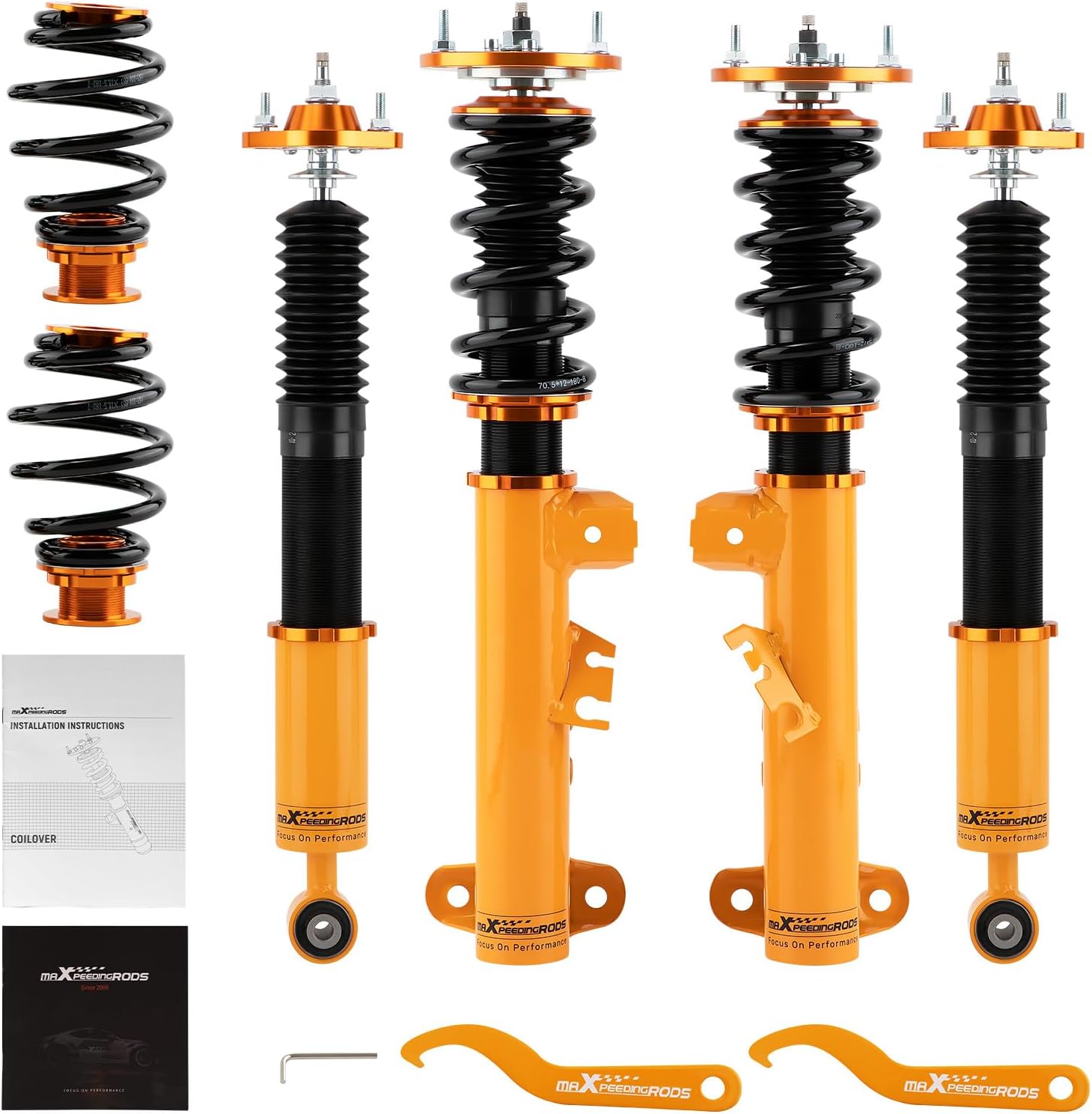
More suspension parts for the BMW E36
If you're shopping for BMW E36 coilovers, you're working with one of the most well-supported chassis in BMW aftermarket history. The E36 - built from 1992 through 1999 in sedan, coupe, convertible, and compact body styles - has been getting suspension upgrades longer than most cars on the road today have existed. The aftermarket knows this car inside and out. That's good news. The bad news is that "well-supported" also means the market is flooded with garbage, and sorting the genuinely useful setups from the budget-trap coilovers that will have you hunting for replacement pillowball mounts in eighteen months takes some effort. I want to save you that effort.
This page covers what you need to know before buying, which brands are worth your money, how the E36's specific geometry affects your choices, and what you should realistically expect out of a coilover setup on a car that's now between 25 and 32 years old. Whether you're building a weekend track car, cleaning up a dedicated drift missile, or just trying to get rid of the stock rubber-bushed floatiness on a daily driver, there's a coilover setup that fits what you're doing - and there are several that absolutely do not.
Why the E36 Gets Coilovers - the Real Reasons
The factory suspension on the E36 was genuinely good for its time. BMW engineers gave this car a proper multi-link rear axle called the Z-axle, a MacPherson strut front, and suspension geometry tuned with real attention to handling balance. The M3 (S50/S52 engine) version in particular has suspension geometry that still holds up as a reference point. But the stock setup has real weaknesses by 2025 standards, and most of them come down to age and design compromises that made sense for a family sports sedan sold new but don't make sense for what most E36 owners are actually doing with these cars today.
The factory struts are almost certainly worn out or close to it on any unrestored example. New OEM-spec replacements are available, but if you're already pulling the front struts and rear shock absorbers, paying for OEM replacements when a quality coilover costs only moderately more makes limited sense. You get height adjustability, rate adjustability on better units, and a chassis that actually responds predictably - something worn OEM dampers absolutely cannot give you.
Beyond wear, the E36 sits tall from the factory. The standard ride height on a 325i or 328i leaves significant wheel gap that looks wrong to any BMW enthusiast's eye and raises the center of gravity enough to affect handling. A modest drop of 1 to 1.5 inches at the front and slightly less at the rear tightens up the visual stance, brings the center of gravity down, and on a well-matched spring rate, actually improves handling. Go further than that without addressing alignment and geometry, and you start fighting the suspension instead of helping it.
There's also the matter of spring rates. The E36's factory spring rates are soft - appropriately soft for a car sold as a comfortable sport sedan, but not what you want if you're running the car at autocross, on track days, or even just on spirited canyon roads. Coilovers let you match the spring rate to your actual use case. That's the upgrade most people don't fully appreciate until they've done it: it's not just about sitting lower, it's about the car responding to inputs with actual precision instead of vague body movement.
E36 Suspension Basics - What You're Working With
Before buying anything, get clear on what the E36 suspension actually consists of, because the front and rear are fundamentally different designs and coilover kits address them differently.
Front suspension
The E36 front end uses a MacPherson strut design. The coilover unit - spring and damper combined - sits inside the strut tower and the bottom of the strut bolts to the spindle/hub carrier. The strut itself carries the spring perch. This is a straightforward design for coilover conversion. Height adjustment on coilovers is achieved by adjusting the lower spring perch up or down on the threaded damper body. Most quality kits give you independent ride height and spring preload adjustment, which matters because you want to set ride height without just cranking preload onto the spring.
The front geometry has a few quirks worth knowing. The E36 uses a relatively small strut tower opening, which means very large-diameter coilover bodies can interfere. Quality manufacturers design around this, but it's worth checking clearance specs if you're running unusually wide springs. The front also has a fairly aggressive camber change through suspension travel, which means that running very low - more than about 2.5 inches of drop - without adjustable front upper mounts or camber plates puts you at significant negative camber at ride height and likely results in uneven and rapid tire wear on the inside edge.
Rear suspension
The rear is where the E36 gets more complex. BMW's Z-axle is a true multi-link design with a separate spring perch on the lower control arm and a separate shock absorber. On the stock car, the spring and shock are not coaxial - they're separate units. Most E36 coilover kits convert the rear to a coaxial coilover design where the spring sits around the shock body. This requires either replacing the spring perch on the lower arm or using a design that mounts the spring to the shock itself, depending on the manufacturer's approach.
This separation matters for a few reasons. First, some budget coilover kits handle the rear conversion poorly - they use designs that load the shock shaft at an angle because the mount geometry doesn't translate cleanly. Second, the rear subframe on the E36 is well-known for cracking around the mounting points, and a stiff rear spring setup on a subframe that hasn't been inspected and reinforced is asking for trouble. More on that in the fitment section.
Body style differences
The E36 came in several body styles and they're not all identical for suspension purposes. The E36/2 coupe and M3 coupe use slightly different front strut geometry than the sedan. The E36/5 compact (the hatchback sold primarily in Europe) uses a different rear suspension design entirely - a torsion beam rear axle rather than the Z-axle multi-link. If you have a compact, confirm that any kit you're considering has a specific compact fitment option, because most kits assume the multi-link rear. The E36 convertible has a reinforced body structure that adds weight and shifts the chassis balance slightly rearward, which some builders compensate for with slightly stiffer rear rates.
The M3 variants - whether you have the European S50-powered car or the North American S52-powered car - have different front strut geometry, wider track widths, and larger brake components. M3-specific coilover kits exist from most manufacturers. Do not assume a standard E36 325i kit fits an M3 without verifying it explicitly.
What to Look for in an E36 Coilover Kit
There are a lot of E36 coilover kits on the market. The price range runs from under $300 for budget import units all the way to $2,500 and beyond for proper adjustable-damping setups. Understanding what separates them is genuinely useful before you spend anything.
Damper adjustability
The most meaningful feature split in coilovers is whether the damping is adjustable. Non-adjustable coilovers - which includes most budget units and even some mid-range ones - have fixed damping tuned at the factory. You get the spring rate and damping the manufacturer chose, and that's what you live with. If their tune happens to match your use case and your specific car's weight, fine. If it doesn't, you have no recourse except buying different coilovers.
Adjustable damping - usually a single knob that adjusts compression and rebound together, though higher-end units separate the two - lets you tune the setup to your use. A single-adjust knob typically gives you 10 to 32 clicks of adjustment on quality units. This matters enormously for street-driven cars where you want some compliance over rough pavement but more control during spirited driving. For dedicated track use, being able to run stiffer settings without the harsh street ride is similarly valuable.
Spring rate choices
Most coilover manufacturers offer their E36 kits in a range of spring rate options or list their standard rates in the product specs. For a street-driven E36 used occasionally at autocross or track days, front rates in the range of 6 to 8 kg/mm and rear rates of 5 to 7 kg/mm are common. Dedicated track builds often run significantly higher - 10 to 14 kg/mm front is not unusual for aggressive track-day setups, though at those rates you need matching alignment, proper geometry, and ideally a more controlled track surface.
The stock spring rates on a base E36 are in the range of 3 kg/mm front and 3.5 kg/mm rear for reference, so even a modest street coilover represents a meaningful increase in rate. This is why the "coilovers make the ride harsh" complaint is often actually a spring rate complaint - cheap coilovers often use excessively stiff rates to give the illusion of performance, when a properly matched rate is both more comfortable and better handling.
Upper mount design
The upper mount is where a lot of coilover kits cut corners or make design choices that affect the car significantly. Street-oriented kits typically use a rubber-bushed upper mount that is softer, absorbs some vibration and noise, and doesn't stress the strut tower as aggressively. Track-oriented kits use either a pillow ball (spherical bearing) mount or a camber plate with a pillow ball. Pillow ball mounts transfer more vibration into the chassis, are noisier on the street, and wear over time - often a few years of regular use - but give you more precise camber control and more direct handling feedback.
For a dual-purpose car, a rubber upper mount with a camber plate option or a soft pillow ball design is usually the right call. For a dedicated track car, full pillow ball mounts front and rear and adjustable camber plates are the standard approach.
Rust and corrosion protection
This might seem like a basic point but it matters enormously on an E36. These cars are old. Any E36 that has lived in a northern climate or near salt water has rust somewhere, and the suspension components are no exception. Quality coilover manufacturers use anodized aluminum spring perches, stainless hardware, and zinc-coated or otherwise protected steel damper bodies. Budget units often use bare steel perches and steel hardware that begins rusting before you've even installed them in a humid climate. If you ever want to adjust ride height after installation, you absolutely cannot have corroded threads. I've seen budget coilover setups where the ride height collars were essentially welded in place with rust after a single winter.
Warranty and rebuild support
Most budget coilover manufacturers sell sealed units with no rebuild path. When the dampers wear out - and they will wear out faster than a quality unit - you replace the whole kit. Premium manufacturers like Bilstein, KW, and Öhlins support rebuilds, and some even have official rebuild programs. On a car you're investing serious time and money into, the long-term cost of ownership matters. A $600 set of coilovers that needs replacing in three years costs more over time than a $1,400 set that can be rebuilt for $300 in year five.
The Top E36 Coilover Options - Real Recommendations
I'm going to be straightforward with you here: I'm giving you my best knowledge of the brands and setups that have genuine track records on the E36. I don't have live current pricing data to cite, so treat any price ranges I mention as general guidance - you'll want to verify current pricing directly with vendors. What I can give you is honest assessment of what's worth considering and why.
KW Variant 1, 2, and 3
KW Suspensions out of Germany makes arguably the most comprehensive coilover lineup for the E36, with their Variant series covering everything from street comfort to aggressive track use. The KW Variant 1 is a fixed-damping street coilover with good quality construction, proper anodized perches, and a well-tuned street ride. The Variant 2 adds rebound adjustability - typically 16-way rebound adjustment - which is genuinely useful for dialing in ride quality on different surfaces without changing the spring rate. The Variant 3 offers independent compression and rebound adjustment and is where the KW lineup becomes legitimately interesting for people who actually want to tune their suspension.
KW makes specific fitment versions for the E36 sedan, coupe, and M3. Their spring rates are well-matched to street and occasional track use. The build quality is German, meaning the hardware and corrosion protection hold up over years of use. Price-wise, expect the Variant 1 to run roughly $1,100 to $1,300, the Variant 2 in the $1,500 to $1,800 range, and the Variant 3 around $2,000 to $2,400 for the E36. These aren't cheap, but they're not overpriced for what you're getting. KW also supports rebuilds through authorized rebuild centers.
One real-world note: KW's street-oriented spring rates for the E36 are conservative enough that the Variant 1 and 2 are genuinely livable on rough pavement. This is not a "coilovers that will rattle your teeth out" situation if you stick within their recommended drop range of roughly 0.6 to 2 inches front and rear.
Bilstein PSS9 and PSS10
Bilstein is one of the most trusted names in performance dampers, and their PSS9 and PSS10 coilover kits for the E36 have been a reference point in the community for years. The PSS9 is a nine-way single-adjust unit (compression and rebound adjusted together) and the PSS10 offers ten-way combined adjustment. Both use Bilstein's monotube damper technology, which handles heat better than twin-tube designs - relevant if you're running hot laps on a track day.
Bilstein's build quality is exceptional, and the monotube design means consistent damping performance as the fluid heats up, rather than the fade you can get from twin-tube units on repeated hard corners. The PSS10 typically runs $1,400 to $1,800 for the E36, depending on the specific fitment variant. Bilstein's rebuild program is well-established. The PSS series uses rubber upper mounts which makes them genuinely comfortable on the street, though you lose some of the precise geometry control you'd get from pillow ball units.
If I had to pick one setup for a well-rounded street/track dual-purpose E36, the Bilstein PSS10 would be near the top of the list. The combination of genuine adjustability, proven monotube damper tech, and street-friendly upper mounts hits a real sweet spot.
Öhlins Road and Track
Öhlins makes the Road and Track coilover series for the E36, and if budget is not your primary constraint, this is the setup most serious E36 track builders are running or aspiring to run. Öhlins uses their own twin-tube DFV (Dual Flow Valve) technology, which behaves more like a monotube in terms of heat management than traditional twin-tube designs. The Road and Track is a single-adjust unit (combined compression and rebound) with 20 clicks of adjustment and spring rates tunable through Öhlins' spring range.
The Öhlins construction quality is on a different level from most of the market. The aluminum bodies, hard-anodized components, and stainless hardware mean these hold up for years without corrosion issues. Öhlins rebuild and re-valve support is among the best in the industry. The Road and Track for the E36 typically costs $2,000 to $2,800 or more depending on current availability and whether you're buying new or finding new-old-stock. That's a significant investment, but if you're building a car you intend to run seriously for years, the total cost of ownership calculation often favors premium units.
The Öhlins Road and Track is not the right choice for someone who wants to set it and forget it at a comfortable street tune. The setup rewards someone willing to actually use the adjustment range and understand what they're tuning. In the right hands, on a properly aligned E36, it's outstanding.
BC Racing BR Series
BC Racing makes one of the most popular mid-range coilover options for the E36, and the BR Series represents a reasonable balance of price and features for someone who doesn't want to spend KW or Bilstein money but also doesn't want to gamble on the cheapest possible option. BC Racing uses 30-way single adjustable damping, aluminum spring perches, and offers optional camber plates. Their E36 fitment is well-documented and they've been making this kit for long enough that most fitment issues have been worked out.
The spring rates BC uses are on the stiffer side - this is common with budget-to-mid-range coilovers as a way of projecting performance. The stock BR Series rates are usable for track-oriented street driving but can feel harsh on bad roads without softening the damping setting. The typical price for a BC Racing BR Series for the E36 runs $500 to $800, which makes them one of the better-value options in the non-budget tier.
The trade-off with BC Racing is build quality relative to the German options. The hardware is adequate but not exceptional. Corrosion resistance is decent in normal conditions but not what you'd see from KW or Öhlins. The damper units are twin-tube and not rebuildable through a straightforward program like Bilstein or Öhlins offers. For a car you're building seriously and keeping long-term, the math sometimes works out better to spend more upfront. But for a first proper coilover upgrade on an E36 budget build, or a car that isn't your primary investment, BC Racing is a reasonable choice.
Fortune Auto 500 Series
Fortune Auto has built a genuine reputation in the E36/E46 community over the past decade-plus for their 500 Series coilovers, which offer serious features at prices below the German alternatives. The 500 Series is a single-adjust twin-tube setup with adjustable spring perches and, importantly, Fortune Auto's own rebuild service. The 500 Series uses relatively conservative spring rates for a mid-range coilover, which translates to actual street usability rather than the "brick on springs" character of cheaper kits.
Fortune Auto is a US-based company, which has two practical implications: customer service is in your time zone and accessible, and their rebuild and respring service is straightforward to use. They make E36-specific fitment including M3 variants. Pricing for the 500 Series typically lands around $700 to $1,000 for the E36, putting them between BC Racing and the KW Variant 2 in cost.
The Fortune Auto 500 Series punches above its price point. The company's focus on the enthusiast market means their spring rates and damping tunes are actually thought out, not just copied from a competitor. The rebuild support means you're not throwing the whole kit away in five years. For a dual-purpose build where you want genuine performance without German-brand pricing, this is one of the most sensible options on the market.
Stance XR1 and ST XTA
Stance and ST Suspensions (related companies) make the XR1 and ST XTA coilovers respectively, which fall firmly in the budget-to-mid-range segment. These are typically priced in the $300 to $600 range and represent the bottom of what I'd consider minimally acceptable for street use on an E36 you care about.
The XR1 and XTA are twin-tube non-adjustable or limited-adjustment units. Build quality is adequate but not impressive. Hardware corrosion is a real concern in wet climates. Damping is fixed at a tuning that works reasonably well for modest street use but isn't remotely suited to track driving. The spring rates are moderate enough to be tolerable on the street in temperate climates.
Where these kits make sense is on a project car or budget build where you need functioning coilovers and OEM replacement-quality parts at BMW-specific geometry, and your total budget for the car doesn't support $1,200 dampers. I would not put these on a car I was tracking, a car I cared about aesthetically having consistent quality, or a car I wasn't prepared to potentially replace within three to four years. But I've seen E36s running these for years without catastrophic failure, so they're not dangerous - just limited.
Tein Flex Z and Street Advance Z
Tein is a Japanese manufacturer with genuine engineering capability and a long history in the E36 market. Their Flex Z and Street Advance Z coilovers sit in different parts of the market. The Street Advance Z is a more street-focused, comfort-biased unit with softer spring rates and a 16-way single adjustment. The Flex Z is stiffer, also 16-way adjustable, and aimed at the sporty street and light track crowd.
Tein has consistently made well-documented E36 fitment kits and their spring rate choices are reasonable. Pricing is in the $600 to $900 range depending on the model. Build quality is better than most budget Chinese options but below the German tier. One genuine advantage of Tein is their support infrastructure - they have US presence, warranty support, and a reasonably functional customer service operation. For someone who wants an adjustable setup without spending KW money and wants more confidence than a generic budget brand, Tein is a viable path.
JRZ and Moton for Serious Track Builds
If you're building a genuine E36 track car - something that's spending significant time on circuits, doing time attack events, or competing in wheel-to-wheel racing - the coilover conversation shifts entirely. Brands like JRZ and Moton make purpose-built motorsport dampers that are fully adjustable, rebuildable, and tunable in ways that street-oriented coilovers simply aren't. These are typically custom-order setups costing $3,000 to $6,000 or more for a four-corner setup, often requiring professional setup and alignment. They are entirely inappropriate for street use. But on a genuine track car where you're investing serious money in the total build, a proper motorsport damper setup will do things a KW or Bilstein simply cannot.
This is not the place to go in detail on motorsport damper setups - that's a whole separate conversation. But if you're in that territory with your E36, know that the broader BMW coilover buyer's guide on BimmerTalk covers some of the motorsport-tier options in more depth.
E36-Specific Fitment Notes - the Details That Actually Matter
The E36 has a few specific fitment considerations that catch people off guard when they're buying or installing coilovers. These aren't hypothetical - they're based on actual common problems in the E36 owner community.
Rear subframe cracking
The E36 rear subframe mounting point cracking is one of the most well-documented chassis issues in BMW history. The subframe mounts to the unibody at four points, and the thin metal around those mounting points is prone to cracking, especially under hard cornering loads or after years of stress. Any E36 being set up for performance use should have the rear subframe mounting area inspected before coilover installation, and ideally reinforced with a subframe reinforcement kit (sometimes called "subframe repair plates" or "subframe gussets").
Stiff coilover spring rates and aggressive driving increase the load on these mounting points. Running a coilover with a rear spring rate significantly higher than OEM without checking and reinforcing the subframe mounts is genuinely risky - the failure mode is the subframe tearing away from the body while driving, which is not a situation you want to experience. Check this before you do anything else with the rear suspension on an E36. This is not unique to coilovers - it applies to any performance spring upgrade - but it's particularly relevant because stiffer springs concentrate more force into those mounting points.
Front brake clearance
Most E36 coilover kits are designed around the stock front brake setup. If you're running larger front brakes - either OEM M3 brakes or aftermarket big brake kits - verify clearance between the coilover spring and the brake caliper. Some big brake setups, particularly 4-piston setups with large rotor hats, can contact the inner spring coils or the damper body at steering lock. If you're on the brake upgrade path as well as coilovers, sort the coilover fitment first and verify caliper clearance before the brake kit purchase, not after.
Wheel offset and lip clearance
Lowering the E36 on coilovers changes the relationship between the wheel's inner edge and the coilover spring. Running a wheel with a lot of positive offset (higher ET) pushes the wheel outward and generally helps clearance. Running a wheel with aggressive negative offset (low ET) or a lot of backspacing pulls the inner lip toward the spring. On a lowered E36, inner spring clearance with aftermarket wheels can be tight. If you're planning to run aftermarket wheels alongside coilovers, get the coilover installed and the car at ride height before finalizing wheel selection, or at minimum get specific clearance measurements from the manufacturer for your target wheel offset.
E36 M3 vs standard E36 fitment
The E36 M3 (E36/2 M3 coupe) has a wider front and rear track than the standard E36, different front strut mount geometry, and larger front brakes as standard. Most major coilover manufacturers make separate SKUs for the M3 versus the standard cars. Do not assume a standard 325i/328i kit fits an M3 or vice versa. The front strut diameters and mounting hardware differ between the two.
There's also the North American M3 consideration. The US-market E36 M3 uses the S52 engine and was sold only as a coupe. The European M3 was sold in coupe, sedan, and convertible body styles with the S50 engine. Suspension-wise, the North American and European M3 coupes share the same basic geometry, but always confirm fitment with the manufacturer using your specific VIN or chassis code if there's any doubt.
Rear spring seat geometry
As mentioned in the suspension overview, the E36 rear suspension uses a separate spring and shock from the factory. When converting to a coaxial rear coilover, the spring perch that attaches to the lower control arm may need specific positioning to avoid binding or abnormal wear. Some budget coilover kits don't execute this conversion cleanly, resulting in side-loading on the shock shaft over suspension travel. Quality manufacturers account for this in their design. If you're evaluating a less-familiar brand, ask specifically how their E36 rear kit addresses the non-coaxial OEM geometry. A vague or dismissive answer is a red flag.
Rear camber considerations
The E36 Z-axle rear suspension has inherent camber built into the geometry, and lowering the car increases rear negative camber. A drop of around 1 inch at the rear typically adds about 1.5 to 2 degrees of negative camber to the rear wheels, in addition to whatever camber was already set. On a street car running moderate tire widths, this is mostly harmless and some additional rear negative camber improves cornering balance. At larger drops - over 1.5 inches - you may want to consider rear camber adjustment links to bring camber back toward a reasonable alignment spec, particularly if you're running wide, expensive tires that you don't want to destroy on the inner edge.
Supporting Modifications When You Install Coilovers
A coilover kit is not a standalone modification. Getting the most out of a coilover installation on the E36 - and protecting the investment - requires several supporting changes. Some are mandatory, some are strongly recommended, and some are situational.
Alignment - this is mandatory
Any time you change the ride height of the car, you need a professional four-wheel alignment. This is not optional. Changing ride height changes virtually every alignment parameter: camber, caster, toe, and thrust angle all shift when the suspension geometry moves to a new static position. Driving on misaligned suspension after a coilover installation will destroy your tires, negatively affect handling, and can stress suspension components in ways they weren't designed for.
Get the alignment done at a shop that has experience with performance BMW setups and knows what alignment targets make sense for a lowered E36. Stock alignment specs are not necessarily the right target for a car running 1.5 inches of drop on performance spring rates. Typical targets for a street-performance E36 run something like -1.5 to -2 degrees front camber, 0 to 0.1 degrees front toe-out, and -1 to -2 degrees rear camber depending on use case and preference. Your coilover manufacturer may have specific alignment recommendations - check those too.
End links
The factory front and rear sway bar end links on the E36 are fixed length. When you lower the car, the geometry of the sway bar attachment point changes, and the OEM-length end links can put the sway bar into a bind or cause it to work at a severe angle that reduces its effectiveness. Adjustable or drop-specific end links are a cheap and worthwhile supporting modification. Many coilover manufacturers include them in their kits, but not all do - confirm before assuming.
Control arm bushings
The E36 front control arms use rubber bushings that are, on most unrestored cars, shot. Coilovers introduce more load into the suspension system, and worn rubber bushings turn that into vague, unpredictable handling rather than the precise feel you're paying for. At minimum, inspect the front lower control arm bushings and the rear trailing arm bushings before or during coilover installation. Replace any that show cracking, compression, or excessive play. Polyurethane replacement bushings are popular and provide more precise handling, with the tradeoff of slightly more noise and harshness through the body. OEM rubber replacements are also available and perfectly suitable for a street car.
Rear shock mounts
The E36 rear shock absorber upper mounts use rubber bushings that wear independently of the shock itself. If you're replacing just the dampers in a coilover conversion (as opposed to the whole strut assembly), inspect these mounts. Failed rear upper mounts cause the familiar "clunking over bumps" that many E36 owners attribute to shock wear but is sometimes the mount itself. Some coilover kits include new rear upper mount hardware; others do not. Budget for replacing these regardless.
Strut tower reinforcement
Front strut tower bars - braces that run from one strut tower to the other across the engine bay - are a common and inexpensive supporting modification for any performance suspension setup on the E36. They reduce flex in the strut tower area under cornering loads, which means the coilover geometry stays more consistent through hard corners. They don't transform the car, but they're a cheap addition that makes sense if you're already investing in coilovers. The E36 engine bay has good clearance for strut tower bars given the smaller engine options in the base cars, though M20/M50/M52/S50/S52 engine sizes all fit different sizes.
Installation Overview - What to Expect
Installing coilovers on an E36 is a reasonable DIY project for anyone with basic mechanical skills, a proper set of tools, and access to a spring compressor. I'd estimate the job at 6 to 10 hours for a first-time installer working carefully, and 3 to 4 hours for someone who's done it before. The front end is straightforward. The rear takes more care given the multi-link geometry.
Tools you need
- Spring compressor - a proper strut spring compressor, not the cheap hook-type. Front disassembly requires compressing the stock spring to remove the strut top nut safely. Coilovers typically come pre-assembled but you may need to set spring preload.
- Torque wrench - strut top nuts, lower strut bolts, and control arm pinch bolts all have specific torque specs. Do not guess on these.
- 17mm, 19mm, 21mm, and 22mm sockets - covers most of the hardware you'll encounter
- Breaker bar or impact wrench - the lower strut pinch bolt on the E36 front end can be very tight, especially on a car that hasn't been apart in years
- Penetrating oil - applied at least the night before to every suspension fastener you plan to remove. This is especially important on an older E36.
- Pickle fork or ball joint separator - useful for separating the front ball joint from the spindle if you need to work on the hub carrier
- Floor jack and jack stands - do not work under a car on a floor jack alone
A useful resource for torque specs and technical service information on the E36 is RealOEM.com for parts identification and the BMW E36 sections of forums like BimmerForums and E30Zone (which covers adjacent generations). The BimmerTalk chassis tool can also help you confirm which specific components apply to your exact E36 variant.
Front installation overview
The front procedure goes: loosen the lug nuts while the car is on the ground, jack the car up and support it, remove the wheel, disconnect the brake line bracket from the strut, disconnect the ABS sensor wire if present, disconnect the sway bar end link from the strut, remove the lower strut pinch bolt (this is usually the fight - use penetrating oil and a long breaker bar), support the hub carrier, and remove the three top strut mount bolts from inside the engine bay. The strut and hub carrier will drop down. Slide the strut out of the hub carrier. Install the new coilover in reverse order. Check that the coilover spring perch lock collar is fully tightened before the car goes back on the ground.
The critical step people rush or skip is setting the ride height before the car goes on the ground and taking an initial measurement. Set the height close to your target, do a quick check measurement, lower the car, and check if the ride height is where you want it before driving anywhere. You'll fine-tune after alignment, but it's much easier to get close before the car is on its wheels than to do major adjustments afterward.
Rear installation overview
The rear is more involved because of the separate spring and shock setup. On the E36, the rear coilover installation typically involves: removing the interior trunk trim to access the rear shock upper mounts, supporting the rear suspension, disconnecting the rear shock at both upper and lower mounts, removing the rear spring from the lower control arm spring perch, installing the new coilover unit through the spring perch opening in the lower arm, and attaching the upper mount. The specific procedure varies somewhat by coilover brand and whether the kit uses a coaxial spring design or retains a separate spring location.
Follow your specific kit's installation instructions carefully. This is one case where generic procedures don't substitute for manufacturer instructions, because the rear installation details vary enough between kits that you can make significant errors working from generic information.
Break-in period
New coilovers benefit from a short break-in period where you avoid maximum suspension loads - hard launches, aggressive curb drops, full-compression hits - for the first few hundred miles. This lets the damper seals seat properly and gives you time to identify any strange noises or behaviors before they become problems. After a few hundred miles, revisit all the torque specs (fasteners can settle slightly on a new installation) and recheck ride height (spring settle is real, especially on fresh springs).
Common Mistakes E36 Owners Make With Coilovers
I've watched enough E36 builds go sideways over the years that I can give you a reliable list of things not to do. Most of these are obvious in retrospect but not obvious when you're excited about a new suspension setup.
Going too low
The temptation to run as much drop as possible is real, especially on a car as visually satisfying as a lowered E36. Resist it. More than about 2 inches of drop on the E36 causes significant geometry problems: extreme negative camber up front that kills the inside tire edge, compromised suspension travel that has you bottoming out on normal road irregularities, potential subframe contact, and degraded handling because you've put the suspension geometry so far out of its designed range that all the clever engineering BMW did with the Z-axle is now working against you. A 1 to 1.5 inch drop gives you a meaningful visual change and a substantial handling improvement without compromising the geometry. If your goal is purely visual, do that - but understand you're trading away handling in exchange for stance, and budget for the accelerated tire wear that comes with extreme negative camber.
Skipping the alignment
I know I covered this already but it's worth repeating because people still skip it. I have spoken to E36 owners who drove for weeks on misaligned suspension after a coilover install because "the car seemed fine." It's not fine - you're just wearing tires unevenly and loading the wrong things. Get the alignment done immediately. Budget for it before you buy the coilovers, not as an afterthought.
Maxing out preload instead of adjusting ride height
On a threaded body coilover, you have two ways to "raise the car": you can thread the lower spring perch up (adjusting ride height directly) or you can preload the spring by tightening the spring against the perch without raising the perch. Preloading the spring does not effectively raise the car - it changes the spring rate (by effectively running it as a shorter spring) and stresses the spring without giving you the ride height you think you're getting. Always set ride height by adjusting the perch position, not by cranking preload. The spring should have minimal to no preload (just enough to keep it from rattling in its seat) in a properly set-up coilover.
Buying budget coilovers for a track car
I mentioned this in the product section but it bears emphasis: if you're tracking the car, budget coilovers are false economy. Track driving generates far more heat and stress than street driving. Cheap twin-tube dampers fade under repeated heat cycles - you'll feel the car handling worse on lap two than lap one, and significantly worse by lap five. Track use also accelerates damper wear dramatically. Spending $500 on a budget set that needs replacing in one track season ends up costing more than spending $1,500 on a Bilstein or KW setup that runs for years with proper maintenance. If budget is a genuine constraint, buy the right coilovers second-hand rather than buying the wrong ones new.
Ignoring the rest of the suspension
Coilovers on a car with worn control arm bushings, loose ball joints, worn tie rod ends, and failed wheel bearings are going to underperform. The coilover can only control what the rest of the suspension lets it control. Spend some time inspecting every other suspension and steering component before or during the coilover installation. The E36 is old enough that almost any unrestored example has at least some worn components. Budget for this. A full E36 front and rear suspension refresh - new control arm bushings, end links, ball joints, tie rod ends, and wheel bearing inspection - can be done for $400 to $800 in parts on a DIY basis and transforms the car more than coilovers alone will.
Not checking the rear subframe before installation
Covered earlier but critical enough to list again. Check the rear subframe mounting points before installing any performance suspension. If you find cracking, repair it before proceeding. The repair plates are inexpensive - typically $30 to $80 for a quality reinforcement kit - and the welding work is straightforward for any competent shop. The alternative is a subframe separation at speed, which is far more expensive in every sense.
Editor's Picks - My Specific Recommendations by Use Case
Rather than making you sort through the brand summaries above, here are my specific recommendations by use case. These are genuine opinions based on what I know of these products and what I'd actually tell a friend building an E36.
Editor's Pick - Best All-Around
For a car that does real street miles and sees occasional track days or autocross events, the Bilstein PSS10 is my first recommendation. The monotube dampers handle heat better than twin-tubes, the 10-way adjustment range covers the street-to-track spectrum usefully, the rubber upper mounts keep it street-livable, and Bilstein's rebuild program means you're not throwing money away when the dampers eventually wear. It's not the cheapest path, but it's the most sensible combination of quality, performance range, and long-term value.
Best Value
For the owner who wants a genuine performance upgrade on a real budget, the Fortune Auto 500 Series represents the best value in the E36 coilover market. You're getting a thoughtfully tuned kit from a company that actually understands BMW suspension, with rebuild support and spring rate options that make sense for street use. If Fortune Auto is outside the budget, the BC Racing BR Series is the next step down in value - usable for street and light track, well-documented fitment, and widely available.
Best Track Setup
For a dedicated track car or a car that does more laps than street miles, the Öhlins Road and Track is the answer if you're willing to invest properly. The DFV technology handles heat and repeated compression cycles better than most alternatives in the non-motorsport tier. The adjustment range and rebuild support make it a genuine long-term performance investment. If the Öhlins budget is out of reach, the KW Variant 3 with independent compression and rebound adjustment is the next best option for a serious track setup.
Best Street Daily
For an E36 that's genuinely used as a daily driver on imperfect roads, the KW Variant 1 is worth considering. The conservative spring rates and well-tuned fixed damping make for a street ride that's actually comfortable while providing a meaningful handling upgrade over stock. You give up adjustability but gain a setup that works well out of the box without fussing with 30 clicks of adjustment on your morning commute. The Tein Street Advance Z is an alternative at lower cost with the addition of soft damping adjustment that lets you take edge off the ride on particularly rough roads.
Brand Comparison Table
| Brand / Model | Approx. Price (USD) | Damper Type | Adjustment | Best For | Rebuild Support |
| KW Variant 1 | $1,100 - $1,300 | Twin-tube | None (fixed) | Street daily | Yes |
| KW Variant 2 | $1,500 - $1,800 | Twin-tube | Rebound only (16-way) | Street / light track | Yes |
| KW Variant 3 | $2,000 - $2,400 | Twin-tube | Separate comp. and reb. | Track / serious street | Yes |
| Bilstein PSS10 | $1,400 - $1,800 | Monotube | Combined 10-way | Street / track dual-purpose | Yes |
| Öhlins Road and Track | $2,000 - $2,800+ | Twin-tube DFV | Combined 20-way | Track / enthusiast | Yes (excellent) |
| Fortune Auto 500 | $700 - $1,000 | Twin-tube | Single adjust | Street / autocross | Yes |
| BC Racing BR | $500 - $800 | Twin-tube | 30-way single | Street / budget track | Limited |
| Tein Street Advance Z | $600 - $900 | Twin-tube | 16-way single | Street daily | Limited |
| Stance XR1 | $300 - $500 | Twin-tube | None or limited | Budget / project car | No |
How Coilovers Interact With Other E36 Performance Upgrades
Suspension work doesn't exist in a vacuum. If you're building an E36 that goes beyond the coilover purchase, here's how coilovers interact with other common upgrades.
Wheels and tires
The most impactful pairing with coilovers is a proper tire upgrade. Lowering the car and running performance spring rates on narrow, all-season tires is genuinely pointless - the tires become the limiting factor almost immediately. The E36 handles well with 225/40 or 225/45 rubber on a properly sized 17-inch wheel. A sticky summer performance tire on a well-setup coilover suspension transforms the car in a way that either modification alone doesn't. Check out the aftermarket wheels section at BimmerTalk if you're planning a combined suspension and wheel upgrade.
Brakes
Better brakes don't directly interact with coilover function, but they're a natural pairing for any car being used more aggressively. The E36's stock brakes are adequate for street use but fade quickly under track conditions. If you're spending money on coilovers to improve track performance, a brake upgrade - at minimum high-performance brake pads - is a logical companion investment. The brake pad section on BimmerTalk covers the E36-compatible options.
Engine modifications
If you're modifying the engine for more power - whether through an intake upgrade or more involved modifications - understand that more power means more weight transfer under acceleration and braking, which puts more demand on the suspension. Spring rates and damping tunes that work well at stock power levels can feel too soft on a car making significantly more power. This is a secondary consideration on most street builds but relevant if you're planning a significant power increase alongside suspension work.
Sway bars
Upgraded sway bars work directly with coilovers to tune handling balance. The E36's stock sway bars are modest in diameter, and many builders pair coilovers with thicker sway bars - front, rear, or both - to tune understeer and oversteer balance. A stiffer front bar relative to the rear promotes understeer (more stable, less fun). A stiffer rear bar promotes oversteer (more fun, requires more skill to manage). For autocross and track use, having adjustable sway bars alongside adjustable coilovers gives you a powerful toolkit for tuning handling balance to specific surfaces and driving styles.
Frequently Asked Questions About BMW E36 Coilovers
What drop should I run on my E36?
For street use, a 1 to 1.5 inch drop is the practical sweet spot. You get the visual improvement, a lower center of gravity, and better handling without compromising suspension geometry, ride quality over real-world roads, or tire wear. Many experienced E36 builders end up at around 30 to 35mm of front drop and 25 to 30mm of rear drop, which gives a slightly raked stance that looks right and keeps the front negative camber at manageable levels. If you're going further than 2 inches, make sure you understand what you're trading away and have the supporting modifications in place.
Can I use E36 coilovers on an E36/5 compact?
No, not without verifying specific compact fitment. The E36/5 compact uses a torsion beam rear axle rather than the Z-axle multi-link, which means rear coilover kits designed for the standard E36 sedan and coupe simply do not apply. Some manufacturers make compact-specific kits; others don't support the compact at all. Always confirm fitment for compact variants specifically.
Do I need camber plates on the E36?
For a street car at modest drop - under 1.5 inches - stock upper mount geometry with adjustment through the eccentric alignment bolts (on models that have them) is usually enough to achieve proper alignment. At larger drops or for a track car where you want maximum adjustable negative camber up front, adjustable camber plates become useful. Most coilover manufacturers offer optional camber plate upper mounts for the E36. If you're on the track with any regularity and want the ability to run specific camber settings, camber plates are worth adding. For a purely street car at mild drop, they're not required.
How long do E36 coilovers last?
This depends entirely on the quality of the kit and how you use the car. Budget coilover dampers might start to feel worn in as little as 30,000 to 50,000 miles of regular street use, or after two to three track seasons. Quality Bilstein or KW units can last 80,000 to 100,000 miles of street use before feeling noticeably degraded. Öhlins units with proper maintenance can last even longer. Signs of worn dampers include: excessive body roll compared to when new, bottoming out more easily than before, and a wallowy or imprecise feel over bumps. If you have rebuildable dampers, rebuilding them at around the 80,000 mile mark is generally good practice.
Can I install E36 coilovers without a lift?
Yes, the job is absolutely doable on jack stands in a driveway with the right tools. The E36 front end is one of the more accessible strut designs on any car from this era. You'll want good jack stands (not cheap ones - the car needs to be stable while you're under it), proper penetrating oil applied the night before, and patience with the lower strut pinch bolt. The rear is more involved but also doable without a lift. A spring compressor is mandatory for front disassembly if your coilovers don't come pre-assembled. Don't attempt this without one.
Are coilovers better than lowering springs for the E36?
For most performance-oriented E36 owners, yes - but it depends what you're optimizing for. Lowering springs paired with quality stock-replacement dampers (Bilstein B6/B8 sport shocks, for example) can give a good street result at lower cost than a full coilover setup. The arguments for coilovers are: height adjustability so you can tune the stance after alignment, the ability to upgrade spring rates independently, and the availability of adjustable damping setups that lowering spring combinations don't offer. For a street car where you want mild drop and a comfortable ride, springs plus sport shocks is legitimate. For anything more involved, coilovers give you more control.
What spring rates are right for my E36 build?
This depends on your specific car (M3 is heavier than a 318i, convertible is heavier than a coupe) and your use case. As a general framework: 4 to 6 kg/mm front and 3.5 to 5 kg/mm rear is the street comfort range. 6 to 8 kg/mm front and 5 to 7 kg/mm rear covers the street-performance to autocross range. 8 to 12 kg/mm front and 7 to 10 kg/mm rear is the track day range. Beyond that gets into dedicated motorsport territory. When in doubt, err on the softer side for street use - a spring rate that feels too stiff will ruin your experience every commute, while a spring rate that could theoretically be stiffer will still be a substantial improvement over stock.
Do I need to change anything else when installing coilovers?
At minimum: professional alignment is mandatory. End links should be checked and likely replaced. Control arm bushings should be inspected and replaced if worn. Rear subframe mounting points should be checked for cracking. Beyond that, wheel bearings, ball joints, and tie rod ends are all worth inspecting since you're already in the suspension. I'd also budget for a set of fresh lug bolts or at least a careful inspection - E36 lug bolts are known to stretch with age and heating cycles. The full suspension section at BimmerTalk covers the supporting components in more detail.
Is the E36 M3 coilover installation different from a standard E36?
Yes, in significant ways. The M3 has wider front and rear tracks, different front strut diameters and mounting geometry, and larger standard brakes. Use only M3-specific coilover kits, confirm the fitment with the manufacturer using your specific M3 variant, and verify brake clearance given the M3's larger stock calipers. Installation procedure is broadly similar but uses different hardware specs in several places.
Will coilovers affect my E36's resale value?
Honestly, yes - but the direction depends on the buyer. To the enthusiast market that most E36 buyers now come from, quality coilovers installed properly and aligned correctly are a positive. Cheap or incorrectly installed coilovers are a red flag. If resale is a consideration, keep the stock suspension components and document the coilover installation with photos, brand information, and the alignment printout. A buyer can see that you did the job properly and paid for quality parts. An E36 with documented quality upgrades installed correctly is more desirable than an unmodified car to most of the people shopping for these cars today.
What do I do if my E36 coilovers rattle or make noise?
First, identify where the noise is coming from. Front rattles over bumps are usually end links, strut top nut torque, or a pillow ball upper mount that's worn. Rear knocking is often the rear shock upper mount or improperly seated spring. A creak or squeak through cornering is usually a dry bushing somewhere in the suspension - often the front lower control arm bushings. Noise after coilover installation that wasn't present before is almost always a torque or seating issue - go back through every fastener with a torque wrench before assuming anything is broken. A loose strut top nut is the single most common cause of front suspension noise after installation.
Can I run an E36 coilover setup for drifting?
The E36 is a popular drift platform and coilovers are a standard first modification for any drift build. For drifting specifically, the priorities shift somewhat from a grip-oriented track setup: you want a relatively stiff front end to promote initial oversteer, softer rear to allow the tail to slide smoothly without snapping unpredictably, and maximum front negative camber to allow large steering angle without scrubbing the front tires. Drift-specific coilover tuning often runs higher front spring rates and lower rear spring rates than a grip setup would use. BC Racing and Fortune Auto are both popular in the drift community for their adjustability at reasonable cost. The main coilovers section on BimmerTalk has more on drift-specific suspension builds.
Getting the Most Out of Your E36 Coilover Investment
Once the coilovers are in and the alignment is done, there are a few habits that will protect your investment and keep the car handling well over the long term.
Check ride height periodically in the first few months after installation. Springs settle - this is normal - and you may find the car is sitting 5 to 8mm lower after the springs have cycled through a few hundred miles. If your coilovers are threaded correctly and the collars aren't corroded, adjustment is a fifteen-minute job. If you're running a quality kit with corrosion-protected perches and you apply a light coating of anti-seize to the threads during installation, adjustments stay easy. If you're running a budget kit and you skipped the anti-seize, good luck in six months.
If you have adjustable damping, actually use it. Spend a drive on the softest setting, then try the stiffest setting on the same route, then find where you want to live between them. Most people set adjustable coilovers when they install them and never touch the adjustment again - that's fine if the default setting works for you, but you paid for adjustability so you might as well use it to dial the car in for how you actually drive.
Get an alignment check annually or any time you notice handling changes. Potholes, curb impacts, and normal suspension wear all shift alignment over time. An annual check at a shop that knows performance BMW geometry takes an hour and costs $80 to $150. It's cheap insurance on a car where you've invested real money in the suspension.
If you're also exploring other upgrades alongside the coilovers - whether that's ECU tuning for more power or looking at proper aftermarket wheels to complete the build - the suspension should come first in the priority order. A better-handling E36 on stock power and stock wheels is more fun and more satisfying to drive than a more powerful E36 that handles like a boat. Get the suspension right first, then build everything else around it.
The E36 is genuinely one of the best platforms for learning about suspension setup because the car is light, the geometry is well-understood, the community knowledge base is enormous, and the parts are widely available. A properly sorted E36 on quality coilovers, aligned correctly, with fresh bushings and a set of sticky tires is a car that will outperform vehicles with twice the power. That's the appeal of this chassis, and it's why people are still building them thirty years after BMW started making them. Do the upgrade right and you'll understand exactly why.

Kamil Siegień
Founder of BimmerTalk. Five years wrenching on BMWs, currently dailying a G20 330i with the B48 turbo four. Spent a year doing marketing for BMW and MINI before going independent. I write everything on this site myself.
More about the site
BMW Coilovers - Lower, Stiffen, and Dial In Your Chassis
A quality coilover kit is the single most impactful suspension upgrade you can make to your BMW. Done right, you get adjustable ride height, tunable damping, and handling that stock suspension engineers were never allowed to deliver - whether you're building a track-day E46 M3, lowering a daily-driven F30 328i, or turning your G80 M3 into a canyon carver. Done wrong, you get a harsh, trampy ride and worn tires. Here's what you actually need to know before buying.
Choosing the Right Coilovers for Your Chassis
Not all coilovers are built equal, and fitment is everything with BMWs. The E9X 3 Series (E90, E91, E92, E93), E46, F3X generation (F30, F32, F80), and G-series platforms all have distinct strut diameters, subframe geometry, and electronic damper considerations. If your car has EDC (Electronic Damping Control) - common on F10 M5s, F8X M3/M4s, and most post-2012 G-chassis vehicles - you'll need coilovers specifically designed for EDC compatibility or be prepared to code out the warning light and disable the factory system entirely.
For the E46 330i or M3, KW Suspension V3 coilovers remain the gold standard - independently adjustable rebound and compression damping, stainless steel construction, and a lifetime warranty. Bilstein PSS10 and PSS9 kits suit drivers who want a sport-biased but still street-friendly setup on E9X and F3X platforms. BC Racing BR Series coilovers offer strong value for E36, E46, and E90 owners who want 30-way damping adjustability without spending KW money. For serious track builds on F80/F82 M3 and M4 chassis, Öhlins Road & Track or TTX kits are the benchmark - fully adjustable, rebuildable, and trusted by professional teams.
Avoid budget coilovers from unknown brands marketed only by spring rate numbers. Cheap digressive valving causes handling that feels stiff over bumps but vague mid-corner - the worst of both worlds. On a BMW with a near-50/50 weight distribution, bad damping tuning is immediately felt and erodes the driving experience these cars are built around.
Look for these specifics when comparing kits: independently adjustable compression and rebound (not just a single knob), pillow ball upper mounts for improved camber and reduced NVH compromise, ride height adjustment that works through the lower mount rather than preloading the spring, and a brand with documented rebuild or revalving service. If you're running a staggered wheel setup on an E92 M3 or F82 M4, confirm the rear ride height range clears your arch with the offset and tire width you're running - most quality brands publish this data.
Install difficulty sits at an intermediate level for most BMW coilover jobs. E46 and E90 front struts are straightforward with a spring compressor and a 22mm strut nut socket. Rear trailing arm and subframe work on E-chassis cars requires proper torquing at ride height to avoid binding bushings. F-chassis and G-chassis jobs are more involved - especially anything with xDrive or active rear steering - and benefit from a two-post lift and alignment immediately after. Budget for a four-wheel alignment every time, no exceptions. Pair your new coilovers with adjustable control arms and alignment kits to actually hit your camber and toe targets, particularly if you're running more than 1 inch of drop.
If you're running a stiffer spring rate, revisit your sway bar setup as well - a common mistake is pairing aggressive coilovers with stock sway bars, leaving the car's roll stiffness distribution unbalanced front-to-rear. The stock front sway bars on most 3 and 4 Series BMWs are undersized for performance use and limit what your coilovers can actually do.
Browse our full selection of fitment-verified coilover kits for E30 through current G-chassis BMWs below. Every kit is listed with chassis compatibility, spring rate, damping adjustability, and EDC fitment notes so you buy once and get it right.