
Coilovers for BMW 3 E46
Affiliate disclosure. BimmerTalk is a proud partner of the Amazon Associates Program and Turner Motorsport. We may earn a small commission on qualifying purchases through our links, at no extra cost to you. Read the full disclosure.

Bilstein B4 Struts B3 Springs Kit for BMW E46 3 Series Sedan
Bilstein

Bilstein B6 Front Struts with B3 Springs Kit for BMW E46 3 Series
Bilstein

Bilstein B4 Struts with B3 Springs - OEM Replacement Coilover Kit for BMW E46
Bilstein

Bilstein B4 Front Struts and Rear Shocks Kit for BMW E46 325xi 330xi
Bilstein

Bilstein TC Series Front Struts and Rear Shocks for BMW E46
Bilstein

Raceland Classic Coilovers - Suspension Kit for BMW E46
Raceland
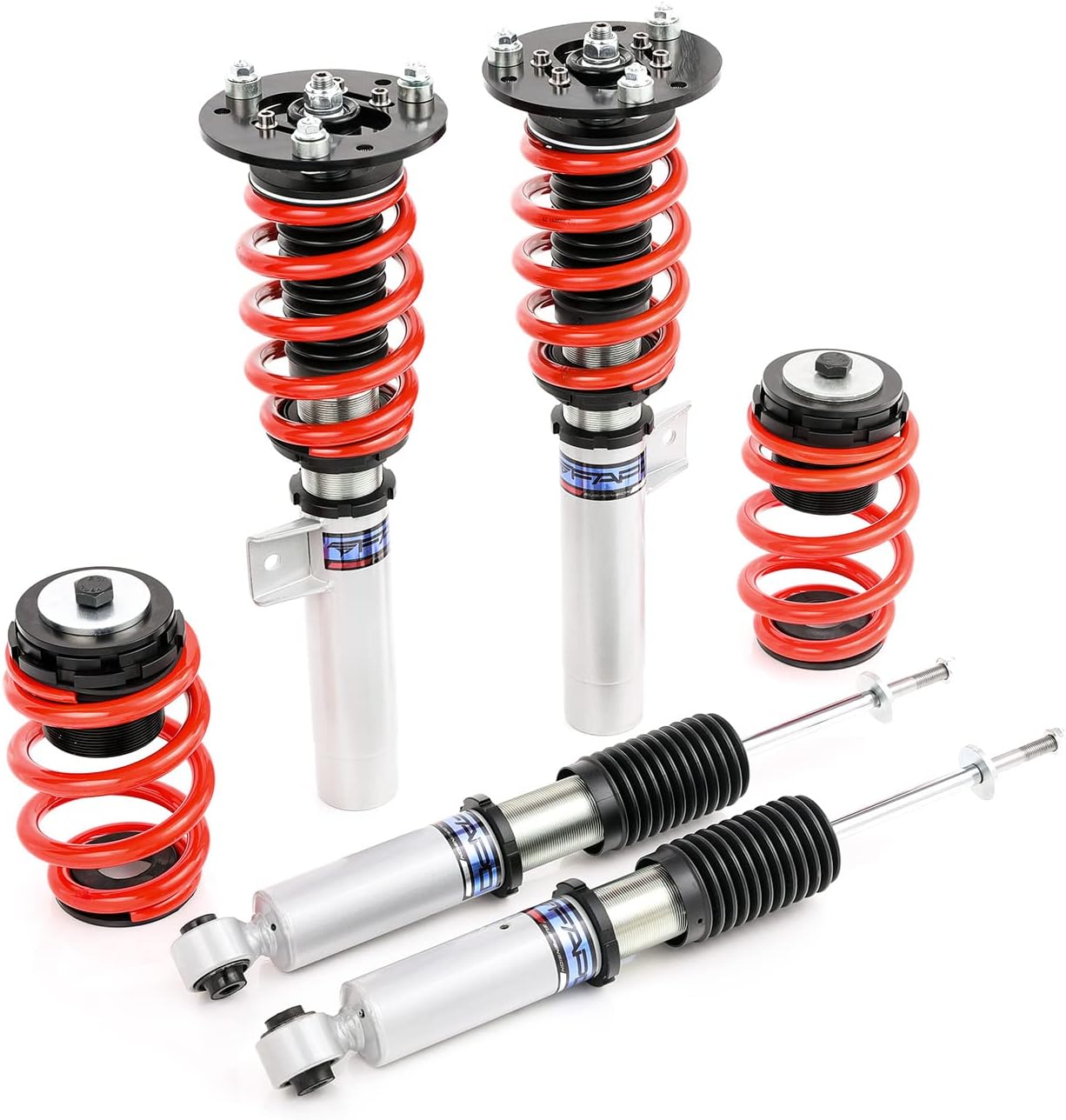
FAPO PS Coilovers - Suspension Kit for BMW E46
FAPO

maXpeedingrods 24-Level Adjustable Coilovers for BMW E46 3 Series 1998-2006
maXpeedingrods
More suspension parts for the BMW E46
If you're shopping for BMW E46 coilovers, you already know the stock suspension is not the car's strong suit. The E46 platform - produced from 1998 to 2006 across sedan, coupe, touring, convertible, and of course the M3 - is one of the most beloved chassis BMW ever made. The 50/50 weight distribution, the perfectly sized footprint, the way it communicates through the wheel. All of that is real. But the factory dampers and springs? They were calibrated for a European market in the late 1990s where comfort sold cars. In 2026, with every E46 on the road being at minimum 20 years old and the OEM suspension long since collapsed into mush, a coilover conversion is not a luxury upgrade. It is basic maintenance that also happens to transform how the car drives.
I have spent five years wrenching on BMWs, I daily a G20 330i with the B48 turbo four, and I spent a year doing marketing for BMW and MINI. I have seen E46s on everything from stock sport suspension to full-race Ground Control setups, and I have helped more than a few owners figure out what they actually needed versus what sounded good on a forum. This page is the honest version of that conversation.
Why the E46 Suspension Wears Out Faster Than You Think
The E46 suspension architecture is double-pivot MacPherson strut up front and a multilink independent setup at the rear - the same basic geometry BMW refined across multiple generations. It is genuinely good geometry. The problem is rubber. Specifically, every single rubber bushing, every strut mount bearing, every thrust arm bushing in the front subframe area, and every trailing arm mount in the rear was designed for a 10-15 year service life. Your car is past that. The OEM struts - typically Sachs or Bilstein depending on specification - lose their damping capacity gradually, which means you might not notice how bad they have gotten until you drive a properly set up car.
The infamous E46 front subframe cracking issue also lives in this conversation. Rear subframe cracking is the bigger-talked-about problem, but the front control arm mounts and the stress placed on the subframe by degraded suspension geometry are real concerns for anyone building a serious street or track car. Getting the suspension geometry right - which starts with coilovers that let you dial in camber and ride height properly - takes load off the subframe and the surrounding structure. This is not a minor point.
Beyond wear, there is the simple issue of what the car can become with proper suspension. An E46 on quality coilovers with alignment work done properly is a fundamentally different driving machine. The steering sharpens because there is less compliance in the suspension travel. The car sits where you want it visually. And the handling balance improves in ways that make every other modification feel less urgent. If you are trying to decide between coilovers and some other upgrade for an E46, coilovers win. Every time. Before you even look at cold air intakes or anything else under the hood, fix the suspension.
E46 Variants and Why Fitment Is Not One-Size-Fits-All
This is the first place a lot of people get burned, so let us be specific. The E46 chassis code covers several distinct variants that differ in ways that matter for coilover fitment.
E46 Sedan and Coupe - 316i Through 330i
The non-M sedans and coupes - 316i, 318i, 320i, 323i, 325i, 328i, 330i - share the same basic suspension geometry and mounting points. The front strut diameter and rear shock dimensions are consistent across these models, which means most aftermarket coilover manufacturers offer a single "E46 non-M" application that fits all of them. However, even within this group you need to confirm whether your car has the factory sport package - in some markets this affected spring rates and sway bar sizing, which matters when you start dialing in damping settings on adjustable coilovers.
E46 M3
The E46 M3 is a separate application for almost every coilover manufacturer on the market. The M3 has different front strut top-mount geometry, different rear subframe pickup points, and different spring rates and travel requirements because the car weighs slightly differently and has fundamentally different handling targets. If you order a non-M E46 coilover kit and try to fit it on an M3, you will have problems - sometimes minor, sometimes serious. Always confirm the M3-specific part number before ordering. This is not optional advice.
E46 Touring and Convertible
The E46 Touring (wagon) and E46 Convertible also get their own applications from most brands. The Touring's rear is sometimes a match to the sedan/coupe, but the unsprung weight and chassis stiffness differences mean the spring rates in a sedan-spec kit may not be ideal. The Convertible has a significantly less stiff chassis due to the lack of a roof structure, which affects how the suspension loads and what spring rates feel right. If you are building a Convertible for anything beyond casual street driving, this is worth a longer conversation about spring rates and what the open chassis does to the car's behavior under load.
Brake Clearance Notes
On the E46, the front coilover housing sits inside the wheel. On cars that have been upgraded to larger front rotors - common on M3s and on non-M cars where owners have swapped to M3 brakes or upgraded to 330mm or larger front brake setups - you need to verify that the coilover body clears the caliper. Most premium coilover brands have solved this for their E46 applications, but budget kits occasionally have oversized lower bodies that create clearance issues with larger calipers. Check before you buy if you have already upgraded the brakes.
What Drop Range Actually Makes Sense on an E46
I hear people say they want to drop their E46 "as low as possible" and it makes me tired. Let me give you the honest version.
The E46 front suspension geometry - with the double-pivot lower control arm arrangement - handles moderate lowering well, but there are limits. The geometry changes meaningfully as you lower the car because the control arm angles change, which affects camber gain and bump steer. A small amount of camber gain as you lower is actually useful for a street car that will see some spirited driving. Too much of it creates uneven tire wear and handling quirks.
For a street-driven E46 that you want to handle well and not destroy tires, the practical drop range is 20-40mm from stock height. That is where most of the reputable brands tune their spring rates and damping curves for E46 applications. The car looks right, the geometry is manageable with a proper alignment, and you are not fighting the suspension every time you hit a dip in the road.
For a track day or HPDE car, you are often looking at similar overall drop but with the ability to run more front camber - typically -2.0 to -2.5 degrees front - and optimized damper settings for a stiffer, more responsive feel. A lot of track-oriented E46 owners do not actually lower the car dramatically; they use the coilover adjustability to find the ideal corner weights and damper settings for their specific tires and track conditions.
For a drift car, you are in different territory. Drift setups typically run the car lower in the rear to shift weight bias, with softer rear springs and stiffer fronts, or the reverse depending on driving style. The adjustability of a coilover system is what makes drift-specific tuning possible at all. SLR Speed's E46 coilover guide has a solid breakdown of how these use cases diverge.
The absolute minimum ride height limit on an E46 - below which you are actively fighting the geometry and risking bump steer and contact issues - is generally considered to be around 50-60mm drop from stock. Some owners go lower, especially with aggressive camber plates and fender rolling, but that is a track or show car situation, not a daily driver. Aggressive lowering also affects your wheel fitment options significantly - check this E46 M3 wheel fitment guide if you are planning an aggressive stance alongside your coilover install.
The Eight Best BMW E46 Coilovers in 2026
Here are the products I would actually recommend to someone building an E46 today. I have organized them from premium down to budget, with honest notes on who each one is right for. Prices are current for 2026 US market.
1. KW Variant 3 - Best Overall Street and Track Kit
The KW Variant 3 is the kit I would put on an E46 if someone handed me the budget. It runs $2,600 to $3,200 depending on application and where you source it, and it earns that price. The V3 gives you independent adjustment of both rebound and compression damping - two separate knobs, meaning you can tune each end of the suspension stroke separately rather than making the same compromise across both. For a car that sees both street and occasional track days, this is meaningful.
KW engineers the spring rates specifically for the E46 application, and the valving is properly matched to those rates - which sounds obvious but is not the case with every brand at this price point. The build quality is excellent. The stainless steel construction on the damper body addresses the corrosion issue that kills budget coilovers in wet climates. And KW backs it with a manufacturer's warranty.
Fitment notes: confirm whether your kit includes top mounts or camber plates for your specific model - E46 non-M versus E46 M3 applications differ, and some builds will need aftermarket camber plates if you are running more aggressive alignment. LK Performance's E46 coilover listings show the full application breakdown clearly.
Common forum complaints about the V3 on E46: occasional top-mount noise after extended use (usually addressed by replacing the bearing plate, not the coilover itself), and the price. Some owners also note that very aggressive front camber settings require additional camber correction beyond what the standard top mounts allow. These are real but minor for most use cases.
If you are deciding between a KW Variant 3 and anything else on this list for a street car that sees track days, pick the V3. The adjustability is not a gimmick - it is the difference between a coilover you set and forget and one you actually tune to your car and driving style.
2. KW Variant 2 - Best Rebound-Adjustable Street Kit
The KW Variant 2 comes in at $2,200 to $2,800 and offers rebound adjustment only - compression is fixed. For a street car that does not see dedicated track days, this is often enough. The spring rates and base damping tune are well matched to the E46 chassis, and the ride quality on well-maintained roads is genuinely good.
The V2 is the right choice when you want the KW build quality and the ability to adjust ride comfort (via rebound) but will not be doing corner weight sessions or chasing lap times. Think of it as the V3's practical sibling - most of the engineering pedigree, less complexity, lower price.
The fitment rules are the same as V3: confirm sedan/coupe/convertible and non-M3 versus M3. The V2 does not close the gap to the V3 for track use - if you are doing HPDE or time attack, spend the extra and get the V3. But for someone who wants a properly sorted street suspension on an E46 they drive daily, the V2 is excellent value at this price point.
3. Bilstein B16 - Best for Owners Who Trust the Brand
The Bilstein B16 runs $2,000 to $2,600 and gives you height adjustment plus damping adjustment. Bilstein's reputation for quality control and damper longevity is well earned - their monotube gas-pressure damper technology produces a consistent, controlled ride that holds up over years and miles in a way that some budget coilovers do not.
For an E46 owner who wants a trusted name, good ride quality, and a setup that will still feel right in five years without rebuilds, the B16 is a strong choice. It is not the most adjustable kit on this list, but the adjustability it does offer is well-executed.
Verify whether your kit is for the E46 M3 or the standard E46 - Bilstein treats these as separate applications with different spring rates and damper tuning. Forum feedback on the B16 generally praises control and longevity but notes a firm ride on rougher surfaces and the need to manage spring perch clearance on lower ride height settings. For a car that sees a mix of good and mediocre pavement, this is worth knowing upfront.
4. Bilstein B14 - Best Fixed-Damping Budget Option from a Premium Brand
The Bilstein B14 costs $1,300 to $1,700 and is a fixed-damping lowering coilover kit. You get Bilstein damper quality without any of the tuning capability of the B16 or KW products. The ride height is adjustable, but you cannot tune the damping to match.
This sounds like a compromise, and it is - but it is the right kit for a specific owner: someone who wants a quality suspension that rides noticeably better than collapsed OEM hardware, looks right, and does not want to spend time adjusting dampers. If your E46 is a driver you use regularly but do not track, and you want to set it and forget it at a sensible ride height, the B14 does exactly that at a price that leaves budget for other work.
The limitation is obvious: if you change your use case - if you start doing track days or want to fine-tune the car's behavior - you will be shopping for coilovers again. The B14 does not grow with you. For someone who knows what they want from their car and it is not track performance, this is a legitimate recommendation. For anyone with HPDE ambitions, skip it and spend more.
5. ST XTA - Best Adjustable Mid-Budget Kit
The ST XTA comes in at $1,600 to $2,100 and is notable on the E46 because some applications include adjustable top mounts, which gives you meaningful camber correction capability without buying separate camber plates. For a lowered E46 where negative camber creep is inevitable, this is a real benefit built into the kit price.
ST is part of the KW Group - they use similar manufacturing processes and quality standards, just positioned below KW in the lineup. The XTA is their more capable tier, and for E46 applications the included top mounts make it meaningfully more useful than a kit that leaves you sourcing camber plates separately.
The ST XTA product page at Club Sport Garage shows the E46 M3 application with the top mount hardware included - worth reviewing before you buy to confirm exactly what is in the box for your specific variant.
Common feedback from E46 owners running the XTA: the adjustable top mounts are the headline feature and they work well for dialing in front camber. Some owners report noise from the pillow ball top-mount hardware, particularly in cold weather - this is a known characteristic of pillow ball mounts versus soft rubber mounts, not a defect. The ride is firmer than a rubber-mount setup as a result. If you want a quieter daily, the rubber-mount version (ST X) is an option, but you lose the camber adjustability. Worth deciding upfront.
6. ST X - Best Entry Point from the KW Family
The ST X runs $1,100 to $1,500 and is the most affordable way into a KW-family product for an E46. It is a simpler kit - no damping adjustment, rubber top mounts, basic height adjustment - but the underlying manufacturing quality is above what you get from budget brands at this price.
For an E46 owner on a tight budget who wants reliable suspension that rides better than stock and looks right, the ST X is honest value. It is not the kit for a track car or for someone who needs camber adjustment, but for a street driver who wants the car to sit correctly and handle confidently, it does the job. The rubber mounts keep the ride quality on the comfortable side of the spectrum, which some owners will prefer over the firmer feel of pillow ball setups.
The tradeoff is obvious: no adjustability means no ability to tune the car. You get what the spring rates and fixed damping give you. If you are someone who enjoys tweaking and dialing in, this is not your kit. If you want to bolt it on and drive, it works.
7. BC Racing BR - Best Budget Kit with Real Adjustability
The BC Racing BR costs $1,150 to $1,450 and is the kit more E46 owners have bolted on than almost any other product on this list. BC Racing has achieved something genuinely difficult: a broadly adjustable coilover at a price point that makes it accessible without being obviously cheap in construction. The BR offers height adjustment, damping adjustment (single-adjustment, combined rebound and compression), and broad E46 chassis coverage.
The honest assessment: BC Racing BRs are good for the money. They are not KWs. The spring rates are on the stiffer side for street use, the low-speed damping compliance is not as refined as a KW or Bilstein product, and the top-hat hardware has a reputation for noise - not always, not on every car, but often enough that it is worth knowing. SLR Speed's E46 coilover rankings note these same characteristics across multiple BC Racing kits.
Where the BR genuinely excels: for a drift car build, an E46 that sees occasional track days on a constrained budget, or an owner who wants to experiment with different damper settings before committing to a more expensive setup, the BR is the right tool. The adjustability lets you learn what your car needs. Then, if you want better, you know what you are looking for when you upgrade.
One thing to know: matching your spring rates to your actual use case matters with BC Racing because the off-the-shelf spring rates are sometimes aggressive for a street car. If you are ordering BC Racing for a daily driver, it is worth asking about spring rate options rather than just taking the default.
8. BC Racing DS - Best Budget Track-Focused Kit
The BC Racing DS runs $1,500 to $1,900 and steps up from the BR with a more track-oriented valving tune and different spring rate options. For an E46 that spends meaningful time on track, the DS offers a better starting point than the BR because the damping is better matched to the higher cornering loads and faster direction changes of circuit driving.
The same caveats about BC Racing quality versus premium brands apply here. The DS is a good kit for what it costs, not a substitute for a KW V3 at half the price. Forum feedback consistently notes better control than the BR but the same potential for noise and the same need to iterate on damper settings to find what works for your setup and tire combination.
Confirm the correct application for your E46 - the non-M and M3 fitments differ for BC Racing as they do for every brand. Get this wrong and you are dealing with return shipping on a heavy box.
Ground Control and Custom Spring-Rate Kits - Best for Experienced Builders
Ground Control-style kits and custom spring-rate packages run $1,400 to $2,500 and up depending on exactly what you are building. These are the choice when you have a specific spring-rate target in mind - perhaps because you have done suspension work on previous builds, know what you want, and want a system where you can swap springs independently of the dampers or keep the OEM dampers while adding the coilover sleeve and spring system.
Ground Control on the E46 makes most sense for dedicated track cars where the owner is doing corner weight sessions, adjusting spring rates per event, and needs a setup that can be tuned with precision. It is not the right starting point for someone buying their first coilover kit. If you are considering this path, you probably already know enough about suspension tuning that this description is confirming what you already thought.
Product Comparison Table
| Kit | US Price (2026) | Adjustability | Best For | Key Limitation |
|---|---|---|---|---|
| KW Variant 3 | $2,600-$3,200 | Height + rebound + compression | Street/track dual use | Price; may need extra camber plates |
| KW Variant 2 | $2,200-$2,800 | Height + rebound | Street-focused with adjustment | Less useful for serious track use |
| Bilstein B16 | $2,000-$2,600 | Height + damping | Quality street build | Firm on rough roads; clearance notes |
| Bilstein B14 | $1,300-$1,700 | Height only | Set-and-forget street | No damping adjustment at all |
| ST XTA | $1,600-$2,100 | Height + damping + camber plates | Mid-budget with camber adjustment | Pillow ball noise; firmer ride |
| ST X | $1,100-$1,500 | Height only | Budget KW-family street kit | No damping adjustment |
| BC Racing BR | $1,150-$1,450 | Height + single-adjust damping | Budget adjustable; drift/budget track | Noise; spring rates can be stiff |
| BC Racing DS | $1,500-$1,900 | Height + single-adjust damping | Budget track use | Same noise/harshness concerns as BR |
| Ground Control | $1,400-$2,500+ | Fully custom spring rates | Experienced track builders | Not a beginner kit; more involved setup |
Fitment Details - What to Know Before You Order
Getting coilover fitment right on an E46 is not difficult, but there are enough variants in this chassis that it is easy to order the wrong kit. Here is what to confirm before hitting buy.
Confirm Your Exact Model and Year
BMW built the E46 from 1998 to 2006, and there were running production changes across that span - particularly with the facelift models from 2001 onward. Most coilover manufacturers treat the full E46 run as one application, but some brands break it out differently, especially around the pre-facelift and post-facelift production dates. When ordering, give the retailer your exact year, body style, and engine code if possible.
Non-M3 versus M3 - the Most Common Mistake
I will say this plainly: if you own an E46 M3, you need an M3-specific coilover kit. Period. The M3 front strut tower geometry, the M3-specific rear subframe, and the different spring rate requirements all make the non-M kit a poor fit. Every brand on this list offers a separate M3 application. Order the right one.
Top Mounts and Camber Plates
The factory E46 front strut top mounts use a rubber bearing that is soft enough to allow a small amount of compliance - which smooths the ride but limits precision. When you fit aftermarket coilovers, you have the option to either reuse the OEM top mount (or an OEM-style replacement) or step up to adjustable camber plates with pillow ball or spherical bearings.
For a street car at moderate lowering, OEM-style top mounts are fine. For a track car or for a street car lowered more aggressively, adjustable camber plates give you the ability to dial in front camber without buying specialty offset top mounts or bending metal. The ST XTA includes adjustable tops as part of the kit. With KW products you often have the option to add them. With BC Racing you typically add them separately.
Budget for camber plates if your intended drop is more than about 30mm and you care about tire wear. The E46's front geometry will pull toward negative camber as you lower it, and without a way to correct it you will either run excessive camber on the street or make alignment compromises.
Front Strut Diameter
The E46 front uses a 50mm strut diameter on most applications - confirm this for your specific car when ordering. The M3 front end has slightly different geometry around the strut top, which is another reason the M3 kit is a separate application. Most reputable brands have engineered their E46 kits around the correct specifications, but it is worth confirming on budget kits where the product descriptions are sometimes less detailed.
Rear Spring Diameter and Length
The E46 rear is a multilink setup that uses a separate spring and shock arrangement on some configurations. Most coilover kits handle this as a coilover-over-shock design for the rear, which simplifies installation. The rear shock length and spring perch positions affect how the car's rear geometry behaves at different ride heights - another reason to stay within the manufacturer's recommended height adjustment range rather than pushing to the extreme limits of thread travel.
Sway Bar Considerations
When you change spring rates and ride height, the effective sway bar stiffness changes relative to the new spring rates. The factory E46 front sway bar is on the softer side, and many owners doing coilover upgrades also address the front and rear sway bars. This is not required to make the coilovers work, but if you are building a track car or want to properly optimize the handling balance, the sway bars are part of the conversation. The suspension sub-category on this site has more detail on that alongside the full suspension upgrade path.
Supporting Modifications You Should Plan For
Coilovers do not exist in a vacuum on the E46. Here is what you will likely need or want alongside them.
Alignment - Not Optional
Every coilover install requires a full four-wheel alignment. Not a toe-only check - a proper four-wheel alignment with adjustments at every corner where adjustment is available. The E46 has rear toe adjustment and front camber/caster through the stock eccentric bolts (and aftermarket solutions), and after fitting coilovers you need to set the geometry correctly for your intended use.
For a street car, target specs are roughly -1.5 to -2.0 degrees front camber, neutral to slightly negative rear camber, with toe set to spec. For a track car you will run more front camber and potentially more aggressive toe settings. Budget $100 to $200 for the alignment in addition to the coilover cost.
One strong recommendation: find a shop that has experience with lowered E46s. A generic alignment shop that punches in factory specs will not serve you well. The factory specs were written for a car at factory ride height running factory tires. Your car is not that car anymore.
Camber Bolts or Camber Plates
As mentioned above, aggressive lowering on the E46 front end requires a way to correct for the additional negative camber. On a budget, eccentric camber bolts in the lower control arm position give you some adjustment. For more correction, or for a track car, adjustable camber plates at the front strut top are the right tool. If you buy the ST XTA, these are included. For other kits, budget for them separately.
Thrust Arm Bushings and Control Arm Condition
Before you torque down a $2,000 coilover kit, look at the condition of the E46 front control arm bushings - specifically the thrust arm bush (sometimes called the control arm front mount or "banana bushing"). This is one of the highest-wear points on the E46 front suspension and one of the first things to go soft. Running new coilovers with worn bushings is like buying new tires and leaving the shocks collapsed. You will not get the precision and steering feel you are paying for.
Polyurethane front control arm bushings are a common upgrade here and are relatively affordable. They firm up the front end noticeably and are a natural companion to a coilover install. If you are already in the suspension while doing the coilover install, do the bushings at the same time.
Strut Mounts
If you are reusing OEM-style top mounts rather than upgrading to camber plates, check the condition of the existing top mount bearing. On a 20-year-old E46 that has never had top mounts replaced, the bearing is likely worn. A clunking front end after coilover installation is very often the top mount, not the coilover itself. New OEM-spec top mounts are inexpensive - just do them.
Wheels and Tires
Coilovers change the car's stance and clearances. If you are also planning to fit wider or offset aftermarket wheels, work through the fitment numbers before buying either the coilovers or the wheels, because what clears at one ride height may not clear at another. The aftermarket wheels section here covers E46 fitment parameters in detail. For the E46 M3 specifically, this M3 wheel fitment guide walks through the square versus staggered considerations.
Installation Overview - What You Are Getting Into
I am not going to write a step-by-step install guide here - that deserves its own page with torque specs and photos. But I want to give you an honest sense of what the E46 coilover install involves so you can decide whether to DIY or shop.
Front End
The front coilover install on an E46 is a classic MacPherson strut job. You are removing the wheel, disconnecting the sway bar end link, disconnecting the brake line bracket from the strut body, removing the lower ball joint pinch bolt from the steering knuckle, and unbolting the three top-mount nuts at the strut tower. The strut comes out as an assembly. The spring needs to be compressed to swap top mounts - you will need a proper spring compressor for this, not a cheap pair of J-hooks. If you are renting tools or buying a spring compressor for this job, get a quality one. A spring under compression has enough energy to cause serious injury if the compressor slips.
Plan for two to four hours per side if you are working methodically and this is your first E46 coilover install. With the right tools and experience, it goes faster. Torque specs for the E46 front strut are specific and important - follow the manufacturer's guidelines for your coilover, not generic spec sheets.
Rear End
The E46 rear coilover install is a separate job - the springs and shocks are separate on the stock configuration, so you are replacing both as a coilover assembly. The rear requires working around the multilink trailing arm geometry and properly supporting the subframe and trailing arms while you work. The rear subframe on the E46 is the infamous cracking subframe - do not put pry bars or jack pressure in the wrong places while you are in here. If your subframe has not been inspected for cracks, this is the time to look.
Plan similar time to the front for the rear, possibly a bit more if you have not done it before and are working carefully around the multilink geometry.
Professional Installation - Worth Considering
A competent independent BMW shop will charge somewhere in the range of $400 to $700 in labor for a full E46 coilover install, alignment not included. If you do not have quality tools, a lift or proper axle stands, or experience with spring compressors, the shop route is worth the money. A botched coilover install - especially anything involving improper spring compression or incorrect torque on the lower ball joint - creates safety issues, not just handling problems.
If you want to learn the job and do it yourself, do it on an E46 with a trusted friend who has done it before, and take your time. It is not a complex job, but it is one where cutting corners is a bad idea.
Common Mistakes E46 Owners Make with Coilovers
I have seen all of these happen. Here is the list so you do not repeat them.
Ordering the Wrong Application
This is number one for a reason. M3 versus non-M, sedan versus coupe versus touring, sometimes pre-facelift versus post-facelift. Call the vendor if you are not certain. Returning a coilover kit because you ordered wrong is expensive and annoying. Ten minutes on the phone is worth it.
Skipping the Alignment
Every coilover install that does not have an alignment done afterward is a liability. The car will not handle correctly, it will wear tires unevenly, and it will feel wrong in ways that are hard to diagnose. Do the alignment. Do not skip it to save money - you just spent serious money on coilovers and you are going to undermine them by not spending $150 on the alignment.
Setting the Ride Height Too Low for Daily Driving
The adjustability of coilovers is genuinely intoxicating when you first install them. People drop their cars further than they should, then live with a suspension that bottoms out on speed bumps, scrapes on driveway lips, and rides harshly because the damper is operating outside its designed travel range. Set the car at a sensible height, drive it for a month, then evaluate. Going too low too fast is how you end up with bent lower control arm brackets and cracked wheel lips.
Not Replacing Worn Control Arm Bushings First
As described above: worn bushings will ruin the feel of new coilovers. Do the bushings. The front thrust arm bushings on the E46 are a known wear item and they are not expensive.
Ignoring Damper Settings After Install
If you bought an adjustable kit, use the adjustability. The factory-set or shipped position is a starting point, not a final tune. Drive the car, note what you feel, adjust. If the car is too stiff at low speeds, soften the rebound. If it wallows through corners, firm up compression. This is the whole point of buying an adjustable kit.
Using Improper Torque on Strut Components
The top mount nuts, the lower ball joint pinch bolt, the control arm bolts - these have specific torque values and some of them need to be torqued with the suspension loaded, not in the air. Look up the specs for your car and your coilover brand and follow them. Over-tightening the lower ball joint pinch bolt is a common mistake that can crack the knuckle on the E46.
Buying Coilovers Before Addressing Subframe Issues
If your E46 has a cracked rear subframe - which is a known issue on higher-mileage cars - or a compromised front subframe, fitting coilovers is not the right first move. Inspect the subframes, address any structural issues, and then build on a solid foundation.
My Editor's Picks
Here is where I stand. These are not sponsored picks. They are what I would actually buy or recommend to a friend based on the research, the forum history, and my own experience with these brands across BMW platforms.
Best Overall - KW Variant 3
If you have the budget, the KW Variant 3 at $2,600 to $3,200 is the answer. The independent compression and rebound adjustment is genuinely useful, the build quality is the best on this list, and the car will feel right for years without needing rebuilds or replacements. For a street car that sees track days, or for someone who wants to invest in the suspension and not think about it again, this is the one.
Best Value - ST XTA
For the owner who wants real adjustability including camber correction at a price that is not $3,000, the ST XTA at $1,600 to $2,100 with adjustable top mounts is the smartest spend on this list. You get KW-family engineering, meaningful camber adjustment capability, and a kit that is genuinely complete for most street and street-plus use cases. The pillow ball noise is a known tradeoff. I would take it.
Best for Budget Track Use - BC Racing BR or DS
For a drift build or a budget track car where you want broad adjustability at a lower entry price, the BC Racing BR at $1,150 to $1,450 or the slightly more track-oriented DS at $1,500 to $1,900 are the right choice. Know the limitations going in: noise is possible, the spring rates are on the stiffer side for street use, and you will tune and retune. That is part of the deal with budget coilovers, and the BC Racing products are among the better budget options for doing exactly that.
Best Set-and-Forget Daily - Bilstein B14
For the E46 owner who wants better suspension, a proper ride height, and zero interest in adjusting dampers, the Bilstein B14 at $1,300 to $1,700 delivers Bilstein quality at a reasonable price. You get a proper, sorted street suspension without complexity. If your E46 is a driver and not a track toy, this is honest value.
Where to Buy and What to Watch Out For
I would always recommend buying from a vendor who specializes in BMW or BMW-compatible performance parts rather than a generic marketplace listing. The reason is simple: application-specific customer support matters when you have a question about whether a kit is the right fit for your specific E46, or when you need help with a warranty claim. LK Performance's BMW E46 coilover section is one example of a vendor with proper application filtering and reasonable selection. In the US market, several BMW-specialist online retailers carry the full range of brands listed here.
Watch out for grey-market listings of KW or Bilstein products at prices that seem too good. Counterfeit damper products exist in the marketplace and a counterfeit damper is not just a bad value - it is a safety issue. Buy from authorized resellers or directly from the manufacturer's retailer network.
Also watch the shipping weight on these orders. A full coilover set is heavy - typically 25 to 40 pounds depending on the kit. On international orders, shipping costs can add meaningfully to the purchase price. Factor that in when comparing vendors.
How Coilovers Fit Into Your Overall E46 Build Plan
The coilovers are the foundation of everything else you do to your E46's dynamics. Think of it this way: you would not put performance tires on a car with worn-out suspension and expect the tires to fix it. Similarly, you would not put more power into an E46 with degraded suspension and expect the car to handle better. Suspension comes first.
After the coilovers and alignment, the natural next steps are typically sway bar upgrades (particularly front, where the stock E46 bar is undersized for performance use), control arm bushing upgrades, and potentially strut bracing if the car is a coupe or convertible. See the lowering springs comparison if you are still weighing that option against coilovers - the short version is that for most E46 owners, coilovers are the right call over springs alone, because you can adjust ride height without changing spring rates.
Once the suspension is right, you can start thinking about other areas. If your E46 has the M54 or S54 engine, there are meaningful power gains available through ECU tuning. For the non-M cars, intake work and exhaust are the common starting points. But none of that makes the car feel better dynamically if the suspension is not sorted first.
For a comprehensive look at how to sequence your E46 build and which products have the best real-world value, the BMW coilovers buyer's guide covers the broader platform considerations and is worth reading alongside this page.
A Note on the E46 M3 Specifically
The E46 M3 with the S54 inline six deserves its own mention here because it is a different proposition from the non-M cars. The M3 is already a proper performance car from the factory - the suspension geometry, the spring rates, and the damping were tuned to a higher standard than the standard E46 non-M range. That means the baseline is better, but it also means the gains from a coilover upgrade are different in character.
On a non-M E46, coilovers represent a dramatic transformation because the stock suspension is genuinely soft and compliant. On an E46 M3, the transformation is more about refinement, precision, and the ability to tune to specific use cases - track days, corner weighting, alignment optimization - rather than a wholesale improvement from soft to good.
For an E46 M3 street car, I would lean toward the KW Variant 3 or Bilstein B16 in M3 specification. The M3 deserves quality hardware that matches the rest of the car. For a track-prepared M3, Ground Control setups or KW V3 with proper camber plates and alignment work are the standard approach. Budget kits like BC Racing are not wrong on an E46 M3 if the budget demands it, but the M3 is a car where proper suspension pays back in driver confidence and lap time in a way that makes the investment feel more justified.
Frequently Asked Questions About BMW E46 Coilovers
What is the best BMW E46 coilover kit overall?
For most E46 owners who want a kit that works excellently for both street and occasional track use, the KW Variant 3 is the best option. It offers independent compression and rebound adjustment, genuine build quality that holds up over time, and fitment options for all E46 variants including the M3. If the price is too high, the ST XTA is the best value alternative with its included adjustable top mounts. SLR Speed's E46 coilover rankings align with this assessment for the premium category.
Will E46 non-M coilovers fit an E46 M3?
No. The E46 M3 requires M3-specific coilover kits due to differences in front strut top-mount geometry, rear subframe pickup points, and appropriate spring rate tuning. Fitting a non-M kit on an M3 will result in poor fitment, incorrect spring rates, and potential handling problems. Every brand listed here offers a separate M3 application - order the correct one.
How much should I lower my E46 for street driving?
The practical range for a street-driven E46 is 20-40mm below stock ride height. This range gives you improved handling, a correct visual stance, and geometry that is manageable with a proper alignment. Going below 50mm from stock on a street car starts creating real compromises in ground clearance, bump steer, and daily driveability. Set the car at a sensible height, drive it, and adjust from there.
Do I need an alignment after installing coilovers on my E46?
Yes, without exception. Every coilover installation on any car requires a full four-wheel alignment afterward. The new ride height changes the geometry at every corner, and without alignment correction you will have uneven tire wear, imprecise handling, and an alignment that does not match your use case. Budget for the alignment as part of the coilover project cost.
Are BC Racing coilovers good for an E46?
Yes, for the right use cases. BC Racing BR and DS kits are well-regarded budget options that offer genuine adjustability at a price below premium brands. They are a solid choice for drift builds, budget track cars, and owners who want to experiment with damper settings without a large investment. The known tradeoffs are potential top-mount noise, spring rates that can be stiff for daily driving, and less damping refinement than KW or Bilstein products. For a daily driver, the ST X or Bilstein B14 are often better fits. For a track car on a budget, BC Racing is a legitimate option.
What is the difference between KW Variant 2 and Variant 3 for the E46?
The KW Variant 2 offers height adjustment plus rebound damping adjustment. The KW Variant 3 adds independent compression damping adjustment on top of that. For a street car without track day ambitions, the V2 is often sufficient and saves roughly $400-600. For a car that sees track use, where you want to tune compression and rebound independently for different conditions, the V3 is worth the extra cost. Both use the same base quality of construction.
Do E46 coilovers include top mounts?
It depends on the kit. Some kits include OEM-style top mounts, some include adjustable camber plates, and some require you to reuse your existing top mounts or purchase tops separately. The ST XTA is notable for including adjustable tops as part of the kit. The KW Variant 3 sometimes includes them depending on the specific application. Always check the kit contents before ordering and decide whether you want adjustable camber plates for your use case.
How long does it take to install coilovers on an E46?
For a DIY installer working methodically with proper tools, plan for a full day - approximately 6 to 8 hours for the complete install plus time to do the initial ride height setting. Front struts are roughly 2-4 hours total for both sides, rear is similar. Factor in time to properly set ride height and do a preliminary check before driving to the alignment shop. An experienced installer or shop will do it faster, but never rush the spring compressor work.
Should I replace control arm bushings when installing coilovers on my E46?
Yes, strongly recommended. The E46's front thrust arm bushings and control arm bushings are wear items that degrade significantly over time, and worn bushings undermine the precision you are trying to achieve with new coilovers. While you are in the suspension doing the coilover install, inspect all the bushing points and replace worn ones. Polyurethane front control arm bushings are a popular upgrade here and add meaningful front-end precision alongside the coilovers.
Can I use E46 coilovers on a touring or convertible?
The E46 Touring and Convertible variants require the correct application-specific kits from your coilover manufacturer. The Convertible in particular has a less rigid chassis structure (no roof) that affects suspension loading and the ideal spring rates for the application. Most brands offer touring/convertible specific versions - always confirm the application before ordering rather than assuming the sedan/coupe kit will transfer.
What camber plates do I need for a lowered E46?
For a street car lowered 20-30mm, stock-style top mounts with eccentric camber bolts in the lower control arm position may provide enough adjustment. For more than 30mm of drop or for a track car running -2.0 degrees or more of front camber, adjustable strut top mounts (camber plates) are the right tool. Options from brands like VAC Motorsports, Ground Control, and others are available, and the ST XTA kit includes its own. Budget roughly $200 to $400 for a quality set of front camber plates if they are not included in your coilover kit.
Is it worth buying coilovers for an E46 beater or project car?
Yes, if the car is structurally sound - specifically if the rear subframe is in good condition and the front subframe is not compromised. Coilovers on a sound E46 chassis transform the car's dynamics completely and the price of a budget kit like BC Racing BR or ST X is not prohibitive even on a project car budget. The caveat is that you should not put money into the suspension of a car with structural problems - address the structure first, then build on it.

Kamil Siegień
Founder of BimmerTalk. Five years wrenching on BMWs, currently dailying a G20 330i with the B48 turbo four. Spent a year doing marketing for BMW and MINI before going independent. I write everything on this site myself.
More about the site
BMW Coilovers - Lower, Stiffen, and Dial In Your Chassis
A quality coilover kit is the single most impactful suspension upgrade you can make to your BMW. Done right, you get adjustable ride height, tunable damping, and handling that stock suspension engineers were never allowed to deliver - whether you're building a track-day E46 M3, lowering a daily-driven F30 328i, or turning your G80 M3 into a canyon carver. Done wrong, you get a harsh, trampy ride and worn tires. Here's what you actually need to know before buying.
Choosing the Right Coilovers for Your Chassis
Not all coilovers are built equal, and fitment is everything with BMWs. The E9X 3 Series (E90, E91, E92, E93), E46, F3X generation (F30, F32, F80), and G-series platforms all have distinct strut diameters, subframe geometry, and electronic damper considerations. If your car has EDC (Electronic Damping Control) - common on F10 M5s, F8X M3/M4s, and most post-2012 G-chassis vehicles - you'll need coilovers specifically designed for EDC compatibility or be prepared to code out the warning light and disable the factory system entirely.
For the E46 330i or M3, KW Suspension V3 coilovers remain the gold standard - independently adjustable rebound and compression damping, stainless steel construction, and a lifetime warranty. Bilstein PSS10 and PSS9 kits suit drivers who want a sport-biased but still street-friendly setup on E9X and F3X platforms. BC Racing BR Series coilovers offer strong value for E36, E46, and E90 owners who want 30-way damping adjustability without spending KW money. For serious track builds on F80/F82 M3 and M4 chassis, Öhlins Road & Track or TTX kits are the benchmark - fully adjustable, rebuildable, and trusted by professional teams.
Avoid budget coilovers from unknown brands marketed only by spring rate numbers. Cheap digressive valving causes handling that feels stiff over bumps but vague mid-corner - the worst of both worlds. On a BMW with a near-50/50 weight distribution, bad damping tuning is immediately felt and erodes the driving experience these cars are built around.
Look for these specifics when comparing kits: independently adjustable compression and rebound (not just a single knob), pillow ball upper mounts for improved camber and reduced NVH compromise, ride height adjustment that works through the lower mount rather than preloading the spring, and a brand with documented rebuild or revalving service. If you're running a staggered wheel setup on an E92 M3 or F82 M4, confirm the rear ride height range clears your arch with the offset and tire width you're running - most quality brands publish this data.
Install difficulty sits at an intermediate level for most BMW coilover jobs. E46 and E90 front struts are straightforward with a spring compressor and a 22mm strut nut socket. Rear trailing arm and subframe work on E-chassis cars requires proper torquing at ride height to avoid binding bushings. F-chassis and G-chassis jobs are more involved - especially anything with xDrive or active rear steering - and benefit from a two-post lift and alignment immediately after. Budget for a four-wheel alignment every time, no exceptions. Pair your new coilovers with adjustable control arms and alignment kits to actually hit your camber and toe targets, particularly if you're running more than 1 inch of drop.
If you're running a stiffer spring rate, revisit your sway bar setup as well - a common mistake is pairing aggressive coilovers with stock sway bars, leaving the car's roll stiffness distribution unbalanced front-to-rear. The stock front sway bars on most 3 and 4 Series BMWs are undersized for performance use and limit what your coilovers can actually do.
Browse our full selection of fitment-verified coilover kits for E30 through current G-chassis BMWs below. Every kit is listed with chassis compatibility, spring rate, damping adjustability, and EDC fitment notes so you buy once and get it right.