BMW Batteries
Batteries for BMW. Compare prices, check fitment, find the right part for your build.
Affiliate disclosure. BimmerTalk is a proud partner of the Amazon Associates Program and Turner Motorsport. We may earn a small commission on qualifying purchases through our links, at no extra cost to you. Read the full disclosure.

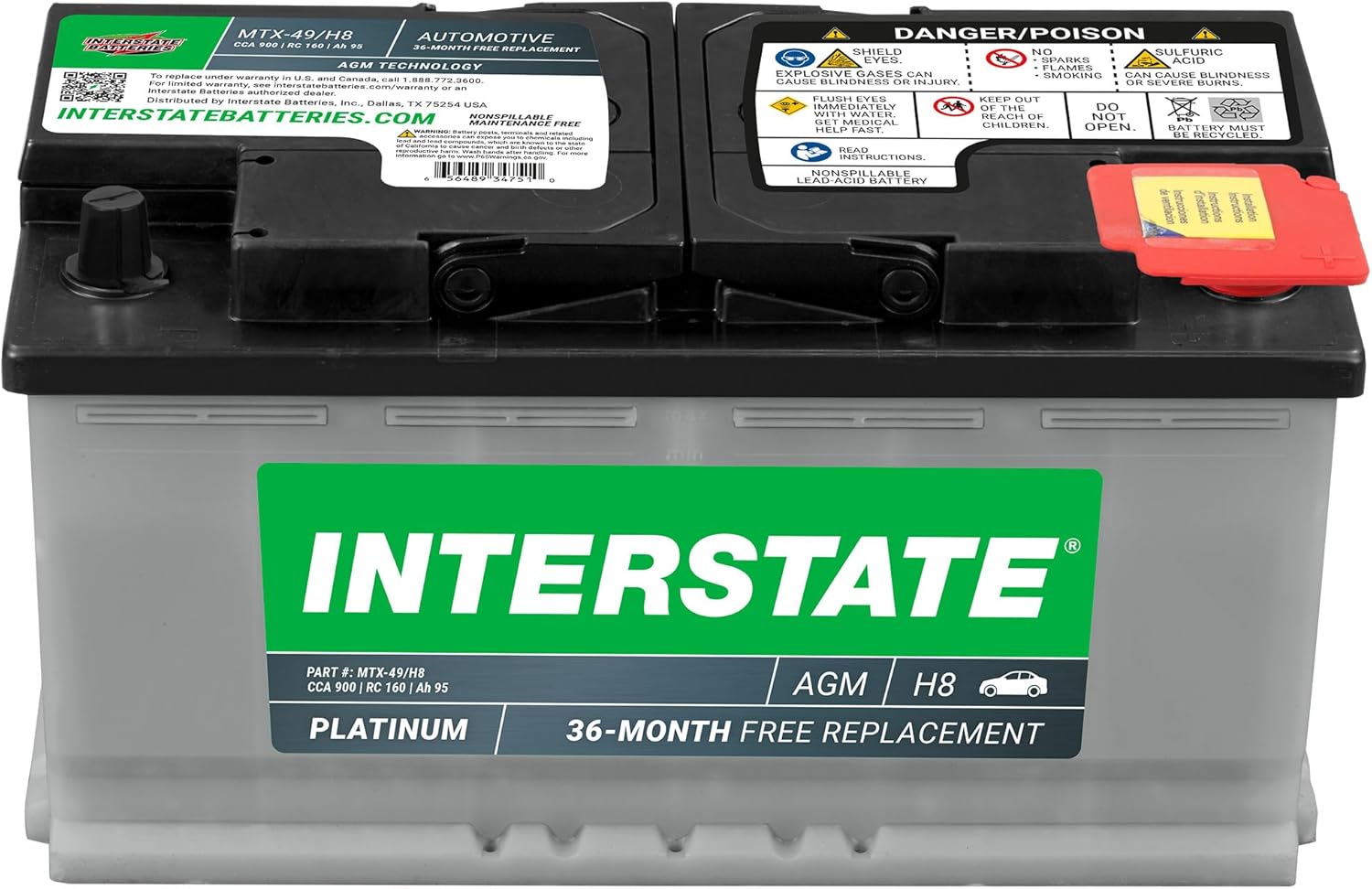
Interstate Batteries MTX AGM Battery for BMW - H8 Group 49 900CCA
the Interstate Batteries

Mighty Max MM-H8 AGM Battery - BCI Group 49, 12V 95Ah 900 CCA
Mighty Max Battery

ACDelco Gold 48AGM - Group 48 AGM Battery for BMW F and G Chassis
Visit the ACDelco Store

Weize Platinum AGM H8 Group 49 Battery - Start-Stop Replacement for BMW E/F/G Chassis
Visit the WEIZE Store

Weize Platinum H7 AGM Battery - Group 94R 850CCA for BMW 3 Series X3 5 Series
Visit the WEIZE Store

UPLUS AGM Battery for BMW - Group 49 H8 L5 12V 95Ah
the UPLUS NEW TECHNOLOGY BATTERY
If you own a BMW long enough, battery questions stop being a boring maintenance footnote and start becoming central to how the whole car behaves. I mean that literally. On older E-chassis cars, a weak battery can show up as lazy cranking, radio resets, or the occasional ABS light. On newer F and G chassis cars, battery condition reaches into start-stop behavior, IBS data, charging strategy, comfort access, electronic steering lock history, transmission shift weirdness, chassis control faults, and the full constellation of low-voltage nonsense BMW owners know too well. A tired battery in a modern BMW does not politely retire. It starts a fight with every module on the car.
I get why this page gets searched so hard. People want to know what bmw battery actually fits, whether they need an AGM, whether an H7 or H8 is right, whether they can save money with aftermarket options, and whether bmw battery registration is truly mandatory or just dealer upsell mythology. I have been on both sides of that question. I spent years wrenching on BMWs, from M50 and M54 era cars up through N-series and B-series stuff, and I also spent a year doing marketing for BMW and MINI, which gave me a front-row seat to how the brand talks about electrical systems versus how they behave when the car is ten years old and the owner is staring at a low-voltage fault tree.
So this page is the practical version. No fluff, no generic battery advice copied from a battery retailer, and no pretending all BMWs use the same setup. An E36 328i with an M52 and a basic electrical load is not asking for the same battery strategy as a G20 330i with a B48, IBS-based charging logic, and every convenience feature switched on. I daily a G20 330i, and I can tell you firsthand that battery health matters more on these cars than many owners realize. If you are trying to choose the right bmw agm battery, figure out whether your car wants an h8 battery bmw setup, or sort out whether coding and registration are needed after replacement, this is the page I would have wanted when I first started seeing all the confusion online.
Why battery choice matters more on a BMW than most cars
BMW has been battery-sensitive for decades, but the reason changed over time. In older cars like the E36, E39, E46, and even many early E60 and E90 models, the issue was mostly that BMWs tend to have higher resting electrical demands than economy cars and they do not tolerate low system voltage gracefully. The modules are tightly integrated, and once voltage sags below what the control units want, you can get faults that look completely unrelated to the battery. Owners chase alternators, wheel speed sensors, ignition switches, transmission problems, or even VANOS symptoms when the root issue is simply weak reserve capacity.
From roughly the late E-chassis into F and G chassis, battery behavior became more actively managed. BMW introduced and then expanded use of the Intelligent Battery Sensor, energy management strategies, brake energy regeneration, and start-stop systems. That changed the game. The car is no longer just charging a 12-volt battery in the old-school sense. It is monitoring state of charge, battery age, charging cycles, and load management. It can shed consumers, alter charging voltage, and expect a certain chemistry and capacity. This is where the distinction between a conventional flooded battery and a proper bmw agm battery stops being marketing and starts being technical requirement.
Owners notice this in everyday use. A weak or mis-specified battery on an F30 328i with the N20, an F32 440i with the B58, or a G30 540i can show up as start-stop becoming unavailable, “increased battery discharge” messages, seat heating limitations, comfort access glitches, or a stack of communication faults after the car sits overnight. On my G20, I pay attention to battery condition because the car is always doing something. Telematics, key detection, sleep cycles, IBS monitoring, and the normal modern luxury-car background load all mean the battery has to be healthy, not just barely able to start the engine.
The other reason battery choice matters is physical fitment. BMW battery wells and hold-downs are not random. Trunk-mounted batteries on E39, E46, E60, E90, F10, and many others are designed around specific dimensions, venting arrangements, and terminal orientation. Buying “close enough” because the numbers look okay often creates real problems. Wrong height can interfere with the hold-down or cover. Wrong vent provision can matter in a trunk-mounted application. Wrong polarity orientation creates stretched cables and ugly workarounds. BMW owners are often comfortable modifying things, but battery fitment is one place I like factory-clean installation.
Finally, there is the cost of getting it wrong. The battery itself may be a $170 to $320 part depending on group size and brand. But the side effects of a low-quality or under-spec battery can send you down a rabbit hole of diagnostics, tow bills, coding appointments, and needless parts replacement. I have seen owners throw a starter at an N52 E90 because it slow-cranked in winter, only to discover the battery had dropped off badly under load. I have also seen F-chassis cars get replacement batteries installed without registration, then come back months later with shortened battery life and persistent energy management complaints. BMWs are not uniquely fragile here, but they are less forgiving than average.
AGM versus flooded on BMWs and why 2007 changed everything
If you own a BMW from roughly 2007 onward, especially an E9x, E6x LCI, E7x, F-chassis, or G-chassis car, the default assumption should be AGM unless you have verified otherwise. AGM stands for Absorbent Glass Mat. It is still a lead-acid battery, but the electrolyte is held differently, which gives AGM batteries better vibration resistance, stronger deep-cycle performance, faster charge acceptance, and better tolerance for the charging and discharge patterns seen in modern BMW energy management systems.
This matters because BMW was leaning into start-stop, intelligent charging, and battery monitoring during that era. Cars with heavier electrical loads, IBS-managed charging, and frequent cycling are simply better served by AGM. If the car was factory-equipped with AGM, replacing it with a conventional flooded battery without coding the change is asking for poor charging behavior and shorter battery life. Even if the car can physically run that way, I would not do it on any F or G chassis car, and I would be very cautious even on later E-chassis models.
On older BMWs, the answer is more nuanced. An E36, E46, or basic E39 can often live just fine with a quality flooded battery if fitment and venting are correct. But that does not mean AGM is a bad idea. In fact, on enthusiast-owned cars that sit for periods, have aftermarket audio, or see seasonal use, AGM can be the better choice because it handles cycling and storage abuse better. I have put AGM batteries in older BMWs simply because the owner wanted a little more reserve and cleaner behavior in winter, not because the chassis absolutely required it.
Why AGM is usually the right call on F and G chassis
BMW’s battery management assumes a known battery type and capacity. On F30, F32, F10, F15, G20, G30, G05, G80, and similar cars, the DME and energy management systems adapt charging behavior based on battery registration data. AGM batteries generally like a different charging profile than flooded batteries. If the car thinks it has one chemistry and capacity but you install another, charging can be too aggressive, too lazy, or just wrong over time. The battery may still crank the car for a while, but life expectancy and system stability suffer.
There is also the practical side. AGM batteries generally deliver strong cold-cranking performance for their size, and BMWs tend to appreciate that in cold weather. Typical BMW-fit AGM batteries in H7 and H8 sizes land around 80Ah to 95Ah and roughly 760 to 900 CCA. That range makes sense for everything from a 3 Series to an X5 depending on equipment, engine, and climate. Once you start comparing these numbers with what a loaded modern BMW asks for, the case for AGM gets pretty clear.
When a flooded battery may still be acceptable
If you are dealing with an older chassis like an E30, E34, E36, E39, or E46, especially one without IBS and without heavy parasitic demands from modern convenience systems, a quality flooded battery can be perfectly serviceable. Plenty of these cars lived their whole lives on conventional batteries. The key is choosing the right group size, making sure it is vented properly if it lives in the trunk, and not buying the cheapest no-name battery on the shelf because the terminals happen to line up.
For example, an E46 330i with the M54 and normal electrical equipment does not have the same battery-management expectations as an F30 335i with the N55. If an E46 owner asks me whether AGM is mandatory, the answer is no. If a G20 owner asks the same thing, my answer is basically yes, or at minimum yes if you want the car to behave the way BMW intended. This distinction gets missed online all the time because battery articles are often written as if every BMW is a single platform.
My rule of thumb
- E36, E39, E46, early E53, some basic older chassis - quality flooded can work, AGM is still a solid upgrade.
- Late E60, E70, E90/E92 and newer with IBS or start-stop - use AGM unless you have exact data showing otherwise.
- All F and G chassis daily drivers - I would run AGM, register it, and not overthink it.
- If the car came with AGM, replace with AGM. Do not downgrade chemistry to save a few bucks.
If you want a step-by-step replacement process after you have chosen the battery, BimmerTalk’s BMW battery replacement guide is the right companion page. This article is the sizing and strategy deep dive. That page is the wrenching walkthrough.
BMW battery group sizes and what actually fits by chassis
This is where most owners get tripped up. They search “BMW battery,” get served a long list of batteries with similar labels, and then wonder why half the internet says H7 while the other half says H8. Group size matters because BMW fitment is not just about whether the engine starts. It is about the battery tray, hold-down, venting, cable length, and the car’s expected reserve capacity. In BMW-land, H7 and H8 are the two sizes most owners run into, with H9 showing up on some larger and heavier-equipped applications.
In general terms, H7 corresponds to BCI Group 94R and H8 corresponds to Group 49. H9 is Group 95R in many catalogs. Physical dimensions differ enough that you should not treat them as interchangeable unless your battery tray and hold-down arrangement support both sizes and you know the exact fitment. On BMWs, H7 often appears in 3 Series, 4 Series, and some X3 applications. H8 is common in 5 Series, X5, larger-load applications, and some heavily optioned or higher-output cars. H9 appears in some F-chassis and larger vehicles where BMW specified more reserve and capacity.
There is also the reality that battery listings online can be sloppy. Some retailers lump E and F chassis together without accounting for exact engine, production date, and equipment differences. Others use “fits BMW” loosely based on terminal orientation alone. I always verify battery dimensions against the original battery, check the tray, and check whether the car originally carried AGM or flooded. If the old battery still has a label with Ah and part information, that is useful data even if you are not buying the same brand.
| Battery Size | Common BCI Group | Typical Capacity | Typical CCA | Common BMW Applications |
|---|---|---|---|---|
| H7 | 94R | 80-94Ah | 760-850 CCA | F30/F31 3 Series, F32 4 Series, some X3, some 5 Series |
| H8 | 49 | 90-95Ah | 850-900 CCA | E60/E61 5 Series, E70 X5, F10 5 Series, F15 X5, G05 X5, many larger-load BMWs |
| H9 | 95R | 95-105Ah | 850-950 CCA | Select F-chassis and larger diesel or high-demand applications |
Typical chassis trends for H7, H8, and H9
For enthusiast shorthand, I think of H7 as the “common modern 3 Series size,” H8 as the “common 5 Series and SUV size,” and H9 as the “bigger reserve option where BMW wanted more overhead.” That is simplified, but directionally useful. For example, many F30 and G20 applications use H7-sized AGM batteries. On the other hand, E70 X5s, F15 X5s, and many 5 Series setups are often H8 territory. If somebody asks me about an h8 battery bmw fitment, I immediately think of E60, F10, X5, and high-demand use cases before I think 3 Series.
The car’s electrical equipment matters too. Heated seats, comfort access, larger infotainment packages, diesel glow systems where applicable, and start-stop all affect what BMW originally specified. A stripped-down base car and a fully optioned luxury trim from the same generation may not carry the exact same battery spec. This is one reason I am hesitant to give one-size-fits-all fitment advice without chassis and engine context.
| Chassis | Typical Engine Examples | Common OE Battery Type | Common Group Size | Notes |
|---|---|---|---|---|
| E46 3 Series | M52TU, M54, S54 | Flooded or AGM upgrade | H6/H7 depending on model | Registration generally not required, venting still matters |
| E90/E92 3 Series | N52, N54, N55 | AGM common on many cars | H7 or H8 depending on spec | IBS-equipped, registration required after replacement |
| F30/F32 | N20, N26, N55, B46, B48, B58 | AGM | H7 common | Start-stop and IBS make AGM the default choice |
| F10 5 Series | N20, N55, B47, N63 | AGM | H8 common, some H9 | Higher module count and larger electrical load |
| F15 X5 | N55, B58, N63 | AGM | H8 common | SUV load and accessories favor 95Ah batteries |
| G20 3 Series | B46, B48, B58 | AGM | H7 common | Registration mandatory, low-voltage issues trigger many faults |
| G05 X5 | B58, N63, S68 | AGM | H8 or H9 depending on configuration | Large reserve capacity is important |
Examples from real-world BMW ownership
Last summer I helped a buddy replace the battery on his E92 335i N54. The car had the usual late-E-chassis battery setup in the trunk and was showing intermittent comfort access issues and a bunch of low-voltage communication faults after sitting. The physical space and original spec pointed us toward an AGM replacement, and because that chassis is IBS-equipped, we registered it immediately afterward. The difference in the car’s behavior over the next few weeks was obvious. Cranking speed improved, nuisance faults disappeared, and the owner stopped blaming his tune for every little electrical oddity.
On the other side, I have seen older E46s with M54 engines happily run for years on the right flooded battery, vented correctly, with no drama at all. But even there, if the car is a weekend toy or sees long storage intervals, AGM is not wasted money. It buys you some forgiveness.
If you own an F30, F32, or G20 and need a common H7 fitment, the Weize Platinum H7 AGM Battery - Group 94R 850CCA for BMW 3 Series X3 5 Series is the sort of sizing that often lands correctly for modern 3 Series and related chassis. If you are in H8 territory, especially 5 Series or X5 range, options like the Interstate Batteries MTX AGM Battery for BMW - H8 Group 49 900CCA fit the kind of reserve and cold-cranking performance many of those cars want.
Chassis-by-chassis battery guidance from E36 to G87
This section is where I want to be as useful as possible for BMW people who speak in chassis codes instead of marketing names. I am not going to pretend there is one exact battery spec per chassis because engines, production dates, and options matter. But there are strong patterns, and those patterns line up with how these cars age in the real world.
E36 and E46
E36 cars with M50, M52, and S50/S52 engines are relatively simple by modern BMW standards. Electrical demand is modest. Battery fitment is still important, especially because many of these cars have been modified or converted for track use, but they do not require battery registration and they are less picky about chemistry. I would use a quality battery that physically fits correctly, provides solid cold-cranking ability, and is vented properly if trunk-mounted. If the car sits a lot, AGM becomes attractive simply because old E36s often spend more time on tenders than in traffic.
E46 cars with M52TU, M54, and S54 power are still straightforward, but they are old enough now that battery-related gremlins can be magnified by aging grounds, tired alternators, and corroded connections. A weak battery on an E46 can trigger DSC lights, rough cold starts, window initialization issues, and transmission failsafe messages on automatics. The chassis itself is not demanding by F/G standards, but because the average E46 is now a project car or hobby car, I often lean AGM for reserve and storage resilience. If the owner daily drives it and wants minimum cost, a good flooded battery is still acceptable.
E60, E70, E90, and E92
This is the transition zone where battery spec and registration become much more important. E60 5 Series cars with N52, N54, N62, and diesels, E70 X5s, and E90/E92 3 Series with N52, N54, and N55 all commonly use IBS and battery registration. Many were equipped with AGM from the factory, especially on higher-demand configurations. If you own one of these cars, do not treat battery replacement like it is a 1995 318i. Match chemistry, match capacity as closely as practical, and register the battery after installation.
E90 and E92 owners in particular get tripped up because these cars now live in a weird market position. They are old enough that people want budget solutions, but modern enough that they still expect correct battery management. I have seen too many N54 and N55 cars with random misfire complaints, steering angle weirdness, and comfort access problems that were at least partly battery-related. A proper AGM replacement and registration is cheap insurance compared with the time wasted chasing phantom module faults.
F30, F32, F10, and F15
By the F-chassis era, AGM is basically normal procedure. F30 and F32 cars with N20, N26, N55, B46, B48, and B58 engines usually live happily on H7 AGM batteries, though exact fitment varies by equipment and market. These cars are less tolerant of low voltage than the E90 generation in my experience because there are simply more systems leaning on battery health in the background. Start-stop complaints, charging system warnings, and unexplained electronic oddities almost always make me think battery and registration early in the diagnostic process.
F10 5 Series and F15 X5 models generally move upward in reserve demand, which is why H8 and sometimes H9 sizes are common. These cars are heavier, often more luxuriously equipped, and more likely to be used for shorter trips where the battery does not fully recover if it is already aging. If someone with an F10 535i or F15 X5 asks whether they should cheap out on a battery, my answer is no. A larger BMW with a weak battery gets annoying fast.
For that type of car, batteries like the Mighty Max MM-H8 AGM Battery - BCI Group 49, 12V 95Ah 900 CCA or the UPLUS AGM Battery for BMW - Group 49 H8 L5 12V 95Ah are in the right spec neighborhood for many H8 BMW applications. The key is still verifying the original battery size and physical tray before ordering.
G20, G30, G05, G80, and G87
Modern G-chassis cars are the least forgiving when battery health is poor. G20 3 Series, G30 5 Series, G05 X5, and current M cars like G80 M3 and G87 M2 all have enough networked electronics that a voltage issue can make the car seem far more broken than it really is. On my own G20 330i with the B48, I treat the battery as foundational maintenance, not an afterthought. If the battery starts aging out, I expect weirdness before I expect a simple no-start.
Most G20 and G30 applications use AGM and require registration after replacement. Physical group size will depend on exact model and options, but H7 is common in 3 Series territory while H8 and H9 appear more often in 5 Series, SUVs, and higher-load builds. M cars are not exempt. If anything, they are more sensitive because the owner is more likely to notice and care when modules start throwing low-voltage faults. S55, S58, and other performance applications still live in the same low-voltage reality as the base cars.
If you are unsure what chassis you actually have because BMW naming got messy over the years, BimmerTalk’s BMW chassis lookup tool is worth using before you order anything. It is much easier to choose a battery once you know whether you are actually dealing with an E92, F32, or G22 equivalent.
| BMW Chassis | Likely Battery Strategy | Registration Needed | My Recommendation |
|---|---|---|---|
| E36 | Flooded or AGM | No | Use quality fitment, AGM if stored often |
| E46 | Flooded or AGM | No in most cases | AGM upgrade is worthwhile for hobby cars |
| E60/E70 | AGM common | Yes | Match original type and register |
| E90/E92 | AGM common | Yes | Do not skip registration |
| F30/F32 | AGM | Yes | H7 common, register every time |
| F10/F15 | AGM | Yes | H8 often best, maintain reserve capacity |
| G20/G30/G05 | AGM | Yes | Battery health is critical, use exact spec |
How to choose the right BMW battery by capacity, CCA, and usage
Once you know the physical group size and whether the car expects AGM, the next question is what numbers matter. The three big ones are amp-hour capacity, cold cranking amps, and reserve quality from a reputable manufacturer. BMW owners love specs, and rightly so, but there is a trap here. Bigger is not always better if the car is coded and registered for something else. Better is usually “matches OE intent closely, from a good brand, with strong actual build quality.”
Amp-hour rating tells you how much energy the battery can store over time. In BMW terms, this matters a lot because these cars often sit with measurable parasitic draw even when healthy. An H7 AGM in the 80-94Ah range is common for many 3 Series and 4 Series applications. An H8 in the 90-95Ah range is common for larger cars and SUVs. CCA tells you how much current the battery can deliver in cold starting conditions. Typical BMW-fit AGM batteries land around 760 CCA on the lower end and 900 CCA on the stronger H8 side.
The trick is to avoid under-speccing. If your F15 X5 or F10 550i came with a 90Ah or 95Ah AGM battery, I would not replace it with a smaller H7 just because the car mostly starts fine in summer. The reserve capacity matters for everything that happens after the start, including electrical stability, accessory use, and surviving short-trip duty. Likewise, on a G20 or F30 that originally carries an H7 AGM, I would not force in a larger battery unless I knew the tray, hold-down, and registration options lined up correctly. BMW battery systems are more “matched package” than “biggest battery wins.”
CCA matters, but reserve matters more than many owners think
BMW owners in cold climates often focus on CCA, and that makes sense. Nothing gets attention like a slow-cranking six-cylinder on a freezing morning. But some of the most annoying battery failures on BMWs happen not because the car cannot crank once, but because the battery no longer supports stable voltage across all the modules after repeated starts, short trips, and overnight rest. Reserve capacity and internal health matter just as much as the peak number on the label.
For example, a cheap battery that advertises 850 CCA may still perform worse in a BMW than a better-built AGM with similar rating but better cycle durability and charge acceptance. I have seen this especially on start-stop cars. They punish batteries in a way older chassis simply did not. If the battery has mediocre deep-cycle characteristics, the car will tell on it sooner than later.
Brand quality matters
BMW OE batteries have historically come from suppliers like Banner, Exide, and VARTA depending on market and application. Bosch’s higher-end AGM lines are also generally solid. In the aftermarket, I care about three things more than branding alone: fitment accuracy, real AGM construction, and consistent quality control. A reputable H8 AGM at 95Ah and 900 CCA from a known source is worth more to me than a mystery battery with inflated spec claims and a generous online description.
Among the fitments sold through BimmerTalk, the Interstate Batteries MTX AGM Battery for BMW - H8 Group 49 900CCA stands out as the type of battery I would consider for a larger BMW or SUV where I want known-name quality and proper reserve. The ACDelco Gold 48AGM - Group 48 AGM Battery for BMW F and G Chassis lands well for some F and G chassis applications in the H6/H7-adjacent range depending on exact fitment. For budget-conscious H8 shoppers, the Weize Platinum AGM H8 Group 49 Battery - Start-Stop Replacement for BMW E/F/G Chassis is the sort of spec sheet that makes sense on paper for many BMWs needing a 95Ah class AGM replacement.
How I choose for daily drivers versus weekend cars
For a daily-driven modern BMW, I prioritize OEM-correct chemistry, exact fitment, and healthy reserve capacity. I do not want the battery to be “just enough.” I want it to stay ahead of telematics, climate loads, repeated short drives, and winter starts. On my G20, that is the mindset I would use every time.
For a weekend E46 M3 or E36 328is that spends time sitting, I prioritize self-discharge behavior, maintenance charging friendliness, and tolerance for storage cycles. AGM often wins there too, even if the chassis does not mandate it.
For a larger X5 or 5 Series used for family duty, lots of accessories, and city driving, I would err on the stronger side of the correct spec. These cars punish weak batteries quickly because they are always being asked to do everything at once.
Best battery brands for BMW and which ones I would actually buy
The internet loves fake certainty on battery brands. One guy says only OEM. Another guy says all batteries are the same with different stickers. Neither is right. There are real differences in manufacturing consistency, plate design, cycle durability, warranty handling, and how honestly the battery’s specs translate to real-world service. On a BMW, where electrical stability matters more than average, I pay attention to brand more than I would on a basic commuter appliance.
BMW OE batteries are a safe answer, especially if you want zero debate about intended chemistry and fitment. Depending on year and region, those can come from suppliers like Banner, Exide, or VARTA. VARTA in particular has a strong reputation in European AGM applications. Bosch’s upper-tier AGM offerings are generally respected too. If you can get the exact OE-sized AGM at a fair price, there is nothing wrong with staying close to factory.
That said, many aftermarket AGM batteries are perfectly viable on BMWs if the specs and fitment are right. Interstate has a strong presence and generally solid reputation. ACDelco’s better AGM lines are often better than people assume because they think of the brand only in GM terms. Weize, Mighty Max, and UPLUS sit more in the value segment, but that does not automatically make them bad choices. It just means I would be more careful about matching application, buying from a reliable source, and making sure the battery is fresh rather than old stock.
| Brand | Typical BMW Use Case | Pros | Possible Downsides |
|---|---|---|---|
| BMW OE Banner/Exide/VARTA | Factory-correct replacement | Known fitment, expected chemistry, proven integration | Usually higher price |
| Interstate AGM | Premium aftermarket H8/H7 replacements | Strong reputation, good reserve, broad availability | Can cost close to OE |
| Bosch S6 AGM | High-quality aftermarket for European applications | Good build quality, strong specs | Availability varies by market |
| ACDelco Gold AGM | Value-oriented F/G chassis replacement | Good specs for price, credible mainstream brand | Need to verify exact fitment carefully |
| Weize / Mighty Max / UPLUS AGM | Budget-conscious H7/H8 applications | Attractive pricing, competitive paper specs | Long-term consistency can vary more than premium brands |
What I would pick for common scenarios
If I had a clean F10 535i, E70 X5, or G05 X5 that needed an H8 and I wanted low drama, I would strongly consider the Interstate Batteries MTX AGM Battery for BMW - H8 Group 49 900CCA. Ninety-five amp-hours and 900 CCA is exactly the sort of spec these larger BMWs respond well to, provided the tray and OE spec line up. It is not the cheapest route, but battery swaps are not where I like gambling on a larger BMW.
If I were shopping budget-first for a 3 Series or 4 Series fitment where H7 is appropriate, the Weize Platinum H7 AGM Battery - Group 94R 850CCA for BMW 3 Series X3 5 Series is the kind of battery I would at least put on the shortlist because the numbers are sensible for many modern BMW daily drivers. Eight hundred fifty CCA is healthy for that class, and AGM is non-negotiable for most F/G applications anyway.
If I needed an H8 on a budget and the spec matched the car, I would compare options like the Mighty Max MM-H8 AGM Battery - BCI Group 49, 12V 95Ah 900 CCA, Weize Platinum AGM H8 Group 49 Battery - Start-Stop Replacement for BMW E/F/G Chassis, and UPLUS AGM Battery for BMW - Group 49 H8 L5 12V 95Ah. All of those sit in the right spec neighborhood for BMWs that genuinely want a 95Ah class AGM. At that point, I would decide based on pricing, warranty, and how quickly I could get a fresh unit.
What I avoid
- No-name batteries with vague AGM claims and no meaningful warranty support.
- Old stock batteries that have sat discharged on a shelf for too long.
- Downgrading from AGM to flooded on a car designed around AGM charging logic.
- Changing capacity dramatically without understanding registration and coding implications.
- Buying solely by CCA number while ignoring venting, dimensions, and terminal layout.
If you are the type who handles your own coding, scanning, and battery registration, BimmerTalk’s coding and diagnostic tools page is useful to keep bookmarked. A good scan tool or BMW-specific app pays for itself quickly once you own more than one modern BMW.
BMW battery registration and coding explained without dealer nonsense
This is the section most people actually need, because there is a lot of half-true information online. BMW battery registration is real, it matters, and on F and G chassis cars it is not optional if you want the charging system to manage the new battery correctly. Registration tells the car a new battery has been installed. That resets battery age data and charging adaptation so the car does not continue charging the new battery as if it were the old, worn one.
Coding is related but not always the same thing. Registration is the act of telling the vehicle a fresh battery is in place. Coding is changing the battery type or capacity data in the vehicle if you installed a battery with a different specification than what the car was configured for. For example, if the car was set up for a 90Ah AGM and you replaced it with another 90Ah AGM, you usually register only. If you changed from 90Ah AGM to 80Ah AGM, or from flooded to AGM, that can require coding so the energy management system knows the new baseline.
Why does this matter? Because BMW’s charging strategy adapts over the life of the battery. As a battery ages, the car may charge differently to maintain usability. If you install a new battery and do not register it, the car can overcharge or improperly charge the replacement based on outdated assumptions about battery age and health. That shortens battery life and can create weird energy-management behavior even if the battery is physically fine.
Which BMWs need registration
As a practical enthusiast rule, assume late E-chassis cars with IBS and all F/G chassis cars need registration after battery replacement. That includes many E60, E70, E90, E92, and most later BMWs. Older cars like E36 and E46 generally do not use the same registration process. There are edge cases, but if you are in the N52/N54/N55 era and newer, battery registration should already be part of your plan.
On E90 and E92, owners sometimes skip it because the car starts and drives right after installation. That proves almost nothing. Battery registration is about long-term charging behavior, not merely whether the starter engages once after the swap. I have seen cars go months before the consequences show up as shortened battery life or recurring low-voltage complaints.
Can you do it yourself
Yes, usually. You do not need the dealer unless that is your preferred route. BMW-specific scan tools and apps can handle registration on many models. ISTA, Autel, Foxwell, BimmerLink, and other tools depending on chassis and feature support can do the job. The exact menu wording varies, but the function is usually obvious once you know what you are looking for. If you already code your own BMW, this is straightforward.
If you are doing your own replacement and registration, read the full BMW battery replacement guide afterward. It pairs well with this page because the mechanical part is easy compared with understanding what the software side actually wants.
What happens if you skip registration
- Reduced battery life due to improper charging strategy
- Battery discharge warnings and start-stop unavailability
- Low-voltage faults across unrelated modules
- Inconsistent charging after short trips or overnight parking
- Owner frustration because the “new battery” still seems to act old
I have heard every counterargument. “My friend skipped it and the car was fine.” Maybe. For now. Or maybe the replacement happened to be close enough in type and capacity that the car tolerated it. But if you are already in there, registration is quick, and the downside of skipping it is real. This is one of those BMW maintenance items where the internet likes to be rebellious for no reason.
Symptoms of a weak BMW battery and how to tell battery from alternator or IBS trouble
Battery diagnosis on BMWs is not hard, but it does require discipline because low voltage causes cascading nonsense. If you jump to conclusions too fast, you can easily blame the wrong component. A weak battery can mimic alternator trouble. A bad IBS can distort battery management behavior. A parasitic draw can kill a healthy battery. Corroded ground straps can make a healthy battery look weak under load. The trick is to read the symptoms in context.
Classic weak battery signs include slow cranking, repeated discharge warnings, clock and trip resets on older cars, and start-stop becoming unavailable on newer ones. BMW-specific symptoms also include random chassis stabilization warnings, transmission failsafe messages, restraint system faults, steering assist warnings, comfort access weirdness, and communication errors across multiple modules after the car sits. If you see a lot of unrelated faults all at once after a weak start, battery voltage should be near the top of your list.
On F and G chassis cars, the battery often tells on itself before outright failure. You may see increased battery discharge messages, remote features behaving inconsistently, or auto start-stop staying disabled even when all the obvious conditions are met. These are early warnings. The car is basically saying it does not trust available state of charge enough to keep doing everything normally.
How I approach diagnosis
First, I check battery age if known. Four to six years is a very normal service life for a BMW AGM battery, and harsh climates or short-trip use can pull that lower. If the battery is already in that age bracket, I start suspicious. Then I test resting voltage after the car has been asleep. Roughly 12.6V is healthy for a fully charged AGM at rest. Mid-12s can still be okay depending on conditions, but once you are seeing 12.2V or lower after proper rest, I am paying attention. During cranking, voltage drop behavior matters too. If it nose-dives badly, the battery may be done even if static voltage looked decent.
Second, I verify charging voltage with the engine running, but I do this with caution on modern BMWs because charging is not always a fixed old-school number. Depending on load and strategy, the car may not sit at one steady textbook voltage all the time. Still, if I see obviously low charging under conditions that should support normal output, I investigate alternator and charging system issues. If charging behavior looks plausible but the battery keeps failing, then battery condition, registration history, or parasitic draw become stronger suspects.
Third, I scan for BMW-specific energy management faults. IBS-related faults, battery disconnection history, undervoltage entries, and charging-system faults can help point the direction. This is why BMW-specific tools matter. Generic code readers are fine for powertrain basics, but battery management diagnosis is where model-aware diagnostics save time.
Battery versus alternator
A bad battery usually shows itself most clearly at startup and after the car sits. A failing alternator often shows up while driving with persistent charging errors, dimming under load, or a battery that never seems to recover even after long drives. But modern BMWs complicate this because charging is load-managed. That is why I resist simplistic “13.8 to 14.4 or it is bad” logic on newer cars. You need to interpret the data in the context of BMW’s smarter charging behavior.
If a fresh, properly registered AGM battery still goes weak quickly, I start looking at parasitic draw, IBS function, and alternator output next. If the old battery is five years old and struggling only in cold weather with no strong charging faults, I usually replace the battery first and retest before getting dramatic.
Battery versus IBS
The Intelligent Battery Sensor lives on the negative terminal in many BMWs and monitors battery condition and current flow. If the IBS itself fails or reports implausible data, the car can make poor energy-management decisions. Symptoms can overlap with battery failure. In some cases, unplugging a suspect IBS temporarily can change charging behavior and help isolate the issue, but that is a diagnostic move, not a permanent fix. You still need proper scan data and a real plan.
I have seen owners blame the IBS because it is a more interesting answer than “your battery is old.” Usually the boring answer wins. But on late E and F chassis cars with persistent energy management faults even after a good registered battery is installed, the IBS absolutely deserves attention.
Battery replacement tips that actually matter on BMWs
Replacing a BMW battery is often mechanically simple and electronically important. The wrenching part is usually less dramatic than the software and setup part, but there are still a few physical details that matter. BMW loves trunk-mounted batteries, vent tubes, and tightly packaged hold-downs. If you rush through the install, you can create future problems even with the correct battery in hand.
Always verify venting. Many BMW batteries are mounted in the trunk or otherwise enclosed, and proper vent routing is not optional. AGM batteries still need proper vent provision if the application calls for it. Make sure the new battery accepts the vent tube in the same arrangement as the old one. If the battery has vent ports on both sides, cap the unused one properly and connect the correct side to the vehicle’s vent tube. This is basic, but it gets missed all the time.
Secure the hold-down correctly. A loose battery in a BMW is not just annoying, it is dangerous for the battery and the car. Vibration kills batteries, especially in cars that see rough roads or spirited driving. The battery should sit flat, the hold-down should clamp it properly, and the terminal connections should be clean and tight without being over-torqued into stupidity.
My replacement checklist
- Confirm original battery type, Ah rating, and physical group size before ordering.
- Match AGM with AGM on late E, F, and G chassis unless a coding change is planned.
- Check battery tray dimensions and hold-down location.
- Transfer or reconnect vent tube correctly.
- Clean terminals and inspect grounds before installing the new battery.
- Register the new battery on BMWs that require it.
- Code the battery if chemistry or capacity changes.
- Scan and clear low-voltage faults after replacement if necessary.
One thing I always look at while I am in there is overall terminal and cable condition. On older cars, battery replacement can reveal a cracked terminal clamp, corrosion creeping under insulation, or a frayed ground path that has been helping kill battery performance for years. If you put a new battery into a neglected electrical environment, you may not get the result you expect.
I also like to think about usage pattern before handing the car back to the owner. If it is a short-trip city car, I tell them straight up that the new battery still needs a healthy charging life to last. Constant five-minute trips with heated seats and rear defrost on are hard on any battery, especially in winter. Some owners blame the battery brand when the duty cycle is the real villain.
Related maintenance that supports battery life
Battery life on a BMW is not isolated from the rest of the car. Cooling system performance affects warm-up behavior and trip quality, and if the car is always doing short, cold runs, battery recovery suffers. If your cooling system maintenance is due, BimmerTalk’s BMW coolant flush guide is worth doing on schedule. Same story with drivetrain maintenance. A car that runs well and gets driven properly tends to treat its battery better than one living with deferred maintenance everywhere else.
Likewise, if you are troubleshooting rough operation and suspect low-voltage effects are spilling into transmission behavior, it can help to understand what “normal” fluid service looks like on your platform. The BMW automatic transmission fluid guide is a good sanity-check resource there. Low-voltage faults can create weird drivability symptoms, and I have seen owners confuse electrical instability with actual transmission deterioration.
Battery lifespan, charging habits, and why BMWs kill batteries early
Most BMW owners want a clean number. How long should a BMW battery last? The honest answer is usually four to six years for an AGM in normal use, with plenty of variation depending on climate, driving pattern, and how healthy the car’s charging and sleep behavior are. Some last longer. Some die in three years because the car does repeated short trips, sits for weeks at a time, or has an unresolved parasitic draw draining it between drives.
BMWs kill batteries early for a few predictable reasons. First, they have meaningful background electrical demand. Second, many are driven in short-trip patterns that do not fully recharge the battery, especially when owners use every comfort feature all winter. Third, owners often wait too long because the car still starts most of the time, ignoring all the warning signs. Fourth, modern BMW charging strategy can only do so much if the battery is already sulfated or has lost capacity from age and abuse.
Climate matters too. Hot climates shorten battery life by accelerating internal degradation. Cold climates expose weak batteries brutally because available cranking performance drops as temperatures fall. The owner in Arizona and the owner in Minnesota will both kill batteries, just in different ways.
Short trips are battery murder
This is probably the biggest modern BMW battery killer. The owner starts the car, drives ten minutes, runs heated seats, climate control, infotainment, lights, and maybe defrost, then shuts it off again. Repeat all week. The battery keeps giving more than it gets back. The energy management system tries to protect itself, but it cannot create charge out of thin air. Start-stop systems can make this pattern even harder on the battery over time if the car is already marginal.
I see this a lot on G20s, F30s, and X models used as urban family cars. The owner is not doing anything “wrong” in the usual sense. They are just using the car in a way that is hard on the battery. If that is your use case, buying a stronger-quality AGM and keeping it properly registered matters even more.
Storage and tenders
Weekend cars, M cars, and seasonal BMWs should be on a quality smart maintainer if they sit for long stretches. That includes E46 M3s, E39 M5s, F80 M3s, G80s, and anything else that lives in the garage more than on the road. AGM batteries generally like smart maintenance charging and will reward you for not letting them sink into a low state of charge repeatedly. Letting a BMW sit for weeks with modern parasitic draw and no tender is basically asking for a shortened battery life story.
If the car sits, I would much rather maintain the battery than repeatedly deep-discharge it and hope it recovers. BMW modules do not enjoy brownout events, and repeated low-voltage episodes age more than just the battery owner’s patience.
When to replace proactively
If a BMW battery is five years old and the car is showing the first real signs of weakness before winter, I am usually pro replacement rather than waiting for a no-start. On a simple old E46, maybe you can play chicken a little longer if you enjoy risk. On an F30, G20, or G05, I would rather replace the battery on my terms, register it, and move on. The cost of a battery is low compared with the chaos of getting stranded or chasing low-voltage faults across a modern car.
For owners trying to estimate overall maintenance needs at the same time, BimmerTalk’s BMW oil capacity tool is handy alongside battery planning. I often bundle battery service with an oil service and a full health scan because it makes sense to reset the car’s electrical baseline while you are already in maintenance mode.
Common BMW battery mistakes I see owners make
Most battery problems I see are not because BMW is uniquely difficult. They happen because owners or general repair shops treat the car like every other vehicle. Sometimes that is fine. Often it is not. BMW battery systems reward correct process and punish shortcuts in annoying ways rather than immediately catastrophic ones, which is why people get away with bad habits just long enough to think those habits are fine.
The biggest mistake is installing the wrong chemistry. If the car wants AGM and gets a conventional flooded battery, the charging strategy can be wrong from day one unless coding is changed appropriately. The owner then reports “bad new battery” six months later. No, not bad new battery. Bad battery strategy.
The second big mistake is ignoring registration. This is the classic F30, E90, G20 owner story. Battery gets replaced in the driveway or at a chain store. Car starts. Owner thinks job done. Months later, battery performance declines weirdly, discharge warnings appear, or start-stop never quite comes back properly. Again, not random BMW drama. Just unfinished work.
Other mistakes that matter
- Choosing by price only and ignoring physical size and venting.
- Buying a battery that has been sitting discharged in a warehouse too long.
- Failing to inspect ground connections and cable condition during replacement.
- Assuming every electrical warning means alternator failure.
- Using the car for endless short trips and blaming the battery manufacturer for physics.
- Leaving a weekend BMW unplugged for weeks and expecting perfect battery health.
I also see owners overcomplicate things. Not every BMW battery issue requires coding wizardry and module-level panic. Sometimes the battery is just old. A load test, a charging check, and honest attention to age and usage pattern solve the case. BMWs can be intricate, but that does not mean every diagnosis needs to be exotic.
At the same time, undercomplication is just as bad. “It starts, so the battery is fine” is not a serious standard on a modern BMW. Plenty of batteries can still spin the starter while causing all kinds of low-voltage instability elsewhere. Modern BMW ownership means expanding the definition of what a battery does beyond starting the engine.
What I would buy for specific BMW scenarios
Rather than pretending there is one universal best battery, I think it is more useful to break the decision down by chassis type and owner priorities. That mirrors real life. The owner of a G20 commuter, an E92 project, and an F15 family hauler are not shopping with the same priorities even if they all need AGM.
For a modern 3 Series or 4 Series daily driver
If I were buying for an F30, F32, or G20 where H7 fitment is appropriate, I would want an AGM with roughly 80 to 94Ah and solid CCA. The Weize Platinum H7 AGM Battery - Group 94R 850CCA for BMW 3 Series X3 5 Series fits the kind of numbers I look for there. Eight hundred fifty CCA is healthy, the group size is right for many of these applications, and AGM is exactly what these chassis expect. I would install it, register it immediately, and then keep an eye on sleep behavior and driving pattern if the car mostly does short trips.
On my own G20, I would rather stay close to OE-style capacity than chase the cheapest possible battery. The car is too dependent on stable voltage for me to get cute about it. If the battery is due, I would handle it proactively, not after the first cold-weather warning light festival.
For a 5 Series, X5, or larger-load BMW
For F10, F15, G05, E70, and similar vehicles that commonly take an H8, I lean toward 95Ah and around 900 CCA if that matches the original spec. These cars are heavier, more accessory-loaded, and often used in stop-and-go duty with family-car electrical loads stacked on top. Here the Interstate Batteries MTX AGM Battery for BMW - H8 Group 49 900CCA is the kind of thing I would recommend to somebody who wants a quality known-name AGM and plans to keep the car.
If budget matters more but the owner still wants the right class of battery, the Mighty Max MM-H8 AGM Battery - BCI Group 49, 12V 95Ah 900 CCA, Weize Platinum AGM H8 Group 49 Battery - Start-Stop Replacement for BMW E/F/G Chassis, and UPLUS AGM Battery for BMW - Group 49 H8 L5 12V 95Ah all sit in the right general spec zone for many of those vehicles. I would still prioritize freshness, warranty, and proper registration after installation.
For older E-chassis enthusiasts
If I had an E36 or E46 that gets driven occasionally and maybe sits a lot, I would decide based on use. If it is a garage queen or weekend toy, AGM is a smart quality-of-life move even if not mandatory. If it is a budget daily and the owner wants cost efficiency, a good flooded battery can still do fine. I would spend more energy making sure the charging system and grounds are healthy than arguing endlessly about chemistry on an old chassis that was never designed around modern energy management.
For E90 and E92 cars, I stop being relaxed. Those cars are old enough to be cheap and new enough to punish sloppy battery work. AGM and registration are part of the job, full stop.
FAQ
What type of BMW battery should I buy for a modern BMW
For most BMWs from the late E-chassis era through F and G chassis, buy an AGM battery that matches the original group size and amp-hour rating as closely as possible. Modern BMWs with start-stop, IBS, and energy management systems are designed around AGM behavior. If the car came with AGM, replace it with AGM.
Do I need to register a new BMW battery after replacement
Yes on most late E-chassis cars with IBS and essentially all F and G chassis BMWs. Battery registration resets battery age data in the charging system so the car charges the new battery correctly. If you skip registration, battery life and charging behavior can suffer.
What is the difference between BMW battery registration and coding
Registration tells the car a new battery has been installed. Coding changes the stored battery specification, such as capacity or chemistry, if you installed a different type than before. If you replace like-for-like, registration is usually enough. If you change from flooded to AGM or change amp-hour rating significantly, coding may also be required.
Is an H8 battery right for my BMW
An H8 battery, also known as Group 49, is common in many 5 Series, X5, and larger-load BMW applications such as E60, E70, F10, F15, and some G05 configurations. It is less common for typical 3 Series fitments, where H7 is often used. Always verify your original battery size and tray before ordering an H8 battery for a BMW.
What size battery does an F30 or G20 3 Series usually use
Many F30 and G20 3 Series cars use an H7 AGM battery, though exact fitment depends on engine, production date, and equipment. Typical specs are around 80 to 94Ah and roughly 800 to 850 CCA. Always confirm against the original battery or VIN-based fitment data.
Can I put a bigger battery in my BMW for more reserve
Only if the battery tray, hold-down, venting, and cable routing support it, and you understand how to code or register the new capacity correctly. Bigger is not automatically better on a BMW. Matching original intended spec is usually the safer path.
How long does a BMW AGM battery usually last
Roughly four to six years is typical, though climate, driving habits, and electrical health matter a lot. Short-trip driving, long storage without a maintainer, and unresolved parasitic draws can shorten life significantly. Some batteries last longer, but once a BMW AGM reaches five years old, I start watching it closely.
What are common symptoms of a bad BMW battery
Slow cranking, increased battery discharge warnings, start-stop becoming unavailable, comfort access glitches, random low-voltage faults across multiple modules, and warning lights that appear after the car sits are all common signs. On modern BMWs, battery problems often look like unrelated electronic issues at first.
Can I replace a BMW AGM battery with a regular flooded battery
You generally should not on late E, F, and G chassis cars that were designed around AGM charging logic. Even if the car starts and runs, the charging profile may be wrong unless you change coding appropriately, and battery life will usually suffer. If the car came with AGM, stay with AGM.
Which battery brands are best for BMW
BMW OE batteries from suppliers like Banner, Exide, or VARTA are safe choices. Bosch AGM lines are also well regarded. In the aftermarket, Interstate is a strong option, while ACDelco Gold AGM and value brands like Weize, Mighty Max, and UPLUS can be reasonable if the fitment, freshness, and specs are right.
Why does my BMW still have battery warnings after installing a new battery
The most common reasons are failure to register the new battery, incorrect battery type or capacity, a charging-system issue, a parasitic draw, or an IBS-related fault. Start by confirming the battery was the correct AGM or flooded type, verify registration was done, and scan the car with BMW-specific diagnostics.
Do older BMWs like E36 and E46 require battery registration
Generally no. Older E36 and most E46 models do not use the same battery registration process as later E, F, and G chassis cars. Fitment, venting, and battery quality still matter, but you usually do not need electronic registration after replacement on those older platforms.
Batteries guides
Expert picks and how-tos for BMW batteries.
Find parts by BMW chassis
Decoder pages with engine specs, common problems, and market range per chassis.