Best BMW Intercooler for N54 and N55, F30 335i Plus E90 335i and F10 535i
Affiliate disclosure. BimmerTalk is a proud partner of the Amazon Associates Program and Turner Motorsport. We may earn a small commission on qualifying purchases through our links, at no extra cost to you. Read the full disclosure.

If you've spent any real time pushing an N54 or N55 past stock power levels, you already know the intercooler is the first hard limit you hit. Not the turbo. Not the injectors. The intercooler. BMW's OEM unit is a classic case of engineering to a cost target - it works fine at 300 horsepower and ambient temperatures below 70 degrees Fahrenheit, but the moment you're on a warm summer highway doing back-to-back pulls, or you've loaded a Stage 2 tune and added a downpipe, charge air temperatures spike and the ECU starts pulling timing. The engine doesn't fail. It just gets slow. That's heat soak, and it is the single biggest enemy of turbocharged BMW performance.
I've been wrenching on BMWs for five years now. My daily is a G20 330i running the B48 - a different animal from the N54/N55, but the physics of intercooling are identical. Before that I spent time in marketing at a BMW and MINI retailer, which meant I got deep into the technical literature, sat in factory training sessions, and watched what actual tuners were doing to the cars we were selling. I've helped friends with their E92 335i builds, spent weekends pulling bumpers on F30s, and spent way too many hours on forums arguing about bar-and-plate versus tube-and-fin. This guide is the article I wish existed when I started all of that.
We're going to cover the N54 and N55 intercooler ecosystem across every relevant chassis - E82 135i, E90/E92/E93 335i, E60 535i, E70 X5 35i, E71 X6 35i, F30/F32/F34 335i, F10 535i, F25 X3 35i, and more. We'll get into the heat soak math, explain why bar-and-plate actually wins, walk through what Stage 1 versus Stage 2 versus full bolt-on builds actually demand from an intercooler, and then go product by product through the best options on the market from CSF, Wagner Tuning, Mishimoto, Evolution Racewerks, VRSF, and Dinan. By the end you'll know exactly what to buy for your specific chassis and power level.
~0.8L
OEM N54 FMIC Core Volume
2.2 - 3.8L
Upgraded FMIC Core Volume (typical)
300 HP / 300 lb-ft
Stock N54 Power (E90 335i)
380 - 420 HP
Typical Stage 2 N54 Target
40 - 80°F
Charge Air Temp Reduction (quality FMIC)
Approx. 140°F IAT
IAT-to-Timing Retard Threshold (N54 ECU)
Why the OEM N54 and N55 Intercooler Falls Short
BMW's stock intercooler on the N54 is a tube-and-fin unit mounted in the front bumper area, feeding charge air to both turbos before it enters the intake manifold. The core dimensions are modest - roughly 550mm wide by 100mm tall by 60mm deep on the E9x application. That gives you a core volume somewhere around 3.3 liters of external volume, but the actual air-side flow area is a fraction of that once you account for tube walls and fins. Under normal driving conditions at stock power levels, it keeps up reasonably well. The problem starts the moment you ask it to do more than it was designed for.
Heat soak on a tube-and-fin core is almost instantaneous under hard use. The aluminum tubes carrying hot charge air transfer heat into the surrounding fin matrix quickly, and once those fins are saturated with heat, the only thing cooling your charge air is whatever ambient air is flowing through the core at that moment. Stop at a light after a hard pull and you're relying entirely on convection from whatever breeze exists. Intake air temperature sensors on the N54 and N55 report IATs back to the DME (Digital Motor Electronics, BMW's ECU), and the DME maps are written to protect the engine by pulling ignition timing when IATs climb past roughly 130-140 degrees Fahrenheit. On a stock car that usually isn't a problem. On a tuned car making 380 horsepower, it's a very real power-robbing scenario that shows up as that frustrating "slow second pull" phenomenon every N54 owner has experienced.
The N55 is a slightly different story because it uses a single twin-scroll turbocharger rather than the N54's twin-turbo setup, but the intercooler architecture is essentially the same concept - a front-mounted air-to-air heat exchanger of similar modest proportions. BMW didn't redesign the intercooler when they went from N54 to N55. On the F30 335i specifically, the intercooler packaging is constrained by the front bumper structure, which is why most aftermarket upgrades for the F30 require either a bumper removal or at minimum a bumper skin pull to install properly. On the E90, the routing is slightly different and some options can be installed with just the front bumper trim removed rather than the full skin. We'll get into the fitment specifics when we go through each product.
There's also the question of charge pipe quality. The OEM plastic charge pipes on both the N54 and N55 are a known failure point - they crack under pressure, especially after years of heat cycling. If you're going to upgrade your intercooler, do yourself a favor and replace the charge pipes at the same time. You can find the right options in the charge pipes section here on BimmerTalk, and it's the kind of job that makes zero sense to do twice by skipping it the first time.
Heat Soak Math - What the Numbers Actually Mean
Let me give you the simplified thermodynamic picture because it changes how you evaluate intercooler claims. When air exits a turbocharger, it's been compressed and heated. The N54 at stock boost (around 8-9 psi) is pushing charge air temperatures out of the turbo outlet somewhere in the range of 250-300 degrees Fahrenheit under hard use - that's the temperature of the air going into the intercooler. The job of the intercooler is to bring that temperature as close to ambient as possible before it enters the combustion chamber. Cooler air is denser, and denser air means more oxygen molecules per unit volume, which translates directly to more power and more resistance to detonation.
The metric that matters is thermal efficiency, which is the percentage of heat removed expressed as a fraction of the maximum possible heat removal. Maximum possible removal would bring the charge air all the way down to ambient temperature. A thermal efficiency of 80 percent means if ambient is 70 degrees Fahrenheit and charge air enters the intercooler at 300 degrees, you'd exit at 70 + (1 - 0.80) x (300 - 70) = 70 + 46 = 116 degrees. An efficiency of 60 percent - more typical of the OEM unit under load - gives you 70 + 0.40 x 230 = 162 degrees. That's a 46-degree difference in intake air temperature, and that's the difference between the ECU holding full timing advance and pulling 2-4 degrees of timing because it thinks the engine is knocking.
Real-world logged data from N54 owners on Stage 1 tunes typically shows post-intercooler IATs of 140-170 degrees Fahrenheit on back-to-back pulls with the stock intercooler in warm weather. With a quality aftermarket unit like the Wagner EVO3 or CSF Stage 2, those same pulls log 90-120 degrees. That is not a small difference. At high power levels it's worth 15-25 wheel horsepower just from the timing recovery, before you even account for the additional oxygen density.
The other number to understand is pressure drop. A bigger, denser core cools better but also creates more restriction. Pressure drop across an intercooler is a real thing - you're paying for that cooling efficiency in some measurable loss of boost pressure. Good modern bar-and-plate designs minimize this through optimized fin spacing and internal passage geometry, but it's not zero. For a street car on a Stage 1 tune, the pressure drop from any quality intercooler is trivial - the boost controller compensates easily. For a high-boost Stage 3 build targeting 500-plus horsepower, you need to specifically look at manufacturers' pressure drop data to make sure the core isn't creating a bottleneck.
Bar and Plate Versus Tube and Fin Construction
This comes up in every intercooler thread on every BMW forum, and the short answer is that bar-and-plate wins for a dedicated performance application, but tube-and-fin has legitimate advantages for a pure daily driver. Let me explain why both camps exist.
Bar-and-plate cores are built from alternating layers of flat plates and corrugated fin inserts. The plates form the walls of the air passages and the fins increase surface area inside those passages. The result is a structurally rigid core with high thermal mass. That thermal mass is a double-edged sword - it takes longer to heat soak because there's more aluminum to absorb heat before temperatures rise, but it also takes longer to recover once it is heat soaked. For a street car that does occasional spirited driving, the slow-to-heat characteristic is exactly what you want. For a track car doing 20-minute sessions back to back, you want recovery speed, and that's where tube-and-fin has an edge.
Tube-and-fin cores use round or oval tubes running through a matrix of external fins. They're lighter, they recover from heat soak faster because there's less thermal mass, and they're typically less expensive to manufacture. The tradeoff is lower thermal efficiency per unit volume - you need a physically larger tube-and-fin core to match the cooling capacity of a bar-and-plate unit. BMW's OEM intercooler is tube-and-fin. So are a lot of the cheaper aftermarket options. If you're running a pure track car and you're worried about session-to-session recovery time, a high-quality tube-and-fin unit from a manufacturer who knows what they're doing can make sense. For 95 percent of enthusiasts doing street driving and occasional track days, bar-and-plate is the answer.
Core thickness is the other variable. OEM N54 cores are roughly 60mm deep. Most quality aftermarket bar-and-plate units run 65-100mm of core depth. More depth means more cooling capacity but also means the core protrudes further into the front bumper area, which creates fitment concerns with the condenser and radiator stack. The good manufacturers have mapped all of this out and their cores fit within the available space, but it's worth confirming before you buy - especially on the E9x chassis where there's less front-end real estate than on the F30.
Stage 1, Stage 2, and FBO - Matching the Intercooler to Your Build
Understanding what level of tune you're running - or planning to run - matters enormously when choosing an intercooler. Spending $1,100 on a Wagner EVO3 for a bone-stock car is overkill. Running a Stage 2 tune on the OEM intercooler is leaving significant power on the table and potentially stressing the engine unnecessarily. Here's how the stages generally map to intercooler requirements on the N54 and N55.
Stage 1 Tune
Stage 1 on an N54 typically means a software-only tune with no hardware modifications other than a quality intake. Power targets are generally 360-390 wheel horsepower depending on tuner and fuel quality. At this level, the OEM intercooler starts to show its limits but doesn't catastrophically fail. You'll see IAT-related timing pull on back-to-back pulls in warm weather, and you'll notice the "slow second pull" on hotter days. An entry-level aftermarket intercooler - the Wagner EVO1 or EVO2, or a Mishimoto unit - provides a meaningful improvement here. You probably don't need a $1,000-plus unit for Stage 1 power on a street car.
Stage 2 Tune
Stage 2 on the N54 assumes at minimum a downpipe (high-flow or catless), likely an upgraded intake, and possibly charge pipe upgrades. Power targets move to 420-460 wheel horsepower on the N54. This is where a quality intercooler becomes non-negotiable, not just nice to have. At this power level and boost pressure, charge air temperatures out of the turbos are significantly higher, the OEM intercooler is completely overwhelmed, and IAT-related timing pull costs you real, repeatable power. The Wagner EVO2 or EVO3, CSF Stage 2, and Evolution Racewerks competition units are the right class of hardware for this application. This is also the level where you're most likely to get a tune that specifically accounts for the intercooler in its maps, so make sure your tuner knows what intercooler you're running.
Full Bolt-On and Beyond
FBO on an N54 adds an upgraded fuel pump, charge pipes, cold air intake, exhaust, and often upgraded turbos or a single turbo conversion. Power targets vary widely - stock turbos FBO can reach 480-520 wheel horsepower on good fuel, upgraded turbos can push well past 600. At this level you want the biggest, most efficient intercooler that will physically fit in your chassis, full stop. Pressure drop across the core matters more because you're running higher boost. The Wagner EVO3 and CSF Stage 3 are designed specifically for this use case. If you're going the single turbo route, the intercooler sizing becomes even more critical because a single large turbo produces even higher charge temperatures than the stock twin setup.
| Build Level | Typical WHP Target | Minimum FMIC Recommendation | Notes |
|---|---|---|---|
| Stage 1 (tune + intake) | 360-390 WHP | Wagner EVO1 / Mishimoto | OEM manages but limits pull consistency |
| Stage 2 (+ downpipe) | 420-460 WHP | Wagner EVO2 / CSF Stage 2 / ER Competition | Non-negotiable upgrade at this level |
| FBO Stock Turbos | 480-520 WHP | Wagner EVO3 / CSF Stage 3 | Pressure drop matters - verify specs |
| Upgraded / Hybrid Turbos | 550-650+ WHP | Wagner EVO3 / CSF Stage 3 | Also revisit charge pipes and BOV |
| Single Turbo Conversion | 600-800+ WHP | Largest available unit for chassis | Custom fabrication may be required |
Stage 1 (tune + intake)
- Typical WHP Target
- 360-390 WHP
- Minimum FMIC Recommendation
- Wagner EVO1 / Mishimoto
- Notes
- OEM manages but limits pull consistency
Stage 2 (+ downpipe)
- Typical WHP Target
- 420-460 WHP
- Minimum FMIC Recommendation
- Wagner EVO2 / CSF Stage 2 / ER Competition
- Notes
- Non-negotiable upgrade at this level
FBO Stock Turbos
- Typical WHP Target
- 480-520 WHP
- Minimum FMIC Recommendation
- Wagner EVO3 / CSF Stage 3
- Notes
- Pressure drop matters - verify specs
Upgraded / Hybrid Turbos
- Typical WHP Target
- 550-650+ WHP
- Minimum FMIC Recommendation
- Wagner EVO3 / CSF Stage 3
- Notes
- Also revisit charge pipes and BOV
Single Turbo Conversion
- Typical WHP Target
- 600-800+ WHP
- Minimum FMIC Recommendation
- Largest available unit for chassis
- Notes
- Custom fabrication may be required
Chassis Fitment Deep Dive - What Changes Between the E9x, F30, F10, and SAVs
This is probably the section most guides gloss over, but it's where builds go wrong. An N54 intercooler kit for an E90 335i does not simply bolt into an F30 335i. The front-end architecture is different, the bumper structure is different, the mounting points are different, and even the charge pipe routing differs enough that you need chassis-specific hardware. Let me go through each platform.
E82 135i and E82 1M Coupe
The E82 uses the N54 in the 135i (2008-2013) and the 1M Coupe. The front end is compact - this is the smallest chassis BMW put the N54 in - and intercooler space is accordingly tight. Most E82-specific FMIC kits require bumper removal for installation. The Wagner EVO3 has an E82/E90 fitment that covers both chassis. Charge pipe fitment on the E82 is tight on the passenger side due to the battery location in the trunk and the way the intake routing goes through the engine bay. Budget 4-6 hours for a first-time installation if you're doing it yourself in a home garage.
E90, E92, E93 335i
The E9x 335i uses the N54 from 2007 through roughly 2011 (with some market variation), then transitioned to the N55 for 2011-2013 depending on market. The front bumper on the E90/E92 is a substantial piece of work to remove properly - you're pulling the undertray, the wheel arch liners (partially), disconnecting fog light harnesses, and unclipping a serious number of retaining clips. Most people can do it in about 90 minutes if they've done it before. Plan for 2.5-3 hours the first time. The intercooler itself sits between the radiator and the bumper skin, and the charge pipes route from the turbo outlets forward through the engine bay and then back to the throttle body. BMW's chassis lookup tool can help you confirm your exact build date and N54 versus N55 fitment if you're unsure.
Last summer I helped a buddy with his E92 335i - M Sport package, 6-speed manual, visual euros - install a Wagner EVO3. The car had been on a Stage 2 tune for about a year with a stock intercooler and he was tired of the heat soak. The bumper came off in about an hour. The OEM intercooler unbolts cleanly once you've disconnected the charge pipes. The Wagner unit dropped in with minor persuasion - the fitment was tight but it fit. Charge pipes went on easily. We had the bumper back on and the car running in about four hours total. The difference on the next set of pulls was immediately obvious - no timing pull on the third consecutive run where the stock unit would have been fully heat soaked by then.
F30, F32, F34 335i and 435i
This is where fitment gets more involved because the F30 generation significantly redesigned the front end structure. The N55 in the F30 335i (2012-2015) and F32 435i is accessed differently - the lower bumper structure has to come off for most full intercooler swaps. Some manufacturers claim "no bumper removal required" for their F30 fitments, which is technically true for some install sequences but practically speaking you'll want it off to route the charge pipes properly and to torque everything correctly. The hood of the F30 also sits lower relative to the engine bay than the E90, which constrains top tank height on the intercooler - this is why you'll see some F30 FMIC units that are shorter overall but wider or deeper to compensate.
One thing to know about the F30/F32/F34 chassis - if your car has the adaptive cruise control radar module, it's mounted in the front bumper and you need to be careful with it during removal. It's a clip-and-connector removal but the module is fragile and replacement units are expensive. Take it slow and document the connector orientations before you pull anything.
F10 535i
The F10 535i uses the N55 in the 2011-2016 model years. The F10's front end is bigger than the 3-series platforms, which sounds like it should mean more intercooler space, but the V-shaped radiator/condenser stack arrangement on the F10 constrains the intercooler placement differently. Wagner makes a specific F10/F01/F12 kit (the F01 is the 7-series, F12 is the 6-series, all sharing similar N55 architecture) that accounts for this. Fitment on the F10 is generally considered easier than the E9x by most DIY builders - the front end comes apart in a more logical sequence and the charge pipe routing is less convoluted.
E60 535i
The E60 535i got the N54 late in its production run (2008-2010). The E60's front end is long and the intercooler sits in a more accessible location than on the compact sedan platforms. However, E60 N54-specific intercooler kits are less common because the production volume was smaller. Most shops that work on the E60 N54 are fabricating or adapting kits from the E9x. Worth confirming chassis-specific availability before you buy for this one.
E70 X5 35i and E71 X6 35i
The E70 X5 (2007-2013) and E71 X6 (2008-2014) use the N54 (and later N55). These are the biggest, heaviest BMWs that got these engines and they have the most front-end real estate to work with. The X5 and X6 front ends are truck-like in their engineering and most intercooler installs involve removing the front skid plate and lower bumper trim but not necessarily the full bumper skin. Wagner makes a specific X5/X6 kit for both E-generation and F-generation (F15/F16) SAVs. The F25 X3 35i and F26 X4 35i with N55 have their own fitment - the Wagner X3/X4 EVO2 kit is the dedicated product for those.
The CSF Intercooler Range for N54 and N55
CSF Radiators has been building OEM-replacement and performance radiators for BMWs for a long time, and their intercooler lineup for the N54/N55 ecosystem has earned a strong reputation. CSF uses what they call their "B-cool" technology in their competition cores - a multi-pass internal turbulator design that increases the charge air turbulence inside the core passages to improve heat transfer without adding significant pressure drop. The result is a core that tests well on efficiency even compared to larger-displacement competitors.
CSF currently offers what they designate as Stage 2 and Stage 3 intercoolers for the N54/N55 applications. The Stage 2 is designed as a bolt-in upgrade for Stage 1 and Stage 2 tuned cars. It's a bar-and-plate unit with a core volume roughly three times that of the OEM unit, and CSF claims roughly 75-80 percent thermal efficiency under moderate boost - much better than the OEM's real-world 55-60 percent. The Stage 3 is their big unit for FBO and turbo upgrade builds. Core volume is substantially larger, and it requires more aggressive bumper modification on some chassis. CSF's fitment quality has improved significantly in recent years - early CSF units were known for requiring minor fab work to fit cleanly, but more recent production runs are precise enough for a home garage install.
The main knock on CSF units from some builders is that they sit at a higher price point than the Wagner units with similar performance data. CSF's counter-argument is that their construction quality and the B-cool internal technology justify the premium. Having seen both in person, I think that's partially true - CSF's end tanks are beautifully made and the welds are clean. Whether that's worth a couple hundred dollars over a Wagner EVO3 is a question only your budget can answer.
One area where CSF does pull ahead is customer support and chassis fitment documentation. Their tech support is genuinely knowledgeable about specific BMW chassis fitment quirks and their installation guides are among the most detailed in the industry. If you're doing a DIY install on your E92 and you run into something confusing, CSF's documentation will generally give you the answer.
Wagner Tuning EVO2 and EVO3 for N54 and N55
Wagner Tuning is a German manufacturer and they've become the dominant brand in the N54/N55 intercooler market largely on the basis of price-to-performance ratio and chassis coverage. They make specific fitment kits for virtually every chassis that got the N54 or N55 engine, and their EVO line is their performance-focused product. The EVO1 is an entry-level unit for mild builds. The EVO2 is their mid-tier competition intercooler. The EVO3 is their top-tier unit for serious power builds.
Wagner EVO3 for E82, E90, E92, E93
The Wagner EVO3 for the E82 135i, 1M, and E90/E92/E93 335i is the product I'd recommend to almost anyone asking about N54 intercoolers for those chassis. It's a bar-and-plate unit with a core measuring roughly 600mm x 300mm x 100mm (external dimensions). Core volume is approximately 18 liters of external volume, with an effective air-side flow area that dwarfs the OEM unit. Wagner claims charge air temperature reductions of 60-80 degrees Fahrenheit at Stage 2 power levels compared to OEM, and the dyno data from various independent sources backs that up within a reasonable margin.
The kit includes the core, cast aluminum end tanks, and all necessary charge pipe adapters and hardware for the E82/E90 fitment. The charge pipes are cast aluminum rather than the OEM plastic - a genuine functional upgrade, not just cosmetic. Installation requires full bumper removal on the E9x. Fitment is generally reported as clean with minimal fettling required on modern production units.
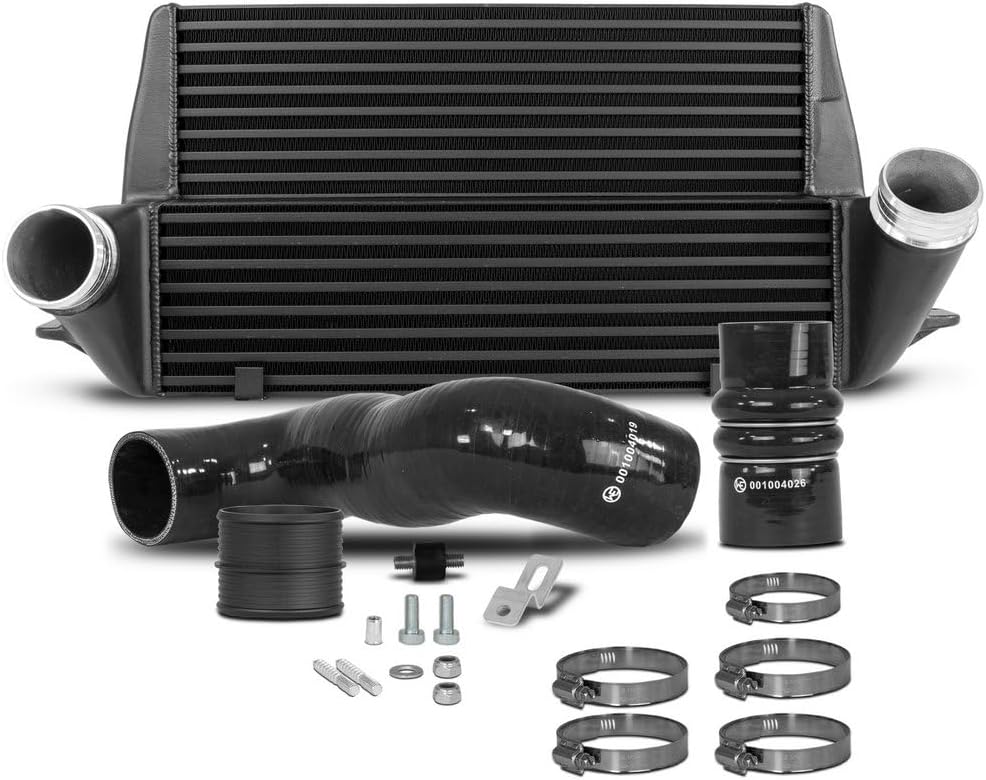
Wagner Tuning EVO3 Competition Intercooler Kit for BMW 135i 335i 1M E82 E90
$1,150.00
The price point on the EVO3 for E82/E90 puts it in a very competitive position when you consider what you get. This is not a budget intercooler - it's a serious piece of hardware. But compared to a CSF Stage 3 it's typically a few hundred dollars less, and the performance difference on a street car running Stage 2 power is essentially undetectable in real-world driving. The competition-level difference only really emerges at FBO+ power levels where you're running above 450 wheel horsepower consistently.
Wagner EVO3 for E90 335d
Worth mentioning separately because diesel BMW owners often get overlooked in these guides - the 335d (E90/E91/E92/E93 chassis) uses the M57N2 diesel six, not the N54, and has its own intercooler requirements. Wagner makes a dedicated EVO3 kit for the 335d. Power potential on the M57N2 diesel is massive - Stage 1 diesel tunes can push these to 350+ horsepower at the crank while doubling torque - and the OEM diesel intercooler has similar heat soak limitations to its gasoline counterpart.
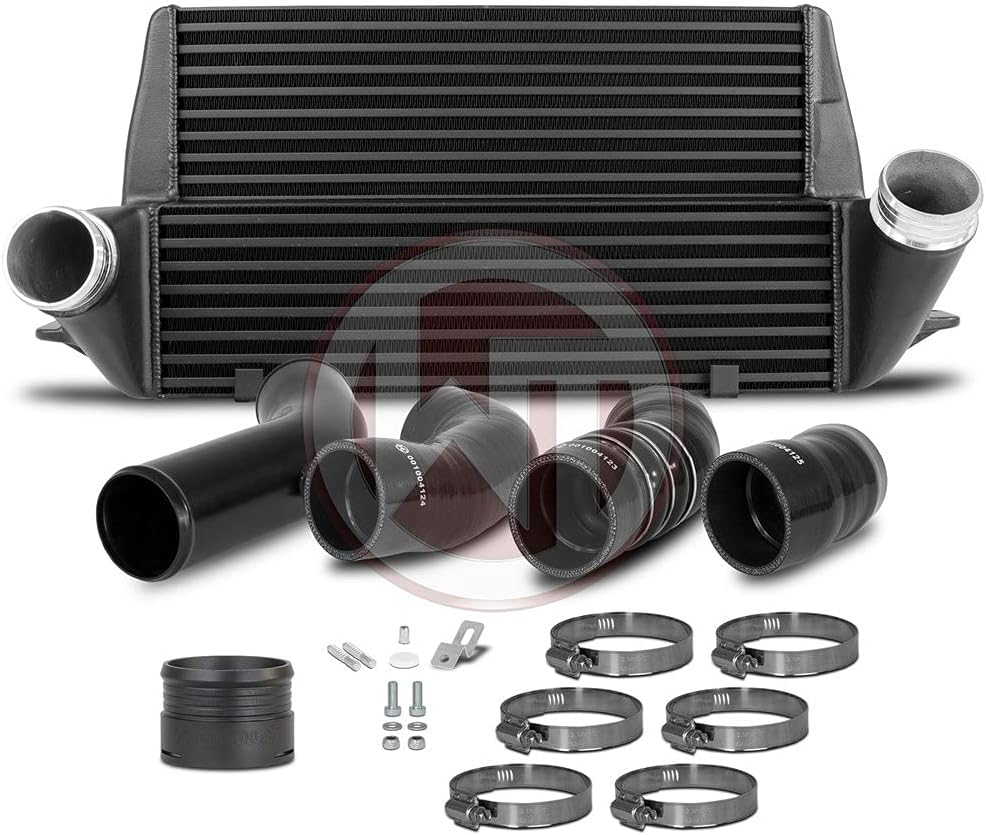
Wagner Tuning EVO3 Competition Intercooler Kit — E90/E91/E92/E93 335d
$1,161.97
Wagner EVO3 for E89 Z4 with N54 or N55
The E89 Z4 35i and 35is use the N54 and are a unique fitment case because the Z4 roadster front end is lower and more aerodynamic than the sedans. Wagner's EVO3 for the E89 Z4 is a modified fitment that routes differently than the E9x sedan kit. If you've got a Z4 35is - the 340 horsepower N54 variant - and you're chasing more power, this is the correct kit.

Wagner Performance Intercooler for F10 535i
The F10/F01/F12 Wagner kit covers the N55-powered 535i (F10), 740i (F01), and 640i/640i Gran Coupe (F12/F13). This is a performance intercooler rather than Wagner's top-tier competition unit, which reflects the typical power targets for these larger, heavier luxury cars. Most F10 535i owners are on Stage 1 to Stage 2 tunes and the performance unit is correctly specced for that application. If you're building an F10 for serious power - upgraded turbos, built motor - then you'd want to discuss custom fitment options or look at what can be adapted from the competition line.

Wagner Tuning Performance Intercooler Kit — F10/F01/F12 535i/740i
$599.00
Wagner Competition Intercooler for X5 and X6 E70, E71, F15, F16
The SAV fitments are Wagner's competition-level units for the E70/F15 X5 and E71/F16 X6. These cover both the N54 and N55 versions across both generations. Given that these vehicles weigh 4,700-4,900 pounds, the power density required to make them feel quick is significant, and the intercooler needs to support the power levels that make that happen.

Wagner Tuning Competition Intercooler Kit — E70/E71/F15/F16 X5 & X6
$1,140.00
Wagner EVO1 for F2x and F3x N20 and N55
This is Wagner's entry-level unit for the F20/F21 1-series and F30/F32/F34 3/4-series with either the N20 four-cylinder or N55 six-cylinder. If you've got an F30 335i and you're on a Stage 1 tune or you're budget-conscious, the EVO1 is a legitimate upgrade over OEM without the price of the competition units. Thermal efficiency is noticeably better than stock and the core volume increase alone makes a difference in heat soak resistance. For anything past Stage 1 power, step up to the EVO2 or better.

Wagner Tuning Evo1 Competition Front Mount Intercooler — F2X/F3X N20/N55
$490.00
Wagner EVO2 for F25 X3 and F26 X4
The F25 X3 35i and F26 X4 35i are N55-powered SAVs that have a dedicated EVO2 kit. These are underrated performance cars - the X4 35i in particular is a surprisingly capable chassis with the right suspension work (check out the coilover section on BimmerTalk for options) and the N55 responds well to tuning. The EVO2 is the right level of intercooler for these cars up to Stage 2 power.

Wagner Tuning Competition EVO2 Intercooler Kit for BMW X3 F25 & X4 F26
$639.00
Evolution Racewerks (ER) Competition Intercoolers
Evolution Racewerks is a California-based company that's built a solid reputation in the N54/N55 community specifically, rather than trying to cover every turbocharged car on the market. Their intercooler product line is focused, well-engineered, and competitively priced. The ER competition intercooler for the E90/E92 335i is a bar-and-plate unit with a core volume that's competitive with the Wagner EVO3. ER's claim to fame is aggressive pricing relative to core quality - they've consistently been one of the better value propositions in the N54 space.
ER also makes complementary products like silicone charge pipe kits that are designed to work with their intercooler routing, which makes them a good one-stop option if you want a matched system. Their customer service has a reputation for being responsive to technical questions, which matters when you're doing a complicated install on a specific E-chassis variant and you need to know about a clearance issue that the generic instructions don't cover.
One area where ER trails Wagner and CSF is international distribution and parts availability. If you're in Europe or Australia, Wagner is generally easier to source and support. If you're in North America, ER is well-stocked and ships quickly. For the F30 specifically, ER's fitment notes are thorough about the bumper removal requirements, and their kits include all hardware including new charge pipe clamps.
ER doesn't have a direct product in the BimmerTalk catalog currently, but they're worth researching as an alternative to the products we can directly link here, particularly for E9x owners who are price-sensitive and doing their own install.
VRSF Intercoolers for the N54 and N55 Ecosystem
VRSF (Velocity Racing Sport Fabrication) has historically been one of the more active brands in the N54/N55 space, particularly known for their downpipes and charge pipes. Their intercooler line is competent and they've made specific kits for the E9x and F3x chassis. VRSF's intercoolers are bar-and-plate construction and their core sizing is generally in the same ballpark as Wagner's competition units.
What VRSF does particularly well is bundle pricing - they frequently offer their intercooler with charge pipes, downpipe, and silicone couplers as a kit at a price below what each component costs individually. If you're doing a comprehensive Stage 2 or Stage 2+ build in one go and you want to do it all from one supplier, VRSF's bundle approach can save you real money. Their F8x M2/M3/M4 intercooler power pack is a good example of this bundling approach applied to a more extreme platform.

VRSF's quality control has historically been slightly less consistent than Wagner or CSF - there have been occasional reports of fitment issues requiring minor modification on E9x installs, and their end tank welding quality varies. That said, for the price they charge, most buyers in the N54 community consider VRSF a legitimate option, especially when bundled. If you're going the VRSF route, order from a reputable dealer who can help with any fitment issues rather than direct if possible.
For the intercooler section of BimmerTalk, you can compare VRSF offerings against Wagner and CSF side by side. The important thing is to confirm that the core you're looking at is specifically made for your chassis year and variant, not just "fits N54" generically.
Mishimoto Intercoolers for BMW Applications
Mishimoto is a well-known brand in the aftermarket cooling space and they make intercoolers for a wide range of turbocharged BMWs. Their product quality is consistent and their marketing is very good, but the honest assessment for performance-focused N54/N55 builds is that their FMIC units are better suited to mild builds than serious power applications.
Mishimoto uses a tube-and-fin construction for most of their BMW intercoolers, which as I discussed earlier means you need a larger external volume to match the thermal efficiency of a same-sized bar-and-plate unit. Their cores are bigger than OEM to compensate, and for a Stage 1 build on a daily driver they do the job. The thermal efficiency improvement over OEM is real. For Stage 2 and beyond, most serious N54 builders would tell you to step up to a bar-and-plate unit from Wagner, CSF, or ER.
Where Mishimoto genuinely excels is in the F8x M2/M3/M4 space with their air-to-water intercooler for the S55 engine. The S55 uses a different cooling architecture - it's a water-to-air intercooler mounted in the intake manifold - and Mishimoto's upgrade for that system is a genuine performance product. But that's outside our N54/N55 scope for this article.

For the everyday N55 F30 335i owner who drives the car to work five days a week, does an occasional autocross, and wants better performance than OEM without the complexity of a full Stage 2 build, Mishimoto is a perfectly reasonable choice. It's easier to find at mainstream retailers, the warranty support is straightforward, and installation documentation is solid. Just don't expect it to keep up with a Wagner EVO3 at 450 wheel horsepower in a track day scenario.
Dinan Intercoolers - The OEM-Plus Option
Dinan is BMW's factory performance partner in North America and they approach intercooler upgrades differently from the pure aftermarket companies. Their dual-core intercooler designs use a stacked dual-core approach that increases air-side cooling surface area while staying within tighter dimensional constraints than a typical single-core aftermarket unit. The result is a product that installs more like the OEM unit and is sized to work within BMW's factory charge pipe routing without major modifications.
The Dinan dual-core intercooler for the F30/F32/F36 (2012-2016 BMW 2/3/4-series) is their main N55 product for the F-chassis small cars. At its price point it's competitive with entry to mid-level aftermarket options, and for someone who wants to buy from a company that has a direct relationship with BMW and values engineering conservatism over maximum performance numbers, Dinan is an excellent choice.

Dinan High Performance Dual Core Intercooler for 2012-2016 BMW 2/3/4-Series
$666.20
For the F87 M2, Dinan has a dedicated high-performance dual-core unit. The M2 with N55 is a different animal from the base 2-series - BMW's M division extracted 370 horsepower from the N55 in the M2 through aggressive turbo mapping and higher boost, and the intercooler upgrade need is proportionally greater. Dinan's M2 unit provides a genuine performance improvement over the OEM intercooler for M2 builds.
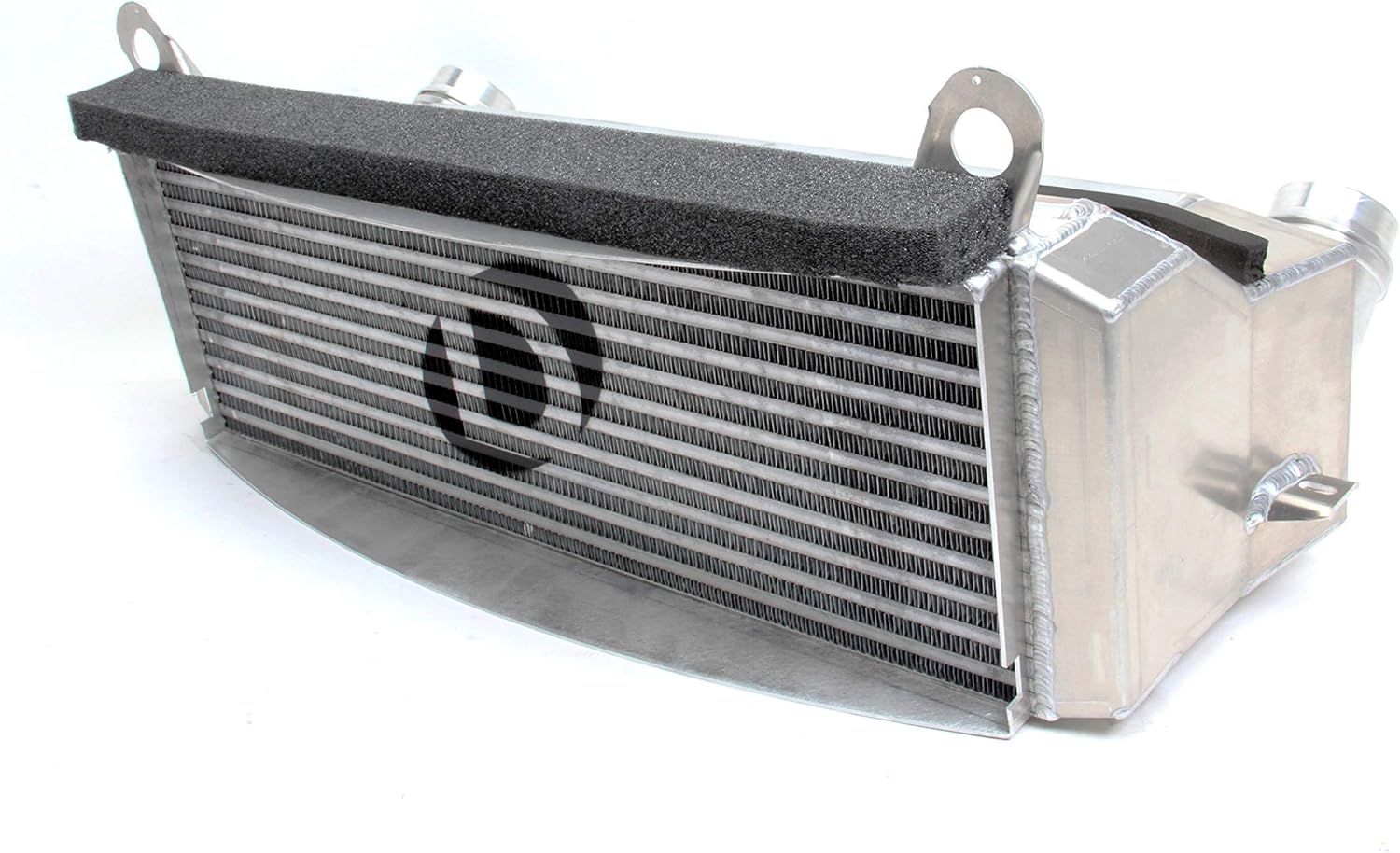
The honest comparison between Dinan and Wagner at similar price points usually favors Wagner on raw thermal performance numbers. Dinan wins on perceived OEM quality, dealer network support, and warranty integration with BMW extended coverage programs. If you have a CPO BMW and you're worried about warranty implications, Dinan is the brand to look at. If you just want maximum charge air cooling for the money, Wagner is the answer.
The F8x M2, M3, M4 and S55 Intercooler Situation
Technically outside the N54/N55 scope of this guide's title, but worth a section because so many N54/N55 owners eventually move up to an F8x and ask the same intercooler questions in a new context. The S55 in the F80 M3, F82/F83 M4, and F87 M2 Competition uses a water-to-air intercooler integrated into the intake manifold - it's a fundamentally different architecture from the air-to-air FMIC on the N54/N55. The water-cooled system has excellent steady-state performance but heat soaks the coolant reservoir quickly under hard use. Aftermarket solutions attack both sides of the equation.
Wagner Tuning makes an air-to-air FMIC conversion kit for the F80/F82/F87 that replaces the water-to-air system entirely. This is a significant modification that requires custom charge pipes and intake manifold modifications, but the results on track are excellent because you're no longer limited by coolant temperature saturation. It's the right approach for a dedicated track car.

Wagner Tuning Performance Intercooler Kit — F80/F82/F87 M2/M3/M4 S55
$1,666.83
For the S55, you can also look at the coilover guide for the F8x if you're doing a full suspension build alongside the intercooler work - these cars benefit enormously from proper corner weights after power modifications change the driving behavior.
Full Comparison Table - All Recommended Products
Here's the side-by-side breakdown of the main options we've covered, with the data that matters for making your decision. I've tried to be honest about where data is manufacturer-claimed versus independently tested. The "core size" column is approximate external core volume - the actual air-side flow area depends on internal construction which varies by manufacturer and isn't always disclosed publicly.
| Brand / Product | Chassis Fitment | Construction | Core Size (approx) | Est. IAT Reduction vs OEM | Power Level Suitability | Price Range |
|---|---|---|---|---|---|---|
| Wagner EVO3 (E82/E90) | E82 135i/1M, E90/E92/E93 335i | Bar and plate | 600x300x100mm | 60-80°F | Stage 1 through FBO+ | ~$1,150 |
| Wagner EVO3 (E89 Z4) | E89 Z4 35i / 35is | Bar and plate | Chassis-specific | 55-75°F | Stage 1 through FBO | ~$849 |
| Wagner EVO2 (F25/F26) | F25 X3 35i, F26 X4 35i | Bar and plate | Mid-size core | 45-65°F | Stage 1 through Stage 2 | ~$639 |
| Wagner Perf. (F10) | F10 535i, F01 740i, F12 640i | Bar and plate | Chassis-specific | 40-60°F | Stage 1 through Stage 2 | ~$599 |
| Wagner EVO1 (F2x/F3x) | F20/F21, F30/F32/F34 N20/N55 | Bar and plate | Entry-level core | 30-50°F | Stage 1 | ~$490 |
| Dinan Dual Core (F30) | F30/F32/F36 2/3/4-series | Dual-core proprietary | Compact dual core | 25-45°F | Stage 1 through mild Stage 2 | ~$666 |
| Dinan D330-0026 (M2) | F87 M2 | Dual-core proprietary | M2-specific | 30-50°F | Stage 1 through Stage 2 | ~$949 |
| Mishimoto FMIC (N54/N55) | Multiple - check fitment | Tube and fin | Larger than OEM | 20-40°F | Stage 1 / mild daily | Mid-range |
| VRSF Power Pack (F8x) | F80 M3, F82 M4, F87 M2 | Bar and plate bundle | Competition core | 50-70°F | S55 Stage 1 through FBO | ~$2,092 |
| CSF Stage 2 / Stage 3 | E9x, F3x - check catalog | Bar and plate | Stage 2: large, Stage 3: XL | 50-75°F (S2), 65-85°F (S3) | Stage 2 / FBO respectively | $800-$1,200+ |
Wagner EVO3 (E82/E90)
- Chassis Fitment
- E82 135i/1M, E90/E92/E93 335i
- Construction
- Bar and plate
- Core Size (approx)
- 600x300x100mm
- Est. IAT Reduction vs OEM
- 60-80°F
- Power Level Suitability
- Stage 1 through FBO+
- Price Range
- ~$1,150
Wagner EVO3 (E89 Z4)
- Chassis Fitment
- E89 Z4 35i / 35is
- Construction
- Bar and plate
- Core Size (approx)
- Chassis-specific
- Est. IAT Reduction vs OEM
- 55-75°F
- Power Level Suitability
- Stage 1 through FBO
- Price Range
- ~$849
Wagner EVO2 (F25/F26)
- Chassis Fitment
- F25 X3 35i, F26 X4 35i
- Construction
- Bar and plate
- Core Size (approx)
- Mid-size core
- Est. IAT Reduction vs OEM
- 45-65°F
- Power Level Suitability
- Stage 1 through Stage 2
- Price Range
- ~$639
Wagner Perf. (F10)
- Chassis Fitment
- F10 535i, F01 740i, F12 640i
- Construction
- Bar and plate
- Core Size (approx)
- Chassis-specific
- Est. IAT Reduction vs OEM
- 40-60°F
- Power Level Suitability
- Stage 1 through Stage 2
- Price Range
- ~$599
Wagner EVO1 (F2x/F3x)
- Chassis Fitment
- F20/F21, F30/F32/F34 N20/N55
- Construction
- Bar and plate
- Core Size (approx)
- Entry-level core
- Est. IAT Reduction vs OEM
- 30-50°F
- Power Level Suitability
- Stage 1
- Price Range
- ~$490
Dinan Dual Core (F30)
- Chassis Fitment
- F30/F32/F36 2/3/4-series
- Construction
- Dual-core proprietary
- Core Size (approx)
- Compact dual core
- Est. IAT Reduction vs OEM
- 25-45°F
- Power Level Suitability
- Stage 1 through mild Stage 2
- Price Range
- ~$666
Dinan D330-0026 (M2)
- Chassis Fitment
- F87 M2
- Construction
- Dual-core proprietary
- Core Size (approx)
- M2-specific
- Est. IAT Reduction vs OEM
- 30-50°F
- Power Level Suitability
- Stage 1 through Stage 2
- Price Range
- ~$949
Mishimoto FMIC (N54/N55)
- Chassis Fitment
- Multiple - check fitment
- Construction
- Tube and fin
- Core Size (approx)
- Larger than OEM
- Est. IAT Reduction vs OEM
- 20-40°F
- Power Level Suitability
- Stage 1 / mild daily
- Price Range
- Mid-range
VRSF Power Pack (F8x)
- Chassis Fitment
- F80 M3, F82 M4, F87 M2
- Construction
- Bar and plate bundle
- Core Size (approx)
- Competition core
- Est. IAT Reduction vs OEM
- 50-70°F
- Power Level Suitability
- S55 Stage 1 through FBO
- Price Range
- ~$2,092
CSF Stage 2 / Stage 3
- Chassis Fitment
- E9x, F3x - check catalog
- Construction
- Bar and plate
- Core Size (approx)
- Stage 2: large, Stage 3: XL
- Est. IAT Reduction vs OEM
- 50-75°F (S2), 65-85°F (S3)
- Power Level Suitability
- Stage 2 / FBO respectively
- Price Range
- $800-$1,200+
Installation Tips and Common Mistakes
Whether you're doing this yourself or taking it to a shop, there are a handful of mistakes I've seen people make repeatedly on N54/N55 intercooler installs. Most of them are preventable with a bit of preparation.
Plastic Charge Pipe Failure Prevention
The OEM N54 charge pipes are plastic for cost reasons, not performance reasons. They crack. They crack when cold. They crack when you're pushing high boost for the first time after an intercooler upgrade because the pressure differential between boosted and non-boosted cycles is higher than the plastic has seen before. The thermal cycling over 60,000 or 80,000 miles has already stressed them. Replace them during the intercooler install. Period. You're already in there with the bumper off. The labor overlap makes it essentially free if you're doing both at the same time. Don't make the mistake of saving $200 on charge pipes and then pulling the bumper again six months later when one cracks. BimmerTalk's charge pipe section has the right options for your chassis.
Silicone Coupler Orientation
Silicone couplers that come with most intercooler kits have a correct orientation - the reinforcing layers in the silicone are structured for a specific stress direction based on whether the coupler is on the pressure or vacuum side. Most modern kits mark these clearly. Don't improvise with mismatched couplers from another kit or cheap universal pieces. A blowoff coupler at 20 psi at full boost is a bad experience.
Intercooler Pipe Torque and Re-Torque
Clamp torque on silicone-to-aluminum joints should follow the manufacturer's spec, and then the car should be allowed to go through 3-5 heat cycles before re-torquing. Silicone compresses under heat cycling and clamps that were correctly torqued at install often need a quarter-turn after the first few heat cycles. This is especially true on bar-and-plate cores where the aluminum end tanks expand more with heat than the OEM plastic pieces do. Five minutes of re-torquing after the first week of driving prevents boost leaks.
IAT Sensor Relocation
The OEM intake air temperature sensor on both the N54 and N55 is located in a specific position in the intake tract. When you move to an aftermarket intercooler with different routing, you need to confirm the IAT sensor is in a position that accurately reads post-intercooler charge air temperature rather than pre-intercooler. Some kits provide a new boss location in the charge pipe for the IAT sensor. Others require you to relocate it. If the IAT sensor ends up upstream of the intercooler outlet, the DME will think air temperatures are higher than they are and may over-enrich or make incorrect timing decisions. Read the installation instructions fully before starting.
Bumper Reassembly and Clip Inventory
BMW bumper clips and retaining fasteners are single-use items - technically you can reuse them, but they're plastic and they lose retention force after removal. Budget $20-40 for a fresh set of the main bumper clips before you start. Reusing old clips and then having a bumper that rattles or sags at one corner is a real outcome that's easily avoided. Check BMW's OEM parts system or a site like RealOEM to identify the clip part numbers for your specific chassis - they vary between E9x and F-chassis.
Cooling System Bleeding After Install
This one is more relevant if you disturb any coolant lines during the intercooler install, which does happen on some F10 and X5/X6 fitments where the charge pipe routing passes near coolant lines. If you do have any coolant loss or line disconnection, bleed the cooling system properly. Air pockets in the N54/N55 cooling system cause hot spots and phantom temperature sensor readings. The BMW coolant guide on BimmerTalk covers the correct procedure.
ECU Tuning Considerations When Upgrading the Intercooler
An intercooler upgrade without an ECU tune that accounts for it is leaving power on the table. The DME's base fuel maps and ignition timing maps are written with the OEM intercooler's thermal characteristics in mind - specifically, the IAT-based timing correction tables expect a certain range of post-intercooler temperatures at a given boost level and ambient temperature. When you dramatically reduce charge air temperatures with a quality aftermarket intercooler, the DME is now working with cooler, denser air than it expects. In best case, it self-adjusts with the closed-loop trims and you see modest gains. In better case, a tune that's written specifically for the upgraded intercooler fully exploits the denser charge air by advancing timing and potentially adding boost.
The main N54/N55 tuning platforms - JB4, Bootmod3, MHD Flasher - all have provisions for intercooler upgrades. On the JB4 specifically, there are configuration adjustments that account for reduced IAT readings from an upgraded intercooler to prevent the unit from reading the lower temperatures as a sensor fault. On Bootmod3 and MHD, your tuner can write maps that exploit the improved charge air quality. If you're getting a custom tune rather than an off-the-shelf map, tell your tuner what intercooler you're running before they start the tune - it's a primary variable in the fuel and timing maps. The ECU tuning section on BimmerTalk has resources for each of these platforms.
One specific thing to watch for on JB4 users - the JB4 has an IAT compensation table that adjusts boost target based on intake air temperature. With an upgraded intercooler, your IATs will be lower, which means the JB4 will allow more aggressive boost targeting than it would with the OEM unit. This is generally a good thing, but make sure your supporting modifications (fuel pump, charge pipes, spark plugs) are up to the increased demand before you chase maximum boost numbers.
Track Use Considerations and the Thermal Recovery Question
If you're taking your N54 or N55 car to track days regularly, the calculus around intercooler selection changes somewhat from pure street use. On track, you're doing sustained high-load operation for 20-25 minute sessions, then going back to the paddock for 20-30 minutes of downtime, then going back out. The critical question is: how well does the intercooler recover during that paddock time?
Bar-and-plate units, as I discussed earlier, have higher thermal mass. Under a sustained track session, a large bar-and-plate core will absorb a significant amount of heat. The advantage is that it absorbs this heat slowly - it doesn't spike IATs as dramatically during the session as a smaller or tube-and-fin unit would. The potential disadvantage is that in a very short paddock session (15 minutes or less), it might not have fully dissipated all that stored heat before the next session starts. On a typical 25-30 minute paddock rotation, the difference is generally negligible - either core type will cool adequately. If you're doing very short rotations at a time attack event, a high-quality tube-and-fin unit might edge out a bar-and-plate on second-session temperatures.
For a dedicated track car, a front-mounted intercooler spray kit is worth considering. These systems use a small water reservoir and solenoid to spray a fine mist of water across the intercooler core during high-load operation or in the paddock during recovery. The evaporative cooling dramatically accelerates heat dissipation. This is a fairly common addition on serious track builds and it works with any front-mounted intercooler type. It's the kind of detail that separates a car that's good for 3 laps from one that's good for 20.
The other track consideration is physical protection. Your intercooler is now mounted directly behind the front bumper opening. At track speeds, anything on the track surface - stones, debris, pieces of other people's cars - can go directly into the intercooler core. A quality intercooler guard or protective mesh across the bumper opening is cheap insurance. A rock through an intercooler core at speed is not.
What About the G20 330i, G20 M340i, and B48/B58 Engines
Since I daily a G20 330i with the B48, and plenty of people reading this are on the newer G-chassis, let me address where things stand for the current generation. The B48 and B58 engines use a charge air cooling architecture that's different from the N54/N55. The B48 in base 330i/430i uses an air-to-air FMIC, but the B58 in the M340i/M440i uses a water-cooled charge air cooler integrated with the intake manifold - similar in concept to what the S55 uses, but fed by a separate low-temperature coolant circuit. The B58 system is impressively efficient from the factory and less prone to heat soak than the N54/N55 under moderate boost. For B58 owners pushing past 500 wheel horsepower on upgraded turbos, an intercooler upgrade becomes necessary, but at stock and mild Stage 1 levels the OEM system handles well.
For the G20 M340i specifically, the heat exchanger upgrade that addresses the low-temperature coolant circuit makes more sense than a traditional FMIC swap. Products like the ETL Performance aluminum heat exchanger for the M340i/G20 address the correct component in the cooling chain for that architecture.

ETL Performance Aluminum Heat Exchanger Upgrade for BMW M340i G20 / Z4 G29 / M440i G22 G42
$549.99
The G80 M3 and G82 M4 with S58 represent the current top of the M performance ladder and use a more advanced version of the water-to-air charge air cooling. Mishimoto has an impressive charge air cooler manifold upgrade for the G80 M3 that replaces the OEM manifold-integrated heat exchanger with a larger unit. For anyone building a G80 M3 past Stage 1, it's worth serious consideration.

If you're on the G20 330i like me and you're looking at supporting modifications for a B48 build, the oil capacity tool on BimmerTalk is useful when you're updating your maintenance schedule to match the increased thermal load of a tuned engine. Oil gets worked harder on a tuned car and service intervals should reflect that.
My Recommendations by Chassis and Build Level
I'm going to be direct here because that's what these guides are for. This is what I'd actually do in each scenario.
E90 or E92 335i N54, Stage 1 Tune
Buy the Wagner EVO3 for the E82/E90 fitment. Yes, it's priced above what Stage 1 strictly requires, but you're going to do more to this car. Everyone does. Stage 1 quickly becomes Stage 2 once you feel Stage 1. Buy the right intercooler once instead of buying a budget unit now and replacing it in 18 months. Do the charge pipes at the same time. Budget a weekend for the install, have a friend help with the bumper if you can.
E90 or E92 335i N54, Stage 2 or FBO
Same answer - Wagner EVO3, full stop. At this power level it's the right size, it's proven, and the price-to-performance ratio is unbeaten. If you want to pay more for CSF's construction quality and support, the CSF Stage 2 is a legitimate alternative. Don't go smaller than EVO3 at Stage 2 power - you'll feel the limitation on hot days.
F30 335i N55, Daily Driver with Mild Tune
The Wagner EVO1 or Dinan dual-core gets the job done here. If you're Stage 1 only and you're not tracking the car, either of these is correct. The Dinan option makes particular sense if you have any dealer relationship or extended warranty considerations. The Wagner EVO1 wins on pure thermal numbers. Spend the savings on a quality ECU tune through Bootmod3 - that's where the real-world improvement comes from at Stage 1.
F30 335i N55, Stage 2 and Above
Wagner EVO2 minimum. EVO3 if you're aiming past 400 wheel horsepower. The F30 chassis has enough front-end space for the larger core and the power and heat management benefits justify the spend at this level. Make sure you're on upgraded charge pipes and confirm the IAT sensor is properly relocated.
F10 535i N55, Any Power Level
Wagner's F10 performance intercooler kit is the clear choice here. The F10 535i community doesn't have as deep an aftermarket ecosystem as the 335i platforms, and Wagner's fitment for the F10 is well-proven. CSF also makes an F10 unit if you prefer their brand. Either way, the install is manageable and the results on a Stage 1 or Stage 2 tuned F10 are excellent - these cars feel dramatically better when the IAT-induced timing pull is removed.
E70 X5 35i or X6 35i, N54 or N55
Wagner's X5/X6 competition kit. The E70 X5 35i responds incredibly well to Stage 2 modifications - the power-to-weight ratio improvement is immediately noticeable in a car that can feel sluggish stock. Getting heat soak under control with a proper intercooler is foundational to a well-sorted Stage 2 X5 build.
F87 M2 with N55
The Dinan dual-core for the M2 is the most conservative option with the best warranty posture. The Wagner for the F80/F82/F87 is the more aggressive option for higher power builds. The VRSF power pack is worth considering if you're doing a comprehensive build and want the bundle pricing. All three are legitimate - pick based on your power target and where you want to spend money.
Supporting Modifications - What Completes the Picture
An intercooler upgrade doesn't exist in isolation. Here are the supporting modifications that make the most sense to do alongside or shortly after an intercooler upgrade on an N54 or N55 car.
Upgraded Charge Pipes
Already mentioned this several times but it warrants its own section header because it's that important. The OEM N54 charge pipes are plastic, they crack, they cost you boost, they're easy to replace. Do it. Every intercooler kit worth buying includes charge pipes, and most of the ones we've discussed here do. If yours doesn't, source them separately. Silicone coupler replacements at all intercooler-to-charge-pipe junctions are also good insurance.
Downpipe Upgrade
On the N54, the stock catted downpipe is the second major restriction after the intercooler for power making. A high-flow catted or catless downpipe unlocks the next 30-50 wheel horsepower and reduces backpressure that would otherwise heat the charge air through radiant heat in the engine bay. Downpipe work and intercooler work logically go together for a Stage 2 build. The ECU tuning section covers which tunes are optimized for the downpipe addition.
Spark Plugs
The N54 and N55 both benefit from reduced heat range spark plugs (one step colder than OEM) when you're running more boost and more timing advance on an upgraded tune. Stock heat range plugs with Stage 2 power levels are a known source of misfires and inconsistent combustion. NGK 97506 or equivalent one-step-colder plugs gapped to the tuner's specification are standard practice for Stage 2 N54 builds. This is cheap insurance given what it protects.
High-Pressure Fuel Pump
The N54's OEM high-pressure fuel pump (HPFP) struggles to maintain fuel pressure at maximum demand above roughly 370-380 wheel horsepower. Port injection on the N54 means the HPFP is the sole fuel delivery mechanism and it's a limiting factor. The N55 has similar characteristics. For Stage 2 and FBO builds, an upgraded HPFP from Fuel-It or similar supplier removes a ceiling that otherwise caps what the intercooler and tune upgrades can achieve. If you're doing intercooler work at Stage 2 power, also verify your HPFP is up to the demand.
Suspension and Handling
Completely separate from the power build, but an N54 or N55 making Stage 2 power on OEM suspension that's 10 years old with original shock absorbers and shot bushings is a car that doesn't feel as fast as it is. The platform deserves corner weight, good dampers, and fresh bushings to actually use the power. The coilover buyer's guide on BimmerTalk has detailed recommendations for every relevant chassis.
Battery and Electrical Health
The N54 and N55 engines stress the electrical system more under high-performance use because the DME is making more calculations more frequently and the fuel pump and ignition system are working harder. An aging battery that can no longer hold proper voltage under load causes all sorts of gremlins - inconsistent boost, DME codes, fuel system faults. If your car has the original battery or one that's more than 4-5 years old, check its health. The BMW battery replacement guide on BimmerTalk covers BMW's battery registration requirement - this is critical to get right on any E9x or F-chassis BMW to prevent charging system issues after a battery swap.
Frequently Asked Questions
Will an aftermarket intercooler void my BMW warranty?
In the United States, the Magnuson-Moss Warranty Act provides some protection - a dealer cannot void your warranty simply for installing an aftermarket part unless they can prove the aftermarket part caused the specific failure being claimed. That said, BMW dealers can and do attempt to deny warranty claims on modified cars, particularly for engine and drivetrain issues. If your car is under warranty and you're concerned, the Dinan option is specifically worth considering - Dinan is BMW's factory performance partner in North America and Dinan-branded modifications are generally accepted by BMW dealers without warranty implications. In Europe, warranty implications vary by market and dealer. If you're outside warranty or don't plan to use dealer warranty, buy whatever performs best for your build.
How much power can the OEM N54 intercooler support before it becomes a problem?
The OEM N54 intercooler performs adequately at stock power levels (300 HP crank) and on mild Stage 1 tunes under 340-350 wheel horsepower in cool weather. Once you push past 350 wheel horsepower and especially in ambient temperatures above 70 degrees Fahrenheit, you'll see consistent IAT-based timing pull on back-to-back pulls. For a single hard pull in cool air, the OEM unit manages. For repeated performance, or for summer driving, or for anything past 350 wheel horsepower, an upgrade pays dividends.
Is there a meaningful difference between the N54 and N55 intercooler needs?
The N55 single twin-scroll turbo setup produces slightly different thermal characteristics than the N54's parallel twin-turbo arrangement. The N54's two smaller turbos spool faster and hit operating temperature faster, which means charge air temperatures rise quickly under boost. The N55's single larger turbo has more thermal inertia. In practice, the N55 is marginally less prone to acute heat soak spikes than the N54 at the same power level, but both engines benefit from the same quality of intercooler upgrade. The product selection doesn't differ significantly between N54 and N55 for a given chassis - most aftermarket manufacturers make their E9x kits compatible with both engines using the appropriate charge pipe adapters.
Do I need a tune after installing an intercooler?
You don't need a tune for the intercooler to work and provide benefit. Dropping charge air temperatures will always allow the stock DME to hold better timing than it would with higher IATs, even on a stock map. However, a tune that's specifically written for your intercooler and power level will extract significantly more benefit because it can take advantage of the cooler, denser charge air with more aggressive timing advance and potentially more boost. The honest answer is that if you're spending $600-1,200 on an intercooler, spending another $400-600 on a quality tune to exploit it is absolutely worth it. The intercooler and tune work together - the intercooler provides the headroom, the tune uses it.
How long does an intercooler upgrade installation take?
For an E9x 335i with full bumper removal, a first-timer doing it alone in a home garage should budget 4-6 hours. Someone who's done it before can do it in 2-3 hours. The F30 is similar. The F10 535i is generally quicker at 3-4 hours first time. The X5/X6 E70 is the easiest of the group - 2-3 hours first time because the front end comes apart cleanly and the intercooler is more accessible. Having a second set of hands for bumper removal makes a significant difference in time and frustration on all platforms. Most professional shops will charge 2-4 hours of labor for the job depending on chassis.
Can I install an intercooler kit myself without any special tools?
For most of the kits we've covered, the tools required are a standard metric socket set (8mm through 19mm will cover it), Torx drivers (T25, T30 are commonly needed for BMW clips), a set of trim removal pry tools (plastic to avoid scratching the bumper), and basic hand tools. A torque wrench is recommended but not strictly required. No welding, no machining, no special BMW tools are needed for a straightforward FMIC swap on any of the platforms we've covered. The fitment on modern production runs from Wagner, Dinan, and CSF is precise enough for a home garage install. The main skill requirement is comfort with disassembling the front end of a BMW, which sounds intimidating but is very manageable with good documentation and patience.
Does a bigger intercooler always mean better performance?
Bigger is generally better up to the point where pressure drop across the core becomes significant or where the core no longer fits properly within the available space and creates clearance issues with the radiator, condenser, or bumper structure. For street builds on stock to Stage 2 power levels, any of the main products we've discussed are sized appropriately and "bigger is better" holds. For FBO and beyond, you're looking at the largest units available for your chassis and pressure drop becomes a relevant data point to verify. The one scenario where bigger can hurt you is if a core that's too thick pushes the radiator rearward and reduces radiator cooling efficiency - good manufacturers account for this in their fitment designs, but it's worth confirming with chassis-specific fitment data.
What's the best intercooler for an E92 335i N54 that I occasionally track?
Wagner EVO3 for the E82/E90 fitment. At the price point, with bar-and-plate construction, at a core size that handles everything from Stage 1 to FBO, it's the right answer for an occasional track car that also does street duty. If you're doing dedicated track days more than once a month, add an intercooler water spray kit for better session-to-session recovery, and make sure your charge pipes are upgraded aluminum units, not the OEM plastic items. The difference between a well-sorted N54 E92 with a proper intercooler and the stock setup at a track day is meaningful and immediately noticeable to anyone who's driven both.
Are there any risks to installing a large aftermarket intercooler?
The main risks are improper installation causing boost leaks (loose couplers, wrong torque on clamps), IAT sensor relocation errors causing DME tuning decisions based on wrong data, and clearance issues with the condenser or radiator if the core is incorrectly positioned. All of these are preventable with proper installation procedure. Follow the manufacturer's instructions, use a torque wrench on clamp hardware, verify IAT sensor location, and double-check clearances before reassembling the bumper. A boost leak after intercooler installation will typically trigger engine codes and cause a very obvious loss of power - it's detectable immediately and easy to fix by finding and tightening the leaking coupler.
Should I also upgrade the intercooler charge pipes at the same time?
Yes. Unambiguously yes. This has come up throughout the article because it genuinely matters that much. The OEM plastic charge pipes on both N54 and N55 are a known failure mode, especially on older higher-mileage cars. If you're pulling the bumper for an intercooler swap, you're 80 percent of the way to doing the charge pipes at the same time. The additional cost is modest. The downside risk of not doing them - pulling the bumper again six months later when a pipe cracks under boost - is real. Most quality intercooler kits include aluminum charge pipes for exactly this reason.
After all of this, the bottom line is straightforward: the N54 and N55 are two of the best inline-six turbo engines BMW has produced, and they respond to intercooler upgrades more directly than almost any other single modification at Stage 1 and Stage 2 power levels. The stock intercooler is the clear limiting factor once you're past stock power, and the aftermarket has matured to the point where there are excellent options at every price point for every chassis. Wagner dominates the price-to-performance calculation on most platforms. CSF wins on build quality and support. Dinan is the choice for warranty-conscious owners or those who want the BMW factory performance blessing. VRSF bundles well for comprehensive builds. The right choice for your car is the one that matches your chassis, your power level, and the way you use the car.
If you're still deciding between platforms or want to dig deeper into the ECU tuning side of the equation to maximize what an intercooler upgrade can do, the ECU tuning section on BimmerTalk is the logical next stop. And if the suspension on your E9x or F30 hasn't been touched since the intercooler ambitions started growing, the coilover guide will give you the same level of detail for the handling side of the build. Build it properly, build it once, and enjoy what these engines can do when they're not thermally limited.