BMW OBD Port Location - Every Model and Chassis
Affiliate disclosure. BimmerTalk is a proud partner of the Amazon Associates Program and Turner Motorsport. We may earn a small commission on qualifying purchases through our links, at no extra cost to you. Read the full disclosure.

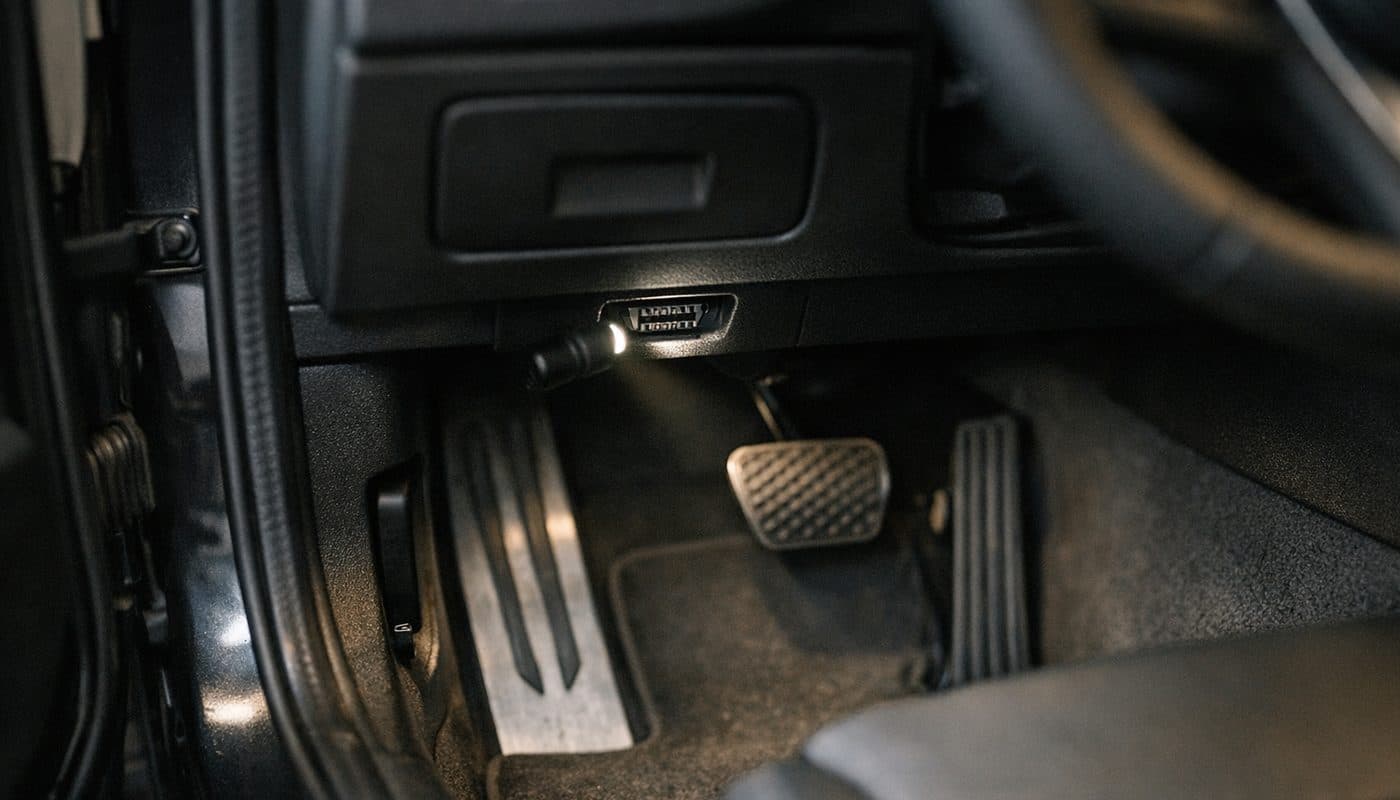
Every BMW built since the mid-1990s has a diagnostic socket somewhere, and on about 95 percent of them it sits in the same place - under the driver's side of the dashboard, above your left knee, usually hiding behind a small plastic flap. If you drive an F, G or U series car, that one sentence is most of what you need. Crouch down, look up, find the flap, done.
The other five percent is where people lose an afternoon. Older E-series cars with a round 20-pin connector under the bonnet that does things the cabin socket cannot. E90s where the cover is tucked so far back you swear it has been deleted. Ports that are exactly where they should be but show no power because the cigarette lighter fuse went. Adapters that fit perfectly and then rest against your kneecap for the entire drive.
This is the reference page I wanted the first time I went hunting under my own G20 with an OBDLink CX in one hand and a phone torch in the other. It covers where the port is on every chassis family BMW has sold in the US, how to get the cover off without snapping a tab, what the old round connector is and whether you actually need it, what the pins do, and what to check when the socket is dead. It is written for owners who want to plug something in - a code reader, a BimmerCode adapter, a K+DCAN or ENET cable - and want the boring part finished in sixty seconds.
16
Cabin port pins
20
Old under-bonnet connector pins
Pin 16
Pin that carries 12 V
roughly to the early 2000s
Round connector lasted
The short answer for almost every BMW
Look under the dashboard on the driver's side, directly above the left footwell. On a left-hand-drive car that means above and slightly left of the pedals, close to where the kick panel meets the lower dash. The socket is the trapezoid-shaped 16-pin connector, open end facing down or facing the seat, and on most cars from the E90 era onward it is behind a small plastic flap that either hinges down or pops off. Right-hand-drive cars mirror the layout, so the port is still on the driver's side.
If you are reading this for a modern car - any F, G or U chassis, any i model, any F-generation MINI - you can stop at the table below. The sections after it exist for the cars that break the pattern, for the people who need to know which pins do what, and for the day your port stops working. If you are unsure which chassis you have, the free BimmerTalk chassis lookup or the VIN decoder will tell you in a few seconds.
| Chassis | Where the port is | Note |
|---|---|---|
| E36 3 Series (1992 to 1999) | Round 20-pin socket in the engine bay near the strut tower. Some late cars also have a cabin 16-pin socket | Where a cabin socket exists it is engine-only on most cars. Use the 20-pin with an adapter |
| E46 3 Series (1999 to 2006) | Driver footwell above the pedals behind a small rectangular cover | Early cars also carry the 20-pin round socket under the bonnet |
| E90 and E92 3 Series (2006 to 2013) | Lower driver dash left of the steering column behind a small flap | The flap sits high and far back so look up not sideways |
| F30 and F31 3 Series (2012 to 2018) | Lower driver dash above the left footwell behind a flip-down cover | Same spot on the 2013 and 2015 328i |
| G20 3 Series (2019 on) | Lower driver dash above the left knee behind a hinged flap | Socket points downward on my own car |
| E39 5 Series | Driver footwell lower dash behind a cover | Most E39s also have the 20-pin round socket in the engine bay |
| E60 and E61 5 Series | Lower driver dash above the left knee with a flip-down cover | Standard E-series placement |
| F10 and F11 5 Series | Lower driver dash above the pedals with a small hinged cover | Standard F-series placement |
| G30 5 Series | Lower driver dash near the steering column with a flip-down cover | On some cars the socket is angled upward |
| F48 X1 | Lower driver dash above the left footwell behind a cover | Look under the dash not at the side panel |
| U11 X1 | Lower driver dash on the driver side | Cover design not confirmed in the sources I could find |
| E83 X3 | Lower driver dash above the footwell with a small cover | Check near the kick-panel edge |
| F25 and G01 X3 | Lower driver dash above the left knee behind a flap | Standard placement |
| E53 X5 | Driver footwell lower dash behind a cover | Early cars also have the 20-pin socket under the bonnet |
| E70 and F15 and G05 X5 | Lower driver dash above the left footwell behind a flap | Standard placement across all three |
| G07 X7 | Lower driver dash above the left footwell with a hinged panel | Standard G-series placement |
| F22 and G42 2 Series | Lower driver dash above the left footwell behind a cover | G42 cover detail not confirmed |
| F32 and G22 4 Series | Lower driver dash above the pedals with a hinged cover | G22 cover detail not confirmed |
| i3 | Lower driver dash above the left footwell with a small cover | Same as contemporary BMWs |
| i4 and iX and i7 | Lower driver dash on the driver side | Modern BMW placement though exact cover varies |
| Z4 E85 and E89 and G29 | Lower driver dash above the left footwell | Trim-specific cover not confirmed |
| MINI R50 and R53 | Above the pedals on the left of the driver footwell | No major trim removal needed |
| MINI R56 and F55 and F56 and F60 | Lower driver dash behind a small flap near the steering column | F60 cover not confirmed in detail |
| MINI J01 (2024 on) | Lower driver dash on the driver side | Not confirmed in detail yet |
E36 3 Series (1992 to 1999)
- Where the port is
- Round 20-pin socket in the engine bay near the strut tower. Some late cars also have a cabin 16-pin socket
- Note
- Where a cabin socket exists it is engine-only on most cars. Use the 20-pin with an adapter
E46 3 Series (1999 to 2006)
- Where the port is
- Driver footwell above the pedals behind a small rectangular cover
- Note
- Early cars also carry the 20-pin round socket under the bonnet
E90 and E92 3 Series (2006 to 2013)
- Where the port is
- Lower driver dash left of the steering column behind a small flap
- Note
- The flap sits high and far back so look up not sideways
F30 and F31 3 Series (2012 to 2018)
- Where the port is
- Lower driver dash above the left footwell behind a flip-down cover
- Note
- Same spot on the 2013 and 2015 328i
G20 3 Series (2019 on)
- Where the port is
- Lower driver dash above the left knee behind a hinged flap
- Note
- Socket points downward on my own car
E39 5 Series
- Where the port is
- Driver footwell lower dash behind a cover
- Note
- Most E39s also have the 20-pin round socket in the engine bay
E60 and E61 5 Series
- Where the port is
- Lower driver dash above the left knee with a flip-down cover
- Note
- Standard E-series placement
F10 and F11 5 Series
- Where the port is
- Lower driver dash above the pedals with a small hinged cover
- Note
- Standard F-series placement
G30 5 Series
- Where the port is
- Lower driver dash near the steering column with a flip-down cover
- Note
- On some cars the socket is angled upward
F48 X1
- Where the port is
- Lower driver dash above the left footwell behind a cover
- Note
- Look under the dash not at the side panel
U11 X1
- Where the port is
- Lower driver dash on the driver side
- Note
- Cover design not confirmed in the sources I could find
E83 X3
- Where the port is
- Lower driver dash above the footwell with a small cover
- Note
- Check near the kick-panel edge
F25 and G01 X3
- Where the port is
- Lower driver dash above the left knee behind a flap
- Note
- Standard placement
E53 X5
- Where the port is
- Driver footwell lower dash behind a cover
- Note
- Early cars also have the 20-pin socket under the bonnet
E70 and F15 and G05 X5
- Where the port is
- Lower driver dash above the left footwell behind a flap
- Note
- Standard placement across all three
G07 X7
- Where the port is
- Lower driver dash above the left footwell with a hinged panel
- Note
- Standard G-series placement
F22 and G42 2 Series
- Where the port is
- Lower driver dash above the left footwell behind a cover
- Note
- G42 cover detail not confirmed
F32 and G22 4 Series
- Where the port is
- Lower driver dash above the pedals with a hinged cover
- Note
- G22 cover detail not confirmed
i3
- Where the port is
- Lower driver dash above the left footwell with a small cover
- Note
- Same as contemporary BMWs
i4 and iX and i7
- Where the port is
- Lower driver dash on the driver side
- Note
- Modern BMW placement though exact cover varies
Z4 E85 and E89 and G29
- Where the port is
- Lower driver dash above the left footwell
- Note
- Trim-specific cover not confirmed
MINI R50 and R53
- Where the port is
- Above the pedals on the left of the driver footwell
- Note
- No major trim removal needed
MINI R56 and F55 and F56 and F60
- Where the port is
- Lower driver dash behind a small flap near the steering column
- Note
- F60 cover not confirmed in detail
MINI J01 (2024 on)
- Where the port is
- Lower driver dash on the driver side
- Note
- Not confirmed in detail yet
One honest caveat about that table. BMW's own documentation does not publish a tidy chassis-by-chassis chart, so the modern-car entries marked "not confirmed" are an educated expectation based on BMW's consistent placement rather than a photo I have seen. If your G42 or iX turns out to have the port somewhere odd, I would genuinely like to hear about it.
How to find the port and get the cover off
What the cover looks like on E, F and G cars
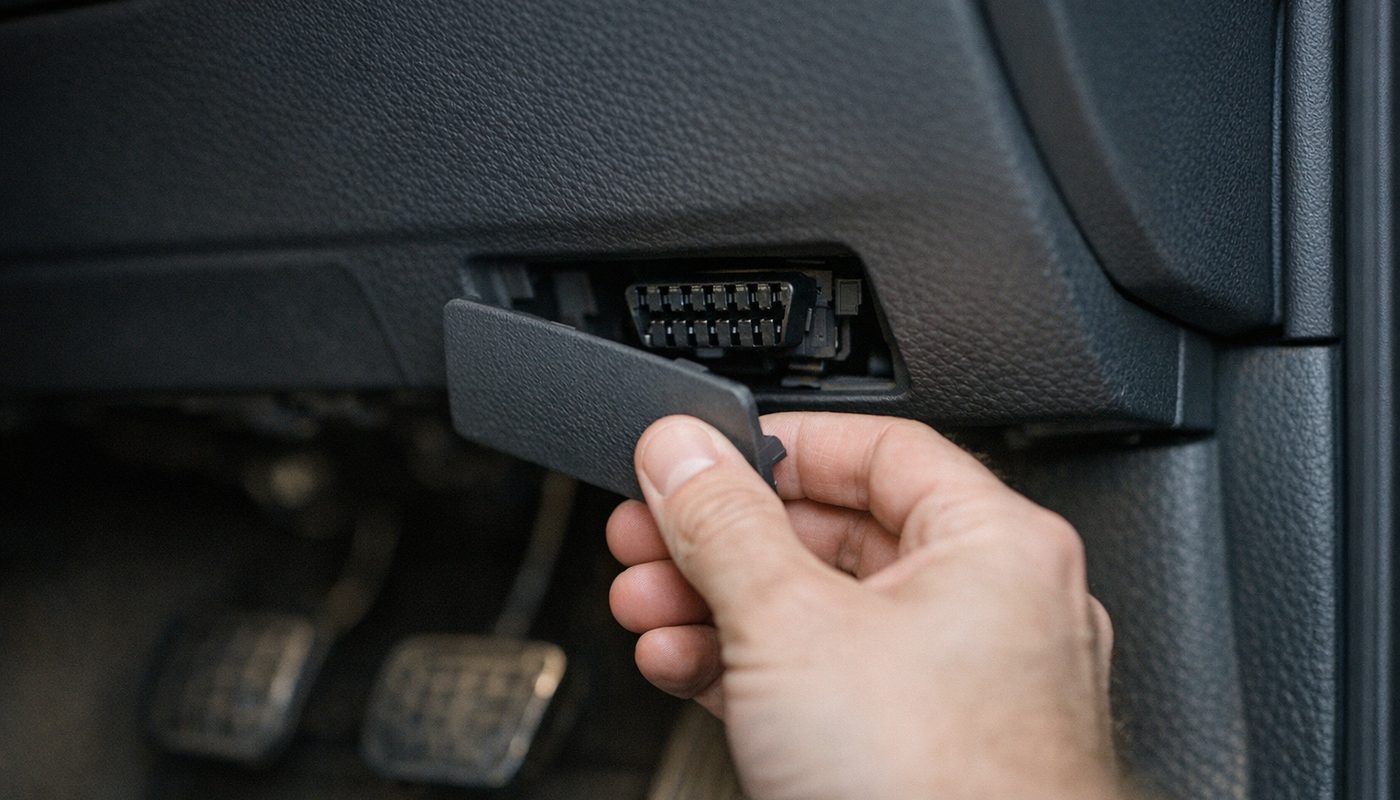
On E46 and E39 era cars the cover is a small rectangular piece of trim, usually in the lower dash or the top edge of the kick panel, held by clips. It pops off and goes back on. From the E90 and E60 onward BMW switched to a hinged flap that lives in the lower dash trim, roughly 10 by 5 cm, with a small cut-out or finger notch on one edge. It swings down and stays attached, which is good news because an E46 cover left on the garage floor is gone forever.
F and G cars keep the hinged flap idea but it is often moulded into the lower dash panel so smoothly that it looks like a seam rather than a door. On my G20 I missed it twice before I realised the "seam" above my left shin was the flap. The socket behind it points down and slightly toward the seat, which matters later when we talk about adapter clearance.
Step by step without breaking a clip
- Open the driver's door, sit on the sill facing the pedals, and look up under the lower dash. A phone torch helps. You are looking for a flap or a rectangular seam within about 30 cm of the steering column.
- On a hinged flap, press the notched edge with a fingertip and swing it down. Do not pry the hinge side.
- On an older clip-in cover (E46, E39, E53, E83), find the finger slot and pull straight toward you. If it resists, wiggle rather than yank - the clips are brittle after twenty years.
- Confirm you are looking at a 16-pin trapezoid socket. Note which way the open end faces.
- Plug the adapter in until it seats. Modern adapters are a firm push, not a hammer job.
- When you are done, swing the flap back up. If you removed a clip-in cover, line up the clips and press, do not punch.
Do not pull the kick panel
Plenty of forum posts tell people the port is "behind the kick panel on the left of the driver's seat". That phrasing sends owners into the side trim with a pry tool. On nearly every BMW the socket is reachable from below without removing the side panel at all. The only time I would touch the kick panel is on an E46 where someone has previously bodged the trim and the cover is missing.
3 Series port location by chassis
E46 (1999 to 2006)
The cabin socket is in the driver footwell above the pedals, behind a small clip-in cover in the lower dash. Easy enough. The complication is that early E46 cars, roughly the first two or three model years, also have the round 20-pin connector under the bonnet near the driver-side strut tower, and on those cars the cabin port may not reach every module. More on that in the 20-pin section below. If you have a later E46 and only see one socket, that is normal.
E90, E91, E92 and E93 (2006 to 2013)
This is the car that generates the most "where on earth is it" posts, and I understand why. The flap sits high up in the lower dash, to the left of the steering column, and the socket inside is set back far enough that a chunky adapter disappears into the dark. Carly's own guide describes it as under the panel to the left of the driver's seat, which is accurate but makes people look sideways. Look up instead. Once the flap is down the port is right there.
F30 and F31 including the 2013 and 2015 328i
Because "2013 BMW 328i OBD port location" is one of the most searched variants of this question, here it is plainly. The F30 port is under the lower driver dash above the left footwell, behind a flip-down cover just left of the column. It is the same on a 2013 328i, a 2015 328i, a 335i and the F31 wagon. US cars and European cars match. The socket is slightly recessed, so a wide dongle may need a gentle angle to clear the trim edge before it seats.
G20 and G21 (2019 on)
On my 2022 330i the hinged flap is in the lower dash above the left knee, and the socket faces downward. When I code with BimmerCode the OBDLink CX sits flush enough that I forget it is there, which is exactly why I bought that adapter rather than a longer one. If you are new to the app side, the BimmerCode adapter guide covers what works with G20s, so I will not repeat it here.
5 Series port location by chassis
E39 (1996 to 2003)
The E39 is the car most likely to confuse a first-time owner because most of them have two connectors. The cabin 16-pin socket is in the driver footwell behind a lower dash cover. The round 20-pin socket is in the engine bay, generally on the driver side near the strut tower or fuse box, under a screw cap. On many E39s the cabin port only talks to the engine, and reading ABS, airbag or transmission faults means going under the bonnet. If you only ever use a generic emissions code reader, the cabin port is fine.
E60 and E61 (2004 to 2010)
Standard mid-2000s BMW layout. Lower driver dash, above the left knee, flip-down flap. The E60 was one of the first BMWs to route all diagnostics through the cabin socket, so there is no second connector to worry about. One quirk owners report is that the flap on some cars sits very close to the knee bolster, so a straight adapter can end up touching the trim when the flap is closed.
F10 and F11 (2010 to 2016)
Lower driver dash above the pedals, behind a small hinged cover near the fuse box area. The socket faces down. This is a comfortable car to work on because the footwell is generous and the socket is not deeply recessed.
G30 and G31 (2017 on)
Since "where is the OBD port in a BMW G30" shows up in People Also Ask, the answer is the same lower driver dash position, near the steering column, behind a flip-down cover. Some owners note the G30 socket is angled upward rather than straight down, so if your adapter will not seat, try tilting the top of the plug toward the dash before pushing. Same placement applies to the G30 M5.
X models from X1 to X7
X1 F48 and U11
The F48 X1 has the port in the lower driver dash above the left footwell, behind a cover. People sometimes get thrown because the F48 shares its front-drive architecture with MINI, but the socket position is pure BMW - look under the dash, not at the side panel. The U11 X1 that replaced it in 2023 almost certainly uses the same area, but I could not find a reliable photo of the exact cover, so treat that as expected rather than confirmed.
X3 E83, F25 and G01
All three put the port under the lower driver dash. On the E83 there is a small clip-in cover near the top edge of the kick panel, and because the E83 footwell is tight the socket can feel further back than it is. The F25 and G01 use the hinged flap above the left knee. Nothing special, nothing hidden.
X5 E53, E70, F15 and G05
"BMW X5 OBD port location" covers four very different cars. On the E53 the cabin socket is in the driver footwell behind a cover, and early E53s (roughly 2000 to 2001, sometimes a little later) also carry the round 20-pin socket under the bonnet. From the E70 onward it is the single cabin port behind a flap above the left footwell, and the F15 and G05 follow suit. One thing worth knowing from the G05 forums - owners who have had an OBD port stop working after installing an aftermarket module behind the dash have traced it to a connector knocked loose or a fuse, not the socket itself. Keep that in mind if your port died right after a dashcam or lighting install.
X7 G07
Lower driver dash, above the left footwell, behind a hinged panel. The X7 footwell is cavernous, so clearance is never a problem here.
1, 2 and 4 Series, Z4 and the M cars
2 Series F22 and G42
The F22 coupe puts the socket in the lower driver dash above the left footwell behind a small cover, same as its F30 sibling. The G42 is expected to match the G20 layout with a flap above the left knee, though I have not seen the cover itself documented. The front-drive F44 Gran Coupe and F45 Active Tourer follow the F48 X1 pattern.
4 Series F32 and G22
F32, F33 and F36 share the F30 dash, so the port is in the lower driver dash above the pedals behind a hinged cover. The G22 and G23 share the G20 dash. If you can find it on a 3 Series, you can find it on the 4 Series.
Z4 E85, E89 and G29
The Z4s are driver-footwell cars like everything else, though the sources I could find are thin on cover details for all three. The E85 is from the same era as the late E46, so expect a clip-in cover. The G29 shares a lot with the Toyota Supra, and both are expected to have the socket under the driver dash near the column. Verify before you buy a right-angle adapter for either.
M cars
Nothing changes. An E46 M3, F80 M3, F87 M2 or G80 M3 has the port in exactly the same place as the standard car it is based on. The S54, S55 and S58 engines talk through the same DME diagnostic lines as their N and B siblings. The only M-specific difference I would flag is the E46 M3, which like early E46s may carry the 20-pin round socket under the bonnet depending on build date.
Electric BMWs i3, i4, iX and i7
"BMW i3 OBD port" is a surprisingly busy search, probably because people assume an electric car with a carbon tub has nothing resembling a normal diagnostic socket. It does. The i3 port is in the lower driver dashboard above the left footwell, behind a small cover, exactly where a contemporary F30 has it. BMW did not design a special EV connector, and the i3 answers to BimmerCode and standard adapters like any other F-series car.
The i4 shares the G26 4 Series Gran Coupe body, so expect the G20-style flap above the left knee. The iX and i7 are their own architecture and I could not find trustworthy confirmation of the cover design, but every indication is that BMW kept the lower driver dash position. One practical note for EVs - the 12 V network that powers pin 16 is fed from the high-voltage battery through a DC converter, so a dead port on an i3 is more likely a fuse or a sleeping 12 V system than a flat battery in the traditional sense.
MINI R and F generation and the Supra
R50 and R53 (2002 to 2006)
The first BMW-era MINI puts the 16-pin socket above the pedals on the left of the driver footwell, reachable without pulling trim. There is a wrinkle that matters if you are buying a cable - the R50 and R53 expose two separate diagnostic buses on pins 7 and 8, and some tools need those pins bridged to reach every module. A cut-down extension cable that only passes the CAN and power pins will leave you talking to the engine and nothing else.
R56 (2007 to 2013)
The R56 port is under the lower driver dash, behind or next to a small flip-down panel close to the steering column and pedal area. It can feel tight because the R56 dash is short, so a compact adapter is a better idea than a full-size one.
F55, F56 and F60 (2014 to 2024)
"Mini Cooper OBD port location" for the F generation is the lower driver dash behind a small flap near the left knee and the column, same as the F48 X1 it shares bones with. On the F60 Countryman the sources I found were vague about the cover, but the position should match. The F cars are fully BMW under the skin, which is why the vLinker BM+ and the OBDLink CX both work with them in BimmerCode. I have a separate rundown of what fits a MINI in the MINI scanner guide.

BimmerTalk rating 3.8/5
$49.99Amazon price as of Nov 8, 2026 - may change
We may earn a commission if you buy - it never changes what we recommend or what you pay.
J01 Cooper and the Toyota GR Supra
The 2024-on J01 Cooper is too new for me to say anything confident about the cover, and the Supra A90 is BMW underneath but Toyota on top, so the dash is Toyota's. Both are expected to have the port under the driver dash near the column, but I would physically look before ordering a right-angle adapter in a specific orientation.
The round 20-pin connector under the bonnet
Which cars have it
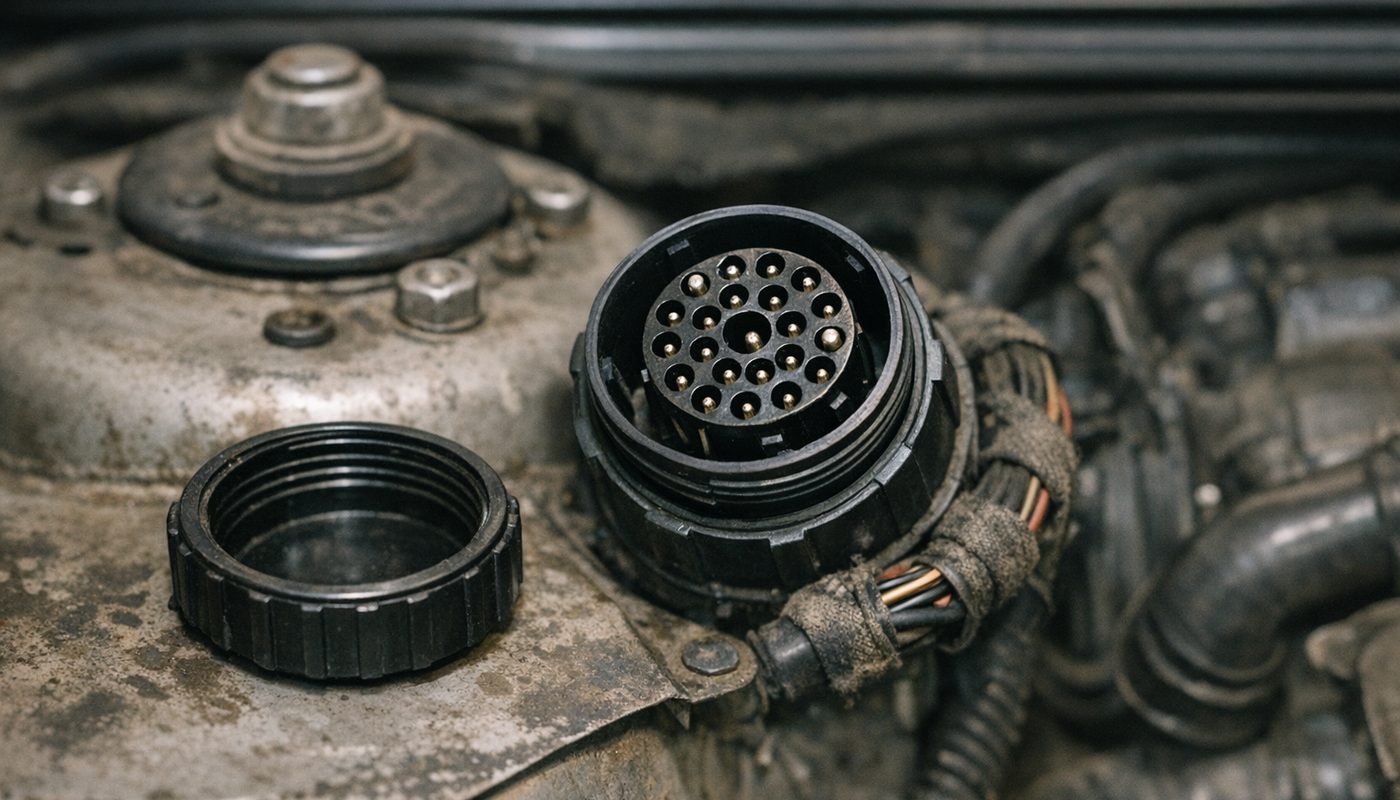
Before BMW fully committed to the cabin 16-pin socket, it used its own round 20-pin connector in the engine bay, normally on the driver side near the strut tower under a black screw cap. Aftermarket adapter listings and owner forums put it on the E36 (about 1992 to 1999), E38 (about 1995 to 2001), E39 (about 1996 to 2001), early E46 (about 1998 to 2001, some later), early E53 X5 (about 1999 to 2001, some later), the E52 Z8 and the Z3. Those year ranges come from adapter compatibility charts rather than BMW production records, so treat them as approximate. The brief rule is that pre-2001 cars probably rely on it, 2001 to 2003 cars might have both, and anything from the E60 era onward has none.
Does the cabin port work on those cars
Sometimes, and this is the part that catches people. On a transitional car with both connectors, the cabin 16-pin socket is often wired for emissions-related engine diagnostics only. That means a generic code reader will pull a DME fault and clear the check engine light, but it will not see the ABS, airbag, EGS transmission or body modules. Those sit on the 20-pin socket. Some cabin sockets on these cars are physically present with only a handful of pins populated. A 20-pin to 16-pin adapter routes whatever the car wired into the round socket to your tool, which is why those adapters exist, but it does not magically add lines the car never had.
So what do you actually do? If you own an E36, an E38, an early E39 or an early E46 and you want more than engine codes, buy a 20-pin to 16-pin adapter (they are cheap, roughly 10 to 20 dollars, prices move) and work from under the bonnet. If you own a late E46 or E53 with only one socket, the cabin port is your full interface. If you have both and are not sure which does what, plug into the cabin port first with a BMW-aware tool and see how many modules it finds.
The pin 7 and 8 bridge for K+DCAN cables
Older BMWs use K-line diagnostics, and some module groups sit on a second K-line that reaches the socket on pin 8. Many K+DCAN USB cables ship with a small switch or solder bridge connecting pins 7 and 8 so the cable can see both. The field convention is bridged for pre-2007 cars and unbridged for 2007-and-newer D-CAN cars, but that is a rule of thumb, not a chassis-wide law - some late K-line cars and early D-CAN cars sit on the wrong side of the year split. If you are going down the INPA route, buy a cable with a selectable bridge and check your build date. I go into this properly in the K+DCAN cable guide.
Pinout basics and what they mean for your adapter
You do not need to memorise the pinout, but knowing four or five pins turns a "my scanner does nothing" problem into a five-minute multimeter job. The 16-pin socket follows the SAE J1962 standard and BMW uses a few of the manufacturer-defined pins for its own purposes.
| Pin | Function | Why you care |
|---|---|---|
| 4 | Chassis ground | Reference for your multimeter |
| 5 | Signal ground | Second ground reference |
| 6 | CAN high | D-CAN diagnostics on 2007 onward cars |
| 14 | CAN low | Pair with pin 6 |
| 7 | K-line | Diagnostics on pre-2007 cars and some modules on transitional cars |
| 8 | Second K-line on old cars and ENET activation on F and G cars | The bridge pin for K+DCAN cables and the wake-up line for ENET |
| 16 | Battery positive always on | Should read roughly 12 V with the car off |
4
- Function
- Chassis ground
- Why you care
- Reference for your multimeter
5
- Function
- Signal ground
- Why you care
- Second ground reference
6
- Function
- CAN high
- Why you care
- D-CAN diagnostics on 2007 onward cars
14
- Function
- CAN low
- Why you care
- Pair with pin 6
7
- Function
- K-line
- Why you care
- Diagnostics on pre-2007 cars and some modules on transitional cars
8
- Function
- Second K-line on old cars and ENET activation on F and G cars
- Why you care
- The bridge pin for K+DCAN cables and the wake-up line for ENET
16
- Function
- Battery positive always on
- Why you care
- Should read roughly 12 V with the car off
K-line, D-CAN and ENET in one paragraph each
K-line is the slow serial diagnostic line BMW used through the E46 and E90 era, on pin 7 with a second line on pin 8 for some modules. A cheap generic reader uses it for engine codes only.
D-CAN is BMW's diagnostic CAN on pins 6 and 14, standard from roughly 2007. It is what BimmerCode, the OBDLink CX and every modern scanner talk over. On my G20 this is the only bus the CX ever touches.
ENET is Ethernet over the OBD socket, which BMW introduced with the F series for programming and the E-Sys style of coding. The Ethernet pairs use pins the J1962 standard leaves for manufacturers, and the ENET cable uses pin 8 as an activation line to wake the car's diagnostic interface. A Bluetooth dongle never uses these pins, which is why a dongle cannot flash a module and an ENET cable can. If that is the road you are on, the ENET cable guide is the companion piece.
What this means when you buy anything
Any extension cable, splitter or right-angle adapter should pass all 16 pins straight through. Emissions-only cables that carry just power, ground and CAN exist and are cheaper, and they will quietly break K-line diagnostics on older cars, the pin 7 and 8 bridge on an R53 MINI and ENET on an F or G car. "Full 16-pin pass-through" is the only phrase in the listing that matters.
BMW OBD port no power - what to check
The symptom is a dongle that normally lights up and now sits dark, or a handheld scanner that will not even boot. Nine times out of ten the socket is fine and something upstream has gone. Here is the order I would work through it.
The fuse that usually powers it
BMW does not generally label a fuse "OBD". On a great many BMWs pin 16 is fed through the same circuit as the front cigarette lighter or 12 V accessory socket, which is why the first question anyone on Bimmerpost asks is "does your lighter socket still work". Owners commonly report the lighter fuse on the E90 as F8 at 20 A, on the F30 as F66 at 20 A, and on the G20 as something in the F46 to F47 area, but fuse assignments shift with build date, market and equipment, and the X5 differs by generation. Treat those numbers as leads. The fuse card in the glovebox or boot for your exact VIN is the only authority, and the fuse panel is behind the glovebox on E90, F30 and G20 cars.
Testing the port in ten steps
- Switch the ignition off and unplug every accessory from the 12 V sockets and the OBD port.
- Open the flap and shine a torch into the socket. Look for a terminal that has been pushed back, bent sideways or is green with corrosion.
- Set a multimeter to DC volts. Put the black lead on pin 4 or pin 5 and the red lead on pin 16. You want roughly battery voltage, typically 12 to 12.6 V with the car off.
- No voltage at pin 16 means a fuse or wiring problem. Test the front 12 V socket with a known-good charger. If it is also dead, you have found the shared circuit.
- Pull every fuse labelled lighter, power outlet, accessory, ACC or DLC and test each one with the meter on continuity. A blade fuse can look fine and still be open.
- Replace a blown fuse with the identical type and rating printed on the fuse card.
- Voltage present but the tool still does nothing? Check the grounds by measuring resistance between pin 4 and a bare metal bolt under the dash. Anything above an ohm or two is suspect.
- Power and ground good but "no link" or "no ECU response"? That is a communication issue - CAN or K-line - not a power issue. Try the tool on another car to rule the tool out.
- If the port died right after someone worked behind the dash, check whether the OBD connector body has been knocked off its bracket or a plug behind it has been pulled.
- Low system voltage makes diagnostics flaky before it kills them, so if the car has been sitting, put a charger on and try again.
Damaged terminals and a loose socket
Repeated plugging of a heavy dongle, especially one with a thick cable hanging off it, can push a terminal back into the socket body or splay it open. Pin 16 and the CAN pins are the usual victims. A pushed-back terminal can often be reseated from the back of the connector with a small pick, and spread terminals can be gently closed. Replacing the complete socket is a last resort and on E-series cars it is a cheap part anyway. If the whole socket moves when you plug in, the bracket clip has broken, and that is the kind of thing that leads to intermittent power at pin 16.
If the port works and you now want to go further, reading and clearing fault codes yourself is the next step, and if a Bluetooth adapter has power but will not pair, that is a different problem covered in the CX connection troubleshooting guide.
Adapters that do not hit your knee
Why the socket orientation matters
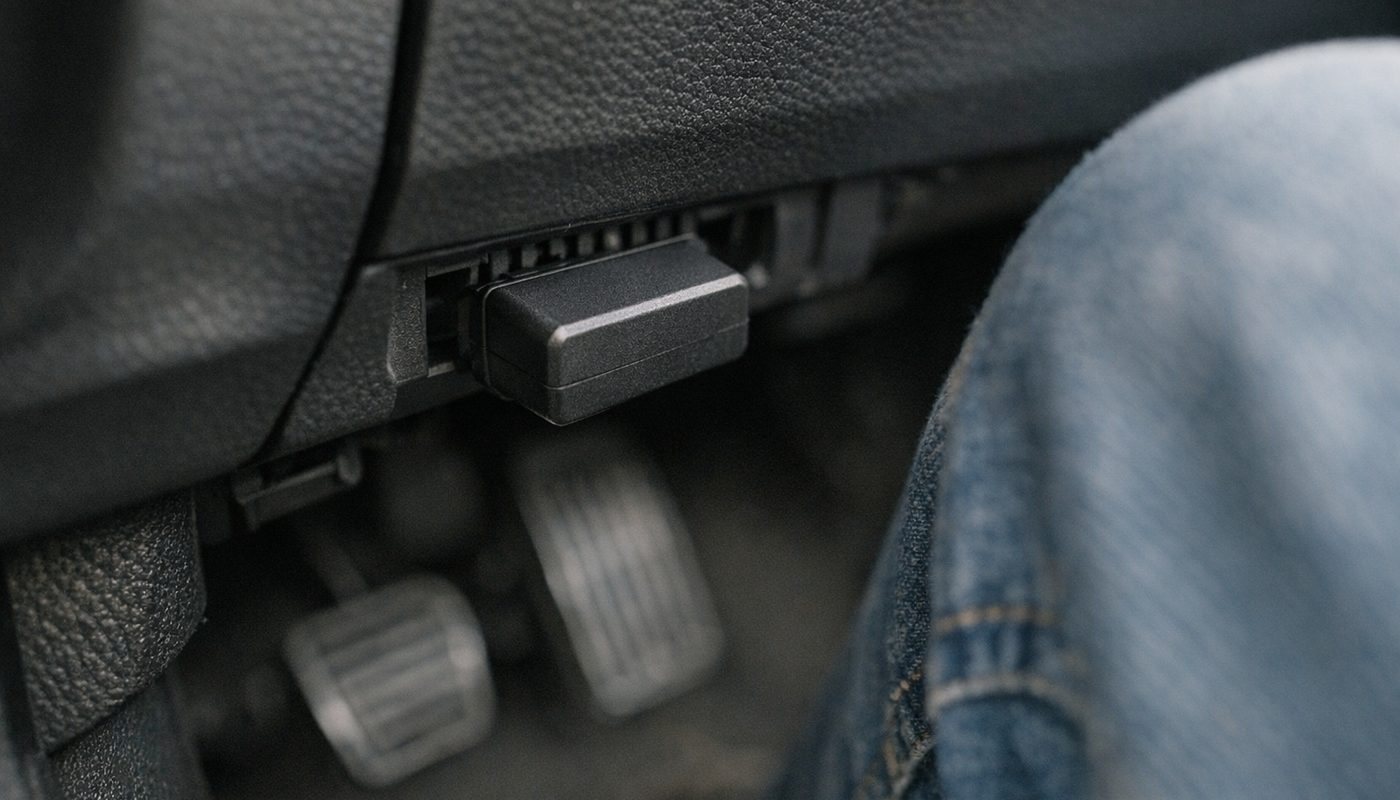
On F and G cars the socket typically points down or toward the seat, and the flap sits a few centimetres above your left shin. A long straight dongle therefore projects straight into the space your knee uses when you brake hard or climb out. On an E90 the socket is recessed enough that most dongles tuck away, on an E60 the flap can close against the plug, and on a G30 some owners report the socket angled upward, which is where a downward right-angle adapter makes a straight dongle fit rather than fight.
This is not a comfort problem only. A dongle that catches a knee a few hundred times a year is the dongle that eventually levers pin 16 back into the socket, and then you are in the no-power section above.
| Option | When it makes sense | Downside |
|---|---|---|
| Low-profile adapter like the OBDLink CX | Daily driver where the adapter stays plugged in | Bluetooth only so no cable for a laptop |
| Right-angle OBD adapter | Socket angled toward the seat or the knee | Must match the socket orientation or it makes clearance worse |
| Short 16-pin extension cable | Bulky scanners and cable tools you use occasionally | Something has to hold the loose end and the cable adds strain on the socket |
| Full-size dongle left in place | Cars with a deep recessed socket like the E90 | Knee contact on most F and G cars |
Low-profile adapter like the OBDLink CX
- When it makes sense
- Daily driver where the adapter stays plugged in
- Downside
- Bluetooth only so no cable for a laptop
Right-angle OBD adapter
- When it makes sense
- Socket angled toward the seat or the knee
- Downside
- Must match the socket orientation or it makes clearance worse
Short 16-pin extension cable
- When it makes sense
- Bulky scanners and cable tools you use occasionally
- Downside
- Something has to hold the loose end and the cable adds strain on the socket
Full-size dongle left in place
- When it makes sense
- Cars with a deep recessed socket like the E90
- Downside
- Knee contact on most F and G cars
What I would actually buy
For a modern BMW where you want BimmerCode, occasional code reading and nothing dangling, the OBDLink CX is the one I use and the one I would buy again. It sits flush enough on my G20 that the flap nearly closes over it, and the OBDLink CX versus MX+ question is already answered in detail elsewhere on the site so I will leave it at that. If you want more than coding - full OBD2 live data and support for other brands - the MX+ is the bigger brother, at the cost of being physically bigger. And if 80 dollars feels steep for a dongle, the vLinker BM+ does the BimmerCode job for less, with the compromises I covered in the vLinker BM review.

BimmerTalk rating 4.4/5
$79.95Amazon price as of Nov 8, 2026 - may change
We may earn a commission if you buy - it never changes what we recommend or what you pay.

BimmerTalk rating 4.0/5
$139.95Amazon price as of Nov 8, 2026 - may change
We may earn a commission if you buy - it never changes what we recommend or what you pay.
For right-angle adapters I cannot point at one model with confidence, because the ones on the big marketplaces change names monthly and I have not tested any. What I can say is that the orientation is everything - look at your socket first, decide whether you want the dongle to go up, down, left or right, then buy. Insist on all 16 pins. And expect roughly 10 to 15 dollars, which is why nobody reviews them.
Broader scanner choices - handheld all-module tools, what reads the DSC and airbag modules, what is overpriced - live in the best OBD scanner for BMW roundup. This page is about the hole in the dash, not what goes in it.
FAQ
Where is the OBD socket on a BMW
Under the driver's side of the dashboard, above the left footwell, within about 30 cm of the steering column, usually behind a small hinged flap or a clip-in cover. That applies to every BMW from the E46 era to today, every X model, every i model and every F-generation MINI. Only 1990s and very early 2000s cars add a round 20-pin connector under the bonnet.
Is there a different location on right-hand-drive BMWs
The layout mirrors. The port stays on the driver's side, so on a UK, Australian or Japanese car it is above the right footwell. Cover designs are the same. The engine-bay 20-pin connector on old cars does not move because it is on the body, not the dash.
How do I put my BMW into diagnostic mode
You do not, in the sense of a hidden menu. The diagnostic socket is live as soon as the car is at ignition position 1 or 2 (press start without your foot on the brake) and the tool handles the rest. For reading codes and coding with BimmerCode, ignition on with the engine off is the normal state. The "hidden menu" people mean is the KOMBI test menu in the instrument cluster, which shows things like battery voltage and fuel level, and is reached by holding the trip reset button - it is a different thing from the OBD port and does not read fault codes.
Do you need a special code reader for a BMW
For a check engine light, no. Any OBD2 reader will pull the engine code through the cabin port on anything from a late E46 onward, and the check engine light article walks through what the codes mean. For everything else BMW - DSC, airbag, EGS, FEM or BDC body modules, iDrive, coding - you need a tool that speaks BMW's own protocols, whether that is a BimmerCode adapter, a BMW-specific handheld, or a K+DCAN or ENET cable with the appropriate software. Generic readers see one module. BMW tools see forty.
Where is the OBD port on a 2013 BMW 328i
Lower driver dash, above the left footwell, behind a flip-down cover just left of the steering column. It is an F30, so it matches every 2012 to 2018 3 Series regardless of engine. Same answer for a 2015 328i, a 335i and the 328d.
Can I use the cabin OBD port on an E46 or E39 instead of the round connector
For engine codes, usually yes. For ABS, airbag, transmission and body modules on an early car with both connectors, often no, because the cabin socket may only carry the engine lines. If you have a late E46 with no round connector, the cabin port is your complete interface. The only way to be sure on a transitional car is to plug in a BMW-aware tool at the cabin port and count how many modules it finds.
Why does my scanner power up but not connect
Power at pin 16 is only half the story. A tool that lights up but reports no link has power and ground but no communication, which points at the CAN lines on pins 6 and 14, the K-line on pin 7 on older cars, a tool that does not speak the right protocol, or in the worst case a bus fault. Try the tool on another car first. If it works there, the BMW's network is the suspect, and if it fails there too, it is the tool.
Does the OBD port drain the battery if I leave an adapter plugged in
It can. Pin 16 is constant battery power, so whatever is plugged in draws current whenever it is awake. Well-designed adapters like the OBDLink CX go to sleep and draw very little, but cheap no-name dongles can keep the car's modules awake or draw continuously and that will flatten a battery over a long park. If your car sits for more than a week, unplug it.
Is the port on a BMW motorcycle the same
No. BMW Motorrad used its own round 10-pin diagnostic connector for years and more recent bikes moved toward a standard OBD style socket with an adapter. That is a separate topic with its own tools, covered in the BMW motorcycle diagnostic guide.
Bottom line
If you take one thing from this page, take this. On any BMW built after about 2003, and every MINI since 2002, the port is under the driver's side of the dash above the left footwell, behind a flap you will find in under a minute once you know to look up rather than sideways. On the 1990s and early 2000s cars, look for the round 20-pin socket under the bonnet too, and understand that the two connectors are not always equal.
When the port is dead, check the cigarette lighter fuse before anything else, confirm 12 V at pin 16 with a multimeter, and do not fit a bigger fuse. When the adapter is in the way of your knee, buy a low-profile one or a right-angle adapter in the orientation your socket actually needs, and only ever a cable with all 16 pins wired.
I keep the CX plugged into my G20 and I genuinely forget it exists until I open BimmerCode, which is what the right adapter in the right port should feel like. Find the flap, take the photo, and go spend the rest of your afternoon on something more interesting than crawling around a footwell. Kamil.